Attention Ladder Blueprint: How Indian Brands Climb From Noise to Brand Love
In 2016, Mamaearth, a new D2C brand, entered India's crowded personal care market, competing against established names like Himalaya, Nivea, and Patanjali. By 2024, Mamaearth had become a household name with over ₹2,000 crore in revenue, a successful IPO, and widespread popularity among mothers in tier-2 and tier-3 cities. This success wasn't due to luck but a strategic ascent up The Attention Ladder Blueprint, a framework illustrating how brands evolve from obscurity to cultural icons. Many marketing efforts fail because they skip steps on this ladder, seeking loyalty and advocacy before earning attention and trust. Understanding this ladder is crucial for building brands in India's competitive, digital marketplace.
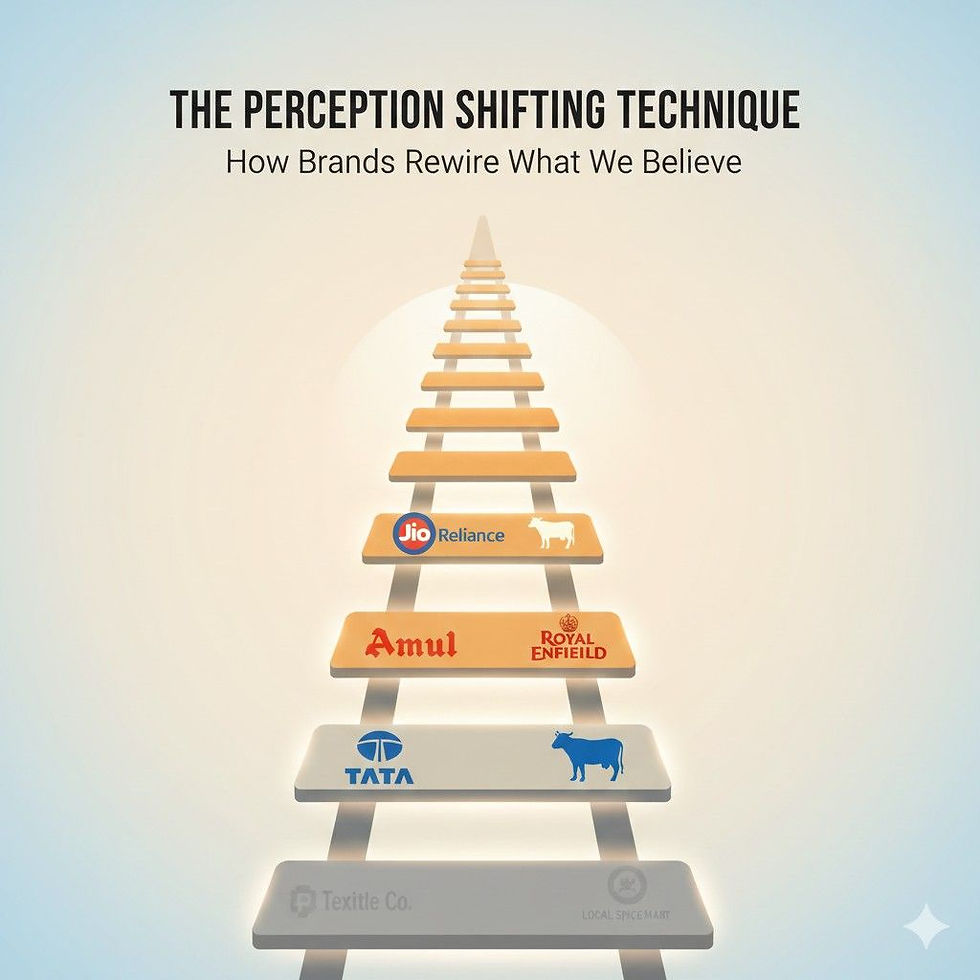
The Five Rungs: From Invisible to Inevitable
The Attention Ladder isn't about campaign creativity or media budgets. It's about the psychological journey every consumer takes with every brand—from "Who are you?" to "I can't imagine my life without you." Here are the five rungs:
Rung 1: Ignorance – The brand doesn't exist in the consumer's mental universe
Rung 2: Awareness – The brand registers as a recognized name or logo
Rung 3: Consideration – The brand enters the shortlist of options
Rung 4: Preference – The brand becomes the first choice
Rung 5: Advocacy – The brand becomes part of identity; consumers defend and recommend it unprompted. Most brands get stuck between awareness and consideration. They're known, but never chosen. Recognized, but not respected. The real game Understanding exactly where you are on the ladder—and what it takes to climb to the next rung.
Rung 1 to Rung 2: Breaking Through the Ignorance Wall
In 2014, nobody in urban India knew what "Bhujia" could mean beyond the Haldiram's packet. Then came Paper Boat, with its nostalgic drinks in Tetrapak cartons, each flavor named after childhood memories—Aamras, Jamun Kala Khatta, Chuskile. The challenge wasn't just launching a product. It was creating a new category in minds already occupied by Coca-Cola, Pepsi, Frooti, and Maaza. Paper Boat's breakthrough strategy? Distinctive branding that stopped the scroll. Those hand-drawn illustrations. The earthy color palette. The story-first packaging that read like poetry: "Remember the time when aam papad was currency?" This is the essence of moving from ignorance to awareness: being impossible to ignore. Not through volume, but through distinctiveness.
The Indian Playbook for Awareness
In India's sensory-overloaded market, awareness demands:
Sharp Visual Identity – Think Amul's typography, Zomato's red, Swiggy's orange burst
Cultural Resonance – Tap into shared memories, festivals, rituals (Cadbury's Kuch Meetha Ho Jaye)
Ubiquity in Trigger Moments – Be present when the need arises (Dunzo during lockdown, Zepto when guests arrive unannounced)
Awareness isn't about being liked. It's about being noticed and remembered. The brands that win here don't blend in—they stand apart with confident clarity.
Rung 2 to Rung 3: From Known to Considered
Awareness is worthless if it doesn't translate to consideration. This is where most Indian brands hemorrhage potential—they're famous, but never make the shortlist. Take boAt. By 2017, everyone knew Indian electronics = cheap quality. Premium audio meant Bose, Sony, Sennheiser—foreign, expensive, aspirational. boAt didn't try to out-engineer Sony. Instead, they asked: "What if young India could access cool, good-enough audio gear at ₹1,500 instead of ₹15,000?" The shift from awareness to consideration required three strategic moves:
1. Reframe the Purchase Criteria
boAt didn't compete on acoustics or noise cancellation specs. They competed on style, bass, and affordability—criteria that mattered more to college students and young professionals streaming on Spotify and watching reels.
2. Build Social Proof at Scale
They flooded Instagram with influencer unboxings, celebrity endorsements (Ranveer Singh, Hardik Pandya), and UGC from real users. Within two years, wearing boAt earphones became a visible social signal: "I'm young, I'm plugged in, I make smart choices."
3. Reduce Friction in Trial
Available on Amazon with next-day delivery. Easy returns. Affordable price points that made impulse buying easy. No need to visit a store or justify a big expense.
The Consideration Unlock
Moving from awareness to consideration requires answering one question better than competitors: "Why should I pick you over the default choice?" In India, this often means:
Value superiority (better outcome per rupee spent)
Social endorsement (people like me use this)
Availability (I can get it now, easily)
If your brand is known but not chosen, you haven't yet made the consideration argument compelling enough.
Rung 3 to Rung 4: The Preference Inflection Point
Consideration gets you shortlisted. Preference makes you the default choice. This is where Swiggy separated itself from Zomato in the food delivery wars. Both had awareness. Both were considered. But Swiggy became preferred through one simple insight: reliability > variety. While Zomato focused on restaurant discovery and reviews, Swiggy obsessed over delivery promise. Their 30-minute delivery standard, proactive order tracking, and "delivery partner is 2 minutes away" notifications built a trust loop. In a market where lunch breaks are 45 minutes and dinner needs to arrive before the match starts, Swiggy became the safe bet. The brand you didn't have to think about.
The Preference Playbook
Preference is earned when:
Consistency Beats Novelty – Delivering the same promise every time (Domino's 30-minute guarantee, Amazon's delivery speed)
Habit Formation Takes Over – The brand becomes the automatic choice (Paytm for recharges, PhonePe for UPI)
Emotional Shortcuts Form – The brand solves a job so well that the brain stops evaluating alternatives
In India's price-sensitive, quality-skeptical market, preference comes from reducing decision fatigue. Once you prove you're the reliable choice, consumers stop looking elsewhere. Amul has lived here for decades. When an Indian household needs butter, the question isn't "Which brand?" It's "Should I get Amul salted or unsalted?"
Rung 4 to Rung 5: From Preference to Advocacy
The highest rung isn't about purchase frequency. It's about identity integration. When Tata faced the Nano's commercial failure, the brand's equity didn't collapse. Why? Because for millions of Indians, Tata isn't just a company—it's a symbol of Indian integrity, nation-building, and ethical capitalism. People don't just prefer Tata. They defend Tata. They feel personal pride when Tata acquires Jaguar or launches an EV. The brand has climbed to advocacy.
How Advocacy Actually Happens
Advocacy emerges when three conditions align:
1. Values Alignment: The brand stands for something the consumer wants to stand for.
Patanjali = swadeshi pride, natural living, resistance to MNC dominance
Fabindia = craft support, artisan empowerment, anti-fast-fashion
CRED = financial responsibility, exclusivity, smart adulting
2. Shared Identity: The consumer sees the brand as an extension of who they are or aspire to be. When someone says, "I'm an Apple person" or "I only shop at Decathlon," they're signaling tribe membership. In India, Royal Enfield achieved this. Riders don't just own a bike—they join the "Enfield gang," go on weekend rides, wear the gear, live the lifestyle.
3. Consistent Behavior Over Time: Advocacy isn't built through one viral campaign. It's the compound effect of showing up correctly, repeatedly, authentically. Amul's daily topicals have run for 50+ years. That's not marketing. That's institutional presence. Generations grow up seeing Amul comment on every major Indian moment—from cricket wins to political shifts. The brand becomes inseparable from Indian life itself.
The Ladder in Action: How Mamaearth Climbed
Let's return to Mamaearth and trace their ladder climb:
2016–2017: Breaking Ignorance
Entered market with "toxin-free" positioning when Indian mothers barely knew what parabens or SLS were
Used educational content marketing (blog posts, Instagram carousels on "chemicals in baby care")
Distinctive blue-and-white aesthetic; founder couple as brand faces (Ghazal and Varun Alagh)
Outcome: Awareness in urban, digitally native mother segment
2018–2019: Building Consideration
Amazon exclusive launch = easy trial, reviews, visibility
Positioned against premium MNC brands as "safer alternative at Indian pricing"
Leveraged influencer moms sharing genuine product experiences
Made "toxin-free" simple and desirable through BIS certifications and ingredient transparency
Outcome: Entered shortlist for online baby care purchases
2019–2021: Earning Preference
Expanded portfolio beyond baby care to skincare, haircare (onion range became bestseller)
Consistent messaging: "Goodness Inside" = trust, transparency, no false promises
Strong D2C + quick commerce presence; product always available
Shark Tank India appearance in 2021 (as investors) reinforced founder credibility
Outcome: Became go-to brand for toxin-free personal care across age groups
2022–Present: Moving Toward Advocacy
IPO success story = pride point (Indian D2C brand wins)
Sustainability narrative (plastic-positive, carbon-neutral)
Community building through social content (skin positivity, real skin stories)
Outcome: Customers defend the brand online, recommend to friends without prompts, see Mamaearth as aligned with their values (health, environment, Made in India)
Why Most Brands Get Stuck—and How to Unstick
The ladder looks simple. The climb isn't. Here's where Indian brands typically get stuck:
The Awareness Trap
Efforts in TV ads and digital reach don't convert awareness into consideration.
Fix: Focus on being meaningful in one area with a compelling reason to be chosen.
The Consideration Plateau
Always considered, rarely chosen.
Fix: Identify and own a tiebreaker like trust, speed, or price.
The Preference Leak
Initial choice doesn't lead to loyalty.
Fix: Create post-purchase engagement with loyalty programs and community access.
The Advocacy Gap
Strong functionally, but lacks emotional connection.
Fix: Stand for values and purpose to foster brand attachment.
The Ladder Isn't Always Linear
Sometimes brands leapfrog rungs. Zomato's IPO turned the brand from a food delivery app into a cultural icon overnight. Suddenly it wasn't just about ordering biryani—it was about Indian startup pride, Deepinder Goyal as a founder hero, and the validation of India's digital economy. Sometimes brands fall. Paytm had massive awareness, strong consideration, decent preference—but regulatory troubles and financial losses damaged trust. The ladder works in reverse too. Sometimes entire categories operate at different rungs. Life insurance in India struggles to move past consideration because of deep distrust. Jewelry brands fight for preference because family legacy dominates purchase decisions. The point isn't to force-fit every brand journey. The point is to know where you are and what move comes next.
Climbing Smart: The Strategic Takeaway
Here's what the Attention Ladder changes about how you should think about growth:
1. Diagnose Before You Strategize: Are you unknown, known but not chosen, or chosen but not loved? The answer determines your entire marketing plan.
2. Don't Skip Rungs: You can't demand advocacy without earning preference first. Most influencer campaigns fail because they try to manufacture rung 5 behavior while the brand is still at rung 2.
3. Different Rungs Need Different Tactics
Ignorance → Awareness = Distinctiveness, media, cultural moments
Awareness → Consideration = Social proof, trial reduction, reframing
Consideration → Preference = Consistency, habit building, reliability
Preference → Advocacy = Values, identity, long-term behavior
4. Measure What Matters at Each Rung
Rung 2: Brand recall, unaided awareness
Rung 3: Shortlist inclusion, comparison searches
Rung 4: Repeat purchase rate, share of wallet
Rung 5: NPS, referral rate, organic mentions
The Ladder Never Stops
Even brands at rung 5 have to keep climbing. Advocacy erodes if not reinforced. Maggi learned this during the lead controversy. Decades of advocacy collapsed within weeks. The climb back required reformulation, transparency campaigns, nostalgia reactivation, and years of rebuilding trust. The ladder isn't a destination. It's a dynamic position in a consumer's mental map—and every brand action either moves you up, keeps you steady, or pushes you down.
Your Move
So where is your brand on the ladder today? Are you stuck at awareness, wondering why ad spending isn't translating to sales? Are you getting trial but no repeat? Chosen occasionally but not preferred? Or are you already preferred—but struggling to turn customers into evangelists? The Attention Ladder isn't theory. It's the hidden structure behind every brand's rise, stall, or fall. The brands that win in India's chaotic, fast-moving market are the ones that see the ladder clearly and climb it strategically. Because in a country of 1.4 billion consumers, awareness is cheap. Attention is expensive. But advocacy—that rare, powerful state where customers become your marketing army—that's where sustainable brand equity is built. And every iconic Indian brand story is, at its core, a story of climbing this ladder—one intentional, insight-driven step at a time.


Comments