Apple's Transition from Hardware to Services Ecosystem
Executive Summary
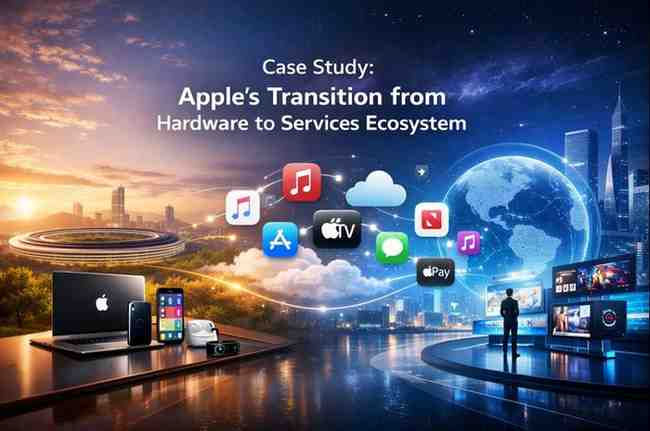
Apple Inc., historically recognized as a hardware manufacturer, has systematically expanded its business model to incorporate a substantial services component. According to Apple's fiscal year 2023 annual report (Form 10-K filed October 27, 2023), Services revenue reached $85.2 billion, representing approximately 22% of total net sales of $383.3 billion. This case study examines Apple's strategic transition toward a services-driven ecosystem, built upon its installed base of over 2 billion active devices as reported in the company's Q1 2023 earnings call.
Company Background
1. Founding and Early History
Apple Inc. was founded on April 1, 1976, by Steve Jobs, Steve Wozniak, and Ronald Wayne in Cupertino, California. The company began with the goal of making personal computers accessible to everyday users.
Its first product, the Apple I, was a hand-built computer that laid the foundation for Apple’s early success. Shortly after, Apple was formally incorporated in 1977, supported by early investor Mike Markkula.
The launch of the Apple II marked Apple’s first major commercial breakthrough, establishing the company as a serious player in the personal computing industry. Apple quickly gained a reputation for combining technology with ease of use and innovative design.
2. Breakthrough with the Macintosh
In 1984, Apple introduced the Macintosh, a revolutionary personal computer that popularized the graphical user interface (GUI) and mouse-based navigation.
This innovation differentiated Apple from competitors and reinforced its identity as a user-centric technology company.
3. Transformation and Product Renaissance
iMac (1998) – revived Apple’s brand image
iPod (2001) – transformed digital music consumption
iTunes Store – created a legal digital music marketplace
iPhone (2007) – redefined the smartphone industry
iPad (2010) – created a new tablet computing category
4. Apple as a Hardware Innovation Leader
Mac computers
iPhone smartphones
iPad tablets
Apple Watch wearables
AirPods wireless audio devices
Vision Pro spatial computing headset
Strategic Context and Rationale
Market Saturation and Growth Constraints
Apple CEO Tim Cook stated in the January 2019 earnings call that iPhone revenue declined 15% year-over-year in Q1 FY2019, marking the first revenue decline for the flagship product in years.
According to the company's Q1 FY2019 letter to investors (January 2, 2019), this decline was attributed to "fewer iPhone upgrades than we had anticipated" and challenging economic conditions in certain markets, particularly Greater China.
Services as a Strategic Priority
In Apple's FY2016 annual report, the company began providing separate revenue reporting for Services as a distinct segment, signaling increased strategic focus.
Tim Cook stated in the Q2 2016 earnings call (April 26, 2016): "We see enormous opportunities in Services... We're investing heavily in original content for Apple Music and developing a much stronger software and services ecosystem."
According to Apple's Q1 2017 earnings call (January 31, 2017), Cook announced a goal to double the size of the Services business from its FY2016 baseline by 2020. Per Apple's annual reports, Services revenue grew from $24.3 billion in FY2016 to $53.8 billion in FY2020, achieving this stated objective.
Services Portfolio Evolution
App Store and Platform Economics
The App Store, launched in July 2008, operates on a commission model. According to testimony by Apple executives during the Epic Games v.
Apple's Senior Vice President of Worldwide Marketing, Phil Schiller, testified in the Epic trial that the App Store had facilitated over $643 billion in billings and sales during 2020, though Apple only recognizes its commission portion as revenue.
Subscription Services Expansion
Apple Music: Launched June 30, 2015, Apple Music reached 100 million subscribers according to statements made in June 2021 (reported by Billboard). The service operates as a subscription-based streaming platform competing with Spotify and others
Apple TV+: Launched November 1, 2019 at $4.99/month, making it one of the lower-priced streaming services at launch. According to various interviews with Apple executives, the company committed over $6 billion to original content production, though specific figures have not been officially disclosed in financial filings
Apple Fitness+: Launched December 14, 2020, integrated with Apple Watch to provide fitness content. Pricing was set at $9.99/month or $79.99/year as announced in Apple's press release (September 15, 2020).
iCloud and Cloud Storage
iCloud, rebranded and relaunched in 2011, offers cloud storage and computing services.
According to Apple's website and public pricing information, iCloud storage plans range from 5GB (free) to 2TB ($9.99/month), with various tiers in between.
Apple Pay and Financial Services
Apple Pay launched in October 2014. According to Apple's Q1 2024 earnings call, Tim Cook stated that Apple Pay is available in nearly 90 markets.
Apple introduced "Apple Pay Later" (a buy-now-pay-later service) in March 2023, as announced in the company's press release, though the company discontinued this service in June 2024 according to Apple's official statement.
Business Model Transformation
Installed Base Leverage
Apple's services strategy leverages its hardware installed base. According to the Q1 2023 earnings call (February 2, 2023), CFO Luca Maestri stated: "We now have more than 2 billion active devices.
This is a powerful testament to the satisfaction, engagement and loyalty of our customers."
The company does not publicly disclose specific device-level retention rates or upgrade cycles.
Bundling Strategy: Apple One
Individual: $14.95/month (Apple Music, Apple TV+, Apple Arcade, iCloud+ 50GB)
Family: $19.95/month (same services, up to 5 people, 200GB iCloud+)
Premier: $29.95/month (adds Apple News+ and Fitness+, 2TB iCloud+)
Privacy as Differentiation
Apple has positioned privacy as a competitive differentiator for its services. The App Tracking Transparency (ATT) framework, introduced with iOS 14.5 in April 2021, requires apps to request user permission for tracking across apps and websites, as detailed in Apple's developer documentation and public announcements.
Tim Cook stated in a January 2021 speech at the Computers, Privacy & Data Protection conference: "If a business is built on misleading users, on data exploitation, on choices that are no choices at all, then it does not deserve our praise. It deserves reform."
Competitive Landscape
Music Streaming
Apple Music competes with Spotify, which reported 226 million premium subscribers as of Q3 2023 (per Spotify's quarterly report), compared to Apple Music's reported 100 million subscribers.
Video Streaming
Apple TV+ competes in a crowded market including Netflix (247 million paid memberships as of Q3 2023 per Netflix's shareholder letter), Disney+ (150 million subscribers as of Q4 2023 per Disney's earnings), and Amazon Prime Video.
Cloud Storage
iCloud competes with Google Drive (Google does not disclose standalone Drive subscriber numbers), Microsoft OneDrive, Dropbox (17.87 million paying users as of Q3 2023 per Dropbox's quarterly report), and others in cloud storage.
Challenges
Regulatory Scrutiny
European Union: The Digital Markets Act (DMA), which took effect March 7, 2024, designates Apple as a "gatekeeper" and requires changes to App Store policies in the EU.
United States: The Department of Justice filed an antitrust lawsuit against Apple on March 21, 2024, alleging monopolistic practices in the smartphone market.
South Korea: The Telecommunications Business Act amendment (effective September 2021) prohibits app store operators from forcing developers to use their payment systems.
Developer Relations
Apple's 30% commission structure has been controversial. The Epic Games lawsuit (filed August 2020) challenged Apple's App Store policies.
The September 2021 ruling by Judge Yvonne Gonzalez Rogers found Apple did not violate antitrust laws as a monopolist, but required Apple to allow developers to include external payment links (though this ruling has been subject to appeals).
Content Investment Requirements
Streaming video requires ongoing content investment.
According to various media reports citing industry sources, Apple has increased content spending, though Apple does not disclose specific content budgets in its financial filings.
Ecosystem Lock-in Dynamics
Cross-Device Integration: Apple's services strategy relies on seamless integration across device.
According to Consumer Intelligence Research Partners (CIRP) data reported in March 2023, iPhone user retention in the US was estimated at 92%, though Apple does not officially disclose retention rates. CIRP is an independent research firm.
Limitations
Subscriber Metrics: Apple does not regularly disclose subscriber counts for individual services (Apple Music, Apple TV+, iCloud paid tiers, etc.). The last disclosed Apple Music subscriber count was 100 million in 2021.
Service-Level Financials: Apple reports Services as a consolidated segment. Revenue contribution, profitability, customer acquisition costs, lifetime value, retention rates.
Customer Segmentation: Apple does not provide geographic or demographic breakdowns of services adoption, retention, or revenue contribution beyond high-level regional revenue reporting.
Key Lessons
1. Installed Base Monetization
Apple successfully leveraged its hardware ecosystem of over 2 billion active devices to create recurring revenue streams.
The Services segment grew from $19.9 billion (FY2015) to $85.2 billion (FY2023), demonstrating how hardware leadership can be extended into software and services monetization.
2. Portfolio Diversification Reduces Revenue Concentration
By expanding beyond the iPhone into multiple service categories, Apple reduced dependence on hardware upgrade cycles.
Services provided 22% of total revenue in FY2023, creating a more balanced and predictable revenue mix.
3. Margin Enhancement Through Services
Services delivered a 70.8% gross margin in FY2023 compared to 36.5% for Products, improving overall company profitability.
This demonstrates the financial attractiveness of transitioning from transactional hardware sales to recurring service revenue.
4. Content Investment Without Clear ROI Disclosure
Apple's entry into streaming video required significant content investment without disclosed return-on-investment metrics or subscriber economics.
This represents a strategic bet on ecosystem value beyond direct service profitability.
5. Hardware Excellence Remains Foundation
Despite services growth, Apple's ability to monetize services depends fundamentally on maintaining hardware market position and device sales.
Services strategy complements rather than replaces hardware excellence as the core business foundation.
Conclusion
Apple’s strategic pivot from hardware-centric sales to a services-driven ecosystem has significantly enhanced its financial resilience and profitability.
By monetizing its vast installed base, diversifying its revenue portfolio, and maintaining hardware excellence, Apple has built a sustainable model that balances innovation with recurring income.
The company’s ability to deliver high-margin services while investing in content and ecosystem value underscores its evolution into a holistic tech platform rather than a pure device manufacturer.


Comments