Case Study: Parle-G – Generational Loyalty in a Price-Sensitive Market
- Dec 20, 2025
- 9 min read
Executive Summary
Parle-G, manufactured by Parle Products Private Limited, is India's largest-selling biscuit brand and one of the most recognized consumer goods brands in the country. Launched in 1939, the glucose biscuit has maintained market leadership for decades through a strategy centered on affordability, wide distribution, and consistent quality. This case examines how Parle-G has sustained generational loyalty in India's highly price-sensitive mass market while competing against multinational corporations and regional players.
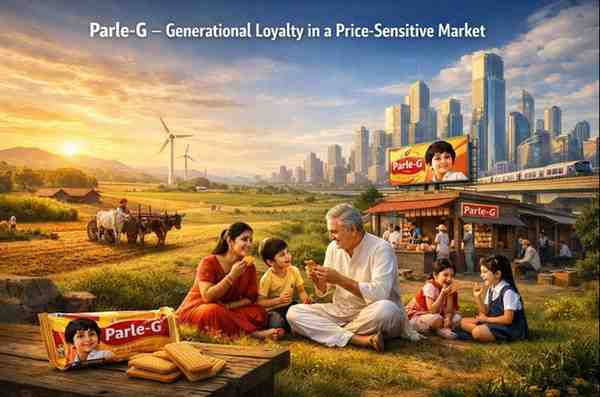
Company Background
Founding and Ownership: Parle Products Private Limited was founded in 1929 by the Chauhan family in British India. The company remains privately held and family-owned, operating without the public disclosure requirements of listed firms.
Brand Origin: Parle-G was introduced in 1939 as a glucose biscuit aimed at the Indian mass market, quickly establishing itself as an affordable and widely trusted staple.
Manufacturing Scale: Parle Products operates 10 company-owned manufacturing facilities and works with approximately 125 contract manufacturing units across India, enabling large-scale production.
Distribution Reach: With a distribution network covering over 6 million retail outlets nationwide, Parle-G is among the most widely available packaged food products in India.
Market Context
India's biscuit market is characterized by intense price sensitivity and fragmented competition. According to Nielsen data cited in Business Standard (June 2019), the organized biscuit market in India was valued at approximately ₹35,000 crore, with Parle Products holding the largest market share.
The same report indicated that Parle-G alone accounted for a significant portion of the company's overall biscuit sales.
The market includes multinational players like Britannia Industries (owned by the Wadia Group and listed on Indian stock exchanges) and ITC Limited, as well as numerous regional and unorganized players. Price competition is severe, with consumers demonstrating high elasticity in lower price segments.
Product Strategy: The Affordability Anchor
Pricing Philosophy
Parle-G's core strategy has centered on maintaining the lowest possible retail price point. According to statements by Mayank Shah, Senior Category Head at Parle Products, in an interview with Business Today (April 2020), the company has historically resisted price increases and has instead adjusted pack sizes to manage input cost pressures.
In March 2020, during the COVID-19 lockdown, Business Standard reported that Parle-G sales surged as consumers stockpiled essential goods.
Shah stated in the same article that the brand witnessed "growth of around 80-100% in the last two weeks of March 2020" compared to the previous year, as the biscuit served as an affordable, long-shelf-life food option during uncertainty.
The Hindu BusinessLine reported in May 2021 that Parle Products had to increase prices by 4-5% due to rising input costs, marking one of the rare occasions the company adjusted pricing upward. This decision was made after exploring alternatives to maintain affordability.
Product Positioning
Parle-G has consistently positioned itself as a nutritious, affordable biscuit suitable for all age groups.
The packaging features the iconic image of a baby, which has remained largely unchanged for decades, creating strong brand recall. According to Ajay Chauhan, Executive Director of Parle Products, in an interview with Mint (August 2019), the brand's visual identity has been deliberately kept consistent to maintain consumer trust and recognition across generations.
Distribution Excellence
Reach and Penetration
Parle Products' distribution strategy is widely regarded as one of its key competitive advantages. In an interview with The Ken (June 2019), Ajay Chauhan explained that the company's distribution model prioritizes depth of penetration over exclusive partnerships.
The company reportedly works with approximately 1,500 distributors who service millions of small retail outlets, including roadside kiosks, tea stalls, and rural provision stores.
According to The Economic Times (March 2020), Parle-G's availability in remote rural areas and small-town India has been a critical factor in building habitual consumption.
The brand is often the only packaged biscuit available in many tier-3 and tier-4 markets, giving it a first-mover advantage in these regions.
Manufacturing and Supply Chain
Parle Products operates a hybrid manufacturing model combining owned facilities with contract manufacturing partnerships.
This approach, as described by company executives in Economic Times (August 2020), allows the company to maintain quality control while achieving cost efficiencies and supply chain flexibility.
The company's 10 owned manufacturing plants are strategically located across India to minimize transportation costs and ensure product freshness. The 125 contract manufacturing units extend production capacity during peak demand period
Brand Building Without Heavy Advertisings
Marketing Approach: Unlike many consumer goods companies, Parle Products has maintained relatively modest advertising expenditures.
According to AdAge India reports cited in Business Standard (July 2018), Parle Products' advertising spend is significantly lower than competitors like Britannia Industries, which reports marketing expenses in its annual financial statements as a listed company.
Mayank Shah stated in an interview with Campaign India (January 2019) that Parle-G relies heavily on word-of-mouth, ubiquitous availability, and consistent quality rather than high-decibel marketing campaigns.
The brand's advertising typically focuses on mass media channels, particularly television, during prime-time slots that reach middle and lower-income households.
Competitive Dynamics
Competition from Organized Players
Britannia Industries, a publicly listed company, provides financial disclosures that offer some context on competitive dynamics. According to Britannia's FY2020 Annual Report, the company's revenue from operations was ₹11,914 crore, with the biscuits segment contributing a majority of sales.
Britannia competes across multiple price segments, including premium and mid-premium categories where Parle-G has limited presence.
ITC Limited, another major competitor, entered the biscuit market in 2003 with its Sunfeast brand. According to ITC's FY2020 Annual Report, the FMCG segment (which includes biscuits) contributed ₹13,195 crore in revenue
The Economic Times reported in September 2019 that Parle Products held approximately 40% market share in the overall biscuit category by volume, significantly ahead of Britannia's approximately 25% share. These figures represent estimates from Nielsen data as reported in media and should be considered approximate given the lack of official company disclosures from Parle Products.
Regional and Unorganized Competition
India's biscuit market includes numerous regional brands and unorganized players, particularly in rural areas. According to industry reports cited in Business Line (February 2019), local unorganized players compete primarily on price, often undercutting organized brands by 10-20% on equivalent products.
Parle-G's competitive response, as described by executives in various interviews, has been to maintain razor-thin margins and leverage economies of scale rather than engaging in direct price wars.
Crisis Response: The COVID-19 Case
The COVID-19 pandemic in 2020 provided a real-world test of Parle-G's market positioning. As India entered a strict nationwide lockdown in March 2020, consumer behavior shifted dramatically toward essential goods and long-shelf-life products.
According to The Hindu (April 2020), Parle Products reported unprecedented demand for Parle-G during the lockdown period. Mayank Shah stated in an interview with PTI (Press Trust of India, March 2020) that the company was operating at full capacity across its facilities to meet demand, with Parle-G experiencing "surge of 80 per cent" in late March 2020.
The Economic Times reported in April 2020 that Parle Products added approximately 4,000-5,000 workers across its manufacturing facilities to cope with increased demand. The company reportedly prioritized production of small, affordable packs that were most accessible to consumers facing income uncertainty.
Business Standard reported in May 2020 that while premium biscuit categories saw declining sales during the lockdown, economy segments like Parle-G grew significantly, indicating a flight to value among consumers. This trend reinforced Parle-G's positioning as a recession-resistant brand serving basic consumption needs.
Generational Loyalty: Factors and Evidence
Consistency and Trust
Industry analysts and media reports consistently cite brand consistency as a key factor in Parle-G's generational appeal. The product formulation, packaging design, and price positioning have remained largely stable over decades.
According to Ajay Chauhan in an interview with Mint (August 2019), this deliberate consistency creates familiarity and trust across age groups.
The brand's presence across multiple touchpoints in consumers' lives – from childhood snacking to adult chai accompaniment – has been noted in multiple industry reports. The Economic Times (December 2018) described Parle-G as having "permeated Indian culture" through its affordability and ubiquity.
Habit Formation Through Availability
Parle-G's extensive distribution ensures that the product is often the default choice in many purchase situations. According to RedSeer Consulting reports cited in Business Line (March 2020), high availability drives habitual purchasing behavior, particularly in impulse-driven categories like biscuits.
The brand's presence at tea stalls, railway stations, and small neighborhood stores creates repeated exposure and consumption occasions. Mayank Shah noted in an interview with Business Today (June 2019) that Parle-G benefits from being "the most accessible branded biscuit" in India, particularly in rural markets where choice is limited.
Price Stability and Value Perception
Parle-G's resistance to frequent price increases has reinforced consumer perception of value. According to statements by company executives in multiple media interviews, the company has historically absorbed input cost fluctuations through operational efficiencies and scale rather than passing costs to consumers.
The Hindu BusinessLine reported in May 2021 that even when Parle Products implemented a rare price increase, the company simultaneously introduced smaller pack sizes at the original price point to maintain accessibility for the most price-sensitive consumers.
Limitations
Thin Profit Margins: Because the brand is built on extreme affordability and "price-sensitivity," there is very little room for error. Even minor increases in raw material costs (like wheat or sugar) significantly squeeze profitability.
Price Lock-In: Parle-G has cultivated a consumer base that expects a specific price point (e.g., ₹5). Raising the price is difficult, often forcing the company to use "grammage reduction" (shrinkflation), which consumers eventually notice.
Low Premium Appeal: The brand is so strongly associated with being "the common man's biscuit" that it is difficult for Parle-G to transition into the premium or luxury biscuit segment under the same brand name.
Dependence on High Volume: The business model relies entirely on massive scale. If distribution logistics are disrupted or rural demand dips, the low margin per unit makes it hard to sustain overhead costs.
Product Stagnation: Maintaining "generational loyalty" and "consistent quality" (as mentioned in your text) can limit innovation. Drastically changing the recipe or packaging risks alienating the core loyalist base.
Key Lessons
1. Price Leadership as Sustainable Strategy in Mass Markets
Parle-G demonstrates that maintaining the lowest price point, when combined with adequate quality and distribution, can create formidable competitive advantages in price-sensitive markets.
The brand's willingness to adjust pack sizes rather than prices, as reported during input cost inflation periods, shows strategic commitment to affordability as a core value proposition rather than a temporary tactic.
The brand's performance during the COVID-19 crisis, as documented in multiple media reports, validated this strategy. This suggests that in mass markets with significant income volatility, consistent affordability builds resilience against economic downturns.
2. Distribution Density Creates Competitive Moats
Parle-G's presence in over 6 million outlets, as stated by company executives, represents a significant barrier to entry for competitors.
This distribution intensity, particularly in rural and semi-urban markets, creates habitual consumption patterns that are difficult to disrupt.
The brand's strategy of working with a large network of distributors rather than exclusive partnerships, as described in media interviews, prioritizes market coverage over control.
3. Brand Consistency Builds Intergenerational Equity
Parle-G's minimal changes to packaging, formulation, and brand identity over eight decades have created cross-generational familiarity. This consistency, as noted by company executives in media interviews, transforms the brand into a cultural reference point rather than merely a product.
Parents who consumed Parle-G as children naturally introduce it to their own children, creating an inherited consumption pattern.
This approach contrasts sharply with frequent rebranding and repositioning strategies common in consumer goods.
4. Operational Efficiency Enables Price-Based Differentiation
Parle-G's ability to maintain low prices while presumably remaining profitable (the company continues operating and expanding, as evidenced by its addition of contract manufacturing partners) indicates significant operational efficiency.
The hybrid manufacturing model combining owned facilities with contract partnerships, as described in media reports, provides scale advantages while maintaining flexibility.
The brand's focus on minimizing advertising expenses, as noted in industry reports comparing spending to competitors, redirects resources toward manufacturing and distribution.
Discussion Questions
1. Scalability of the Parle-G Model Across Emerging Markets
Replicability Potential
Parle-G’s extreme affordability model is partially replicable, but only in markets that share India’s structural realities.
Essential Market Characteristics:
Highly skewed income distribution with a large low-income mass
High frequency, low-value consumption patterns
Weak private-label penetration and trust in legacy brands
Price sensitivity outweighs brand experimentation
Required Company Capabilities:
Ultra-efficient cost management and scale economics
Deep last-mile distribution reach
Ability to absorb margin shocks without eroding volumes
Strong emotional brand equity built over decades
2. Strategic Trade-offs of Private Ownership
Advantages of Family-Owned Structure:
Long-term orientation over quarterly profit pressure
Ability to prioritize market share and affordability
Faster, values-driven decision-making
Strong control over brand integrity and pricing discipline
Disadvantages vs Public Competitors:
Limited access to growth capital for modernization and digital expansion
Lower organizational transparency and governance benchmarks
Slower response to large-scale category disruptions
Vulnerability against capital-intensive strategies by ITC and Britannia
Succession and Growth Implications:
Private ownership raises succession risk
Future growth depends on professional management depth, not just family leadership
3. Disruption Risks from Premiumization
Key Risk Factors:
Rising incomes and aspirational consumption
Entry of premium and health-focused biscuit brands
Shift from quantity-driven to value-driven purchases
Will Loyalty Persist?
Parle-G enjoys habit-based and nostalgia-driven loyalty
However, upwardly mobile consumers may trade up for occasions, not daily consumption
Strategic Path Forward:
Maintain Parle-G as a pure mass icon
Use separate brands (not Parle-G extensions) for premium plays
Protect Parle-G’s symbolic value as “India’s everyday biscuit”
4. Digital Transformation & D2C Strategy
Limitations of Digital Channels:
Parle-G thrives on impulse, proximity, and availability
E-commerce favors basket shopping, not single ₹5–₹10 purchases
Online price comparison erodes low-price advantage
Strategic Recommendation:
Use digital channels for:
Brand storytelling and nostalgia
Limited bundles or family packs
Data-driven demand sensing
Avoid full-scale D2C competition with retailers
5. Sustainability of Low-Margin Competition
Structural Cost Pressures:
Rising prices of wheat, sugar, palm oil
Higher packaging, compliance, and labor costs
Increasing environmental and food safety regulations
Strategic Options:
Micro price increases without headline price shocks
Grammage optimization instead of price hikes
Operational innovation in logistics and sourcing
Selective premium adjacencies via separate brands
Balancing Affordability & Sustainability:
Affordability must remain strategic, not absolute
Long-term survival requires economic viability alongside social value
Conclusion
Parle-G’s enduring leadership in India’s biscuit market highlights the power of extreme affordability, deep distribution reach, and generational brand trust in a highly price-sensitive economy.
Backed by private ownership, Parle Products has consistently prioritized volume, accessibility, and long-term market share over short-term profitability, enabling Parle-G to remain a daily staple across income segments.
Its vast manufacturing scale and unmatched penetration across millions of retail outlets have created formidable entry barriers for competitors.
While evolving consumer preferences, digital disruption, and rising cost pressures pose future challenges, Parle-G’s core strength lies in its ability to balance operational efficiency with emotional loyalty. The case underscores that in emerging markets, sustainable mass-market success is driven as much by cultural relevance and distribution excellence as by price alone.


Comments