From Russian Royalty to Indian Chai: The 150-Year Journey of Marie Biscuit
- Jan 26
- 8 min read
On January 23, 1874, in London, Grand Duchess Maria Alexandrovna of Russia married Prince Alfred, Duke of Edinburgh, Queen Victoria's second son. The union symbolized Anglo-Russian diplomatic ties in the Victorian era. To commemorate this high-profile royal wedding, London bakery Peek Freans created a special biscuit—simple, elegant, embossed with the name "Marie" in her honor. One hundred fifty years later, that commemorative treat has become the world's most international biscuit, consumed daily across five continents, from Venezuela to Finland, Pakistan to Australia, and dominating India's tea-time ritual. This is the story of how a royal wedding biscuit became everyman's comfort food.
The Creator: Peek Freans and Industrial Revolution Baking (1857-1874)
Peek Freans was a prominent London-based bakery established in 1857 that specialized in mass-produced baked goods during the Industrial Revolution. The company pioneered mechanized biscuit production at scale, creating consistent products that could withstand long-distance shipping—critical for reaching Britain's expanding colonial empire.
By 1861, Peek Freans began exporting biscuits to key colonies such as Australia. The company was already becoming synonymous with quality British biscuits when the opportunity arose to create something special for the 1874 royal wedding.
The Royal Occasion: A Marriage of Empires (January 23, 1874)
The wedding between Grand Duchess Maria Alexandrovna and Prince Alfred was no ordinary ceremony. Maria was the daughter of Tsar Alexander II of Russia—an Emperor's child. Alfred was son of Queen Victoria, ruler of the British Empire. Their marriage represented a significant diplomatic alliance between two of the world's most powerful dynasties.
Making a biscuit for a royal wedding was not an easy task. Peek Freans used the best bakers, the best tasters, and the highest quality ingredients. The biscuit was prepared so that anyone in the country could buy it for the least amount of money. Therefore, the recipe used four ingredients that were abundant in the country: wheat flour, sugar, sunflower oil, and vanilla extract.
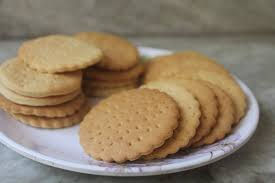
The original 1874 design featured a simple, stamped "Marie" motif with decorative scalloped edges and small perforations for even baking. The biscuit was thin, round, crisp—a cookie made primarily from wheat flour, sugar, and vegetable fats, characterized by its slightly sweet, mild vanilla flavor.
Interestingly, the Grand Duchess Marie Alexandrovna would not be amused at how she is remembered. She had a strong sense of her status, to the extent of annoying her mother-in-law, Queen Victoria. Marie insisted that as an Emperor's child, she outranked Alexandra (wife of Victoria's eldest son Edward), who was merely a King's daughter. Queen Victoria didn't agree, and Marie was so displeased that when her husband later became Duke of Saxe-Coburg and Gotha, she jumped at the chance to leave Britain.
Despite this royal drama, the biscuit bearing her name was destined for immortality.
The European Journey: From Commemoration to Symbol (1874-1940s)
The Marie biscuit quickly gained popularity throughout Europe for its affordability and long shelf life, evolving from a British specialty into a continental staple. It became particularly popular in Spain and Portugal, where it was known as "Maria."
Following the Spanish Civil War (1936-1939), Europe saw a wheat surplus. Spanish bakeries produced Marie biscuits in mass quantities to utilize this excess produce of wheat. The biscuit became a symbol of Spain's economic recovery after the civil wars, and bakeries mass-produced it to consume surplus wheat—transforming it from royal treat to symbol of resilience and hope.
There's even a fake legend in Spain that persists to this day, claiming that in 1920, confectioner Eugenio Fontaneda named the biscuit after his granddaughter. This story is told over and over again despite being completely fictional—the Marie biscuit was already 46 years old by 1920.
The Colonial Expansion: Tea Culture's Perfect Companion (Late 19th-Early 20th Century)
The Marie biscuit spread across the British Empire, traveling with ships, trade routes, and the colonial craving for afternoon tea. Its simple, crisp flavor was meant to complement, rather than compete with, the drink—making it the perfect tea companion.
As the working hours expanded following the Industrial Revolution, overseas trade through sea routes saw new openings, and long-distance train journeys became the norm. Biscuits gained popularity as instant food—easy to carry with long shelf life. The demands of growing industrialization established the first global Marie brands, with names still familiar today: Huntley & Palmer, McVitie's, and Peek Frean.
While Peek Freans began exporting to colonies in 1861, the Marie itself followed in the late 19th and early 20th centuries. Production in India began by the 1920s, when a dedicated Peek Freans factory was established in Dum Dum, Calcutta in 1924 to meet growing demand.
The biscuit entered India under British rule specifically as a tea biscuit—and found its perfect cultural home.
The Indian Adoption: From Colonial Import to Desi Staple (1920s-1947)
While colonial India had no shortage of imported biscuits, the real desi takeover began after Independence in 1947. When the British brought tea culture to India, Marie quietly tagged along in the luggage. But what started as a colonial import became thoroughly Indian.
The biscuit's simple design remained consistent worldwide: round in shape, name embossed in the center of the top surface, with intricate designs embossed on the edges. In India, it was called "Marie" (the English pronunciation) rather than "Maria" as in Spain and Latin America.
The Manufacturing Science: Precision Behind Simplicity
Although Marie biscuits are found around the world, there is a precise method in its crafting which makes it so unique. The manufacturing process follows exacting specifications:
Flour Requirements: Flour should not exceed 9.0% protein—higher protein will result in a hard biscuit. Cornflour and maize flour are used to reduce total gluten content and make a more tender eating biscuit.
Dough Process: Marie biscuits are made with medium protein flour and contain SMS (Sodium Metabisulphite) to develop a soft, extensible dough. The doughs are mixed on horizontal mixers to a temperature of 40-42 degrees Celsius.
Shaping: The dough is sheeted and cut in standard shape and size with the distinctive perforations and edge designs that define the Marie.
This scientific precision explains why, despite the simple ingredient list (wheat flour, sugar, palm oil or sunflower seed oil, vanilla), the Marie biscuit has such a distinctive texture and taste that's difficult to replicate.
The Indian Market Revolution: Britannia, Parle, ITC (1950s-Present)
In India's organized biscuit market, Marie became one of the most enduring categories. Britannia's Marie Gold is one of the oldest biscuit brands in India and enjoys extensive consumer awareness due to the brand's extensive advertising and promotion campaigns. They had first-player advantage as they were the first ones to bring the tea biscuit to India.
Britannia initially advertised Marie Gold biscuits in India by leveraging their well-established presence as a British biscuit maker. They focused on making the product affordable, hygienic, and long-lasting. The company later launched Vita Marie Gold specifically targeted at women.
Parle, India's largest biscuit maker, also entered the Marie segment with Parle Marie. ITC Ltd launched Marie Light as a healthy and tasty biscuit, later introducing newer variants enriched with natural wheat fibre, oats variant, and orange flavored versions.
Today, the Marie category in the organized biscuit market is valued at around ₹3,500 crore, with Britannia dominating the category. The major brands include Britannia's Marie Gold and Vita Marie, Parle Marie, ITC's Marie Light, and DK Bakings' Nutribake Morning Marie.
The Growth Anomaly: 17-18% in a 7-8% Market (2010s-2020s)
According to ITC's divisional chief executive for foods, Chitranjan Dar, Marie is one of the fastest-growing biscuit categories, growing 17-18% annually whereas the overall biscuit industry grows at 7-8%. This is remarkable because Marie is a plain biscuit competing in an era of cookies and cream.
The category grows in demand due to repositioning in the health segment, having a non-intrusive taste, and affordable pricing compared to premium digestive biscuits. As Future Group CEO Devendra Chawla explained, "Marie is a value for money digestive biscuit and this segment keeps showing steady growth at a time when the glucose segment is slowing down."
Marie biscuits are creating a niche segment between the entry-level glucose and the premium digestive biscuits—positioned as healthy and good for all ages.
The Global Footprint: 50+ Countries, Countless Brands
Marie biscuits are ubiquitous globally, with major brands operating in virtually every continent:
Asia-Pacific: Fibisco (Philippines - three brands: Marie, Marie Time, Marie Munch for toddlers), Khong Guan Biscuit Factory (Singapore), Hup Seng (Malaysia - Marie and Coffee Marie), Maliban (Sri Lanka - Gold Marie), Julie's (Malaysia), Regal Maria Biscuits (Indonesia)
Europe: Sætre AS and NorgesGruppen (Norway), Goteborgs Kex (Sweden - Guld Marie), Pally (Holland - Marriebiscuits), Kharkiv Biscuit Factory (Ukraine)
Latin America: Gamesa (Mexico - popularized as household item), Grupo Siro (Spain - Maria, Maria Dorada, Maria Clasica), Cuetara (Spain - Maria Oro and Portugal - Bolacha Maria), LU-Fontaneda (Spain - La Buena Maria), Productos Alimenticios Pascual (Panama), Kraft Foods (Uruguay - Maria de Famosa), El Trigal (Uruguay - Maria Rika)
Middle East & Africa: Bakers (South Africa - Maries and Cappuccino Marie), English Biscuit Manufacturers (Pakistan - Peek Freans), Katalina Foods (Syria), ANI Biscuit (Turkey - Marie), Simsek (Turkey - Gorona), Jacob's (various countries)
This represents one of the most globally distributed food products ever created—a truly international biscuit.
Cultural Integration: More Than Just a Biscuit
In Latin America, Maria cookies are ubiquitous, found in virtually all Mexican households. As Spruce Eats explains: "Similar to how graham crackers are used in the United States, Marie cookies may be eaten as breakfast or a snack, used in countless dessert recipes, or given to babies to munch on."
In India, countless people wake up every morning, make themselves steaming hot tea or coffee, and take out a couple of Marie biscuits—almost as a ritual. The biscuit has become so integrated into daily life that it transcends brand loyalty; people simply ask for "Marie" regardless of manufacturer.
The biscuit's versatility contributes to its enduring appeal: ideal for dunking in tea, milk, or coffee due to its dry, non-creamy texture; suitable as starting food for toddlers; usable in dessert recipes; acceptable as breakfast or snack; long shelf life for storage; affordable across economic classes.
Corporate Evolution: From Peek Freans to Global Portfolios (1982-1994)
Key corporate milestones shaped Marie's late 20th-century trajectory. In 1982, Nabisco Brands acquired Peek Freans' parent company. In 1994, Danone purchased the portfolio, integrating Marie into larger international portfolios and easing entry into emerging markets like the Middle East and Southeast Asia.
These acquisitions didn't change the fundamental product—the 1874 design featuring the simple stamped "Marie" motif influenced regional variants while maintaining the biscuit's light, crisp profile suitable for long-distance shipping.
Why Marie Endures: The Formula for 150 Years
Simplicity: Four basic ingredients—wheat flour, sugar, oil, vanilla—create universally acceptable taste without cultural barriers.
Versatility: Works for breakfast, snacks, desserts, toddler food, tea companion—adapts to any meal occasion.
Affordability: Positioned as value-for-money option accessible across economic classes.
Health Perception: Seen as healthier than cream biscuits or cookies while more premium than basic glucose biscuits.
Consistency: The design, taste, and experience remain unchanged globally for 150 years—building multi-generational trust.
Perfect Dunkability: Dry texture and mild sweetness make it ideal for tea/coffee—neither too sweet nor too bland.
Long Shelf Life: Practical for households, retailers, and long-distance shipping.
Cultural Neutrality: Vanilla flavor and simple design don't align with specific cuisines, allowing adoption everywhere.
The Legacy: A Duchess Remembered Daily
The person who crafted the first Marie biscuit finds no place in recorded history—only Peek Freans as a company is credited. Yet this anonymous baker created something that outlasted empires, survived world wars, transcended cultures, and became daily ritual for a billion people.
Grand Duchess Maria Alexandrovna, who insisted on royal precedence and left Britain displeased with her mother-in-law Queen Victoria, could never have imagined her legacy. She's not remembered for diplomatic achievements, royal status, or imperial lineage. Instead, millions across five continents honor her name daily—dunking a simple biscuit into tea.
Every morning when someone in Mumbai reaches for Marie Gold with their cutting chai, when a Mexican mother gives Maria cookies to her toddler, when a Norwegian enjoys Guld Marie with coffee, when a Filipino worker packs Marie Time in their lunch—they're participating in a 150-year tradition that began with a royal wedding in Victorian London.
The Marie biscuit proves that sometimes the simplest creations endure longest. Four ingredients, one design, 150 years—and still the world's most international biscuit.
Because true classics need no reinvention. They just need to be Marie.


Comments