Heinz Ketchup: Behavioral Insight Leading to Packaging Innovation
- Dec 15, 2025
- 6 min read
Executive Summary
This case study examines Heinz's packaging innovation journey, specifically the introduction of the upside-down squeeze bottle in 2002. The innovation addressed a fundamental consumer frustration with traditional ketchup bottles and represented a shift from aesthetic packaging design to functionality-driven design based on behavioral insights. The case demonstrates how observing actual consumer behavior can drive product innovation that creates competitive advantage.
Company Background
1. Founding and Early History
H.J. Heinz Company was founded in 1869 by Henry John Heinz in the United States.
The company began with a focus on producing high-quality, preservative-free food products, which was a key differentiator during that era.
Heinz emphasized trust, purity, and consistency, helping the brand gain early consumer confidence.
In 1876, Heinz introduced its tomato ketchup, which would become its most iconic and enduring product.
The product was positioned as a reliable, standardized condiment at a time when food adulteration was common.
Heinz ketchup quickly gained popularity due to its consistent taste and quality assurance.
2. Iconic Packaging and Brand Identity
The octagonal glass bottle introduced by Heinz became a strong visual and cultural symbol in American households.
The transparent bottle design reinforced the brand’s promise of purity and honesty, allowing consumers to see the product.
Over time, the bottle evolved into a powerful brand asset, contributing to high recall and differentiation.
3. Legacy and Global Significance
Over decades, Heinz transitioned from a domestic food company into a globally recognized brand.
The success of Heinz ketchup laid the foundation for expansion into multiple food categories and international markets.
Heinz remains a textbook example of brand-led market leadership in consumer packaged goods (CPG).
The Problem: Behavioral Observation
Consumer Frustration
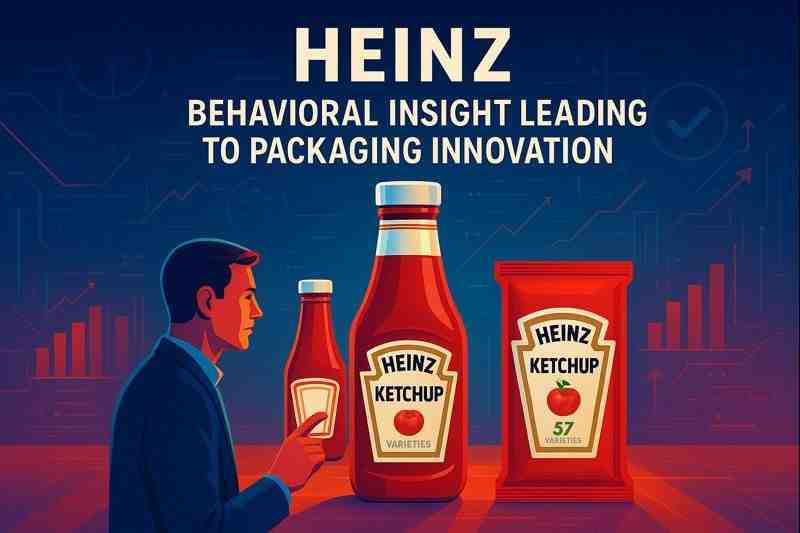
According to multiple interviews with Heinz executives published in business media, including Fast Company and BusinessWeek, the company identified a significant consumer pain point through direct observation. The traditional glass bottle design, while iconic, created frustration for users attempting to extract ketchup from the bottle.
Casey Keller, who was involved in the innovation process at Heinz, stated in interviews that consumers would "bang, shake, and wait" to get ketchup out of the traditional bottle. The company observed that the thick consistency of ketchup and the positioning of the bottle opening at the narrow top created difficulty in dispensing the product, particularly as the bottle emptied.
The "57 Varieties" Dilemma
The traditional Heinz glass bottle featured the famous "57 Varieties" marking on the neck.
According to company statements and packaging industry reports, Heinz had long advised consumers to tap the "57" spot on the bottle to help ketchup flow. This workaround itself was evidence of the fundamental design flaw - the product packaging required special instructions for basic use.
The Innovation: Upside-Down Squeeze Bottle
Development and Launch
The key design elements, as documented in product announcements and packaging industry publications, included:
Inverted storage position: The bottle was designed to be stored cap-down, keeping ketchup at the dispensing point
Wide, stable cap base: Allowed the bottle to stand upside down without tipping
Valve closure system: Prevented leaking when stored inverted
Squeezable plastic construction: Enabled easier product dispensing through pressure
Design Rationale
According to statements from Heinz representatives reported in business press, the innovation directly addressed the behavioral insight about consumer frustration. By storing the bottle upside down, gravity kept ketchup at the dispensing end, eliminating the need to wait, shake, or bang the bottle.
Michael Okoroafor, a Heinz executive, was quoted in packaging industry publications stating that the company focused on making the product "easier to use" rather than simply creating novel packaging.
Market Response and Impact
Consumer Adoption
According to news reports and industry publications from 2002-2004, including Supermarket News and Progressive Grocer, the upside-down bottle was well-received by consumers. While specific sales figures were not uniformly disclosed, media reports indicated strong initial sales performance.
The Wall Street Journal reported in 2003 that the new packaging format was gaining traction with retailers and consumers. According to industry analysts quoted in these reports, the innovation helped Heinz maintain its market leadership position during a period of increased private label competition.
Industry Recognition
The packaging innovation received recognition from design and packaging industry organizations.
According to reports in packaging trade publications, the design won multiple awards for packaging innovation, including recognition from the Institute of Packaging Professionals.
Competitive Response
Following Heinz's introduction of the upside-down bottle, competitors including Hunt's and private label brands introduced similar inverted bottle designs, according to reports in trade publications and supermarket industry news outlets.
This pattern of competitive imitation validated the consumer appeal of the design innovation.
Behavioral Insights Framework
Observation Over Assumption
According to interviews with Heinz team members published in business and design publications, the innovation emerged from direct observation of how consumers actually used the product, rather than focus group discussions or survey research alone.
The company reportedly conducted in-home observations and analyzed consumer complaints to understand the friction points in the user experience. This approach exemplifies the value of behavioral observation in identifying innovation opportunities.
Solving for Actual Behavior
Rather than attempting to change consumer behavior (e.g., teaching people to store bottles differently or use specific tapping techniques), Heinz redesigned the product to accommodate existing behavioral patterns.
Consumers naturally wanted to use ketchup quickly and easily; the new design eliminated barriers to that goal.
Form Follows Function
The upside-down bottle represented a philosophical shift from form-driven to function-driven design.
According to packaging industry analyses published in trade journals, Heinz prioritized functional performance over traditional aesthetic considerations, though the company maintained brand identity through labeling and color schemes.
Broader Industry Impact
Packaging Innovation Precedent
The innovation demonstrated that even mature product categories with established packaging norms could benefit from behavioral insight-driven redesign. Industry publications including Packaging World and Packaging Digest cited the Heinz example in articles about user-centered packaging design throughout the 2000s.
Extension to Other Categories
The success of inverted bottle design influenced packaging decisions in other viscous product categories. According to reports in consumer goods trade publications, categories including mustard, mayonnaise, and personal care products subsequently adopted similar inverted bottle formats.
Strategic Implications
Product Differentiation
According to market analysts quoted in business press during this period, the packaging innovation provided Heinz with a differentiation point during a time when ketchup was increasingly viewed as a commodity product.
Premium Positioning: While specific pricing data was not uniformly disclosed, retail industry reports indicated that the new packaging format generally commanded a slight price premium compared to traditional bottle formats, attributed to both the packaging costs and the perceived added value.
Brand Modernization
According to brand analysts quoted in marketing publications, the innovation helped modernize Heinz's image without abandoning its heritage.
The company maintained the iconic Heinz branding while demonstrating innovation capability.
Limitations
Detailed market share changes directly attributable to the packaging innovation. While Heinz maintained market leadership during this period, the specific impact of packaging versus other factors (pricing, promotion, distribution).
Consumer research methodology details beyond general descriptions are not available. While executives mentioned observation and consumer input, specific research sample sizes, methodologies.
Engineering and manufacturing challenges are referenced generally in packaging industry publications but specific technical problems solved and solutions implemented.
Sustained sales performance data for the upside-down format over multiple years is limited in public sources. While the format remained in market.
Cannibalization effects between the traditional glass bottle and new plastic bottle
Key Lessons
1. Observe Actual Behavior, Not Stated Preferences
Heinz's innovation emerged from watching how consumers actually used the product rather than relying solely on what consumers said they wanted. The frustration with traditional bottles was observable behavior that translated directly into a design solution.
Solve real friction points
The packaging addressed a genuine, frequent pain point in the user experience. The innovation's success suggests that eliminating friction in product use can create meaningful competitive advantage, even in mature categories.
3. Functionality Can Drive Differentiation
In a category where products were largely undifferentiated on taste or quality, functional packaging superiority created a tangible reason for brand preference.
4. Simple Solutions to Complex Problems
The upside-down bottle was a relatively simple solution - inverting the storage orientation - that solved a complex behavioral problem. This illustrates the value of reframing problems to identify elegant solutions.
5. Behavioral Insights Apply Across Categories
The principle of designing for actual user behavior rather than ideal behavior has applicability beyond food packaging. The case demonstrates the broader value of behavioral observation in product design.
6. Innovation Requires Organizational Courage
Changing an iconic package format required organizational commitment to prioritize function over tradition. According to interviews with team members, there was internal resistance to changing the familiar bottle, demonstrating that behavioral insights must be coupled with organizational will to implement change.
Conclusion
The Heinz upside-down ketchup bottle represents a case study in how behavioral insights can drive product innovation in mature categories. By observing actual consumer behavior and designing packaging to accommodate rather than change that behavior, Heinz created functional differentiation in a commodity category.
The innovation's success and subsequent industry imitation validate the approach of prioritizing user experience and functional performance in product design. For business strategists and product designers, the case demonstrates that opportunities for innovation exist even in long-established categories when approached through the lens of actual user behavior rather than conventional assumptions.

Comments