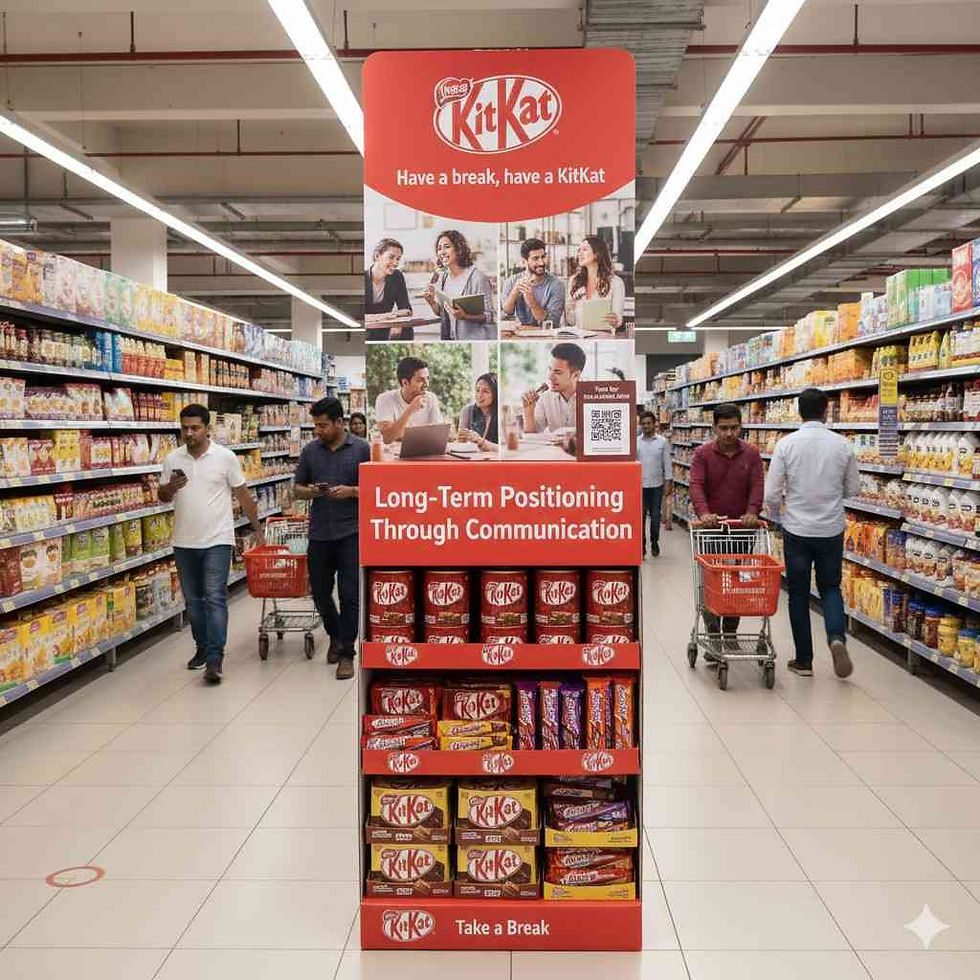
KitKat "Have a Break, Have a KitKat": Long-Term Positioning Through Communication
- Jan 9
- 14 min read
Executive Summary
KitKat, the chocolate-covered wafer bar owned globally by Nestlé (except in the United States where Hershey holds licensing rights), represents one of the most enduring examples of consistent brand positioning through a singular communication platform. Launched in the United Kingdom in 1935 by Rowntree's, the brand developed its iconic "Have a Break, Have a KitKat" slogan in 1957, establishing a positioning that has remained largely unchanged for over six decades. This case examines how KitKat built and sustained a distinctive brand identity centered on the moment of taking a break, transforming a product attribute—the breakable wafer fingers—into a powerful emotional and behavioral association. The brand's communication strategy demonstrates how long-term consistency, creative adaptation, and cultural embedding can create enduring brand equity in the highly competitive confectionery market, where product differentiation is limited and consumer switching costs are low.
Product Origins and Category Context
KitKat was introduced in the United Kingdom on August 29, 1935, by Rowntree's of York under the name "Rowntree's Chocolate Crisp." According to historical documentation referenced in The Guardian and confectionery industry histories, the product was renamed KitKat Chocolate Crisp in May 1937, and eventually shortened to simply KitKat. The name's origin has been attributed to the Kit-Cat Club, an 18th-century literary and political club in London, though the direct connection has not been definitively documented in publicly available sources.
The product's distinctive format—chocolate-covered wafer fingers that could be snapped apart—was innovative for its time. According to Nestlé's corporate history materials and reports in business publications, this breakable design was both functional and symbolic, eventually becoming central to the brand's identity. The four-finger bar became the standard format, though two-finger versions and other variations were introduced over subsequent decades.
Rowntree's was acquired by Nestlé in 1988, as reported in The New York Times and other major business publications. The acquisition brought KitKat into Nestlé's global confectionery portfolio, enabling broader international distribution while maintaining the brand's heritage and positioning. Notably, in the United States, Hershey had obtained a perpetual license to manufacture and distribute KitKat in 1970 under an agreement with Rowntree's that continued after Nestlé's acquisition, as documented in various business and legal publications.
The confectionery market, particularly the chocolate and wafer segment, is characterized by intense competition, frequent product innovation, and significant marketing expenditure. Major global players include Mars, Mondelez International, Ferrero, Lindt, and Hershey, alongside numerous regional brands. In this context, establishing distinctive brand identity beyond taste and format represents a critical competitive challenge.
Development of the "Have a Break" Positioning
The "Have a Break, Have a KitKat" slogan was created in 1957 by the J. Walter Thompson advertising agency for Rowntree's, according to advertising industry histories and documentation from The History of Advertising Trust. This positioning was developed during a period when British advertising was becoming more sophisticated in linking products to consumer lifestyles and emotional needs rather than merely describing product features.
The genius of the positioning lay in several dimensions. First, it connected the product's physical characteristic—the breakable fingers—to a behavioral and emotional moment: the break. This created mnemonic coherence between product form and brand meaning. Second, it identified and "owned" a specific consumption occasion: the pause in daily activity. While other chocolate brands might be positioned around indulgence, energy, or social sharing, KitKat claimed the psychological territory of respite and refreshment.
Third, the positioning was elastic enough to remain relevant across changing cultural contexts while maintaining its core meaning. A "break" could be interpreted in multiple ways—a break from work, a coffee break, a moment of personal time, a pause in study, or simply a respite from routine. This semantic flexibility allowed the brand to resonate with diverse consumer segments and adapt to different cultural contexts globally without abandoning its fundamental positioning.
According to advertising effectiveness research documented by the Institute of Practitioners in Advertising (IPA) in the UK and referenced in marketing case studies, the "Have a Break" campaign achieved high recall and strong association with the brand. The slogan's linguistic structure—rhythmic, alliterative, and incorporating the brand name—made it memorable and distinctive. Over decades, it became one of the most recognized advertising slogans in markets where it was consistently used.
Communication Strategy and Creative Execution
KitKat's communication strategy has been characterized by remarkable consistency in strategic positioning combined with tactical creativity in execution. While the core message remained constant, the creative expressions evolved to maintain freshness and relevance across generations.
Early KitKat advertising in the UK, as documented in advertising archives and retrospectives, featured simple, direct messaging showing people pausing their activities to enjoy a KitKat. Television commercials from the 1960s through 1980s typically depicted workplace or domestic settings where the protagonist took a break from tasks to have a KitKat, often accompanied by the jingle "Have a break, have a KitKat."
According to marketing publications and advertising industry analyses, the brand's communication approach emphasized relatability over aspiration. Unlike luxury chocolate brands that might use exotic imagery or premium lifestyles, KitKat advertising focused on ordinary, everyday moments—a factory worker's tea break, an office employee's afternoon pause, a student's study break. This democratic positioning made the brand accessible and personally relevant to broad consumer segments.
A significant evolution in KitKat's creative strategy occurred with the "KitKat: Breaks" campaign developed for the UK market. While specific campaign dates and creative details are scattered across various marketing publications, the approach involved clever visual and narrative techniques to reinforce the break association. Some executions played with the idea of "breaking" in multiple senses—breaking from routine, breaking free, even playing with words and images that suggested interruption or pause.
In Japan, where KitKat became exceptionally successful, the brand's communication adapted to local cultural contexts while maintaining the break positioning. According to reports in The Japan Times, Nikkei Asia, and international marketing publications, KitKat in Japan benefits from a fortuitous linguistic association: "KitKat" sounds similar to "kitto katsu," a Japanese phrase meaning "surely win" or "certainly succeed." This phonetic similarity enabled the brand to position KitKat as a good luck charm, particularly for students before examinations. Nestlé Japan capitalized on this association through targeted marketing campaigns during exam seasons, as documented in various business and cultural analyses of Japanese consumer behavior.
Geographic Market Strategies
KitKat's global presence spans over 100 countries, with varying levels of market penetration and adaptation. The brand's communication and positioning have been adapted to different markets while attempting to maintain core elements of the break association.
In the United Kingdom, KitKat's home market, the "Have a Break" positioning has been consistently maintained since 1957. According to market research data referenced in UK advertising and marketing publications, KitKat has maintained strong brand awareness and favorable positioning in the British confectionery market for decades. The brand is deeply embedded in British culture, with the phrase "have a break" becoming somewhat synonymous with the brand in colloquial usage.
In Japan, as noted previously, KitKat has achieved remarkable success through cultural adaptation. Beyond the "kitto katsu" linguistic association, Nestlé Japan introduced extensive product innovation, launching hundreds of limited-edition flavors over the years. According to reports in Bloomberg, The Guardian, and Japanese business media, these flavors ranged from traditional Japanese tastes like matcha (green tea), sake, and wasabi to seasonal and regional specialties. This strategy of extreme product variety, while maintaining the KitKat brand name and format, created collectibility and cultural relevance. The communication strategy in Japan has emphasized both the good luck association and the experiential diversity of flavors, adapting the global break positioning to local consumer preferences for novelty and gift-giving.
In India, where Nestlé has significant operations, KitKat has been marketed with communication that emphasizes the break moment in the context of busy, work-intensive lifestyles. According to reports in The Economic Times, Business Standard, and Mint, Nestlé India has used television, digital, and outdoor advertising to promote KitKat, often featuring scenarios of students, young professionals, or families taking a moment of respite. The tagline "Have a break, Have a KitKat" has been adapted into regional languages in some campaigns, maintaining the core message while enhancing local accessibility.
In the United States, where Hershey markets KitKat, the communication strategy has been somewhat different due to different competitive dynamics and the Hershey brand architecture. According to advertising tracked by industry publications and marketing analyses, Hershey's KitKat advertising in the US has sometimes emphasized the product's features—crispy wafers, chocolate coating—alongside the break association, but with less consistent focus on the "Have a Break" platform compared to Nestlé markets. This reflects Hershey's broader portfolio strategy and the different cultural context of American confectionery consumption.
Digital and Social Media Evolution
As consumer media consumption shifted toward digital platforms in the 2000s and 2010s, KitKat adapted its communication approach while maintaining positioning consistency. According to reports in marketing and advertising publications, Nestlé developed digital strategies for KitKat that leveraged social media, content marketing, and interactive campaigns.
One notable digital initiative was the "KitKat YouTube Channel Break," launched around 2013-2014. According to reports in advertising trade publications and digital marketing analyses, this concept positioned KitKat as the sponsor of the break people take while watching YouTube videos. The brand created short, entertaining content designed to be consumed during brief viewing breaks, aligning the digital behavior of pausing video consumption with the brand's core positioning around taking breaks.
KitKat has also engaged in social media conversations and cultural moments related to breaks, pauses, and relaxation. While specific campaign details and performance metrics are not consistently available in public sources, the brand's social media presence across platforms like Facebook, Twitter (now X), Instagram, and YouTube has maintained thematic consistency with the break positioning, featuring content about workplace breaks, study breaks, travel breaks, and moments of personal time.
In some markets, KitKat has explored user-generated content campaigns inviting consumers to share their break moments, though comprehensive public documentation of these campaigns' structure and outcomes is limited. The general strategic approach has been to position the brand as an enabler and companion of break moments in consumers' daily digital lives, extending the traditional positioning into new media contexts.
Product Innovation and Packaging
While communication consistency has been a hallmark of KitKat's strategy, the brand has also engaged in product innovation and packaging evolution to maintain relevance and appeal. These innovations have generally been communicated in ways that reinforce rather than contradict the core break positioning.
KitKat has introduced various formats beyond the original four-finger bar, including two-finger bars (widely available in multiple markets), KitKat Chunky (a thicker bar introduced in the UK), KitKat Bites (bite-sized pieces), and various sharing bags and multipack formats. According to reports in grocery and confectionery trade publications, these format innovations address different consumption occasions and preferences while maintaining the KitKat brand identity and the breakable wafer concept.
Flavor innovations have been particularly pronounced in Japan but have also occurred in other markets. In the UK, according to reports in The Guardian and confectionery industry media, KitKat has introduced variations including KitKat Orange, KitKat Mint, KitKat Dark, and limited-edition seasonal flavors. These innovations provide variety and news value, generating consumer interest and trial while the core product maintains mass appeal.
Packaging has evolved over decades to reflect changing design trends, regulatory requirements, and sustainability concerns. According to Nestlé's corporate communications and sustainability reports available on the company's website, the company has committed to making all KitKat packaging recyclable or reusable. In 2019, Nestlé announced plans to introduce paper-based packaging for KitKat in several markets as part of its broader sustainability commitments, as reported by Reuters and The Guardian. This packaging innovation was communicated as part of Nestlé's environmental responsibility positioning, complementing rather than replacing the break-focused brand positioning.
Competitive Context and Brand Differentiation
The confectionery market presents significant challenges for brand differentiation. Chocolate products are relatively similar in basic composition, and taste preferences, while important, do not typically create strong barriers to switching. Price sensitivity varies by segment, but in the mass-market chocolate category where KitKat primarily competes, price competition is significant.
KitKat competes with numerous chocolate and snack brands, including direct competitors like Mars bars, Snickers, Twix, and Cadbury products, as well as broader snack options including cookies, chips, and other confectionery. According to market research data referenced in industry publications, brand loyalty in confectionery is moderate—consumers often have a repertoire of acceptable brands rather than exclusive loyalty to one.
In this context, KitKat's communication-driven brand positioning represents a source of differentiation. While competitors may emphasize taste, ingredients, hunger satisfaction, or indulgence, KitKat has consistently owned the "break" territory. This ownership creates mental availability—when consumers think of taking a break, KitKat comes to mind, and when they encounter KitKat, the break association is activated.
The strength of this positioning is evidenced by the brand's longevity and sustained market presence across diverse markets. While specific market share data is not consistently available in public sources, KitKat's continued production, distribution, and marketing investment by Nestlé (and Hershey in the US) over many decades indicates sustained commercial viability and consumer relevance.
Brand Equity and Cultural Embedding
One measure of KitKat's communication effectiveness is the extent to which the brand has become culturally embedded. The phrase "have a break" has, in British English, become somewhat synonymous with the brand, demonstrating how effective long-term communication can blur the line between product messaging and everyday language.
According to analyses in marketing and branding literature, including case studies from business schools and marketing textbooks, KitKat represents a textbook example of effective brand positioning that creates distinctive brand assets. These assets include the slogan itself, the visual design of the four-finger format, the red packaging, and the association between the product and the behavior of taking a break.
The brand has also been subject to trademark and intellectual property discussions that reveal its cultural significance. According to reports in The Guardian, BBC, and legal publications, Nestlé has been involved in trademark disputes regarding the shape of the four-finger KitKat bar, arguing that the shape has acquired distinctiveness through long use. While legal outcomes have varied across jurisdictions, these cases demonstrate the company's recognition that the product's format is integral to brand identity and worthy of protection.
KitKat has appeared in popular culture, referenced in television shows, films, and other media, typically without commercial arrangement, suggesting genuine cultural penetration. While systematic documentation of such appearances is not available in public sources, their occurrence indicates that the brand has achieved a level of recognition beyond mere commercial presence.
Challenges and Adaptations
Despite its long-term success, KitKat has faced challenges common to established brands in mature categories. Health concerns about sugar, chocolate, and processed foods have affected the entire confectionery industry. According to reports in major business publications and Nestlé's own corporate communications, the company has responded through reformulation efforts to reduce sugar content, introduce portion control options, and communicate more transparently about nutritional information.
These health-related challenges pose potential tension with the break positioning. If breaks are associated with chocolate consumption, and chocolate faces increasing scrutiny as unhealthy, does the positioning become problematic? Nestlé's approach, based on available public communications, has been to position KitKat breaks as moments of moderation and mindful indulgence rather than excessive consumption, emphasizing portion control and balanced enjoyment. However, detailed strategic documentation of how the company navigates this tension is not available in public sources.
Competition from healthier snack options—protein bars, nuts, fruit snacks, and other alternatives positioned as better-for-you choices—represents another challenge. Younger consumers, particularly in developed markets, may be more health-conscious and less likely to choose traditional chocolate confectionery for snacking occasions. KitKat's response has included limited product innovation toward lower-sugar or smaller-portion options, though the core product remains unchanged.
Digital media fragmentation and declining effectiveness of traditional television advertising create challenges for maintaining brand presence and communication consistency. As audiences disperse across multiple digital platforms, maintaining the frequency and consistency of brand messaging that characterized earlier decades becomes more difficult and expensive. KitKat's adaptation has involved diversifying across digital channels while attempting to maintain message coherence.
Sustainability and Corporate Responsibility Communication
In recent years, Nestlé has integrated sustainability messaging into its corporate and brand communications, including for KitKat. According to the company's corporate reports and press releases available on Nestlé's website, commitments include sourcing cocoa responsibly, reducing environmental impact, and improving packaging sustainability.
In 2016, Nestlé announced that KitKat would use 100% sustainably sourced cocoa through the company's Cocoa Plan, as reported in The Guardian and corporate announcements. This commitment was communicated as part of broader corporate responsibility, though it has not fundamentally altered KitKat's consumer-facing brand positioning around breaks.
The paper-based packaging initiative announced in 2019, as previously mentioned, represented a visible sustainability commitment that could be communicated to consumers. However, the primary brand positioning remained focused on the break moment rather than environmental attributes, suggesting a deliberate separation between corporate responsibility communications and core brand identity.
This approach reflects a strategic choice common among FMCG brands: sustainability is communicated as a corporate responsibility that consumers can feel good about, but it does not replace the fundamental emotional and behavioral brand positioning that drives purchase behavior in the confectionery category.
Communication Consistency vs. Creative Refresh
A central strategic question for any long-established brand is how to maintain consistency while remaining fresh and relevant. KitKat's approach has been to preserve the core positioning absolutely while varying creative executions. The "Have a Break, Have a KitKat" message has remained constant, but the ways it is expressed have evolved.
According to advertising industry analyses and marketing publications, this strategy requires creative discipline and clear brand guidelines. Creative agencies working on KitKat must understand the boundaries within which they can innovate—the messaging must always reinforce the break association, but the scenarios, visual styles, humor, and media channels can vary.
This balance between consistency and freshness distinguishes successful long-term brand building from either creative stagnation or positioning drift. Brands that change positioning too frequently fail to build cumulative associations in consumers' minds, while brands that execute the same creative approach for too long risk becoming stale and ignored.
KitKat's decades-long communication history demonstrates how consistency in strategic positioning can coexist with variation in creative expression, providing a model for other brands seeking to build enduring brand equity.
Lessons for Brand Management
The KitKat case offers several insights for brand managers and marketing strategists managing established brands in competitive categories.
First, long-term positioning consistency can create cumulative brand equity that becomes a sustainable competitive advantage. In categories where product differences are marginal, psychological differentiation through positioning becomes primary. KitKat's ownership of the "break" moment represents differentiation that competitors cannot easily replicate because the association has been built over decades.
Second, effective positioning links product characteristics to emotional or behavioral moments, creating coherence between what the product is and what it means. The breakable wafer fingers are not just a physical attribute but a symbol of the break moment, making the positioning intrinsic to the product rather than an arbitrary external claim.
Third, semantic elasticity in positioning allows adaptation across contexts without abandonment of core meaning. A "break" means different things to different people in different situations, allowing personal relevance while maintaining collective brand identity.
Fourth, successful global brands require both consistency in core positioning and flexibility in local adaptation. KitKat's Japanese success demonstrates how fundamental brand meaning can be enhanced by cultural interpretation rather than forced into rigid uniformity.
Fifth, long-term brand building requires organizational commitment beyond individual marketing managers or campaigns. The fact that KitKat's positioning has remained consistent across multiple decades, corporate ownership changes, and agency relationships indicates institutional commitment to strategic continuity rather than the pursuit of short-term creative novelty.
Finally, established brands must balance heritage with innovation. Product innovation, packaging evolution, and sustainability initiatives refresh the brand without replacing its fundamental identity, demonstrating that loyalty to positioning does not require stagnation in all other dimensions.
Conclusion
KitKat's "Have a Break, Have a KitKat" positioning represents one of the longest-running and most successful brand communication strategies in consumer marketing. Launched in 1957 and maintained for over six decades across multiple markets, ownership changes, and media revolutions, the positioning has created a distinctive brand identity in a competitive category where differentiation is challenging.
The brand's success stems from several factors: the intrinsic connection between product format and brand meaning, the emotional and behavioral relevance of the break moment, the flexibility of the positioning across contexts and cultures, and the organizational discipline to maintain strategic consistency while varying creative executions.
As consumer markets become more fragmented, attention more divided, and competitive intensity greater, the KitKat case offers a counterintuitive lesson: sometimes the path to long-term brand success is not constant reinvention but rather relentless consistency in positioning combined with continuous creativity in execution. By owning a specific moment in consumers' daily lives—the break—KitKat has created mental availability and emotional connection that transcend the functional attributes of chocolate-covered wafers, demonstrating how communication can transform commodity products into enduring brands.
Discussion Questions
Question 1: Evaluate the strategic decision to maintain the "Have a Break, Have a KitKat" positioning for over 60 years despite massive changes in media landscapes, consumer behaviors, and competitive contexts. Under what circumstances would you recommend maintaining such long-term positioning consistency, and when might fundamental repositioning be necessary? Consider the concepts of brand equity accumulation, positioning elasticity, and organizational capabilities in your analysis.
Question 2: Analyze KitKat's approach to global expansion, particularly the contrast between maintaining core positioning (the break moment) while adapting to local cultural contexts (such as the "kitto katsu" association in Japan and extensive flavor innovation). What principles should guide brand managers in determining which brand elements must remain globally consistent versus which can or should be locally adapted? How should companies structure decision-making authority to enable both global coherence and local relevance?
Question 3: The confectionery category faces increasing health concerns regarding sugar content, obesity, and processed foods. How should KitKat's brand positioning evolve, if at all, to address these concerns without undermining the break association that has defined the brand? Should the brand introduce "better-for-you" variants with prominent positioning, reformulate the core product, adjust messaging around moderation, or maintain its current approach? Justify your recommendation considering both short-term consumer response and long-term brand equity implications.
Question 4: Compare KitKat's communication-driven differentiation strategy with alternative approaches to building competitive advantage in the confectionery market, such as product innovation (new formats or ingredients), premiumization (moving upmarket with higher quality or artisanal positioning), or value leadership (becoming the price-competitive option). Which approach offers the most sustainable competitive advantage in mature, highly competitive consumer categories? Under what conditions might a brand need to shift from one approach to another?
Question 5: As traditional mass media (television, print) declines and digital media fragments audiences across numerous platforms and formats, how should KitKat maintain the frequency and consistency of brand communication necessary to sustain mental availability? Evaluate the effectiveness of different digital strategies—social media engagement, content marketing, influencer partnerships, programmatic advertising, or branded entertainment—for maintaining long-term positioning consistency. What organizational capabilities and measurement approaches would be required to ensure that digital fragmentation does not lead to positioning dilution?


Comments