The Idea Validation Matrix: How Bangalore's Chai Wallah Built a ₹50 Lakh Business
- Jan 5
- 6 min read
The moment everything changed. It was a humid July evening in 2019 when Ramesh stood outside his small tea stall in Koramangala, watching yet another customer walk away disappointed. "Bhaiya, aap cold coffee nahin banate?" the young techie had asked.
That was the third person that day asking for something other than his famous cutting chai. Ramesh had spent fifteen years perfecting his tea recipe. His family thought he was crazy to even consider changing anything. "Customers want chai, give them chai," his brother insisted. But Ramesh couldn't shake off a nagging feeling—was he missing something bigger? Six months later, Ramesh's expanded menu had tripled his revenue. But here's the twist: it wasn't because he added cold coffee.
The validation trap we all fall into
We've all been there. You're lying awake at 2 AM, convinced you've stumbled upon the next big thing. Maybe it's an app idea. A YouTube channel concept. A new product line. The excitement is intoxicating. By morning, you're already designing logos in your head. But here's what nobody talks about: Most ideas fail not because they're bad, but because we validate them wrong. Think about Snapdeal's premium fashion pivot in 2016. Or remember Tata Nano? Brilliant ideas on paper. Devastating in execution. The problem? They validated what they wanted to hear, not what the market was screaming at them.
Enter the Idea Validation Matrix
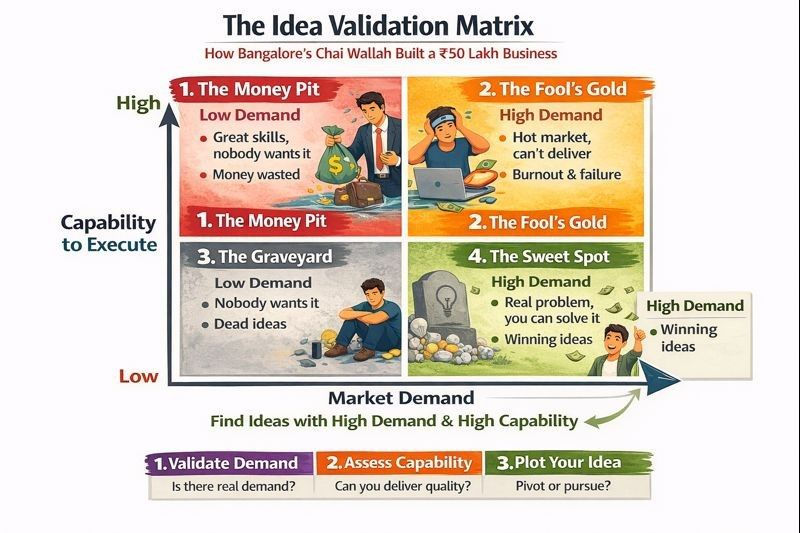
The Idea Validation Matrix isn't some fancy MBA framework gathering dust in a textbook. It's a practical filter that helps you separate golden opportunities from gold-plated disasters. Imagine a simple 2×2 grid:
Horizontal axis: Market Demand (Low to High)
Vertical axis: Your Capability to Execute (Low to High)
This creates four quadrants, and understanding which one your idea falls into can save you years of wasted effort and lakhs of rupees.
Quadrant 1: The Money Pit (Low Demand, High Capability)
Remember when Kingfisher Airlines decided to launch Kingfisher Water? Vijay Mallya had the resources, the brand, and the distribution network. Everything except one crucial thing: nobody was asking for premium airline-branded water. This is the quadrant where ego lives. You're good at something, so you assume people want it. But skill without demand is just an expensive hobby. Ramesh almost fell into this trap. He was amazing at making tea. He could have introduced fifteen varieties of artisanal chai. But here's what his actual validation revealed: his location was surrounded by tech offices where 60% of workers preferred cold beverages in Bangalore's heat.
Warning signs you're in the Money Pit:
You're more excited about the idea than anyone you pitch it to
Your validation consists mainly of friends saying "sounds interesting"
You find yourself explaining why people should want this
Quadrant 2: The Fool's Gold (High Demand, Low Capability)
In 2020, during the first lockdown, everyone wanted to start something online. Suresh from Pune saw the exploding demand for online fitness classes. He'd gone to the gym for three months in 2019. Good enough, right? Six weeks later, his Instagram fitness page had 47 followers (12 were family members), and he'd given up. High demand means nothing if you can't deliver at the level the market expects. This quadrant is littered with "I could do that" casualties who discovered that wanting to do something and being capable of doing it well are universes apart.
The brutal questions for this quadrant:
Can you be in the top 20% of providers within 6 months?
Do you have access to resources/skills that are genuine barriers to entry?
Are you willing to put in 10x more work than you initially estimated?
If you answered no to any of these, you're staring at Fool's Gold.
Quadrant 3: The Graveyard (Low Demand, Low Capability)
This is where ideas go to die quietly. You neither have the skills nor is anyone asking for what you're planning to offer. Picture this: Rajesh from Jaipur decides to start a blog about typewriter repair techniques. He doesn't own a typewriter, has never repaired one, and the last time someone searched "typewriter repair near me" in Jaipur was probably 2003. The only thing this quadrant is good for is learning humility. Most people don't intentionally aim for this quadrant—they drift into it through wishful thinking and poor validation. "If I build it, they will come" is not a strategy; it's a prayer.
Quadrant 4: The Sweet Spot (High Demand, High Capability)
Back to Ramesh's tea stall. After that third customer asked for cold coffee, Ramesh didn't just add it to his menu. He spent two weeks doing something unsexy but crucial: validation.
He counted footfall. He surveyed 100 customers about their actual beverage preferences throughout the day. He researched competitor pricing. He tested his capability by making sample batches and getting honest feedback. Here's what he discovered:
65% of his afternoon customers wanted cold beverages
Nobody was doing fresh fruit-based coolers in his area
He already had the blender and fruit connections from his morning juice side-hustle.
The demand was there. His capability was there. He just needed to connect the dots.
Within three months of introducing fresh fruit coolers (not cold coffee—the market research revealed a gap), Ramesh's afternoon sales jumped 180%. He wasn't competing with the nearby Café Coffee Day anymore; he'd found his own lane.
How to actually use the matrix
Step 1: Demand Validation (Be brutally honest)
Don't ask people "Would you buy this?" They'll lie to be nice. Instead:
Search Google Trends for related keywords (Are searches increasing or flattering?)
Check if competitors exist and are thriving (Competition means demand)
Look for people actively complaining about current solutions
Count how many transactions are already happening in this space
When Nykaa's Falguni Nayar validated the online beauty market in 2012, she didn't just trust her instinct. She saw Indian women spending hours in offline stores, struggling with limited options. She saw the rising searches for international beauty brands. She saw frustrated Amazon reviews for beauty products. The demand was screaming; she just needed to listen.
Step 2: Capability Assessment (Drop the delusion)
This is where founders lie to themselves most. Ask:
Can you deliver at market-standard quality right now? (Not after you "learn quickly")
Do you have the time, money, and energy for the next 12 months minimum?
What's your unfair advantage? (If you can't name one, you probably don't have one)
Zerodha's Nithin Kamath didn't wake up one day and decide to disrupt brokerage. He'd worked in trading for 15+ years. He understood the pain points intimately. He had the technical capability to build the platform. His capability wasn't aspirational—it was proven.
Step 3: Plot and Pivot
Once you've honestly assessed both axes, plot your idea on the matrix. Then:
If you're in the Sweet Spot: Move fast, but validate in small steps
If you're in the Money Pit: Either find the hidden demand or abandon it
If you're in Fool's Gold: Acquire capabilities first, or partner with someone who has them
If you're in the Graveyard: Pivot completely or walk away
The validation techniques nobody talks about
The ₹100 Test: Before building anything, try to get 10 people to pay you ₹100 for the promise of your product/service. Not friends. Not family. Real potential customers. If you can't get 10 people to part with ₹100, you probably can't get 10,000 people to part with anything.
The Competitor Customer Interview: Find 20 people using competitor products. Ask them what frustrates them. Don't pitch your idea—just listen. If you hear the same pain point 15+ times, you've found validated demand.
The 30-Day Content Test: Create content around your idea for 30 days. Write posts, make videos, share insights. If nobody engages, saves, or shares after 30 days of consistent effort, the demand is weaker than you think. Kunal Shah didn't just launch CRED. He built a massive Twitter following first by sharing insights about consumer behavior and credit cards. He validated that people cared about this space before asking them to download an app.
Real reason Ramesh succeeded
Six months after his menu expansion, I met Ramesh at his now-bustling stall. His success wasn't just about the fruit coolers. It was about his mindset shift. "Pehle main sochta tha ki main kya achha banata hoon," he told me (Earlier, I used to think about what I make well). "Ab main sochta hoon ki customer kya chahta hai, aur kya main woh de sakta hoon" (Now I think about what the customer wants, and whether I can deliver it). That's the Idea Validation Matrix in one sentence.
Your move: Find the Truth Behind Your Idea
Pull out that idea that's been rattling around in your head. The one you keep telling yourself you'll start "soon." Get honest with yourself:
Is there real, measurable demand, or just your enthusiasm?
Can you deliver at a level that matters, or are you just hoping to figure it out?
Plot it on the matrix. Be brutal. Be honest. Because the market doesn't care about your passion. It doesn't care about your effort. It only cares about whether you're solving a real problem for people who actually want it solved.The Sweet Spot isn't where your dreams live. It's where your capabilities meet someone else's urgent need. Find that intersection, and you won't need to convince anyone of anything. They'll be convincing you to take their money. Just ask Ramesh. He's opening his second location next month. What idea have you been sitting on? More importantly—which quadrant does it really belong to? Drop a comment below. Sometimes the hardest truths come from people who aren't invested in protecting your feelings.


Comments