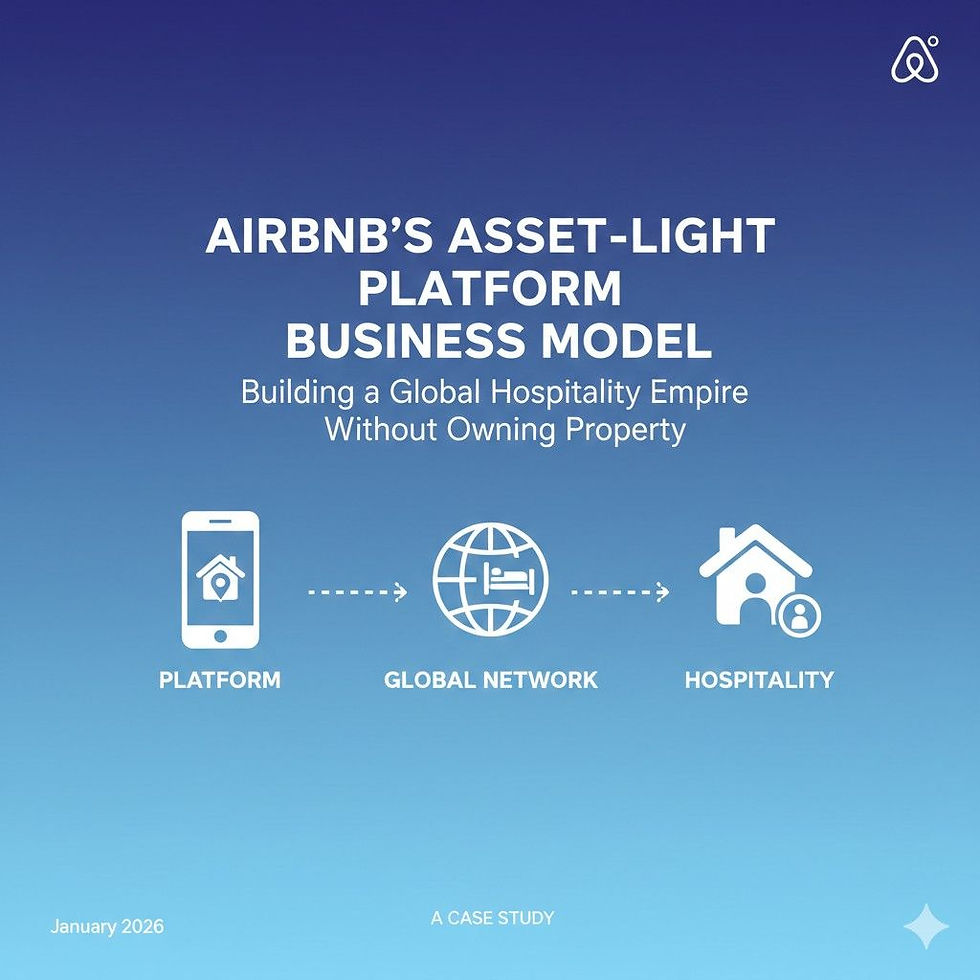
Airbnb's Asset-Light Platform Business Model: Building a Global Hospitality Empire Without Owning Property
Executive Summary
Airbnb represents one of the most significant disruptions in the global hospitality industry, having built a multibillion-dollar business without owning a single hotel room or property. Founded in 2008 by Brian Chesky, Joe Gebbia, and Nathan Blecharczyk, the company pioneered the peer-to-peer accommodation marketplace model, fundamentally challenging traditional hotel chains by enabling homeowners to monetize their spare rooms and properties. By operating as a pure platform connecting hosts with guests, Airbnb demonstrated how technology could unlock dormant supply in the accommodation sector while creating an entirely new category of travel experiences. The company's asset-light model allowed rapid global expansion, reaching over 220 countries and regions, though it also exposed vulnerabilities during crises like the COVID-19 pandemic when transaction volumes collapsed.
Industry Context and Market Opportunity
The global hospitality industry before Airbnb's emergence was dominated by traditional hotel chains and small bed-and-breakfast establishments. According to the company's 2020 SEC filing ahead of its initial public offering, the founders identified a significant market inefficiency: millions of people had spare rooms or properties that sat empty while travelers faced limited accommodation options, particularly in cities with constrained hotel supply or during peak events when hotels were fully booked. The company's S-1 filing with the Securities and Exchange Commission stated that Airbnb was founded on the belief that "people can belong anywhere and that travel should be accessible, authentic, and affordable." This positioning directly challenged the standardized, often expensive hotel experience with a promise of unique, local stays at various price points. The timing proved fortuitous. As reported by TechCrunch in multiple articles covering the company's early years, Airbnb's launch coincided with several enabling factors: the 2008 financial crisis created economic pressure on homeowners seeking additional income; smartphone adoption was accelerating, making mobile booking accessible; and social media was normalizing online trust and sharing economy concepts, as evidenced by the concurrent rise of platforms like Uber and TaskRabbit.
The Asset-Light Business Model: Core Mechanics
Airbnb's fundamental business model innovation was constructing a two-sided marketplace without holding inventory. Unlike Marriott, Hilton, or other hotel operators that own or lease properties and employ staff to manage them, Airbnb functions purely as an intermediary platform. The company's 2020 prospectus detailed this structure: hosts list their properties on Airbnb's platform, set their own prices and availability, and manage guest interactions, while Airbnb provides the technology infrastructure, payment processing, insurance coverage, customer support, and trust mechanisms. According to the company's public filings, Airbnb's revenue model is commission-based. As reported in its S-1 document, Airbnb typically charges guests a service fee ranging from 5% to 15% of the booking subtotal, and charges hosts a service fee of approximately 3% per booking. This commission structure means Airbnb's revenue scales directly with booking volume and value, without corresponding increases in property-related fixed costs like maintenance, utilities, or property management labor. The capital efficiency advantages were significant. As Brian Chesky explained in a December 2020 interview with The New York Times' DealBook Summit, traditional hotel companies must invest hundreds of millions or billions of dollars to build or acquire properties before generating their first dollar of revenue. In contrast, Airbnb's primary capital requirements were technology development and marketing to attract both hosts and guests to the platform—a fundamentally different cost structure. This model created several strategic advantages. First, scalability: Airbnb could enter new markets without building physical infrastructure. As reported by Reuters in November 2020, by the time of its IPO, Airbnb had approximately 7 million listings globally, a number that would have required potentially hundreds of billions of dollars in real estate investment if owned directly. Second, variety: the platform offered everything from private rooms to entire homes, luxury villas, and unique properties like treehouses and castles, providing accommodation diversity no single hotel chain could match. Third, local presence: hosts provided localized knowledge and authentic experiences that standardized hotels struggled to replicate.
Strategic Growth Phases
Phase 1: Initial Traction and Product-Market Fit (2008-2011)
Airbnb's origin story has been extensively documented in business media. According to multiple accounts, including a detailed Harvard Business School case study from 2014, the company began when founders Brian Chesky and Joe Gebbia, struggling to pay rent in San Francisco, rented out air mattresses in their apartment during a 2008 design conference when hotels were fully booked. They created a simple website called "Air Bed & Breakfast" and successfully hosted three guests. The founders recognized this could address a broader market need. As reported by Forbes in a 2011 profile, they joined the Y Combinator startup accelerator in early 2009, which provided seed funding and mentorship. However, early growth proved challenging. In interviews documented by Fast Company, Chesky noted that the company was struggling with low booking volumes and needed creative approaches to gain traction. One early strategic decision, as reported by TechCrunch in 2009, was the founders personally visiting hosts in New York to improve listing quality. They discovered that poor-quality photographs were deterring bookings, so they began offering professional photography services to hosts—an investment that improved listing appeal and conversion. This insight about supply quality would become a recurring theme in Airbnb's platform management strategy. The company also focused on specific high-demand events where hotel capacity was constrained. According to The Wall Street Journal's coverage from 2011, Airbnb strategically targeted cities during major events like South by Southwest in Austin and political conventions, where accommodation shortages made the value proposition obvious to travelers.
Phase 2: International Expansion and Trust-Building (2011-2015)
Airbnb, after gaining traction in the U.S., pursued international expansion by acquiring European competitors like Accoleo, providing immediate market presence and local expertise. This acquisition strategy accelerated European growth but also highlighted trust and safety challenges. In a notable incident, a San Francisco host's property was vandalized, threatening Airbnb's core promise of safe home-sharing. CEO Brian Chesky responded by introducing a $50,000 guarantee for host damages, later expanded to the "Host Guarantee" program covering up to $1 million. Airbnb also improved verification, secure payment systems, and a two-way review system, enhancing platform credibility. Regulatory challenges arose as cities like New York and San Francisco claimed Airbnb facilitated illegal hotel operations and worsened housing shortages. New York's Attorney General subpoenaed host data in 2014, citing violations of short-term rental laws.
Phase 3: Product Diversification and Experience Expansion (2016-2019)
By 2016, Airbnb was the leading peer-to-peer accommodation platform globally, facing competition from hotel chains and platforms like HomeAway and Booking.com. To diversify, Airbnb launched "Trips" in November 2016, offering local experiences such as cooking classes and tours. CEO Brian Chesky explained this expanded Airbnb's focus from accommodation to all travel activities, aiming to capture more traveler spending and time. Airbnb introduced "Airbnb Plus" in February 2018, featuring high-quality homes with in-person inspections, addressing concerns over inconsistent listing quality. "Airbnb for Work" targeted business travelers, tapping into a lucrative market segment traditionally dominated by hotels.
The COVID-19 Crisis: Stress-Testing the Asset-Light Model
The COVID-19 pandemic in early 2020 severely impacted Airbnb, with a 67% revenue decline in Q2 2020 and a liquidity crisis, leading to $2 billion in debt financing. In May 2020, Airbnb laid off 1,900 employees (25% of its workforce) to cut costs. However, its asset-light model allowed flexibility compared to hotel competitors with fixed costs. The pandemic shifted travel preferences to isolated, unique properties, aligning with Airbnb's offerings. Domestic bookings rebounded in Q3 2020, declining only 20% year-over-year. The crisis accelerated trends like remote work, enabling longer stays. Airbnb promoted monthly stays and remote work-friendly properties.
The Initial Public Offering: Market Validation
In December 2020, Airbnb's IPO was a success, with shares priced at $68 and surging 113% on the first day, valuing the company at $100 billion. This validated Airbnb's model despite pandemic challenges. Investors believed Airbnb would remain the dominant marketplace post-pandemic, benefiting from shifts toward unique properties and longer stays. Brian Chesky envisioned Airbnb as synonymous with travel, aiming to expand into comprehensive travel services.
Competitive Advantages and Strategic Moats
Airbnb's asset-light model created several competitive advantages that became more apparent over time, as analyzed in multiple Harvard Business School and Stanford Graduate School of Business case studies:
Network Effects: As reported in business strategy analyses published by Harvard Business Review, Airbnb benefited from powerful two-sided network effects. More hosts attracted more guests due to greater selection, while more guests attracted more hosts due to higher earning potential. This created a self-reinforcing cycle making it difficult for competitors to achieve comparable scale. By the time of its IPO, Airbnb's SEC filings showed approximately 4 million hosts and over 1 billion cumulative guest arrivals since founding—a network advantage built over years that competitors could not easily replicate.
Brand Recognition: Airbnb became synonymous with home-sharing and alternative accommodations. As documented in multiple marketing case studies, the brand achieved global recognition without the decades of advertising investment traditional hotel chains required. A 2019 study cited in the company's investor presentations showed Airbnb had over 90% brand awareness among U.S. travelers, comparable to major hotel brands that had existed for 50-100 years.
Supply Diversity: The variety of accommodation types on Airbnb—from budget rooms to luxury estates, urban apartments to remote cabins—was unmatched. As Chesky noted in various investor presentations and media interviews, this inventory diversity would be impossible for any hotel company to replicate through owned assets. The platform's 7 million listings covered price points, property types, and locations far beyond traditional hospitality supply.
Technology Platform: Airbnb's proprietary technology for search, booking, payments, messaging, reviews, and dynamic pricing represented years of development investment. As discussed in technology industry analyses by publications like The Information and TechCrunch, the platform's sophistication in matching travelers with relevant properties, facilitating secure transactions, and managing trust created barriers to entry for potential competitors.
Persistent Challenges and Model Limitations
Despite its success, Airbnb's asset-light model also revealed limitations and ongoing challenges documented in business media and regulatory proceedings:
Quality Control: Unlike hotels with standardized operating procedures and brand standards, Airbnb properties varied wildly in quality, cleanliness, and amenities. As reported by consumer publications including Consumer Reports and The Wall Street Journal through the 2010s, guests sometimes encountered properties that did not match listing descriptions, creating dissatisfaction. While Airbnb implemented verification programs and quality tiers, the decentralized nature of supply made consistent quality assurance difficult.
Regulatory Uncertainty: The asset-light model's regulatory treatment remained ambiguous. As extensively reported by The New York Times, Bloomberg, and local media outlets worldwide, cities debated whether Airbnb should be regulated like hotels, subject to hotel taxes, zoning restrictions, and safety inspections. Some jurisdictions, including Barcelona, Paris, and Tokyo, implemented strict regulations limiting short-term rentals, as documented by Reuters and local news sources. These regulatory constraints could potentially limit supply growth in key markets.
Housing Market Impact: Critics argued, as reported in academic research and media investigations by The Guardian, ProPublica, and local newspapers, that Airbnb removed housing units from residential markets as landlords found short-term rentals more profitable than long-term leases. Studies in cities including New York, San Francisco, and Barcelona suggested this contributed to housing affordability challenges, creating political backlash. Airbnb disputed these claims, but the perception created regulatory risk.
Lack of Direct Control: Because Airbnb did not own or directly operate properties, it had limited ability to ensure host compliance with platform policies, local laws, or guest expectations. High-profile incidents, including unauthorized parties, discriminatory treatment of guests, and safety issues, periodically emerged in media reports from outlets including Vice News, BuzzFeed, and Bloomberg Businessweek. While rare relative to total bookings, these incidents highlighted the challenge of governing a decentralized network of independent hosts.
Dependence on Trust: The entire model required strangers to trust staying in each other's homes and trust the platform to facilitate safe, reliable transactions. Any erosion of this trust—through safety incidents, data breaches, or fraudulent activity—could undermine the platform's value proposition. As cybersecurity experts noted in interviews with CNBC and The Wall Street Journal, Airbnb's platform security was mission-critical in ways that physical hotel room keys were not.
Strategic Implications and Lessons
Airbnb's asset-light platform model offers several strategic lessons applicable beyond hospitality, as analyzed in business school case studies and strategy research:
Unlocking Latent Supply: The company demonstrated that massive value could be created by connecting underutilized assets with unmet demand. Before Airbnb, spare rooms represented dormant, unmonetized assets. The platform created a marketplace that activated this supply at scale. This principle has been applied in other industries—ride-sharing, co-working spaces, equipment rental—suggesting opportunities exist wherever asset utilization is low.
Capital Efficiency Enables Rapid Scaling: By avoiding capital-intensive property ownership, Airbnb scaled globally far faster than traditional competitors could. The company's market capitalization at IPO (approximately $100 billion) exceeded most traditional hotel chains despite operating for only 12 years, as noted by financial analysts at Morgan Stanley and Goldman Sachs in research reports. This demonstrated how platform models could create enormous value with relatively modest capital investment focused on technology and marketing rather than physical assets.
Platform Governance Is Critical: Managing a two-sided marketplace of independent actors required sophisticated governance mechanisms. Airbnb's investments in trust and safety—including verification, insurance, secure payments, and review systems—were essential to platform viability. As business model researchers at MIT and Stanford noted in published analyses, platforms must invest continuously in governance to prevent market failure from adverse selection or moral hazard.
Regulatory Strategy Is Strategic: For asset-light disruptors, regulatory relationships are not peripheral issues but central strategic challenges. Airbnb's mixed success navigating city-level regulations worldwide demonstrated that platform companies entering regulated industries must invest in policy advocacy, local partnerships, and compliance systems. The company's approach evolved from initial regulatory confrontation toward more collaborative engagement with cities, as documented in policy research by the Brookings Institution and academic studies of platform regulation.
Crisis Vulnerability vs. Resilience: The COVID-19 pandemic revealed both vulnerability and resilience in asset-light models. Transaction-based revenue models suffered severe shocks when activity collapsed, creating short-term existential risk. However, the absence of fixed asset obligations provided flexibility to cut costs and pivot strategy more readily than asset-heavy competitors. This suggested asset-light models faced higher revenue volatility but potentially greater long-term adaptability.
Conclusion
Airbnb's asset-light platform business model disrupted the global hospitality industry by proving a company could dominate accommodation without owning hotels or employing staff. By connecting property owners with travelers, Airbnb created a scalable business operating in over 220 countries, with a market valuation surpassing traditional hotel chains. The model's success relied on unlocking underutilized residential properties, developing technology for matching supply and demand, building trust for transactions between strangers, and establishing network effects. These elements created a new travel category and showcased platform business models' ability to disrupt traditional industries. However, the model faced challenges like quality control across decentralized supply, regulatory uncertainty, political backlash from urban housing impacts, and revenue volatility during crises like COVID-19. Airbnb's future involves leveraging its platform while addressing quality, regulation, and community impact concerns. Its shift toward a comprehensive travel platform, including experiences and long-term stays, aims to deepen engagement and diversify revenue. Whether asset-light platforms can maintain dominance amid regulation and competition is a strategic question for Airbnb and the platform economy.
Discussion Questions for MBA-Level Analysis
Platform Governance and Quality Assurance: Airbnb's asset-light model creates tension between platform scalability and service quality consistency. How should platform businesses balance the benefits of decentralized supply (variety, capital efficiency, rapid growth) against the challenges of quality control and brand consistency? What governance mechanisms and incentive structures could Airbnb implement to improve property quality without sacrificing the fundamental benefits of its asset-light approach?
Regulatory Strategy for Disruptive Platforms: Airbnb's relationship with municipal regulators has been contentious, with some cities implementing restrictive regulations while others embraced the platform. Evaluate Airbnb's regulatory strategy evolution from initial confrontation toward collaborative engagement. What factors determine whether disruptive platforms should pursue aggressive market entry despite regulatory uncertainty versus preemptive partnership with regulators? How does this trade-off vary across different regulatory contexts and stages of platform maturity?


Comments