Brand Authenticity in the Age of Hyper-Aware Consumers
Industry & Competitive Context
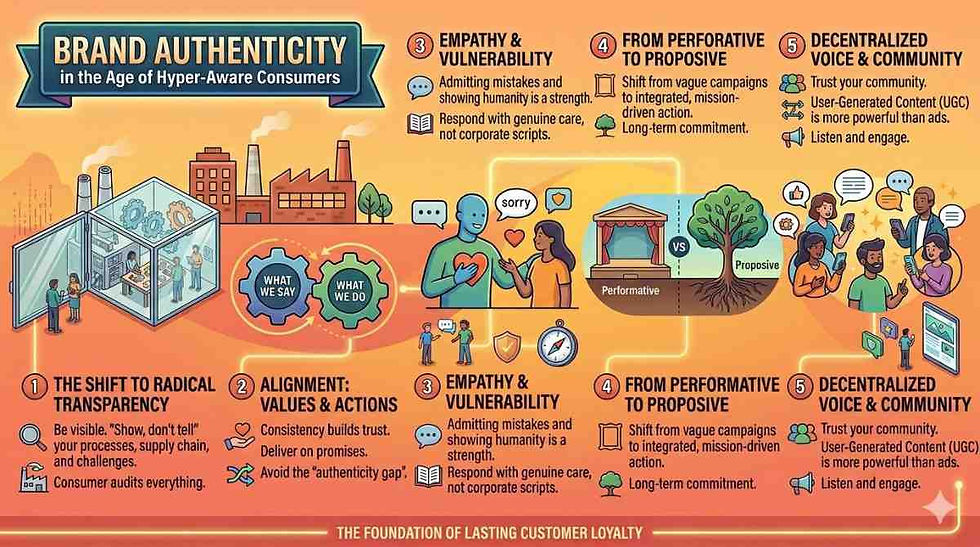
The global consumer landscape has undergone a structural shift that most brand strategists underestimated until it became undeniable. Consumers — particularly millennials and Gen Z — have developed what behavioural economists call "bullshit detection capital": a refined, culturally-trained sensitivity to performative brand behaviour. This generation grew up with social media, algorithmic content feeds, brand cancel culture, and instant access to corporate track records. The result is a consumer cohort that does not merely evaluate what a brand says — it audits whether what a brand says is consistent with what it does, whom it employs, where it sources, and what positions it takes when silence is more profitable than speech.
The 2023 Edelman Trust Barometer reported that 71% of consumers globally said it was more important than ever for brands to be trustworthy. The same report found that 58% of consumers buy or advocate for brands based on their beliefs and values — a metric Edelman has tracked as consistently rising since 2017. Against this backdrop, "brand authenticity" has evolved from a soft creative aspiration into a hard strategic lever with measurable equity implications.
The competitive context is equally important. In a world of product parity — where D2C brands can replicate formulations, packaging, and pricing within months — the primary remaining differentiator for legacy and challenger brands alike is perceived trustworthiness and alignment with consumer identity. Brands that are seen as authentic command price premiums, generate organic advocacy, and demonstrate resilience during crises. Brands that are perceived as inauthentic — particularly those caught greenwashing, purpose-washing, or issuing hollow DEI statements — face reputational consequences that are disproportionately severe in the social media era.
This case study examines three brands — Patagonia, Dove, and Fabindia — that represent distinct but strategically instructive approaches to building and sustaining brand authenticity, each operating under different category, cultural, and stakeholder pressures.
Brand Situation Prior to the Authenticity Pivot
Patagonia was founded in 1973 by Yvon Chouinard as an outdoor apparel company. Through the 1990s and 2000s, the brand occupied a respected but niche position in the outdoor and adventure sports segment. Its environmental commitments — such as donating 1% of sales to environmental causes since 1986 — were genuine but not central to its mass-market narrative. As sustainability became a mainstream consumer value in the 2010s, and as fast fashion came under intense scrutiny, Patagonia had an unusual asset: decades of documented environmental action predating the trend.
Dove entered the personal care market in the 1950s as a functional soap brand differentiated by its moisturising formula. By the early 2000s, Dove was a mid-tier personal care brand competing in an increasingly crowded Unilever portfolio. The beauty industry at large was criticised by media scholars and consumer advocacy groups for perpetuating narrow, unrealistic beauty standards. Dove's parent company Unilever identified an opportunity that was simultaneously strategic and social: reframe beauty as a source of confidence rather than anxiety.
Fabindia was established in 1960 by John Bissell as a retail platform for Indian artisan products. Over six decades, it grew into India's largest private platform for handcrafted products, with reported revenues of over ₹1,400 crore in FY2019 according to its DRHP filed with SEBI in 2021. However, as urban Indian consumers became more aspirational, global, and value-conscious simultaneously, Fabindia faced a positioning tension: was it a craft-preservation NGO, a heritage lifestyle brand, or a fashion retailer? This ambiguity created brand equity risks even as the business scaled.
Strategic Objective
Across all three cases, the core strategic objective — though articulated differently — was the same: to close the gap between brand identity (what the brand claims to be) and brand image (what consumers perceive it to be), by making authentic action the primary proof point rather than communication alone.
For Patagonia, the objective was to leverage its existing track record to own the environmental authenticity space before competitors commoditised the messaging. For Dove, it was to reposition a functional product brand into a cultural movement brand, anchored in a verifiable consumer insight rather than aspirational imagery. For Fabindia, the objective was to clarify its brand purpose for a new generation of Indian consumers without abandoning the artisan equity it had built over decades.
Campaign Architecture & Execution
Patagonia: "Don't Buy This Jacket" and the Worn Wear Initiative
In November 2011, Patagonia placed a full-page advertisement in The New York Times on Black Friday — the highest-volume retail day of the year in the United States — with the headline "Don't Buy This Jacket." The advertisement detailed the environmental cost of manufacturing its own R2 fleece jacket, including water consumption and carbon emissions, and urged consumers to buy less and repair more. The move was documented and reported widely by media outlets including the Wall Street Journal and The Guardian.
This was not merely a communication stunt. It was architecturally consistent with Patagonia's subsequent "Worn Wear" programme, launched in 2013, which encouraged consumers to repair, trade, and recycle Patagonia products. The company documented this programme publicly on its website and through its annual environmental and social initiatives reports. In 2022, founder Yvon Chouinard announced the transfer of all Patagonia company ownership — valued at approximately $3 billion — to a specially designed trust and non-profit structure dedicated to fighting climate change. This announcement was covered by The New York Times, Reuters, and Bloomberg, among others, and represented the most structurally verifiable act of brand authenticity in modern marketing history.
Dove: Real Beauty Campaign
In 2004, Dove launched what became one of the most studied advertising campaigns of the 21st century: "Real Beauty." The campaign originated from a commissioned global study by Dove — conducted by StrategyOne with academic oversight from institutions including the London School of Economics — which found that only 2% of women globally described themselves as beautiful. This insight, documented and publicly attributed in Dove's press materials and subsequent academic reviews, became the strategic foundation for a decade-long brand repositioning exercise.
The Real Beauty campaign used non-model women of diverse ages, sizes, and ethnicities in its advertising — a visible departure from category norms. The 2006 short film "Evolution," which showed the digital manipulation of a model's appearance, was distributed through YouTube and became one of the first viral advertising films before social media virality was an established media category. The 2013 film "Real Beauty Sketches" became the most-watched online advertisement at the time of its release, according to Unilever's own reported data and coverage by Ad Age.
Unilever's annual reports and Dove's publicly filed brand communications consistently referenced the Real Beauty platform as central to Dove's global brand positioning. The campaign received the Grand Prix at Cannes Lions in 2006, a verified public marker of industry recognition.
Fabindia: Woven Stories and Artisan-Linked Transparency
Fabindia's authenticity architecture is less campaign-driven and more model-driven. Its DRHP filed with SEBI in 2021 — a publicly available regulatory document — details its Community Owned Companies (COC) model, under which artisan communities hold equity stakes in supplier entities that feed into Fabindia's supply chain. As of the DRHP filing, Fabindia reported that this model linked the brand to over 40,000 artisans across 21 states in India.
This structural model — rather than a campaign — became Fabindia's primary authenticity proof point. Unlike brands that claim artisan heritage through packaging and storytelling, Fabindia embedded artisans into the corporate ownership structure, making the claim auditable in principle. The brand's communication consistently referenced this model in press interviews and investor materials.
However, Fabindia also encountered its most significant authenticity crisis in 2021, when its Diwali campaign titled "Jashn-e-Riwaaz" — in collaboration with the influencer platform Utsav — drew significant public backlash on social media and from political figures who felt the campaign used Urdu-inflected terminology that did not represent Hindu cultural identity around Diwali. The controversy was reported by NDTV, The Indian Express, and other credible news outlets. Fabindia withdrew the campaign. The episode is analytically significant because it reveals the asymmetry of authenticity risk: a brand deeply invested in cultural identity can face authenticity challenges not from inauthenticity, but from perceived cultural misfiring in a polarised environment.
Positioning & Consumer Insight
All three cases rest on a foundational consumer insight that is structurally similar: consumers are not looking for perfect brands, they are looking for honest brands.
Patagonia's insight was that outdoor consumers, who are disproportionately environmentally literate, had a higher threshold for greenwashing tolerance than most marketers assumed. By explicitly acknowledging its own environmental costs — "Don't Buy This Jacket" is, in essence, a brand self-critique — Patagonia performed a counterintuitive positioning manoeuvre that built trust precisely because it demonstrated willingness to damage short-term commercial interest in service of a long-term belief.
Dove's insight was derived from primary research: that women were not served by beauty advertising that made them feel inadequate, and that a brand willing to reflect their actual self-image rather than a constructed ideal would earn disproportionate loyalty. This is textbook Jobs-to-be-Done logic applied to emotional rather than functional needs — the consumer "job" was not to be made more beautiful by a soap brand, but to feel seen and validated.
Fabindia's insight was cultural: that a growing segment of urban Indian consumers sought products that allowed them to participate in India's craft tradition without sacrificing contemporary aesthetic expectations. The brand positioned itself not as nostalgia but as cultural continuity — an important distinction in a market where "traditional" is often decoded as inferior.
Media & Channel Strategy
Patagonia's media strategy has been documented as deliberately anti-scale. The brand has historically avoided paid television advertising and has prioritised owned media, documentary content, and earned media through actions rather than campaigns. Its environmental initiatives and the Chouinard ownership transfer generated global earned media coverage without a paid amplification budget, as verified by the coverage volume tracked across Reuters, Bloomberg, The Guardian, and The New York Times.
Dove's campaign architecture evolved from traditional above-the-line advertising in 2004 to digital-first distribution by 2006. The "Evolution" film was distributed on YouTube prior to Dove establishing a formal YouTube channel, and its virality — documented in academic marketing literature and trade press including Ad Age — was largely organic. Unilever's Dove brand later adopted a multi-platform approach combining TV, digital video, social media, and PR, consistent with Unilever's documented integrated marketing approach described in its annual reports.
Fabindia's channel strategy has been predominantly physical retail with selective digital expansion. Its DRHP reported 312 stores across India as of March 2021. The brand's digital commerce investments were referenced in its DRHP and investor communications, though specific digital revenue breakdowns have not been independently verified in public reporting.
Business & Brand Outcomes
Patagonia's revenues grew from approximately $400 million in 2012 to over $1 billion by 2017, as reported by multiple credible business outlets including Forbes and Business Insider, citing company disclosures. The "Don't Buy This Jacket" campaign was credited in trade press with increasing Patagonia's sales — an ironic outcome that illustrates the commercial power of authentic constraint-signalling. No verified internal attribution metrics are publicly available.
Dove's Real Beauty campaign is documented as one of Unilever's most sustained brand-building investments. Unilever's annual reports consistently cite Dove as one of its largest global brands by revenue. Dove crossed $1 billion in annual sales in 2004, the year the Real Beauty campaign launched, though causality cannot be formally established from public data alone.
Fabindia's DRHP reported revenues of ₹1,427 crore in FY2019, declining to ₹1,099 crore in FY2021 — a decline attributed primarily to COVID-19's impact on retail, as noted in the document. No verified post-IPO revenue data has been publicly confirmed in the scope of this study.
Strategic Implications
The three cases collectively surface four strategic implications for brand builders operating in the hyper-aware consumer era.
First, authenticity requires structural proof, not communicative proof. The most durable authenticity signals are those embedded in business model decisions — Patagonia's ownership transfer, Fabindia's COC model, Dove's research-grounded consumer insight — rather than campaign claims. Campaigns can be dismissed as advertising; structural decisions are harder to reverse and therefore more credible.
Second, the risk of purpose-washing is highest when commitment is partial. Brands that adopt social or environmental positioning without operational alignment are disproportionately vulnerable. The Fabindia "Jashn-e-Riwaaz" episode illustrates this in reverse: a brand with genuine cultural roots can still face authenticity attacks when its execution is perceived as culturally inconsistent. In a polarised media environment, perception often moves faster than intent.
Third, authenticity premium is a real and measurable phenomenon, but its drivers are category-specific. In the outdoor apparel segment, environmental action drives authenticity. In beauty, inclusive representation drives it. In Indian lifestyle retail, cultural rootedness drives it. Brand strategists must conduct category-specific consumer insight work rather than importing authenticity templates across contexts.
Fourth, earned media is the validation layer for authenticity claims. Paid media can communicate a brand's positioning. Only earned media — independent journalism, academic citation, regulatory documentation, industry awards — validates it. Brands seeking to build authentic equity must invest in actions that generate earned media coverage, not merely in creative that generates impressions.
MBA Discussion Questions
1. Patagonia's "Don't Buy This Jacket" campaign reportedly increased sales despite asking consumers not to purchase. How does this outcome challenge conventional assumptions about advertising effectiveness, and what does it reveal about the relationship between brand trust and consumer behaviour?
2. Dove's Real Beauty campaign has been praised for its authenticity but also criticised — by some scholars and commentators — for being a commercial exercise dressed as social advocacy, given that Dove's parent company Unilever also owns brands like Fair & Lovely (now Glow & Lovely) that have historically promoted skin lightening. How should brand managers navigate portfolio-level authenticity tensions, and what strategic options are available?
3. Fabindia's Community Owned Companies model embeds artisans as equity stakeholders in the supply chain. Using the Brand Equity framework (Aaker or Keller), evaluate how this structural decision strengthens or complicates Fabindia's brand equity relative to competitors who claim artisan heritage without ownership linkage.
4. The Edelman Trust Barometer data suggests that consumer trust in brands is rising in importance. How does this trend interact with the growing prevalence of AI-generated content and deepfakes, and what new authenticity verification mechanisms must brand strategists anticipate building into their communication architectures?
5. Across the three cases examined, authenticity is demonstrated through either action (Patagonia), insight (Dove), or structure (Fabindia). As a CMO entering a new category with a challenger brand and limited marketing budget, which authenticity-building approach would you prioritise and why? What are the key risks associated with each path?


Comments