Country Delight: Engineering Trust as a Brand Strategy in India's Dairy Market
- 49 minutes ago
- 11 min read
Executive Summary
Country Delight is a Gurugram-based direct-to-consumer (D2C) food essentials brand founded in 2015 by IIM Indore alumni Chakradhar Gade and Nitin Kaushal. The company built its market position not through conventional FMCG advertising or price competition, but by converting supply chain transparency into a brand asset — making the absence of adulteration its primary product promise. This case examines how Country Delight used a full-stack, farm-to-doorstep operating model, a subscription-led revenue architecture, and proof-based marketing to create a differentiated brand in a market long dominated by cooperative giants. By FY24, the company reported revenues of ₹1,380 crore — a 46% year-on-year increase — and had raised a cumulative $221 million across 20 funding rounds, reaching a reported valuation of approximately $820 million.
Industry & Competitive Context
India is the world's largest producer and consumer of milk, with the dairy sector valued at approximately USD 18 billion and growing at 7–8% annually at the time of Country Delight's formative growth phase. Despite this scale, the supply chain has historically been highly fragmented, comprising cooperative institutions (primarily Amul and Mother Dairy), private dairy processors, and a vast unorganized sector of local vendors and informal "milkmen."
The structural tension in this market is well-documented. Cooperative brands like Amul command enormous trust and retail reach, but their supply chains involve multiple intermediaries, long transit times, and high-temperature processing (UHT), which consumers associate with reduced freshness. At the other extreme, local informal vendors offer perceived freshness but are associated with adulteration risks. A study by the Food Safety and Standards Authority of India (FSSAI) found that a significant proportion of loose milk sold in India did not conform to prescribed quality standards — a finding that received credible media coverage and contributed to a documented trust deficit among urban consumers. This structural gap — between the reliability of organized brands and the freshness of informal channels — created the market space that Country Delight entered. The company's founding thesis was that urban, middle-to-upper-income consumers would pay a premium for a product that delivered both attributes: traceable freshness and verifiable purity. The competitive set Country Delight faced includes: Amul and Mother Dairy (cooperative, mass-market, wide retail distribution); Akshayakalpa Organic and Sid's Farm (premium organic/natural dairy, limited geography); Milk basket and Otipy (last-mile grocery delivery platforms); and, more recently, quick commerce platforms like Blinkit and Zepto that offer on-demand dairy delivery without origin-traceability as a core proposition.
Brand Situation Prior to Strategy Formulation
Country Delight officially launched in 2015, though the founders' exploration of the dairy market began earlier. According to publicly available accounts, Gade and Kaushal had attempted to start a cattle-farming operation in Delhi around 2011 with bootstrapped capital, before pivoting to a direct-sourcing and distribution model. When the company formally entered the market, it was an unknown startup competing against Amul — arguably India's most recognized consumer brand — and against the deeply habituated practice of buying loose milk from local vendors. The brand had no legacy equity, no mass retail presence, and no celebrity association. Its initial geographic focus was the Delhi-NCR region, a market with above-average income levels and documented consumer concern about food adulteration. The core strategic problem was not product differentiation per se, but credibility of the product promise. Any brand can claim purity. The strategic challenge was to make that claim believable and verifiable — turning a product attribute into a brand proof point.
Strategic Objective
Country Delight's identifiable strategic objective, as evidenced by its operational decisions, marketing architecture, and investor communications, was to create a new behavioral category in urban dairy consumption: the subscription-based, verified-quality, direct-to-home model. This required achieving three simultaneous goals: First, establish brand credibility by making quality claims verifiable rather than merely declarative. Second, build behavioral lock-in through subscription mechanics and morning delivery routines. Third, leverage the milk subscription as the anchor product to expand into adjacent daily essentials — using trust already established in dairy to reduce acquisition friction for new product categories. The broader strategic implication was to position Country Delight not as a "better milk brand" but as the platform for trusted daily essentials — a category that legacy FMCG players and quick-commerce aggregators were structurally ill-positioned to occupy.
Brand Architecture & Strategic Execution
The Full-Stack Supply Chain as a Brand Moat
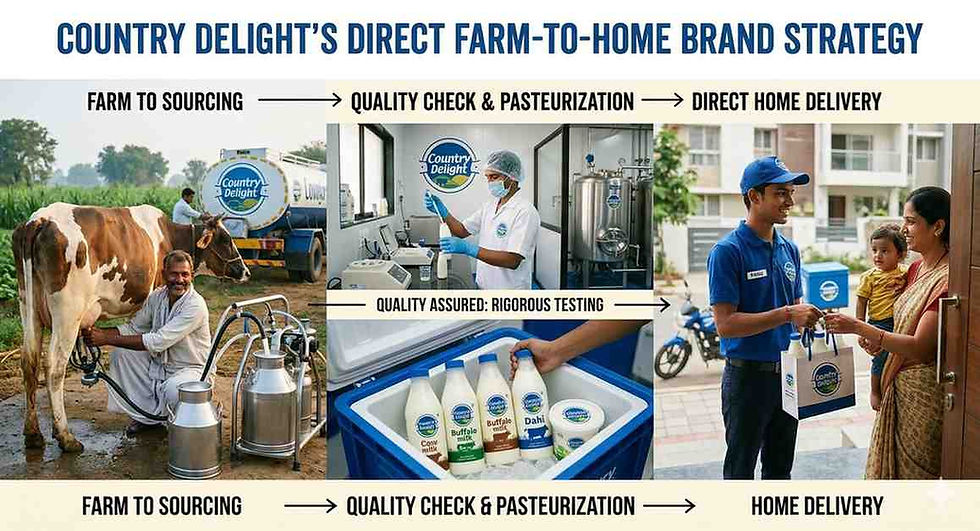
Country Delight's most significant strategic decision was to own and operate the entire supply chain — from direct sourcing from farmers to last-mile delivery through a proprietary fleet — rather than rely on third-party logistics or procurement aggregators. According to publicly available information, the company built relationships with a network of over 5,000 farmers, installing bulk milk chillers at the village level to ensure cold-chain integrity from the point of collection. The milk undergoes quality testing before acceptance, and the company employs a continuous cold chain maintaining 4°C through pasteurization, packaging, and delivery. Crucially, Country Delight chose pasteurization over UHT (ultra-high temperature) processing — a technical choice that signals freshness but requires faster distribution cycles, reinforcing the 36-hour farm-to-doorstep delivery promise. This operational investment served a dual strategic purpose: it was both a genuine quality control mechanism and a narrated brand differentiator. The supply chain was not merely functional — it was the story. Every element of the logistics model (direct sourcing, temperature monitoring, rapid transit) was converted into consumer-facing brand communication. Each milk packet includes a unique QR code that allows consumers to trace the product back to the source farm — a transparency mechanism that transforms the supply chain into an interactive brand touchpoint. This is a textbook application of the Jobs-to-Be-Done (JTBD) framework: the consumer's underlying job is not simply "buy milk" but "be confident my family is consuming safe, unadulterated food." The QR code fulfills a verification need that the product itself cannot communicate at point of consumption.
The DRDO Testing Kit: Proof-Based Marketing
One of Country Delight's most strategically distinct tactics was the inclusion of a DRDO (Defence Research and Development Organisation)-approved home milk-testing kit with the first order. This was not a promotional gimmick but a direct embodiment of the brand's transparency positioning. The logic was elegant: instead of asking consumers to trust the brand's purity claims, Country Delight invited them to test and verify. By bundling a credible, government-institution-endorsed testing kit, the brand simultaneously communicated confidence in its own product and activated consumer skepticism toward alternatives. The testing kit functioned as acquisition marketing, retention marketing, and competitive differentiation in a single gesture. This tactic reflects a behavioral insight rooted in the Elaboration Likelihood Model: for high-involvement, high-trust categories like food for children and families, consumers process quality claims through direct evidence, not persuasion. Country Delight operationalized this insight by making the purchase decision a scientific act rather than a leap of faith.
The "Naturally Acha Naturally Sacha" Campaign
In 2021, Country Delight launched a TVC featuring Madhuri Dixit, built around the brand ethos "Naturally Acha Naturally Sacha" (Naturally Good, Naturally Honest). The campaign was notable for its meta-advertising structure — the commercial opened by explicitly depicting what a typical milk advertisement looks like (a mother chasing her child, magical transformation), before subverting that narrative to show the actual production and delivery process. This approach was strategically significant on multiple levels. First, it positioned Country Delight as the honest alternative to the category's historically aspirational but uninformative advertising. Second, by showing the farm-to-doorstep process in the TVC itself, the brand reinforced supply chain transparency as its primary communication platform. Third, the use of a mainstream Bollywood celebrity provided mass reach credibility for what was still, at that point, a subscription-only digital brand. According to publicly available coverage from credible media sources including afaqs and Best Media Info, the TVC highlighted the brand's 26-step quality testing process and the complimentary DRDO-approved testing kit on the first order. Co-Founder Chakradhar Gade was quoted in press releases and media coverage stating: "The inception of Country Delight was this consumer obsession where we wanted to provide our customers with 100% fresh cow and buffalo milk, which gives the true benefits for which milk has been known for generations." The "Live Better" digital campaign, documented in credible industry coverage, was reported to have crossed 5 million views across digital platforms, reinforcing the brand's health and natural living narrative.
Positioning & Consumer Insight
Country Delight's positioning occupies a distinctive quadrant in India's dairy market: mass premium — not the niche price-point of certified organic brands like Akshayakalpa, but meaningfully above the commodity pricing of Amul or local vendors, justified through transparency and freshness. The central consumer insight that underpins the strategy is identifiable and well-supported by FSSAI documentation and media coverage: milk, as a daily essential consumed by children and elderly family members, carries disproportionately high perceived risk if quality is uncertain. In behavioral economics terms, loss aversion is activated — the fear of consuming adulterated food for one's family is a stronger motivator than the positive appeal of "fresher milk." Country Delight's brand strategy exploits this insight by framing its value proposition not as a luxury upgrade but as risk elimination. The premium is not for taste or lifestyle — it is for verified peace of mind. This framing is more psychologically durable than aspiration-based positioning, because it addresses a persistent anxiety rather than a transient desire. The target consumer is identifiable from Company communications and investor-facing materials as the urban, middle-to-upper-income household decision-maker — typically in Tier-1 cities — who is health-conscious, digitally fluent, and skeptical of mass-market food brands. This segment's willingness to pay a premium for credible quality assurance is the economic foundation of Country Delight's business model.
Media & Channel Strategy
Country Delight is a digital-first brand. Its primary customer acquisition and retention channel is its proprietary mobile application, through which all subscriptions, order modifications, and delivery tracking are managed. This is not merely a UX decision — it is a data strategy. By owning the consumer relationship through a direct app rather than through a retail shelf or marketplace, the company retains first-party behavioral data on consumption patterns, enabling AI-powered demand forecasting and personalization.
The subscription model — in which consumers pre-commit to daily milk deliveries — creates a revenue base reported to account for approximately 90% of orders, providing operational predictability that enables tighter supply chain management and reduces wastage.
From a media standpoint, the brand has operated across TVC (as evidenced by the 2021 Madhuri Dixit campaign), digital video, and social media. The "Live Better" campaign was executed on digital platforms. Additional celebrity endorsements by Sonali Bendre and Kajol have been documented in credible media coverage, supporting mass awareness objectives without departing from the brand's health and trust narrative. Referral mechanics and community word-of-mouth appear to have been significant early-stage acquisition drivers, consistent with the brand's trust-first positioning — satisfied consumers in high-trust product categories are more likely to recommend. The following financial and operational milestones are drawn from credible published sources including Inc42, Entrackr, The Arc, and Wikipedia, based on regulatory filings and verified media reports:
Revenue trajectory: Country Delight reported revenues of ₹542.6 crore in FY22, approximately ₹900 crore in FY23 (a 66% YoY increase), and ₹1,380 crore in FY24 (a 46% YoY increase). The H1 FY24 operating revenue was reported at ₹650 crore by Inc42.
Loss position: The company reported a net loss of ₹28.2 crore in FY21 and ₹186.4 crore in FY22, reflecting the capital-intensive scaling of its supply chain and customer acquisition investments. FY23 loss figures were not independently confirmed at the time of available reporting. The company's co-founder stated in September 2023 that profitability was expected within 8–10 months.
Funding and valuation: Country Delight has raised a total of approximately $221–248 million across 20 funding rounds. Key milestones include a $10 million Series B led by Matrix Partners in 2019, a $25 million Series C led by Elevation Capital, a $108 million Series D in May 2022 led by Venturi Partners with participation from Temasek, and subsequent Series E tranches in 2024 and 2025 led by Temasek. As of March 2025, the company's valuation was reported at approximately ₹6,950 crore (~$820 million) by Tracxn, based on the latest Series E round.
Operational scale: The company reported operations across 18 cities in 11 states. A 2022 Forbes reference cited by Wikipedia noted that Country Delight's 6,000 delivery workers fulfilled more than 5 million orders per month and served more than 30,000 homes. The company holds an estimated 2–3% share of the organized milk segment.
Product diversification: Non-milk product categories (including ghee, paneer, bread, eggs, fresh produce, oils, and pulses) were reported to contribute approximately 40% of FY24 revenue, with stated targets to grow this to 60–70% — a critical strategic lever for margin improvement, given the inelastic margins in the commodity milk segment.
IPO intent: The company has publicly signaled plans for an IPO listing by 2026.
Strategic Implications
The Supply Chain as Brand Strategy: Country Delight's most instructive lesson for marketers is the inversion of the conventional FMCG model. Traditionally, brands invest in supply chains for efficiency and margins, and separately invest in marketing for perception. Country Delight collapsed this distinction — the supply chain is the marketing. This is a model with direct applicability to any category where consumer trust in quality is structurally under-developed.
Trust as a Durable Moat in D2C: Quick commerce platforms and marketplace aggregators can replicate Country Delight's product range and delivery speed, but they cannot easily replicate verified origin traceability, farm-direct sourcing relationships, or a DRDO-endorsed testing protocol. These are genuine entry barriers — not because competitors lack resources, but because they lack the operating model that makes the brand promise credible. Country Delight's supply chain is, in Michael Porter's terms, a form of operational effectiveness translated into strategic differentiation.
The Milk Flywheel: The subscription model for a daily essential like milk creates a behavioral flywheel. Once a consumer embeds the brand into their morning routine, the cognitive cost of switching is high, and the trust established in dairy becomes the pathway for category expansion into eggs, bread, paneer, fresh produce, and kitchen staples. This is a classic platform extension strategy: acquire the consumer on a high-frequency, high-trust anchor product, then expand wallet share across adjacent categories. The reported shift of non-milk revenue to 40% of FY24 revenues validates this model.
The Tension Between Transparency and Scale: As Country Delight expands geographically and diversifies its product portfolio, maintaining the operational integrity behind its transparency promise becomes exponentially more complex. The brand's equity rests entirely on verified quality. Any documented lapse in supply chain standards — at any stage of the expanded product portfolio — carries disproportionate reputational risk. This is the primary strategic vulnerability the company must manage as it approaches its IPO trajectory.
Quick Commerce Adjacency: Country Delight's reported entry into quick-commerce delivery pilots in Gurugram (competing directly with Blinkit and Zepto on delivery speed) represents a meaningful strategic pivot — from a habit-based, pre-planned subscription model to a demand-triggered, convenience model. These are behaviorally and operationally distinct. The risk is that the brand's positioning equity (rooted in deliberate, trust-based sourcing) could be diluted by associations with convenience and speed. Preserving brand coherence across both models is a significant strategic communication challenge.
Conclusion
Country Delight's brand strategy is a rare case in Indian marketing of a company for whom the operational architecture and the brand narrative are genuinely the same thing. The farm-to-home model was not designed for marketing purposes and then communicated — it was designed for quality control, and the communication strategy was built to make the model visible. This coherence between operations and brand is difficult to engineer, but when achieved, it creates the kind of consumer trust that advertising alone cannot buy. The company's trajectory from a bootstrapped Delhi-NCR milk delivery startup to a near-unicorn with ₹1,380 crore in FY24 revenue is, at its core, a case study in the commercial value of verified honesty.
Discussion Questions
1. Supply Chain as Brand Architecture: Country Delight's vertically integrated supply chain functions simultaneously as an operational asset and a marketing differentiator. What are the conditions under which a company's operational model can substitute for conventional brand-building? What risks does this create when operational quality is compromised at scale?
2. The Trust Premium and Price Elasticity: Country Delight charges a documented premium over commodity milk brands by positioning on verified purity. Using the concepts of perceived risk reduction and mental availability, evaluate the sustainability of this trust premium as the brand expands beyond its core dairy category into commoditized staples like pulses, oils, and grains.
3. Subscription Model vs. Quick Commerce: Country Delight's core business is built on subscription-led, pre-planned delivery (habit buying), while its recent strategic expansion into quick commerce addresses impulse and emergency buying. Analyze the brand coherence risk of serving both behavioral contexts. What positioning guardrails should the company establish to prevent brand dilution?
4. Category Expansion and the Flywheel Thesis: The company has identified non-milk revenue growth (from 40% to a targeted 60–70% of revenues) as critical to margin improvement and profitability. Using the Jobs-to-Be-Done (JTBD) framework, evaluate which product categories are most strategically coherent with Country Delight's existing brand promise, and which carry the highest risk of brand misalignment.
5. IPO Readiness and Brand Equity: As Country Delight prepares for a potential IPO, it must communicate brand equity and growth story to public market investors. What are the key brand-side risks an investor should evaluate — including competitive threats from quick commerce platforms, margin pressure in the dairy category, and the challenge of maintaining quality transparency at pan-India scale?


Comments