Decathlon's Value-for-Money Brand Strategy in Sports Retail
- Feb 21
- 14 min read
Executive Summary
Decathlon, the French sporting goods retailer founded in 1976, has built a global retail presence across over 70 countries through a distinctive value-for-money brand strategy centered on vertically integrated private label product development, accessible pricing, and comprehensive sports category coverage. Unlike competitors who primarily retail third-party sports brands, Decathlon designs, manufactures, and sells its own house brands across virtually every sport, controlling the entire value chain from product conception to retail distribution. This integration enables aggressive pricing while maintaining quality standards, positioning Decathlon as democratizing sports participation by making equipment and apparel affordable for mass-market consumers rather than exclusively serving enthusiasts willing to pay premium prices for established sports brands.
This case study examines the publicly documented elements of Decathlon's value-for-money strategy, its vertical integration approach, private label brand architecture, retail store experience design, India market entry and expansion, and competitive positioning in global sports retail, based exclusively on official company communications, credible news reporting, and recognized industry analysis.
Company Background and Global Presence
Decathlon was founded in 1976 by Michel Leclercq in Englos, France, as part of the Mulliez family's retail business interests. According to Decathlon's official corporate information, company history documentation, and coverage in Financial Times, Reuters, and other international business publications, the company pioneered the sports retail superstore concept in Europe, offering wide sports category selection under one roof with house brand products at accessible prices.
The ownership structure involves the Mulliez family retail conglomerate. According to reports in Financial Times, Les Echos, and other European business press, Decathlon is owned by Association Familiale Mulliez, the holding structure for the Mulliez family's retail businesses which also include Auchan hypermarkets, Leroy Merlin home improvement, and other retail chains, though Decathlon operates independently under its own management.
Decathlon's global expansion has been extensively documented. According to the company's official communications, annual reports published in various markets, and international business press coverage including in Financial Times, Reuters, The Economic Times, and regional business publications, Decathlon operates in over 70 countries as of recent public statements, with presence across Europe, Asia, Americas, and other regions through owned stores, franchises, and e-commerce platforms.
The company's scale in sports retail is significant. According to industry analysis published in SportsBusiness Journal, Financial Times, and retail industry reports, Decathlon is one of the world's largest sporting goods retailers by store count and presence, though specific global market share figures are not comprehensively disclosed in single verified public sources given fragmentation of sports retail across regions and categories.
Vertical Integration as Strategic Foundation
Decathlon's defining strategic characteristic is comprehensive vertical integration across the sporting goods value chain. According to Decathlon's official communications, company presentations, and extensive analysis in Financial Times, The Economic Times, Retail Week, and business school case studies, Decathlon controls design, manufacturing (through owned facilities and contract manufacturers), logistics, and retail distribution, distinguishing it from sports retailers who primarily purchase and resell third-party brands.
The vertical integration model enables cost advantages. According to analysis published in Financial Times, The Economic Times, and retail industry publications, by eliminating wholesaler and brand owner margins that retailers typically pay when purchasing established sports brands, Decathlon can offer products at significantly lower retail prices while maintaining acceptable margins, or alternatively offer comparable prices with higher quality than competitors sourcing from branded suppliers.
Product development occurs through in-house design teams organized by sport. According to Decathlon's communications and coverage in retail and business publications, the company operates sport-specific design centers where teams of sports enthusiasts and product developers create equipment and apparel for particular sports categories, with designers practicing the sports they create products for to ensure functionality and user understanding.
Manufacturing combines owned production facilities and contract manufacturing. According to reports in Financial Times, The Economic Times, and supply chain publications, Decathlon operates some owned manufacturing plants while also contracting production to third-party manufacturers, particularly in Asia, maintaining quality control through specification management and inspection processes while achieving cost efficiency through global sourcing.
The integration extends to logistics and distribution. According to Decathlon's operational descriptions and retail industry coverage, the company operates its own distribution centers and logistics networks, controlling inventory management and store replenishment, providing additional operational efficiency and cost control compared to retailers dependent on third-party brand distribution networks.
Private Label Brand Architecture
Decathlon operates multiple private label brands, each focused on specific sports or sports categories. According to Decathlon's official brand portfolio information, website documentation, and analysis in The Economic Times, Financial Times, and retail publications, the company has developed sport-specific brands including Quechua (mountain sports), Tribord/Olaian (water sports), B'Twin (cycling), Kipsta (team sports), Domyos (fitness), Kalenji (running), Inesis (golf), and others, with each brand addressing particular sporting activities.
The sport-specific brand architecture serves strategic purposes. According to analysis in retail and branding publications, separate brands for different sports create focused identities that resonate with participants in specific activities, allowing targeted product development, marketing, and brand positioning rather than attempting to make a single corporate brand relevant across disparate sporting contexts with different cultures and requirements.
Brand positioning emphasizes accessibility and functionality over prestige. According to Decathlon's communications and product positioning documented across retail coverage, the house brands are positioned on delivering functional performance and value rather than aspirational lifestyle branding or professional athlete association that characterize premium sports brands like Nike, Adidas, or specialized equipment manufacturers.
Quality positioning aims for "good enough" at accessible prices. According to analysis of Decathlon's strategy in Financial Times, The Economic Times, and business publications, product quality targets recreational and casual participants rather than professional or serious enthusiast segments, creating equipment and apparel that functions adequately for typical usage while keeping costs low enough to enable aggressive pricing.
Innovation focuses on cost reduction and usability. According to coverage of Decathlon's product development in retail and business press, innovation efforts emphasize manufacturing cost reduction through material choices and production processes, user-friendly features for non-expert participants, and solving practical problems recreational athletes face, rather than pursuing performance maximization or technical sophistication that premium brands emphasize.
Pricing Strategy and Value Proposition
Aggressive pricing relative to established sports brands is central to Decathlon's value proposition. According to product pricing visible in stores and documented in retail analysis published in The Economic Times, Financial Times, and consumer publications, Decathlon products are typically priced substantially below comparable offerings from Nike, Adidas, Puma, and other established sports brands, making sports participation economically accessible to broader consumer segments.
The pricing strategy addresses mass market rather than premium segments. According to Decathlon's positioning documented in retail coverage and company communications, the target customer is the recreational participant or beginner rather than the serious enthusiast or professional, with pricing set to remove economic barriers to sports participation rather than capturing willingness-to-pay from committed participants for whom cost is secondary to performance.
Entry-level price points are particularly emphasized. According to product range analysis in The Economic Times, retail publications, and consumer coverage, Decathlon offers very low-price entry products in many categories—basic bicycles, starter tennis rackets, budget running shoes—designed to enable trying sports without significant financial commitment, supporting the brand mission of sports democratization.
Quality-price balance is carefully managed. According to analysis in Financial Times and The Economic Times, Decathlon maintains quality sufficient to avoid negative experiences that would discourage sports participation or damage brand reputation, while ruthlessly controlling costs to enable low pricing, walking a strategic line between adequate functionality and extreme cost minimization.
The value perception extends beyond absolute price. According to consumer research findings reported in retail publications and The Economic Times, Decathlon's value proposition encompasses product range breadth, store convenience, staff knowledge, and return policies alongside pricing, creating overall value experience beyond purely transactional price comparison.
Store Experience and Retail Format
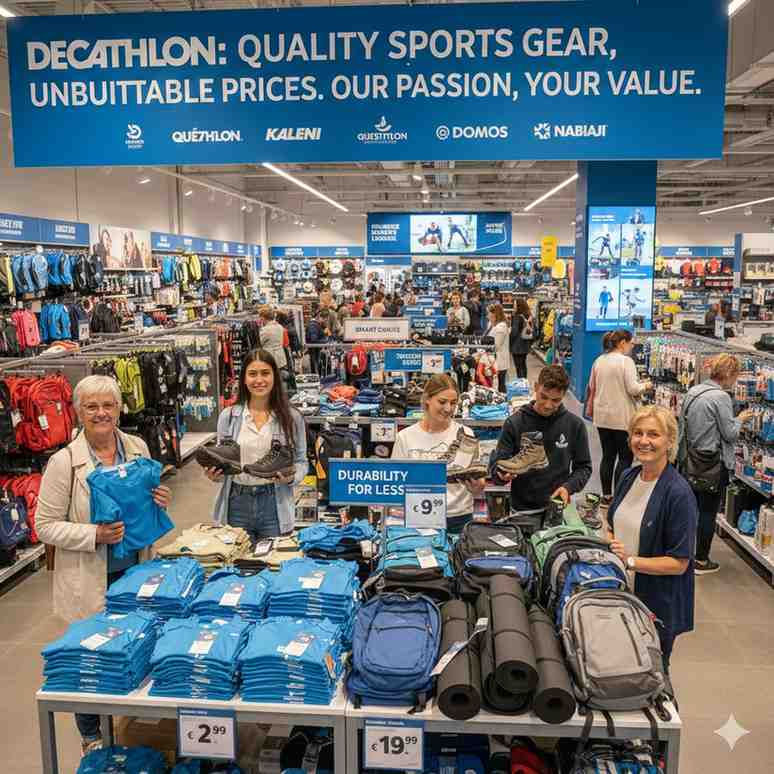
Decathlon stores follow a distinctive large-format warehouse retail model. According to store descriptions in retail publications, The Economic Times, and Decathlon's official information, stores typically occupy 4,000-8,000 square meters or more, featuring open layouts with products organized by sport, hands-on trial areas for testing equipment, and self-service shopping with minimal sales pressure.
Product testing and try-before-buy are emphasized. According to store experience descriptions in The Economic Times, Retail Week, and consumer publications, Decathlon stores feature facilities enabling customers to test bicycles on ramps, try tents in dedicated areas, test badminton rackets, and experience products before purchase, reducing purchase uncertainty particularly important for customers unfamiliar with sports equipment.
Sports enthusiasm is cultivated through store environment. According to coverage of Decathlon's retail concept in business and retail publications, stores display products in context suggesting sports participation, feature sports imagery and inspiration, and employ staff passionate about sports who can provide advice based on personal sports experience, creating environments that encourage rather than intimidate new participants.
The self-service model reduces operational costs. According to retail industry analysis of Decathlon's operations, the warehouse-style self-service approach with limited sales floor staff enables lower operating costs than service-intensive sporting goods retail, supporting the overall cost structure that enables aggressive pricing while maintaining profitability.
Store location strategy favors accessible suburban locations. According to real estate and retail coverage of Decathlon's location choices documented in various markets, stores typically locate in suburban areas with ample parking, highway access, and lower rents than prime urban retail locations, supporting cost control while serving car-mobile suburban families who constitute significant sports equipment consumer segments.
India Market Entry and Expansion
Decathlon entered the Indian market in 2009, opening its first store in Bangalore. According to reports in The Economic Times, Business Standard, Mint, and Decathlon's official communications, the India entry represented part of Decathlon's Asian expansion strategy, with India identified as a significant growth opportunity given its large population, rising middle class, and underdeveloped organized sports retail sector.
The initial store received significant consumer response. According to coverage in The Economic Times and Mint of the Bangalore store opening, the large-format sports retail concept with affordable pricing attracted substantial customer traffic, validating Decathlon's hypothesis that value-for-money sports retail could succeed in India's price-sensitive market.
Expansion across Indian cities accelerated over subsequent years. According to reports in The Economic Times, Business Standard, and Mint tracking Decathlon's India growth, the company expanded to over 100 stores across Indian cities by 2023, establishing presence in metropolitan areas, Tier-2 cities, and smaller towns, making Decathlon India one of the company's largest and fastest-growing international markets.
The India strategy emphasized adaptation to local preferences. According to reports in The Economic Times and Business Standard, Decathlon India developed products and assortments addressing Indian sports preferences including cricket, which became a major focus given the sport's cultural significance in India, requiring product development specifically for cricket equipment and apparel categories less emphasized in Decathlon's European origins.
Pricing proved particularly competitive in Indian market context. According to analysis in The Economic Times, Mint, and Business Standard, Decathlon's value-for-money positioning resonated strongly with India's price-sensitive middle-class consumers, with products priced well below established sports brands while offering quality sufficient for recreational participation, creating compelling value in a market where sports participation was often aspirational but cost-constrained.
Manufacturing and sourcing leveraged India's production capabilities. According to reports in The Economic Times and Business Standard, Decathlon established sourcing relationships with Indian manufacturers for products sold globally and in India, contributing to cost efficiency while supporting "Make in India" positioning and potentially benefiting from lower logistics costs for India-consumed products sourced domestically.
Digital Commerce and Omnichannel Development
Decathlon developed e-commerce capabilities complementing physical stores. According to the company's digital presence, reports in The Economic Times and Mint covering e-commerce development, and retail industry publications, Decathlon operates online shopping through dedicated websites and mobile applications across markets, enabling product discovery, purchase, and delivery without physical store visits.
The digital strategy emphasizes product information and education. According to Decathlon's website content and digital strategy coverage, online platforms provide detailed product information, usage guides, sport-specific advice, and content supporting informed purchase decisions, particularly valuable for sports equipment where product knowledge reduces purchase uncertainty.
Omnichannel integration developed over time. According to reports in retail publications and The Economic Times, Decathlon implemented capabilities including online purchase with in-store pickup, in-store return of online purchases, and inventory visibility across channels, though the degree of omnichannel sophistication varies across markets based on infrastructure and local market conditions.
Marketplaces and third-party platforms extended digital reach. According to reports in The Economic Times and Mint covering Decathlon's India e-commerce approach, the company sells through e-commerce marketplaces including Amazon India and Flipkart alongside its owned digital channels, accessing marketplace traffic and customers while maintaining control over owned channels for direct customer relationships.
No verified public information is available on specific online sales percentages, detailed digital commerce strategy documentation, or comprehensive assessment of omnichannel effectiveness beyond general descriptions in company communications and retail industry coverage.
Competitive Positioning in Sports Retail
Decathlon's competitive positioning contrasts sharply with traditional sports retail models. According to analysis in Financial Times, SportsBusiness Journal, and The Economic Times, conventional sports retailers including specialty sports stores, department store sports sections, and sports brand-owned retail primarily sell third-party branded products from Nike, Adidas, Puma, Under Armour, and other brands, earning retail margins on wholesale-purchased inventory.
Sports brand manufacturers' direct retail creates different competitive dynamic. According to retail industry analysis, Nike, Adidas, and other major sports brands increasingly operate their own stores selling exclusively their brands, controlling brand presentation and customer experience while capturing retail margins, but limiting consumer access to multi-brand selection and comparison that multi-brand retailers provide.
Decathlon's vertical integration creates structural cost advantage. According to business analysis in Financial Times, The Economic Times, and retail publications, by eliminating brand owner margins and controlling manufacturing, Decathlon achieves structural cost positions enabling lower prices than retailers purchasing branded inventory, creating price competitiveness difficult for conventional retailers to match without comparable integration.
Quality perception challenges exist relative to established brands. According to consumer research findings reported in The Economic Times and retail publications, some consumer segments perceive Decathlon's house brands as inferior quality to established sports brands with greater marketing investment, athlete endorsements, and technical heritage, limiting Decathlon's appeal to serious enthusiasts or consumers for whom brand prestige matters.
The recreational participant target segment provides competitive space. According to analysis in Financial Times and The Economic Times, Decathlon's focus on recreational participants and beginners addresses market segments underserved by premium sports brands targeting serious athletes and enthusiasts, creating market positioning that avoids direct competition for premium-seeking consumers while serving mass-market accessibility needs.
Sustainability and Corporate Positioning
Decathlon has articulated sustainability commitments in corporate communications. According to the company's sustainability reports, official statements, and coverage in Financial Times, The Guardian, and sustainability-focused publications, Decathlon has established goals regarding circular economy, product durability, recycled materials usage, carbon emissions reduction, and responsible sourcing.
Product repair and second-hand initiatives have been implemented. According to Decathlon's communications and coverage in retail and sustainability press, the company operates product repair services in stores, offers second-hand equipment through "Decathlon Occasions" or similar programs in various markets, and emphasizes product longevity and repairability in design, supporting circular economy principles.
The accessibility mission frames sustainability positioning. According to Decathlon's communications, making sports accessible to everyone is positioned as fundamentally aligned with sustainability by enabling longer product use across broader populations, repairing rather than replacing, and democratizing sports participation as social good, though critics might question whether encouraging mass consumption through low pricing creates environmental costs.
Transparency and traceability have been emphasized. According to statements in Decathlon's communications and coverage in Financial Times and sustainability publications, the company has disclosed supply chain information, manufacturing locations, and sourcing practices to varying degrees across markets, responding to consumer and stakeholder demands for supply chain transparency in apparel and retail.
No verified public information is available on comprehensive independent verification of sustainability claims, systematic third-party audits of environmental and social practices across the full supply chain, or detailed quantitative assessment of sustainability performance against stated goals beyond what Decathlon discloses in official reports.
Employment Model and Staff Engagement
Decathlon employs a significant retail workforce across global operations. According to company information and employment coverage in various markets, Decathlon stores employ sports-enthusiast staff intended to provide knowledgeable advice based on personal sports participation, creating employment value proposition around shared passion for sports alongside typical retail employment.
The sports passion among staff is emphasized in employment branding. According to Decathlon's employment communications and coverage in HR publications, the company recruits sports participants, encourages staff sports activity, and positions employment as part of sports lifestyle rather than purely transactional retail work, creating cultural positioning distinct from typical retail employment.
Employee sports clubs and participation programs exist. According to Decathlon's communications and HR coverage, the company operates internal sports clubs, sponsors employee participation in sports events, and integrates sports activity into company culture, aligning employment experience with brand identity around sports democratization.
No verified public information is available on comprehensive employee satisfaction metrics, detailed compensation and benefits benchmarking against retail industry standards, systematic assessment of employee retention rates, or independent evaluation of workplace conditions across Decathlon's global operations beyond what company discloses and what has been covered in employment-focused journalism.
Challenges and Market Evolution
Decathlon faces documented challenges in various markets. According to coverage in Financial Times, The Economic Times, and retail industry publications, challenges include increasing competition from specialized online sports retailers, direct-to-consumer sports brands bypassing traditional retail, Amazon and e-commerce marketplaces expanding sports categories, and changing consumer preferences toward brand prestige and technical performance that premium brands better address.
E-commerce disruption affects physical retail advantage. According to retail industry analysis, Decathlon's large-format stores requiring significant physical infrastructure investments face competitive pressure from online-only competitors with lower cost structures, though product testing and immediate availability benefits of physical retail provide partial defense against pure-play online competition.
Brand perception limits in premium segments persist. According to consumer research reported in The Economic Times and retail publications, serious sports enthusiasts and performance-oriented consumers often prefer established sports brands with technical heritage, professional athlete associations, and premium positioning, limiting Decathlon's penetration of higher-value enthusiast segments where willingness-to-pay is less price-elastic.
Real estate and location constraints affect expansion. According to retail industry coverage, Decathlon's large-format store model requires suitable real estate increasingly scarce and expensive in dense urban areas, potentially limiting expansion in certain markets or requiring format adaptations that might compromise the store experience advantages that differentiate Decathlon from online competitors.
Conclusion
Decathlon's value-for-money brand strategy represents a documented case of vertically integrated retail enabling aggressive pricing through structural cost advantages. Based on publicly available information from company communications, international business press, and retail industry analysis, Decathlon built global presence across over 70 countries by controlling design, manufacturing, and retail distribution of sport-specific private label brands, eliminating intermediary margins to offer functional sports equipment and apparel at prices substantially below established brands.
The strategy effectively addresses mass-market recreational participants and beginners for whom cost barriers inhibit sports participation, creating social value through sports democratization while building commercially successful retail operations. The large-format store experience, product testing emphasis, and sports-enthusiast staff support the value proposition beyond purely transactional pricing.
However, the model faces challenges from e-commerce disruption, premium brand preferences among enthusiast segments, and the capital intensity of physical retail expansion. Publicly available information on comprehensive performance metrics, detailed profitability assessment across markets, systematic customer satisfaction measurement, and complete supply chain transparency remains limited beyond what Decathlon discloses in selected communications and what has been documented in business press coverage.
MBA-Level Discussion Questions
Question 1: Vertical Integration in Retail Economics Analyze the strategic trade-offs in Decathlon's choice of comprehensive vertical integration controlling design, manufacturing, and retail versus the asset-light model of retailing third-party brands. Under what industry and competitive conditions does vertical integration create sustainable advantage versus becoming an operational burden? How should retailers evaluate whether controlling upstream value chain activities provides sufficient margin benefit and strategic differentiation to justify the capital requirements, operational complexity, and reduced flexibility that integration creates?
Question 2: Private Label Positioning and Brand Architecture Evaluate Decathlon's strategy of operating multiple sport-specific private label brands rather than a single corporate brand across all sports categories. What are the benefits of specialized brands (Quechua, Kipsta, Kalenji, etc.) focused on particular sports versus potential efficiency advantages of unified branding? How does this architecture affect brand investment requirements, consumer recognition, and competitive positioning? Under what conditions should retailers operate portfolio brands versus consolidated brand strategies?
Question 3: Mass Market Versus Premium Segment Targeting Discuss Decathlon's strategic choice to target recreational participants and beginners with value-for-money positioning rather than pursuing premium segments with higher margins. What structural factors make mass-market accessibility positioning strategically viable and potentially more defensible than premium positioning in sports retail? How should companies evaluate trade-offs between volume-driven mass market strategies and margin-focused premium approaches? What capabilities and organizational characteristics determine which positioning succeeds in different competitive contexts?
Question 4: Physical Retail Investment in E-Commerce Era Analyze Decathlon's continued investment in large-format physical stores despite e-commerce growth and capital intensity of physical retail. What specific value does physical retail provide in sports equipment categories that online channels cannot replicate? How should omnichannel retailers balance physical store investment against digital commerce development when consumer shopping increasingly shifts online? What store experience elements, formats, or services justify physical retail's higher cost structure in product categories where e-commerce provides adequate purchase experiences?
Question 5: Value-for-Money Positioning and Quality Perception Evaluate the sustainability of value-for-money positioning in categories like sports equipment where brand prestige and performance perception influence consumer choice. How can value-positioned brands overcome negative quality perceptions relative to premium competitors when price itself signals potential lower quality? What strategies beyond pricing—product design, marketing, retail experience, endorsements—might elevate value brands' perceived quality without undermining cost advantages that enable value positioning? At what point does pursuing quality improvement contradict the structural cost discipline required for value leadership?


Comments