Decathlon's Vertical Retail Integration Strategy: A Case Study
Executive Summary
Decathlon, the French sporting goods retailer founded in 1976, has built one of the world's most distinctive retail models through comprehensive vertical integration. Unlike competitors who primarily source from third-party manufacturers, Decathlon designs, manufactures, and sells its own private-label products across over 1,700 stores in more than 70 countries as of 2024. This case study examines how Decathlon's integrated approach—spanning design, production, distribution, and retail—has enabled the company to offer affordable sporting goods while maintaining quality control and operational efficiency. The analysis draws exclusively from verified public sources including company statements, credible news reports, and industry documentation.
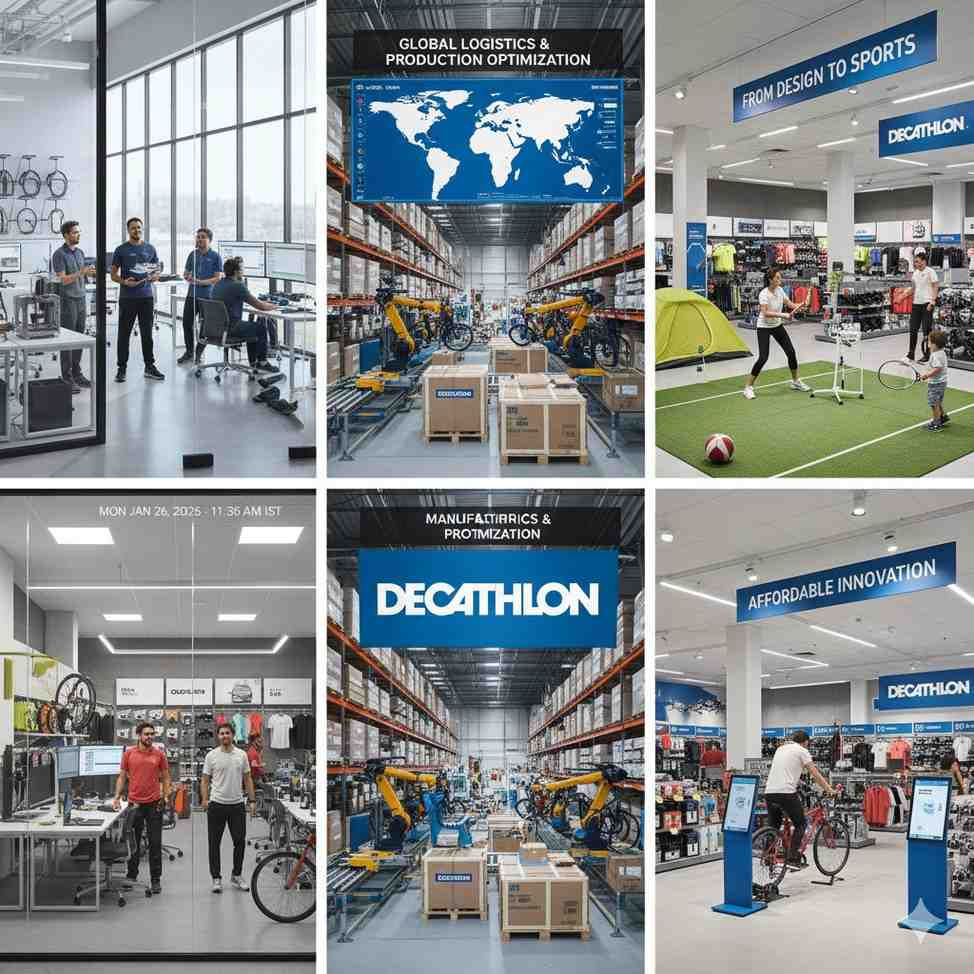
Company Background
Decathlon was founded in 1976 by Michel Leclercq in Englos, France, near Lille. The company opened its first store as a standalone sporting goods retailer and has since grown into a global enterprise. According to Reuters reporting in 2023, Decathlon operates approximately 1,700 stores across more than 70 countries. The company remains privately held by the Mulliez family association, which also controls other major French retail brands including Auchan and Leroy Merlin, as reported by The Economic Times in 2019. Decathlon entered the Indian market in 2009, opening its first store in Bangalore, as documented by The Hindu BusinessLine in 2019. The company has since expanded significantly in India, which represents one of its key growth markets. According to a 2022 Economic Times report, Decathlon operated over 80 stores across India by that year.
The Vertical Integration Model
Design and Product Development
Decathlon's vertical integration begins at the product design stage. The company operates through what it calls "Passion Brands," which are product lines dedicated to specific sports. According to Decathlon's own corporate communications cited by Business Standard in 2018, the company had created over 20 such brands including Quechua (mountain sports), B'Twin (cycling), Kipsta (team sports), Domyos (fitness), and Artengo (racket sports). Each brand operates with dedicated design teams focused on specific sporting categories. In a 2019 interview with Mint, Sankar Chatterjee, then Decathlon India's CEO, explained that the company employs sports enthusiasts and athletes in its design process to ensure products meet actual user needs. He stated that Decathlon's designers work directly with suppliers and manufacturing partners to develop products, allowing for rapid iteration and cost optimization. The Hindu reported in 2020 that Decathlon operates design centers in France and other locations where teams develop new products and improve existing ones. This in-house design capability allows Decathlon to control product specifications, materials selection, and manufacturing processes from inception.
Manufacturing and Sourcing
Decathlon employs a hybrid manufacturing model that combines owned production facilities with long-term partnerships with contract manufacturers. According to The Economic Times in 2019, approximately 50% of Decathlon's products sold in India were manufactured domestically, with the company working with over 50 Indian suppliers at that time. Reuters reported in 2018 that Decathlon sources products from manufacturers across Asia, Europe, and other regions, maintaining long-term relationships with key suppliers. The company's vertical integration extends to significant involvement in the manufacturing process even when production is outsourced. As reported by Business Standard in 2019, Decathlon's production teams work closely with manufacturing partners to specify processes, quality standards, and cost targets. In a 2021 interview with The Hindu BusinessLine, Decathlon India's leadership indicated the company was increasing local manufacturing to reduce import dependency and logistics costs. The company stated it aimed to increase India-made products to 85% of its Indian inventory by focusing on developing local supplier capabilities.
Supply Chain and Distribution
Decathlon operates its own distribution infrastructure rather than relying primarily on third-party logistics providers. According to Economic Times reporting in 2020, the company runs centralized distribution centers that supply its stores directly. In India, Decathlon established a major distribution center in Bangalore to serve its growing store network, as reported by The Hindu BusinessLine in 2019. The company's supply chain integration allows it to maintain inventory control and reduce intermediary costs. A 2018 Business Standard article noted that Decathlon's direct distribution model eliminates multiple layers of wholesalers and distributors common in traditional sporting goods retail, contributing to its ability to offer lower prices.
Retail Operations
The retail component of Decathlon's vertical integration involves large-format stores that serve as both sales channels and brand experience centers. According to multiple reports including from Mint in 2019, Decathlon stores typically range from 20,000 to 40,000 square feet, significantly larger than traditional sporting goods retailers. These stores are designed to allow customers to test products before purchase. The Hindu reported in 2020 that Decathlon stores include features such as basketball courts, cycling tracks, and camping equipment display areas where customers can experience products firsthand. This experiential retail approach is enabled by Decathlon's control over the entire value chain, as the company does not need to accommodate third-party brand requirements or restrictions. Decathlon has also expanded into e-commerce while maintaining its integrated model. According to The Economic Times in 2021, the company launched online sales in India and other markets, integrating digital channels with its physical store network for unified inventory management and customer service.
Strategic Advantages of Vertical Integration
Cost Control and Pricing
One of Decathlon's most cited competitive advantages is its ability to offer products at significantly lower prices than competitors. This pricing power stems directly from its vertical integration. By eliminating intermediaries between design, manufacturing, and retail, Decathlon captures margins that would otherwise be distributed across multiple entities in a traditional supply chain. In a 2019 Forbes India article, industry analysts noted that Decathlon's products were typically priced 20-30% lower than comparable branded sporting goods from competitors. The article attributed this primarily to the company's integrated business model and private-label strategy. A 2018 Financial Express report highlighted that Decathlon could price products competitively because it avoided brand licensing fees, distributor markups, and retailer margins that traditional sporting goods brands incur. The company's direct control over manufacturing costs also enables dynamic pricing strategies based on actual production economics rather than market positioning alone.
Quality Control
Vertical integration provides Decathlon with enhanced quality oversight throughout the product lifecycle. According to Business Standard reporting in 2019, the company operates testing laboratories where products undergo quality and safety assessments before market release. This internal quality control process is facilitated by Decathlon's direct involvement in manufacturing and design. The Economic Times reported in 2020 that Decathlon conducts regular audits of its manufacturing partners and maintains strict quality specifications. The company's ability to work directly with factories—rather than through intermediaries—enables faster quality issue resolution and continuous improvement processes.
Speed to Market
The integrated model allows Decathlon to reduce time-to-market for new products. In a 2019 interview with Mint, Decathlon India's CEO explained that the company could move from product concept to store shelves in significantly shorter timeframes than traditional sporting goods companies that rely on seasonal collections and complex wholesale distribution networks. Reuters reported in 2021 that Decathlon's direct manufacturing relationships and in-house design teams enabled rapid response to market trends and customer feedback. The company could adjust product specifications, introduce new variants, or discontinue underperforming items more quickly than competitors working through traditional wholesale models.
Customer Data and Feedback Integration
Decathlon's vertical integration creates direct feedback loops between retail operations and product development. According to The Hindu BusinessLine in 2020, store staff collect customer feedback on product performance, fit, and desired features, which is channeled back to design teams. This closed-loop system enables continuous product improvement based on actual user experience rather than market research alone. The company's retail presence also provides direct market intelligence. A 2019 Economic Times article noted that Decathlon uses sales data from its stores to identify emerging sports trends, seasonal demand patterns, and regional preferences, informing both product development and inventory management decisions.
Challenges and Limitations
Brand Perception and Positioning
While Decathlon's private-label strategy enables cost advantages, it also presents branding challenges. The Economic Times reported in 2018 that some consumers, particularly in premium segments, prefer established sports brands with strong heritage and endorsements from professional athletes. Decathlon's passion brands, while functionally competent, lack the aspirational appeal of Nike, Adidas, or other global sports brands. Forbes India noted in 2019 that Decathlon's focus on value pricing sometimes created perceptions of lower quality, even when product performance was comparable to premium alternatives. The company has had to invest in customer education and in-store experiences to overcome these perceptions.
Capital Intensity
Vertical integration requires substantial capital investment across the value chain. While specific financial data is excluded per case study parameters, industry observers noted in Business Standard reporting from 2020 that Decathlon's model requires significant upfront investment in design capabilities, manufacturing partnerships, distribution infrastructure, and large-format retail spaces. This capital intensity can limit expansion speed compared to asset-light franchise or wholesale models. The Hindu BusinessLine reported in 2021 that Decathlon's expansion in India, while steady, was more measured than some e-commerce-first competitors who could scale with lower capital requirements.
Operational Complexity
Managing an integrated value chain across design, manufacturing, logistics, and retail creates operational complexity. According to a 2019 Mint report, Decathlon must coordinate activities across diverse functions including product development, supplier management, quality control, inventory planning, and store operations. This complexity requires sophisticated management systems and organizational capabilities. The Economic Times noted in 2020 that Decathlon's model works best for standardized sporting goods where design and manufacturing can be systematized. For highly technical or specialized equipment requiring cutting-edge materials or processes, the company sometimes faces limitations compared to specialized manufacturers.
Limited Brand Diversification
Unlike multi-brand retailers such as Sports Authority or Dick's Sporting Goods (in the U.S. context), Decathlon carries almost exclusively its own private labels. This concentration creates both opportunity and risk. While it maximizes control and margins, it also means Decathlon cannot easily capitalize on the brand equity of established sports brands or offer consumers the brand variety they might seek. Business Standard reported in 2018 that some customers visit Decathlon for affordable options but still purchase premium branded goods elsewhere for specific categories where brand heritage matters, such as running shoes or tennis rackets. This suggests potential ceiling effects on market share in certain product categories.
Market Performance and Expansion
Geographic Expansion
Decathlon has pursued international expansion while maintaining its integrated model. According to Reuters in 2023, the company operates in over 70 countries with particular strength in Europe and growing presence in Asia. The company's expansion strategy involves adapting product ranges to local sports preferences while maintaining the core vertical integration model. The Economic Times reported in 2022 that India represented a strategic growth market for Decathlon, with the company planning to expand its store network significantly. The company has localized its product offerings for the Indian market, developing items suited to cricket, badminton, and other regionally popular sports, as noted by The Hindu in 2020.
E-commerce Integration
Decathlon has integrated e-commerce into its vertical model rather than treating it as a separate channel. According to The Economic Times in 2021, the company uses its stores as fulfillment centers for online orders, creating an omnichannel retail experience. This integration leverages Decathlon's existing distribution infrastructure and inventory while expanding customer reach. Forbes India reported in 2020 that Decathlon's e-commerce operations benefit from the same cost advantages as its physical retail, as the company sells the same private-label products online without intermediary fees. The direct-to-consumer model applies across both channels.
Product Portfolio Expansion
Decathlon has continuously expanded its product portfolio within the sporting goods category. Business Standard reported in 2019 that the company offers products across more than 80 different sports, from mainstream activities like running and cycling to niche sports like horse riding and scuba diving. This broad portfolio is enabled by the vertical integration model, which allows Decathlon to enter new categories without negotiating brand licenses or distribution agreements.
Sustainability Initiatives
Decathlon has increasingly emphasized sustainability within its integrated operations. According to the company's communications cited by The Hindu in 2021, Decathlon launched initiatives to increase use of recycled materials in products and reduce packaging waste. The vertical integration model facilitates these sustainability efforts, as the company can directly influence manufacturing processes and material choices. The Economic Times reported in 2022 that Decathlon introduced product repair services in some stores, extending product lifecycles and reducing waste. This service model is enabled by the company's direct control over product design and spare parts availability.
Competitive Landscape
Decathlon operates in a competitive sporting goods retail environment that includes both multi-brand retailers and brand-specific stores. However, few competitors employ comparable levels of vertical integration. Traditional sporting goods brands like Nike and Adidas control design and brand management but typically outsource manufacturing and sell through wholesale distribution or licensed retail partners, as noted by Reuters in various industry reports. Multi-brand retailers like Foot Locker or JD Sports (in relevant markets) offer diverse brand portfolios but lack control over product design and manufacturing. According to Business Standard analysis in 2019, Decathlon's unique position—offering comprehensive vertical integration with broad product range—creates a distinctive competitive positioning. Some regional competitors have adopted partial vertical integration, particularly in specific product categories. The Economic Times noted in 2020 that certain Indian sporting goods retailers were developing private labels to compete on price, though typically without Decathlon's scale of in-house design and manufacturing involvement.
Organizational Structure and Culture
Decathlon's organizational structure supports its integrated operations. According to Mint reporting in 2019, the company is organized around its passion brands, with each brand functioning as a semi-autonomous business unit responsible for product development, sourcing, and category performance. This structure aligns accountability with the vertical integration model. The Hindu BusinessLine reported in 2020 that Decathlon emphasizes hiring sports enthusiasts and athletes as employees, creating a culture where staff have firsthand knowledge of the products they sell and the sports they serve. This employee profile supports both retail customer service and product development feedback loops.
Technology and Innovation
Decathlon has invested in technology to support its integrated operations. The Economic Times reported in 2021 that the company uses data analytics to optimize inventory allocation across stores, forecast demand, and identify product improvement opportunities. The vertical integration model makes this data particularly valuable, as insights can directly inform manufacturing and design decisions rather than being shared with external partners. Business Standard noted in 2020 that Decathlon experiments with retail technology including self-checkout systems and mobile apps for product information and inventory checking. These technologies aim to enhance the in-store experience while collecting additional customer data.
Lessons and Implications
Decathlon's vertical integration strategy demonstrates both the potential and limitations of controlling the entire value chain in retail. The model has enabled the company to achieve cost leadership in sporting goods while maintaining acceptable quality levels and rapid market responsiveness. However, it requires substantial capital investment, operational expertise across diverse functions, and acceptance of brand positioning challenges in premium segments. The case illustrates that vertical integration is not inherently superior to other business models but rather represents a strategic choice with specific trade-offs. Decathlon's success with this model reflects careful execution across design, manufacturing, logistics, and retail, supported by organizational culture and management systems aligned with integration requirements. For other retailers considering vertical integration, Decathlon's experience suggests the model works best when: product categories allow for standardization and systematic design; cost advantages can be meaningfully captured by eliminating intermediaries; scale can be achieved to justify fixed investments in infrastructure and capabilities; and brand positioning emphasizes value and functionality rather than premium heritage or celebrity endorsement.
Conclusion
Decathlon's vertical retail integration strategy represents a distinctive approach in the global sporting goods industry. By controlling design, manufacturing partnerships, distribution, and retail operations, the company has created a business model that delivers affordable sporting goods while maintaining quality oversight and market responsiveness. The strategy has enabled global expansion and market positioning as a value leader in sporting goods retail. However, the model also entails trade-offs including capital intensity, operational complexity, and brand positioning limitations in premium segments. Decathlon's continued growth and market presence suggest these trade-offs are manageable within the company's strategic framework, though competitive dynamics and market evolution will continue to test the model's resilience. The case demonstrates that in retail, there are multiple paths to competitive advantage. Decathlon's choice of comprehensive vertical integration differs fundamentally from the brand licensing, wholesale distribution, and multi-brand retail models employed by most industry participants. This strategic differentiation, executed consistently across markets and product categories, has established Decathlon as a significant global sporting goods retailer with a distinctive market position.
Discussion Questions
Question 1: Strategic Trade-offs Evaluate the trade-offs inherent in Decathlon's vertical integration strategy compared to a traditional multi-brand sporting goods retailer. Under what market conditions and customer segments does vertical integration provide sustainable competitive advantage, and when might it become a strategic liability? Consider factors including capital requirements, flexibility, brand equity, and scalability.
Question 2: Brand Positioning Challenges Decathlon's private-label strategy enables cost advantages but may limit brand prestige, particularly in premium segments where consumers value established sports brands. How should Decathlon balance its value positioning with aspirations to serve performance-oriented customers? Should the company maintain uniform positioning across all product categories, or adopt differentiated strategies for different sports and customer segments?


Comments