Fabindia’s Connection to Ethnic Identity and Lifestyle
- 41 minutes ago
- 8 min read
Industry & Competitive Context
India’s ethnic wear and lifestyle retail market has historically occupied a unique position within the country’s broader fashion industry. While organized apparel retail in India expanded rapidly after economic liberalization, much of the premium retail landscape remained heavily influenced by Western fashion formats, global aesthetics, and fast-fashion merchandising. Against this backdrop, Fabindia emerged as one of the earliest large-scale Indian brands to commercialize indigenous crafts, handloom textiles, and artisanal products for urban consumers.
Founded in 1960 by John Bissell, Fabindia initially operated as an export business focused on home furnishings made by Indian artisans. Over time, the company evolved into a domestic retail brand with a strong focus on handcrafted apparel, home décor, organic food, and personal care products sourced from rural Indian producers and artisan communities. Publicly available information indicates that Fabindia built its sourcing network around traditional craftspeople across India and later incorporated community-owned supply-region companies in which artisans held equity participation.
The company’s positioning became particularly significant in the context of increasing urbanization and the rise of aspirational middle-class consumption in India. Unlike brands competing primarily on fashion cycles or Western silhouettes, Fabindia built a retail identity centered on Indian textiles, regional craftsmanship, natural fabrics, and cultural authenticity.
Industry analyses and retail reports have consistently positioned Fabindia differently from traditional ethnic occasion-wear brands. While brands such as Manyavar and designer-led labels emphasized ceremonial and wedding consumption, Fabindia focused on everyday ethnic and lifestyle usage. Publicly available industry reports described the company’s design philosophy as “artisanal,” “indigenous,” and rooted in Indian crafts across multiple categories.
This differentiation became strategically important because it allowed Fabindia to occupy a broader cultural and lifestyle territory rather than compete solely as an apparel retailer.
Brand Situation Prior to the Lifestyle Expansion
Fabindia’s early growth coincided with a period in which Indian consumers increasingly began rediscovering domestic cultural identity within urban consumption. According to multiple business publications, the company succeeded in making handloom fabrics, kurtas, and handcrafted home products acceptable—and eventually aspirational—for educated urban consumers.
Business Today described Fabindia’s approach as a “contrarian path” in a market where fashionable consumption was often associated with Western culture. The company’s leadership publicly articulated a belief that Indian consumers should not need Western validation for cultural expression. This philosophy became central to the brand’s long-term identity.
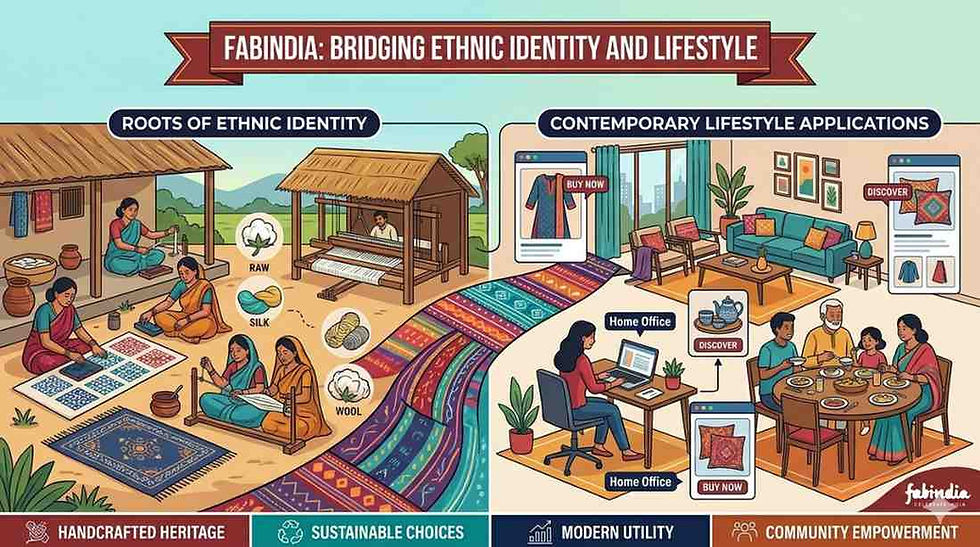
Fabindia’s retail proposition evolved beyond selling ethnic clothing. The company created an ecosystem of products associated with a broader Indian lifestyle aesthetic. Public filings and company descriptions documented the expansion of Fabindia into categories including apparel, furnishings, furniture, organic food, and wellness products.
This expansion reflected a strategic shift from category retailing toward lifestyle branding. Rather than positioning ethnic wear as occasional or ceremonial, Fabindia integrated Indian aesthetics into daily living. The stores themselves increasingly reflected this positioning through natural materials, craft-oriented visual merchandising, and product adjacencies that reinforced a unified cultural narrative.
By the late 2000s and early 2010s, Fabindia had become associated with a specific urban consumer identity: culturally rooted, socially conscious, and aesthetically aligned with Indian craftsmanship. Several media analyses described the brand as appealing strongly to India’s urban middle and upper-middle-class consumers seeking authenticity and cultural expression.
At the same time, the company faced structural tensions. As it scaled nationally, it needed to balance artisanal sourcing, commercial growth, premium positioning, and operational standardization. Public reporting also indicated that Fabindia increasingly competed with organized ethnic fashion retailers entering the market with more trend-driven assortments and faster merchandising cycles.
Strategic Objective
Fabindia’s strategic objective evolved from being a handicrafts retailer into becoming a culturally anchored lifestyle platform.
Publicly available information suggests that the company pursued three interconnected strategic goals.
First, Fabindia sought to mainstream Indian ethnic identity within urban everyday consumption. Rather than positioning traditional Indian products as niche or heritage-only items, the company integrated them into contemporary retail formats and daily use categories.
Second, the company aimed to build a scalable lifestyle brand around Indian craftsmanship. This involved extending the brand into home décor, wellness, personal care, and organic food categories while maintaining a consistent aesthetic and cultural philosophy.
Third, Fabindia attempted to differentiate itself structurally through its artisan-linked sourcing ecosystem. Bloomberg and other business publications documented the company’s artisan-shareholding model and community-owned sourcing entities, which reinforced the brand narrative around social inclusion and craft preservation.
Importantly, Fabindia’s strategic positioning was not based solely on product authenticity. It was built around identity signaling. Consumers were not merely purchasing apparel or furnishings; they were participating in a broader expression of Indian cultural modernity.
Campaign Architecture & Execution
No verified public information is available on a single formal campaign officially titled “Fabindia’s Connection to Ethnic Identity and Lifestyle.” However, substantial publicly available evidence demonstrates that the company consistently executed a long-term brand strategy centered on Indian cultural identity and lifestyle positioning.
Fabindia’s execution model relied less on short-duration advertising campaigns and more on sustained brand architecture across products, stores, communication, and category expansion.
The company’s retail design strategy played a central role in this execution. Public reporting documented Fabindia’s development of “Experience Centres” and large-format stores that integrated apparel, home décor, wellness, organic products, and community-oriented experiences under one umbrella. This retail environment reinforced the perception of Fabindia as a holistic Indian lifestyle brand rather than a conventional apparel retailer.
Product strategy also reflected this positioning. Fabindia consistently emphasized handcrafted fabrics, indigenous techniques, regional weaves, block printing, natural fibers, and artisanal production methods. Rather than presenting ethnic wear as purely ceremonial, the company adapted silhouettes and fits for urban professional and casual settings.
In 2019, reports indicated that Fabindia increased its focus on fusion fashion to address changing urban consumption patterns among younger consumers. However, the company reportedly consolidated these efforts under the core Fabindia identity rather than separating them into independent fashion sub-brands. This suggested that management viewed cultural continuity as strategically more valuable than pursuing aggressive Western-fashion diversification.
The company’s communications also reinforced themes of heritage, craftsmanship, sustainability, and Indian identity. Publicly documented messaging frequently emphasized artisanship, authenticity, and preservation of traditional techniques.
Fabindia’s Diwali 2021 campaign controversy further illustrated the sensitivity of culturally positioned branding. The company promoted a festive collection using the phrase “Jashn-e-Riwaaz,” which generated criticism in parts of the Indian public sphere. The campaign was later withdrawn. Verified public reporting confirms the controversy and withdrawal, although no verified public information is available regarding measurable business impact.
From a strategic perspective, the incident demonstrated that brands positioned around cultural identity face elevated scrutiny regarding symbolic alignment and communication choices.
Positioning & Consumer Insight
Fabindia’s core positioning rested on the intersection of culture, authenticity, and modern lifestyle integration.
Unlike many ethnic wear brands that focused on weddings or festival-specific consumption, Fabindia normalized Indian attire and handcrafted products within everyday urban life. This positioning aligned with a broader shift among Indian consumers toward rediscovering local identity amid globalization.
Public commentary and business analyses consistently described Fabindia as a brand that made Indian ethnic consumption both aspirational and socially acceptable within urban elite and professional environments.
The underlying consumer insight appeared to center on identity reconciliation. Urban Indian consumers increasingly wanted products that reflected cultural rootedness without appearing outdated or impractical. Fabindia addressed this by modernizing usability while retaining visible craft authenticity.
The company’s value proposition therefore extended beyond aesthetics. Fabindia represented a socially and culturally meaningful consumption choice. Consumers could simultaneously express ethnic identity, support artisanal production, and participate in premium retail consumption.
This identity-based positioning became difficult for competitors to replicate because it was reinforced by decades of sourcing relationships, cultural associations, and category consistency.
Importantly, Fabindia’s positioning also benefited from timing. The rise of wellness, sustainability, conscious consumption, and localism globally strengthened the relevance of handcrafted and culturally rooted retail propositions. Fabindia’s pre-existing identity allowed it to participate naturally in these trends without fundamentally repositioning the brand.
Media & Channel Strategy
No verified public information is available on Fabindia’s complete media spending strategy or detailed channel allocation.
However, publicly documented information indicates that Fabindia relied heavily on integrated retail experience, store presence, category adjacency, and brand consistency rather than high-frequency mass-market advertising.
The company operated an extensive physical retail network across India and internationally. Public reporting from 2020 documented more than 300 stores, including international locations. These stores functioned not only as distribution channels but also as brand environments communicating the company’s cultural positioning.
Fabindia also expanded digitally through e-commerce and omnichannel initiatives. Public interviews and retail reports referenced investments in digital commerce and omnichannel retail capabilities while retaining the company’s craft-oriented identity.
Media visibility additionally emerged through earned media, public discourse, and brand symbolism. Fabindia’s association with Indian cultural identity frequently generated organic visibility in fashion, business, and cultural discussions.
Unlike fast-fashion brands dependent on rapid trend marketing, Fabindia’s strategy appeared more dependent on long-term symbolic consistency and experiential reinforcement.
Business & Brand Outcomes
Publicly available information confirms that Fabindia achieved significant scale while maintaining its culturally differentiated positioning.
Economic Times reported that Fabindia crossed ₹1,500 crore in sales during FY20. Public reporting also documented continued store expansion and category diversification across apparel, furnishings, food, and personal care.
Fabindia’s Draft Red Herring Prospectus, filed in preparation for a proposed IPO, provided additional evidence of the scale of the company’s operations and multi-category strategy. The filing confirmed the company’s presence across multiple lifestyle segments and extensive artisan sourcing relationships.
The brand also achieved sustained cultural relevance. Multiple business publications identified Fabindia as one of India’s most recognizable ethnic lifestyle brands. The company became associated with a distinct form of urban Indian identity that combined cultural pride with premium consumption.
Public reporting additionally documented the scale of Fabindia’s artisan ecosystem. Various reports referenced tens of thousands of artisans and craftspeople participating in the company’s supply chain.
The company’s expansion beyond apparel into home, wellness, and food categories demonstrated that consumers accepted Fabindia as a broader lifestyle brand rather than a single-category retailer.
At the same time, the company faced competitive and strategic pressures. Reports indicated increasing competition from organized ethnic fashion brands and changing consumer preferences toward faster trend cycles and fusion fashion.
No verified public information is available regarding customer retention metrics, lifetime value, conversion rates, or other internal marketing performance indicators.
Strategic Implications
Fabindia represents an important case in culturally anchored brand strategy.
First, the company demonstrated that ethnic identity can function as a scalable mainstream positioning rather than a niche heritage category. Fabindia normalized Indian cultural aesthetics within modern urban retail consumption.
Second, the case illustrates how lifestyle branding becomes more defensible when it is built around symbolic meaning rather than product attributes alone. Competitors could imitate silhouettes or fabrics, but replicating Fabindia’s accumulated cultural legitimacy proved more difficult.
Third, Fabindia showed that retail brands can use cultural authenticity as a long-term differentiation mechanism in increasingly commoditized markets. The company’s artisanal sourcing relationships and craft-oriented identity created strategic distance from purely trend-driven competitors.
Fourth, the company’s expansion into adjacent categories demonstrated the power of coherent identity-based brand extension. Home décor, wellness, and food categories reinforced rather than diluted the brand because they aligned with the same cultural and lifestyle narrative.
Finally, the Fabindia case highlights the risks associated with identity-led branding. Brands operating within culturally sensitive spaces face heightened reputational exposure because symbolic interpretation becomes central to consumer perception.
Fabindia’s trajectory therefore offers a broader lesson for marketers: cultural positioning can generate enduring brand equity, but only when supported by operational authenticity, category coherence, and long-term consistency.
MBA Discussion Questions
How did Fabindia transform Indian ethnic wear from a niche cultural category into a mainstream urban lifestyle proposition?
What strategic advantages did Fabindia gain by positioning itself as a lifestyle brand rather than only an apparel retailer?
To what extent is Fabindia’s competitive advantage replicable by newer ethnic fashion brands?
How should culturally positioned brands manage communication risks in politically and socially sensitive consumer environments?
What lessons can global lifestyle brands learn from Fabindia’s integration of authenticity, identity, and commercial scalability?


Comments