Growth Marketing Frameworks Used by High-Growth Startups
Industry & Competitive Context
The decade between 2012 and 2023 produced a distinct class of companies — across consumer internet, quick commerce, edtech, and marketplace verticals — that scaled from zero to hundreds of millions of users with marketing architectures that bore little resemblance to traditional brand-building. These companies did not rely primarily on paid media at launch. Instead, they engineered growth into the product itself, treating acquisition, retention, and referral as product design problems rather than communication problems.
Three publicly documented cases have become near-canonical in the study of growth marketing frameworks: Airbnb's Craigslist integration and referral loop (United States, 2008–2012), Duolingo's notification and habit-loop architecture (global, 2012–present), and Zepto's dark store and hyperlocal density model (India, 2021–present). Each operates in a different category, addresses a different consumer behaviour, and deploys a distinct growth lever — yet all three share a structural logic: growth is a function of product design, behavioural insight, and channel discipline, not advertising spend.
The broader competitive context is significant. Each of these companies entered markets with either entrenched incumbents (Airbnb versus the hotel industry; Duolingo versus established language learning software like Rosetta Stone; Zepto versus Swiggy Instamart and Blinkit in quick commerce) or markets that were nascent and needed to be created. In all three cases, the growth framework served a dual strategic function: it lowered the cost of customer acquisition while simultaneously building a structural barrier against incumbent response.
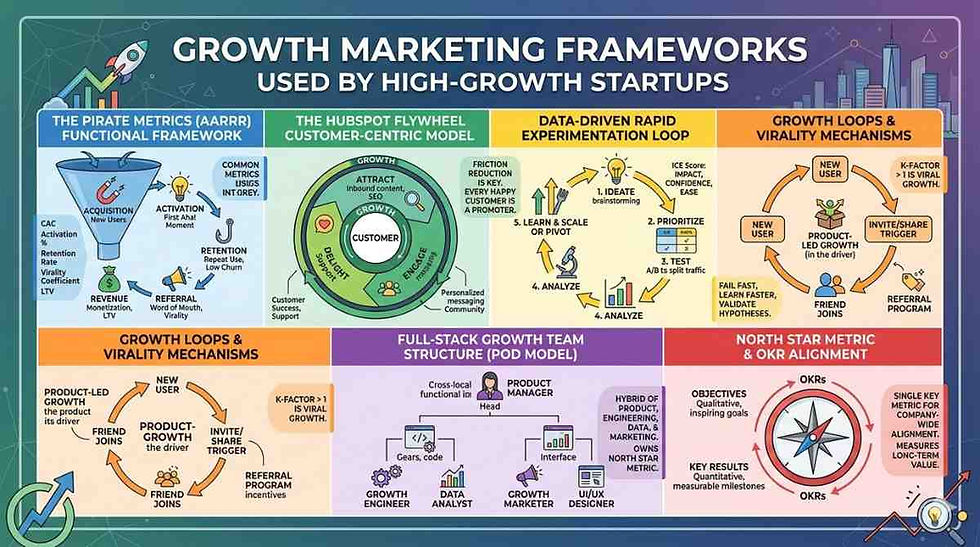
Brand Situation Prior to Growth Intervention
Airbnb launched in 2008 during a period of acute economic stress in the United States. The company's early proposition — renting out air mattresses in private homes — faced a severe trust and awareness deficit. The two-sided marketplace problem was acute: hosts would not list without guests, and guests would not arrive without inventory. Airbnb's early traction was documented in founder accounts published through Y Combinator and later through Harvard Business School case material, confirming the company generated under $200 per week in early 2009 before its growth interventions took effect.
Duolingo, founded in 2011 by Luis von Ahn and Severin Hacker, launched into a language learning market dominated by Rosetta Stone, which used a high-cost, box-software model. Duolingo's free-to-use, mobile-first design was structurally differentiated but faced the classic engagement problem of consumer edtech: users acquire the app with high intent and abandon it within days. Duolingo's own product team has publicly discussed this retention challenge in blog posts and in CEO Luis von Ahn's documented talks, noting that building a sustainable daily active user base required engineering habit formation at the product level.
Zepto, founded in 2021 by Aadit Palicha and Kaivalya Vohra — both Stanford dropouts — entered the Indian quick commerce market that was already occupied by Swiggy Instamart, Blinkit (then Grofers), and BigBasket's BB Now. Zepto's positioning around a 10-minute delivery promise was not merely a marketing claim; it was a supply chain and real estate thesis. At the time of its Series C fundraise in 2022 (publicly announced and covered by The Economic Times, CNBC TV18, and TechCrunch), Zepto had validated demand in Mumbai and Bangalore but had not yet established the dark store density required to make 10-minute delivery economically reproducible at scale.
Strategic Objective
The growth objective across all three cases was structurally similar even when the product categories differed: achieve compounding user growth at a cost-per-acquisition low enough to sustain scale without continuous infusion of paid media capital. The specific objectives, as reconstructable from public filings and documented founder commentary, were as follows.
For Airbnb, the objective was to solve the cold-start problem of a two-sided marketplace by engineering supply-side growth first, then leveraging that supply to attract demand organically. The Craigslist integration strategy — which has been widely written about in the technology press including by Wired and First Round Capital's published case material — involved building a tool that allowed Airbnb hosts to cross-post their listings to Craigslist, effectively piggybacking on Craigslist's existing high-intent traffic. This was not an officially sanctioned Craigslist integration; it was a product engineering decision that exploited the open structure of Craigslist's posting system. Airbnb's growth team later discussed this approach publicly at growth conferences and in interviews documented through Y Combinator's content channels.
For Duolingo, the objective was daily active user retention and the creation of a measurable habit loop — what the company's product team, in published blog material, refers to as a "streak" mechanic. The streak, a counter tracking consecutive days of practice, was introduced as a core product feature and is documented in Duolingo's publicly available product history and in Luis von Ahn's talks, including a TED Talk viewable on the TED platform, where he discusses the role of gamification in driving engagement.
For Zepto, the strategic objective was proof-of-concept on unit economics at the dark store level before national expansion — demonstrating that the 10-minute delivery promise could be made economically viable in high-density urban markets before scaling the model. This objective was articulated in Zepto's publicly reported fundraising narrative, covered in detail by The Economic Times and Mint in 2022 and 2023.
Growth Architecture & Execution
Airbnb's growth architecture is the most studied of the three and is most usefully understood through the concept of a viral loop — a mechanism by which each new user generates the conditions for acquiring additional users. The Craigslist cross-posting tool was the supply-side loop. On the demand side, Airbnb engineered a referral programme that gave both the referrer and the referred user a travel credit, creating a bilateral incentive. The structure of this referral programme, including credit values and programme mechanics, has been documented in Airbnb's own engineering blog and in startup growth literature widely cited by practitioners. The combination of Craigslist-driven supply growth and referral-driven demand growth constituted what growth theorists, drawing on Andrew Chen's published work at Andreessen Horowitz, call a "two-sided viral loop."
Duolingo's growth architecture is best described through the AARRR framework (Acquisition, Activation, Retention, Referral, Revenue), with the company's documented emphasis falling on Retention and Referral. The streak mechanic is the retention engine: it creates a daily usage obligation that is emotionally, not rationally, enforced. Duolingo's product team has published data on the streak in its official blog, noting that users with streaks above a certain length show materially higher retention rates. Additionally, Duolingo's mascot, the green owl Duo, became the vector for a push notification strategy that the company's own marketing team has discussed publicly — aggressive, personality-driven notifications that created cultural currency and organic social sharing. The virality of Duolingo's notification memes is documented in mainstream media coverage including pieces in The Verge, Wired, and the New York Times, all of which noted the organic social media amplification generated by the brand's notification tone.
Zepto's growth architecture is operationally distinct from the other two because its primary growth lever is physical infrastructure rather than digital product design. The dark store model — small-format, non-public-facing warehouses positioned within a 1–2 kilometre radius of dense residential clusters — is the unit of Zepto's growth strategy. Each dark store, when correctly positioned, serves as both a fulfilment node and a marketing proof point. The 10-minute delivery, when consistently delivered, generates word-of-mouth that is geographically concentrated and therefore more efficient than broadcast marketing. Zepto's expansion into cities including Hyderabad, Pune, Chennai, and Delhi NCR — documented in press releases and news coverage by The Economic Times and Business Standard between 2022 and 2024 — followed a density-first logic: achieve sufficient dark store concentration in one zone before moving to the next, rather than spreading thinly across geographies.
Positioning & Consumer Insight
The consumer insight underpinning each framework is worth isolating, because it is where the strategic differentiation is most clearly visible.
Airbnb's insight was behavioural and cultural: there existed a latent supply of under-utilised residential space, and there existed a demand segment — price-sensitive, experience-seeking travellers — that was willing to accept the discomfort of staying in a stranger's home in exchange for cost savings and local authenticity. The marketing challenge was not awareness; it was trust. Airbnb's early positioning, documented in its own brand history and in articles published by Fast Company and Forbes, leaned heavily into the concept of "belonging anywhere" — a positioning that addressed the psychological barrier to staying with strangers by reframing the transaction as a form of local belonging.
Duolingo's insight was psychological: the primary barrier to language learning is not lack of access to content but lack of sustained motivation. The gamification architecture — streaks, experience points, leagues, and mascot-driven emotional engagement — is a direct application of behavioural economics principles, specifically loss aversion (the streak creates a fear of losing progress) and variable reward schedules (completing a lesson delivers unpredictable but positive feedback). These mechanisms are not unique to Duolingo but have been applied more consistently and at greater scale than by any comparable edtech product. Luis von Ahn has discussed the application of these principles in multiple documented public forums.
Zepto's consumer insight was contextual and India-specific: in high-density urban markets with unreliable access to organised grocery retail, time — not price — is the primary purchase driver for a specific and growing consumer segment. The 10-minute delivery promise is not about convenience as a lifestyle value; it is about solving a functional need (running out of a specific ingredient, needing a product urgently) that the Indian grocery market had previously addressed only through informal neighbourhood kirana stores. Zepto's positioning, as documented in its public-facing communications and founder interviews published in YourStory, Inc42, and The Ken, frames the dark store as a modern kirana — familiar in function, superior in speed and range.
Media & Channel Strategy
All three companies share a notable characteristic in their early channel strategy: a deliberate avoidance of paid broadcast media in favour of earned and owned channels, with paid media deployed only after product-market fit had been validated at the unit level.
Airbnb's primary channels in the 2008–2012 period were SEO, the Craigslist cross-posting mechanism (an owned/engineered channel), and PR. Airbnb's early PR strategy — which included the infamous Obama O's and Cap'n McCain's breakfast cereal campaign to fund early operations — generated disproportionate media coverage that served as a brand awareness channel at near-zero cost. This story has been documented extensively in startup journalism including pieces in The Atlantic and by Y Combinator's own media presence.
Duolingo's channel strategy is product-centric: the app itself is the primary channel, with the notification system serving as a re-engagement channel and social media serving as an earned amplification channel. Duolingo does invest in paid media — its Super Bowl advertising spend in 2023 was publicly reported by AdWeek and the Wall Street Journal — but its foundational user base was built on organic app store discovery, word-of-mouth driven by the streak mechanic, and earned media generated by the Duo notification meme culture. No verified public data is available on Duolingo's paid media budget as a proportion of overall marketing spend.
Zepto's channel strategy is hyperlocal by design. The company has invested in performance marketing targeted at pin-code level audiences — a channel approach documented in interviews with Zepto's leadership team published in Inc42 and The Ken — combined with influencer and creator partnerships in specific urban markets. Zepto has also used IPL sponsorships and high-visibility outdoor advertising in metro cities, with its 2023 and 2024 IPL association reported by Afaqs and Exchange4Media. The hyperlocal targeting logic is structurally consistent with the dark store model: there is no value in reaching a consumer in Chennai with an ad for Zepto's Mumbai dark store network.
Business & Brand Outcomes
Only verified, publicly attributable outcomes are presented here.
Airbnb reached profitability on an adjusted EBITDA basis for the first time in 2022, as disclosed in its Q4 2022 earnings report filed with the SEC and reported by Reuters and Bloomberg. As of its 2023 annual report, Airbnb reported over 7 million active listings across more than 220 countries and regions. Revenue for fiscal year 2023 was reported at $9.9 billion, up from $8.4 billion in 2022, as per Airbnb's official investor relations filings. The two-sided viral loop and referral architecture built between 2008 and 2012 is widely credited — including in Airbnb's own investor communications — as the foundation of its supply density, which remains a primary competitive moat.
Duolingo reported in its Q4 2023 earnings — available on its investor relations page and covered by CNBC and the Financial Times — that daily active users reached 26.9 million, representing a 65% year-over-year increase. Duolingo's total revenue for fiscal year 2023 was reported at $531.1 million, up 44% from fiscal year 2022. The company also reported its first full year of GAAP net income profitability in 2023. No verified public data is available on the specific contribution of the streak mechanic to these outcomes; the attribution is inferential based on product design documentation rather than disclosed metrics.
Zepto's publicly reported valuation reached $1.4 billion following its Series E funding round in 2023, as reported by The Economic Times, TechCrunch, and Mint, making it one of the fastest Indian startups to reach unicorn status. The company disclosed an annualised revenue run rate of approximately $1 billion in late 2023, as reported by The Economic Times. No verified public data is available on Zepto's unit economics, per-order profitability, or dark store-level EBITDA as of the time of writing.
Strategic Implications
The three cases collectively illustrate a set of principles that can be abstracted into a working framework for growth marketing strategy in high-growth startups.
The first principle is that growth frameworks must be architected from product, not bolted onto it. In all three cases — Airbnb's referral mechanic, Duolingo's streak, Zepto's dark store geometry — the growth lever is structural to the product or operations, not a campaign overlay. This distinguishes these companies from those that attempt to manufacture growth through advertising without the underlying product engine to retain acquired users.
The second principle concerns the role of behavioural insight in framework design. Each company identified a specific psychological or behavioural barrier — trust (Airbnb), motivation (Duolingo), urgency and functional need (Zepto) — and designed the product and its marketing architecture to address that specific barrier. This is consistent with the Jobs-to-Be-Done framework (JTBD), which argues that consumers do not buy products; they hire them to do a specific job. Understanding the job — including its emotional and functional dimensions — is the prerequisite for designing a growth architecture that works.
The third principle is channel discipline: the most durable growth companies build earned and owned channels before deploying paid media at scale. This is not a categorical rejection of paid media; Duolingo's Super Bowl spot and Zepto's IPL sponsorship are both documented paid media investments. The sequence matters. Paid media deployed before product-market fit accelerates churn. Paid media deployed after a functioning organic growth loop multiplies a dynamic that already exists.
The fourth and most strategically consequential implication concerns moat construction. In each case, the growth framework does not merely acquire users — it builds a structural competitive barrier. Airbnb's supply density makes it nearly impossible for a new entrant to match listing volume. Duolingo's streak mechanic creates switching costs rooted in emotional investment, not contractual lock-in. Zepto's dark store density means that matching its delivery speed requires matching its real estate and inventory investment, not merely its marketing spend. Growth, properly engineered, is not merely an acquisition function — it is a moat-building function.
For marketing strategists and founders, the practical implication is clear: before designing a growth campaign, the prior question is whether the product contains a growth mechanism. If it does not, the campaign acquires users into a leaking bucket. If it does, the campaign acts as an accelerant on a compounding system. The distinction between these two situations is the difference between growth marketing and growth theatre.
Discussion Questions
Q1.Duolingo's streak mechanic exploits loss aversion — a well-documented cognitive bias to drive daily engagement. What are the ethical boundaries of applying behavioural economics principles in product design, and how should marketers distinguish between dark patterns and legitimate behavioural design?
Q2.Airbnb's Craigslist cross-posting strategy involved exploiting the technical openness of a competitor's platform without formal permission. How should growth marketers evaluate the long-term brand risk of growth hacks that exist in a legal or ethical grey zone?
Q3.Zepto's growth model is predicated on physical infrastructure density rather than digital product design. What are the conditions under which a physical-world growth model is more defensible than a digital-world viral loop, and how does this vary by market context?
Q4.All three companies prioritised organic and earned channels before deploying paid media at scale. Evaluate the conditions under which this sequencing is strategically optimal versus situations where early paid media investment may be necessary for market formation.
Q5.Each of the three growth frameworks described in this case study can be mapped to one or more of the five stages of the AARRR (Pirate Metrics) framework. Conduct this mapping and analyse which stage each company chose to optimise first — and argue whether that choice was necessary or contingent on category-specific factors.


Comments