Hindustan Unilever's Surf Excel "Daag Achhe Hain" (Stains Are Good) Kindness Campaigns
Executive Summary
Hindustan Unilever Limited (HUL), India's largest fast-moving consumer goods (FMCG) company, transformed its Surf Excel detergent brand positioning through the "Daag Achhe Hain" (Stains Are Good) campaign platform launched in 2005. Unlike traditional detergent advertising that emphasized stain removal efficacy, Surf Excel's campaigns reframed stains as evidence of positive childhood experiences, learning, creativity, and kindness. Over nearly two decades, HUL developed this platform into one of India's most recognized and emotionally resonant advertising campaigns, particularly through annual advertisements around Holi and Ramadan that connected cleanliness to broader values of compassion and social harmony. This case study examines the strategic development, creative execution, cultural integration, and documented impacts of Surf Excel's kindness-focused campaigns using only publicly verified information from company reports, advertising industry publications, news coverage, and academic analysis.
Company and Brand Background
Hindustan Unilever Limited, the Indian subsidiary of Unilever PLC, has operated in India since 1933. According to HUL's FY 2022-23 Annual Report, the company's products reached over 90% of Indian households, with operations spanning multiple FMCG categories including home care, personal care, and foods.
Surf, one of HUL's oldest detergent brands, was launched in India in 1959, according to brand history information documented in Campaign India and other advertising trade publications. According to these sources, Surf was positioned as a premium detergent brand emphasizing superior cleaning performance. In 1995, HUL launched Surf Excel, a reformulated variant with improved stain removal properties, according to brand timeline information reported in these publications.
For decades, Surf Excel's advertising followed conventional detergent marketing approaches emphasizing product efficacy, demonstrating before-and-after stain removal, and focusing on mothers' concerns about keeping children's clothes clean. According to analysis in Campaign India and Brand Equity (advertising trade publications) documenting Indian advertising history, this approach was consistent with category norms across detergent brands globally and in India.
India's detergent market is highly competitive, with major players including HUL's multiple brands (Surf Excel, Rin, Wheel), Procter & Gamble's Ariel and Tide, and regional brands. According to articles in The Economic Times and Business Standard from the 2000s and 2010s discussing the detergent category, competition centered on price, efficacy claims, and distribution strength across diverse income segments.
Strategic Context and Campaign Genesis
The 2005 "Daag Achhe Hain" Launch
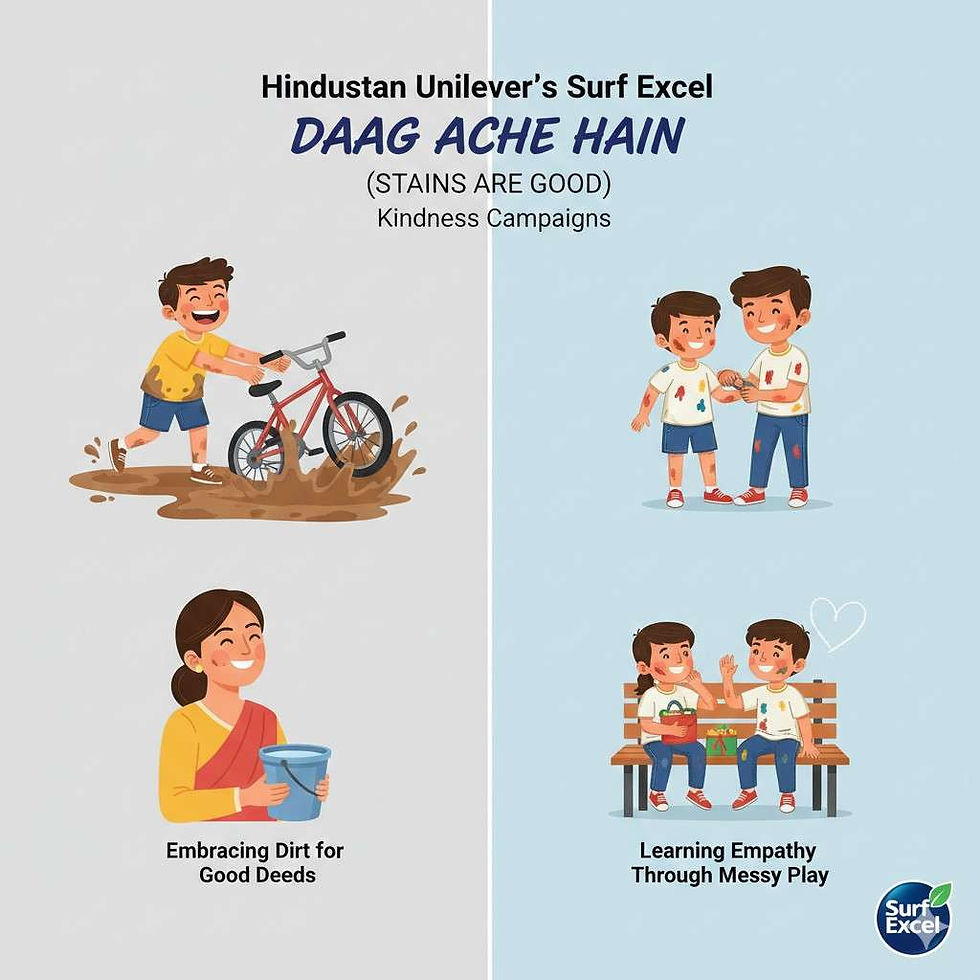
In 2005, Surf Excel launched a fundamentally different advertising approach with the tagline "Daag Achhe Hain" (Stains Are Good). According to extensive coverage in Campaign India, Brand Equity, and other advertising publications documenting the campaign's history, the first advertisement in this campaign showed children getting dirty while engaged in creative play, learning, or helping others, with the message that such stains were badges of positive experiences rather than problems to be avoided.
The campaign was developed by Lowe Lintas (later Lowe Lintas + Partners, and subsequently MullenLowe Lintas Group), HUL's creative agency, according to information in these advertising trade publications. According to Campaign India's coverage of the campaign's development, the strategic insight was to shift focus from the problem (stains/dirt) to the positive activities that caused stains, repositioning the brand's relationship with mothers and children.
According to articles in these publications, rather than depicting mothers as anxious about stains and positioning Surf Excel as solving a problem, the new approach encouraged mothers to view children's active, exploratory, kind, and creative behaviors positively, with Surf Excel's role being to enable such experiences by removing stains afterward.
No verified public information is available on the consumer research process that informed this strategic shift, specific insights from research, internal debates about the repositioning, or quantitative testing of the campaign concept before launch.
Strategic Rationale
According to analysis in Campaign India, Brand Equity, and business publications including The Economic Times discussing the campaign in subsequent years, the "Daag Achhe Hain" positioning offered several strategic advantages. The emotional positioning differentiated Surf Excel from competitors still emphasizing functional stain-removal benefits, creating distinctive brand equity beyond product performance. The approach addressed premium positioning by associating the brand with progressive parenting values rather than competing primarily on efficacy or price.
According to these analyses, the campaign reflected broader social trends including increasing emphasis on child development, experiential learning, and emotional intelligence in Indian urban middle-class families. By aligning with these values, Surf Excel positioned itself as understanding modern parenting priorities.
Major Campaign Executions and Themes
Early "Daag Achhe Hain" Advertisements
According to documentation in advertising trade publications, early advertisements in the "Daag Achhe Hain" series featured scenarios such as children helping paint a school, getting muddy while rescuing an animal, or engaging in messy creative activities. According to Campaign India's coverage, these advertisements consistently emphasized that the stains resulted from positive, character-building activities.
The creative execution maintained consistency across advertisements through visual style, emotional tone, and the repeated tagline reinforcing the core message. According to analysis in these publications, the campaigns avoided explicitly showing product usage or stain removal demonstrations, instead focusing on the activities that caused stains and the emotional payoff of enabling childhood experiences.
Holi-Themed Advertisements
Among the most discussed executions in the "Daag Achhe Hain" platform were annual advertisements released around Holi, the Hindu festival of colors. According to coverage in The Economic Times, The Hindu, Campaign India, and other outlets documenting these campaigns:
According to reporting by Campaign India and The Economic Times in March 2014, one Holi advertisement titled "Rang Laye Sang" depicted a Hindu boy offering to get colored (a central Holi activity) on behalf of his Muslim friend so the friend could attend prayer while wearing clean white clothes required for the occasion. According to these reports, the advertisement depicted the Hindu boy arriving home covered in colors, with his mother understanding and supporting his act of kindness.
According to subsequent coverage in The Hindu, The Times of India, and Campaign India from 2015-2020, HUL released similar Holi-themed Surf Excel advertisements annually, many incorporating themes of interfaith harmony, childhood friendship transcending religious differences, or acts of kindness involving getting dirty or stained to help others.
These advertisements generated significant media coverage and public discussion, according to documentation in news outlets. According to reporting in The Economic Times and Campaign India, the Holi campaigns became anticipated annual events, with audiences expecting Surf Excel's advertisements as part of the cultural conversation around the festival.
Ramadan-Themed Advertisement (2019)
In 2019, Surf Excel released an advertisement during Ramadan that generated substantial controversy. According to extensive coverage in The Hindu, The Times of India, The Economic Times, Indian Express, and international outlets including Reuters and BBC:
The advertisement, according to descriptions in these outlets, depicted a young Hindu girl protecting her Muslim friend from being hit by colored balloons (during Holi season, which sometimes coincides with Ramadan) so he could reach the mosque for prayers without his clothes getting stained. According to these reports, the girl wore white clothes that became stained while shielding her friend.
According to reporting in these outlets, the advertisement generated both praise for promoting interfaith harmony and significant criticism and backlash. According to The Hindu and The Times of India coverage in March 2019, social media saw calls to boycott Surf Excel, with a hashtag #BoycottSurfExcel trending on Twitter. According to these reports, critics accused the advertisement of religious pandering, "love jihad" narratives (a controversial term used by some groups in India alleging organized efforts to convert Hindu women), or inappropriate religious messaging in commercial advertising.
According to reporting by Reuters and The Economic Times, defenders of the advertisement praised it as promoting unity, tolerance, and kindness across religious communities. According to these articles, advertising industry professionals quoted in news coverage generally praised the advertisement's creative execution and message, though noting it entered sensitive sociopolitical territory.
According to statements from HUL reported in The Economic Times and Campaign India, the company defended the advertisement, stating it reflected brand values of kindness and was consistent with Surf Excel's long-standing messaging. No verified public information is available on whether the controversy affected sales, brand perception metrics, or HUL's subsequent advertising strategies.
Other Kindness-Themed Executions
According to coverage in Campaign India and Brand Equity documenting the campaign's evolution, numerous other advertisements in the "Daag Achhe Hain" platform depicted children performing acts of kindness that resulted in getting dirty, including helping elderly people, protecting animals, assisting in community work, or supporting friends in need.
According to these publications, the consistent creative formula involved showing children's selfless or generous behavior, the resulting stains or dirt, and positive resolution affirming the behavior's value. The tagline "Daag Achhe Hain" served as the philosophical anchor across diverse executions.
Cultural Resonance and Public Response
Awards and Industry Recognition
According to reporting in Campaign India, Brand Equity, The Economic Times, and international advertising publications, Surf Excel's "Daag Achhe Hain" campaigns received extensive industry recognition. According to Campaign India's coverage of advertising award ceremonies from 2006-2020, various executions within the campaign platform won awards at Indian and international advertising festivals including the Cannes Lions, Effie Awards, and other competitions.
According to these publications, industry recognition cited creative excellence, emotional resonance, cultural relevance, and sustained consistency of the campaign platform over many years. The campaign became a case study in Indian advertising education and professional discourse, according to references in advertising trade publications.
Integration into Cultural Conversation
According to analysis in The Hindu, The Times of India, and other mainstream publications beyond advertising trade press, "Daag Achhe Hain" entered popular culture in India as a recognizable phrase and concept. According to these articles, the tagline was referenced in general cultural contexts beyond advertising, suggesting broader cultural penetration.
According to reporting in Campaign India and Brand Equity, the annual Holi advertisements became anticipated cultural events, generating discussion on social media and in mainstream media each year. According to these reports, this anticipation reflected successful brand-culture integration where advertising became part of festive conversation rather than mere commercial messaging.
No verified public information is available on quantitative measures of cultural impact such as brand awareness studies, message recall, brand perception tracking, or systematic consumer research documenting the campaign's cultural resonance.
Strategic Marketing Analysis
Emotional Versus Functional Positioning
Surf Excel's shift represented a strategic choice to compete on emotional differentiation rather than primarily on functional product attributes. According to marketing strategy analysis published in business journals and discussed in Harvard Business Review articles about brand positioning (cited in Indian business media analyzing the campaign), emotional brand positioning can create sustainable differentiation when functional attributes are difficult to differentiate or easily copied by competitors.
In the detergent category, where most brands could claim effective stain removal and where consumers might struggle to perceive significant performance differences, emotional positioning offered a basis for premium pricing and brand loyalty beyond functional considerations. According to this strategic logic discussed in business publications analyzing the campaign, Surf Excel aimed to win not by claiming superior cleaning but by owning values and emotions associated with good parenting, childhood development, and kindness.
However, this approach also created risk that the brand might be perceived as lacking functional efficacy if emotional messaging overshadowed product performance. No verified public information is available on whether HUL tracked perceptions of Surf Excel's cleaning performance over time or whether the emotional positioning affected functional attribute perceptions.
Premium Brand Positioning
According to HUL's annual reports and descriptions in business media, Surf Excel was positioned at the premium end of HUL's detergent portfolio, with other HUL brands like Rin and Wheel targeting mid-market and value segments respectively. The "Daag Achhe Hain" campaign supported premium positioning by associating the brand with progressive values and premium parenting approaches.
According to analysis in The Economic Times and Business Standard discussing FMCG pricing strategies, premium brands justify higher prices through superior product formulations and through emotional and status benefits. Surf Excel's approach addressed the latter dimension by positioning the brand as aligned with enlightened, values-based parenting that prioritized children's development and character over mere cleanliness.
Values-Based Marketing and Purpose-Driven Branding
Surf Excel's campaigns reflected broader trends toward "purpose-driven" or values-based marketing. According to analysis in Harvard Business Review, The Economic Times, and other business publications discussing marketing trends in the 2010s, brands increasingly incorporated social values and purposes into positioning, moving beyond purely functional or emotional consumer benefits to articulate broader societal roles.
According to these discussions, purpose-driven marketing offered potential advantages including deeper consumer connections, employee engagement, and differentiation in crowded categories, but also created risks including perceptions of insincerity, backlash if values messaging appeared performative, or controversy when brands took positions on socially sensitive issues.
Surf Excel's experience, particularly with the 2019 Ramadan advertisement controversy, illustrated both the potential power and risks of values-based marketing. The campaign generated strong positive responses from consumers aligned with the promoted values while also triggering backlash from those who disagreed with the messaging or objected to brands entering sociopolitical territory.
Sociopolitical Context and Controversy Management
Interfaith Messaging in Polarized Context
Surf Excel's emphasis on interfaith friendship and religious harmony in several advertisements occurred during a period of increasing religious and political polarization in India. According to reporting in The Hindu, The Times of India, Indian Express, and international outlets including The Guardian and The New York Times discussing Indian social and political trends in the 2010s, religious identity politics intensified during this period, with increasing communal tensions in various parts of the country.
In this context, advertisements depicting Hindu-Muslim friendship and mutual support represented not merely generic kindness messaging but engagement with socially and politically charged themes. According to analysis in these outlets, some viewers interpreted such advertisements as taking implicit political positions on debates about secularism, religious relations, and national identity.
The boycott calls and social media backlash documented in news coverage of the 2019 advertisement illustrated that brand messaging touching on religious themes could generate strong reactions from segments of the population. According to these reports, critics viewed the advertisements as one-sided or as promoting particular narratives about religious relations that they disagreed with.
HUL's Response to Controversy
According to reporting by The Economic Times, Campaign India, and The Hindu covering the 2019 controversy, HUL issued statements defending the advertisement and its messaging. According to these reports, the company framed the advertisement as consistent with Surf Excel's long-standing values and as promoting universal themes of kindness and childhood friendship.
According to Campaign India's coverage, HUL did not withdraw the advertisement or apologize despite the backlash. This response suggested the company viewed the core messaging as aligned with brand values worth defending, even amid controversy. However, no verified public information is available on whether the controversy influenced subsequent advertising strategies, creative approaches to religious themes, or internal policies about navigating sensitive sociopolitical content.
According to some marketing analysts quoted in The Economic Times and Campaign India, the controversy generated additional visibility and discussion for the brand, potentially providing benefits even amid negative reactions from some segments. However, without access to HUL's consumer research or brand tracking data, the net impact on brand equity or business performance cannot be verified from public sources.
Limitations of Available Information
Significant gaps exist in publicly available information about Surf Excel's "Daag Achhe Hain" campaigns:
Consumer research insights informing the initial strategic shift and subsequent creative development are not publicly documented beyond general descriptions of strategic rationale.
Quantitative performance metrics including campaign-specific sales impacts, brand awareness changes, brand perception tracking, message recall, or purchase intent metrics are not publicly disclosed.
Development and decision-making processes including how creative concepts were developed, how HUL evaluated different creative approaches, internal debates about messaging, or approval processes for sensitive advertisements are not documented in public sources.
Segmentation and targeting analysis showing how different consumer segments responded to the campaigns, whether the messaging resonated uniformly or varied by demographics, or how campaigns were tailored to specific audiences is not publicly available.
Comparative effectiveness of "Daag Achhe Hain" campaigns versus previous or alternative advertising approaches, including whether the emotional positioning delivered superior business results compared to functional efficacy messaging, is not documented in verified public sources.
Controversy impact assessment including systematic research on how the 2019 backlash affected brand perceptions, purchase behavior, or consumer segments' brand relationships is not publicly released.
Media investment and channel strategy details about advertising spending levels, media mix across television, digital, and other channels, or geographic targeting are not publicly disclosed beyond HUL's total marketing expenditure reported in annual reports.
Competitive response analysis showing how competitors reacted to Surf Excel's positioning or whether other brands adopted similar emotional positioning approaches is not comprehensively documented.
Long-term strategic evolution including whether HUL continues the "Daag Achhe Hain" platform, how the platform has evolved post-2020, or planned future directions is not publicly detailed.
Key Lessons from Publicly Available Information
Lesson 1: Emotional Differentiation in Functional Categories
Surf Excel's strategic shift from functional stain-removal messaging to emotional kindness positioning demonstrates how brands in functionally-similar categories can create differentiation through emotional territory rather than product attribute claims. The documented industry recognition and cultural penetration of the "Daag Achhe Hain" platform suggests this approach achieved distinctive positioning. However, the lesson comes with caveats: emotional positioning requires sustained investment and consistency over many years, as evidenced by the campaign's nearly two-decade duration. Additionally, emotional positioning must remain credible and connected to product category—Surf Excel maintained implicit connection to cleaning by positioning stains as positive when they result from good activities, still requiring detergent to remove them. The transferability of this approach to other brands and categories remains uncertain without access to performance data.
Lesson 2: Cultural Integration Through Festival and Values Alignment
Surf Excel's integration of campaigns with cultural festivals, particularly Holi, demonstrates a strategy of aligning brand messaging with culturally significant moments and deeply held values. The documented annual anticipation of Holi advertisements suggests successful integration where advertising became part of cultural conversation rather than commercial interruption. The strategic lesson is that brands can achieve deeper consumer connections by authentically engaging with cultural moments and values that matter to target audiences. However, this approach requires understanding cultural nuances and avoiding superficial exploitation of cultural symbols. The documented industry recognition suggests Surf Excel's execution was perceived as authentic rather than opportunistic, though the basis for this perception beyond creative quality is not documented in public sources.
Lesson 3: Risks of Values-Based Marketing in Polarized Contexts
The 2019 Ramadan advertisement controversy illustrates that values-based marketing involving socially or politically sensitive themes creates both opportunities and risks. While promoting interfaith harmony aligned with Surf Excel's kindness positioning, it also triggered backlash in a politically polarized context. The lesson is that brands must carefully evaluate whether values messaging might generate controversy and must decide whether promoting particular values is sufficiently aligned with brand identity to justify potential backlash. HUL's decision not to withdraw the advertisement suggests the company deemed the messaging central to brand values. However, without access to impact data, whether this decision proved strategically beneficial cannot be verified. The broader lesson is that values-based marketing is not risk-free and requires conviction and willingness to defend messaging under criticism.
Lesson 4: Consistency and Long-Term Platform Development
The "Daag Achhe Hain" platform's maintenance across nearly two decades, documented in advertising trade publications, illustrates the value of consistency in building distinctive brand equity. Rather than changing creative approaches frequently, HUL developed variations on a consistent theme, allowing the core message to become strongly associated with the brand. The strategic lesson is that sustainable differentiation through advertising requires patient, consistent investment in a platform rather than constantly seeking novelty. However, this approach also creates risk of messaging fatigue or reduced effectiveness over time, and the optimal balance between consistency and refreshment is not documented in public sources regarding Surf Excel's experience.
Lesson 5: Measuring Success in Emotional and Cultural Campaigns
The absence of publicly disclosed quantitative performance metrics for Surf Excel's campaigns illustrates broader challenges in measuring the impact of emotional, values-based advertising. While industry awards and cultural discussion provide qualitative evidence of impact, translating emotional resonance into verified business outcomes remains challenging without access to comprehensive performance data. This limitation affects strategic evaluation—without clear metrics demonstrating that emotional positioning drives superior business performance, the strategic wisdom of this approach versus alternatives cannot be definitively assessed. The lesson is that organizations pursuing emotional positioning strategies must develop robust internal measurement systems even when such metrics are not publicly disclosed, and external analysts should acknowledge the limitations of evaluation based solely on creative recognition and qualitative cultural impact.
Discussion Questions for MBA Analysis
Evaluating Trade-offs Between Functional and Emotional Positioning: Surf Excel shifted from functional stain-removal messaging to emotional kindness positioning. From a brand strategy perspective, how should managers evaluate whether to emphasize functional benefits versus emotional territory? Develop a framework considering factors including category maturity, competitive differentiation possibilities, consumer decision-making processes, premium positioning objectives, and performance perception risks. Under what conditions should brands prioritize emotional differentiation? When might functional messaging remain optimal? Consider how your framework would apply to other FMCG categories and whether Surf Excel's approach is broadly replicable.
Navigating Sociopolitical Sensitivity in Values-Based Marketing: The 2019 Ramadan advertisement controversy illustrates risks when brand values messaging intersects with politically or socially polarized issues. Develop decision criteria for determining when brands should engage with sensitive social or political themes versus focusing on less controversial values. Consider factors including brand identity centrality, target audience alignment, stakeholder impacts, controversy management capabilities, and long-term brand equity implications. How should companies balance authentic values expression with commercial risk management? What governance processes should guide decisions about creatively approaching sensitive themes?
Measuring ROI of Emotional Brand Building Campaigns: Without access to Surf Excel's performance data, how would you design a comprehensive measurement framework to evaluate whether emotional brand building campaigns deliver superior business outcomes compared to functional product messaging? Define metrics across short-term (sales, awareness), medium-term (brand perceptions, loyalty), and long-term (brand equity, pricing power) horizons. Specify how you would isolate campaign effects from other factors influencing brand performance. What experimental or quasi-experimental designs could rigorously test emotional versus functional messaging effectiveness? Discuss feasibility and cost implications of your measurement framework.
Sustaining Creative Platforms Over Long Time Horizons: Surf Excel maintained the "Daag Achhe Hain" platform for nearly two decades. From a creative strategy perspective, analyze the trade-offs between consistency (building strong associations through repetition) and refreshment (maintaining interest and avoiding fatigue). How should brand managers determine when an established platform remains effective versus when it requires evolution or replacement? What signals or metrics would indicate platform fatigue? Design a process for sustaining creative platforms over time while maintaining freshness. Consider organizational challenges including agency relationships, creative team turnover, and leadership changes that affect platform continuity.
Cultural Authenticity Versus Commercial Opportunism in Festival Marketing: Surf Excel integrated messaging with cultural festivals, particularly Holi. From a cultural branding perspective, how can marketers distinguish between authentic cultural engagement and opportunistic exploitation of cultural moments? What principles should guide brand participation in culturally significant festivals or traditions? Consider the perspectives of diverse stakeholders including consumers, cultural critics, and community leaders. Develop guidelines for respectful, authentic festival marketing that creates value for both brands and cultural communities. How would you evaluate whether specific executions meet standards of authenticity versus constituting cultural appropriation or commercial exploitation?


Comments