How Brands Use Data Analytics to Shape Marketing Strategy
Section 1: Industry & Competitive Context
The global marketing analytics market has grown substantially over the past decade, driven by the proliferation of digital touchpoints, the maturation of customer data platforms (CDPs), and rising pressure on marketing teams to demonstrate measurable return on investment. According to a McKinsey Global Institute report, companies that are data-driven in their marketing decision-making are significantly more likely to acquire and retain customers relative to competitors that rely primarily on intuition-led planning.
In India specifically, the rise of e-commerce, OTT platforms, and mobile-first consumption has generated an unprecedented volume of behavioral, transactional, and attitudinal data. Brands operating in FMCG, retail, financial services, and direct-to-consumer categories have increasingly moved toward building in-house data capabilities or partnering with analytics firms to extract strategic advantage from this data infrastructure.
The competitive dynamic in data-led marketing is no longer about who has the most data — it is about which organizations have built the institutional capability to translate data into actionable marketing decisions at speed.
Section 2: Brand Situations and Strategic Entry Points
2.1 Netflix — Audience Intelligence as a Programming and Marketing Asset
Netflix represents one of the most thoroughly documented examples of a brand embedding data analytics at every layer of its marketing and content strategy. The company has publicly disclosed, through investor letters, earnings calls, and official communications, that its recommendation engine drives a significant proportion of content discovery on the platform. Netflix's content investments — including decisions around which original programming to commission — are informed by its understanding of viewer behavior patterns aggregated across its subscriber base.
From a marketing strategy standpoint, Netflix uses audience data not merely to serve recommendations but to design its entire promotional apparatus. Trailer selection, thumbnail personalization, and push notification timing are all informed by behavioral signals. Netflix executives have publicly acknowledged in earnings communications that personalization at scale reduces subscriber churn by improving content-match quality.
This represents a strategic application of what marketers would classify as a behavioral segmentation model layered onto a product experience — where the marketing function and the product function are, in effect, unified through data.
2.2 Hindustan Unilever — Consumer Insight Architecture in an FMCG Context
Hindustan Unilever Limited (HUL) has publicly stated, across multiple investor days and annual reports, that data and analytics form a central pillar of its Compass growth strategy. HUL has disclosed investments in building digital capabilities including data infrastructure, programmatic advertising, and precision targeting — shifting a meaningful proportion of its media spend toward digital channels where attribution and audience intelligence are more accessible than in traditional broadcast media.
In its 2022 and 2023 annual reports and investor presentations, HUL referenced the use of data to sharpen its portfolio strategy — identifying high-growth consumption occasions, geographic demand clusters, and category white spaces. The company has talked publicly about using consumer data platforms to improve campaign ROI and to enable personalization at scale across its brand portfolio.
For a company operating across price-sensitive, mass-market segments in India, the strategic implication of data analytics is not just media efficiency — it is the ability to make sharper portfolio decisions, identifying which brands need investment, repositioning, or harvest in a given market cycle.
2.3 Zomato — Real-Time Data as a Brand and Communication Engine
Zomato provides a well-documented case of a digital-native Indian brand that has institutionalized data not just in its performance marketing stack but in its brand communication strategy. Zomato's annual reports and public filings as a listed entity on the Indian stock exchanges provide insight into its approach to customer engagement and platform intelligence.
The company has publicly disclosed metrics around order frequency, platform usage patterns, and customer cohort behavior in its quarterly investor communications. More notably, Zomato has used publicly observable behavioral data — such as order timing trends, cuisine preferences by geography, and consumption occasion data — as the raw material for culturally resonant brand content and social media communication.
This approach — where real-time platform data feeds directly into content strategy — represents a significant evolution from traditional marketing planning cycles. Zomato's communication style, which has been widely covered in marketing trade publications, reflects a data-informed understanding of when its audience is most receptive, what cultural moments are relevant to its consumption category, and how to convert behavioral triggers into brand moments.
Section 3: Strategic Objectives Served by Data Analytics
Across the documented cases above and broader industry evidence, data analytics serves four distinct strategic objectives in marketing:
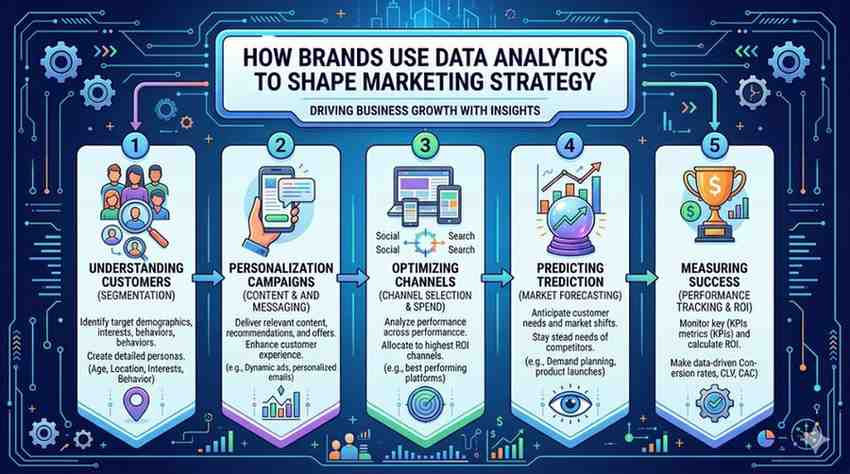
First, precision segmentation. Traditional demographic segmentation has been augmented by behavioral, psychographic, and occasion-based segmentation enabled by data. Brands are no longer targeting "urban males aged 25–35" — they are identifying high-intent, high-frequency consumers within that cohort who exhibit specific behavioral signals.
Second, marketing mix optimization. Data analytics enables brands to model the relative contribution of different media channels to brand and business outcomes, allowing more disciplined allocation of marketing investment. This is particularly relevant as media fragmentation has increased complexity in multi-channel planning.
Third, content and creative decision-making. As Netflix's thumbnail and trailer strategy demonstrates, data increasingly informs creative decisions — not by replacing creative judgment but by providing systematic feedback loops that improve message relevance and audience-fit.
Fourth, brand health monitoring. Several large brands have moved toward continuous brand tracking methodologies powered by social listening, search trend analysis, and panel-based measurement, replacing annual brand health surveys with near-real-time diagnostic tools.
Section 4: Campaign Architecture Shaped by Data
4.1 Spotify Wrapped — Data as the Campaign
Spotify's annual Wrapped campaign is among the most thoroughly documented examples of data analytics functioning as the campaign itself, rather than merely informing it. Spotify has publicly discussed the Wrapped product in multiple official communications, press releases, and media interviews with its marketing leadership.
The strategic logic of Wrapped is instructive: rather than using data as a backend optimization tool, Spotify converts user behavioral data — listening history, top artists, minutes streamed — into a personalized, shareable narrative for each user. The campaign functions simultaneously as a brand celebration, a retention mechanism, and a word-of-mouth acquisition engine.
From a marketing strategy standpoint, Wrapped demonstrates how data can be the creative insight, the product experience, and the distribution mechanism all at once. The social sharing behavior that Wrapped generates has been widely covered in marketing and business press, with significant earned media value documented annually.
4.2 Amazon — Behavioral Data and Cross-Category Marketing
Amazon's publicly available shareholder letters and AWS marketing communications have consistently articulated how customer behavioral data powers its marketing and product recommendation architecture. Amazon's recommendation engine — which the company has discussed publicly as a driver of sales — represents the application of collaborative filtering and predictive analytics to marketing personalization.
For brands selling on Amazon and for Amazon's own private labels, the behavioral data architecture enables a form of marketing that is categorically different from traditional brand communication: it is contextual, intent-driven, and calibrated to the individual's position in the purchase journey rather than to a mass-market message.
Section 5: Positioning and Consumer Insight
The brands that have most effectively used data analytics to shape marketing strategy share a common positioning logic: they have repositioned data not as a performance measurement tool but as a source of consumer understanding. This distinction is strategically significant.
When data is treated as a measurement tool, it answers the question: "How well did our campaign perform?" When data is treated as a consumer insight tool, it answers the question: "What does our consumer actually value, need, or expect — and how does our brand fit into that context?"
This shift in the strategic framing of data unlocks fundamentally different marketing decisions. Brands that have made this shift — Netflix, Spotify, Zomato, and others operating in data-rich digital environments — have moved toward what researchers and practitioners now describe as "behavioral brand building": using observed behavior rather than stated preferences as the primary signal for strategic decisions.
The consumer insight extracted through data analytics is most valuable when it reveals what consumers do, not merely what they say. Survey-based research captures stated preferences; behavioral data captures revealed preferences. For marketing strategy, revealed preference data is structurally superior for decisions around product positioning, media timing, pricing sensitivity, and message framing.
Section 6: Media and Channel Strategy
Data analytics has materially transformed media and channel strategy in several documented ways.
Programmatic advertising, now a standard component of digital media buying, is entirely dependent on data infrastructure — audience segments, contextual signals, and real-time bidding logic. Large Indian advertisers, including HUL and Nestle India, have publicly discussed increased digital media allocation in their investor communications, reflecting the shift toward data-addressable media channels.
Attribution modeling — the analytical process of assigning credit to different touchpoints across a consumer's path to purchase — has become a standard planning discipline for brands with multi-channel media presences. While specific attribution models are rarely disclosed publicly, the investment in measurement capabilities has been documented in industry reports by organizations such as WARC and Nielsen, both of which publish publicly available market intelligence.
The strategic implication for channel strategy is significant: brands with robust data infrastructure can dynamically reallocate media investment based on in-flight performance signals, rather than committing to static annual media plans. This agility in media deployment represents a structural competitive advantage for data-mature organizations.
Section 7: Business and Brand Outcomes (Documented)
The business outcomes most consistently associated with data-led marketing strategy — as documented in public sources — fall into several categories.
Netflix reported in its 2023 annual report and earnings communications that its personalization and recommendation infrastructure contributes meaningfully to engagement and subscriber satisfaction, though it does not publicly disclose specific attribution percentages for individual features.
Spotify's Wrapped campaign has been recognized in multiple industry publications including Cannes Lions and WARC as among the most effective brand engagement campaigns of recent years, with documented evidence of significant social media amplification and press coverage generated annually.
HUL's investor communications have referenced improved digital marketing ROI and more efficient media spend as outcomes of its data capability investments, though specific efficiency figures are not publicly broken out.
Amazon's publicly available financial reports document its advertising services as one of its fastest-growing revenue segments, growing from approximately $31 billion in 2021 to over $46 billion in 2023 as reported in Amazon's annual reports — a figure that reflects the commercial value of its behavioral data infrastructure for both Amazon and third-party advertisers.
Zomato's public filings as a listed company in India document improvements in customer order frequency and engagement across cohorts, attributed in part to its platform intelligence and personalization capabilities.
Section 8: Strategic Implications
Several strategic implications emerge from this analysis, each relevant to brand teams, agency planners, and growth strategists.
Data maturity is now a brand asset, not just an operational capability. Organizations that have built robust first-party data infrastructure — consent-based, well-governed, and analytically capable — possess a brand-building advantage that compounds over time. The quality of strategic decisions improves as data quality and coverage improve.
The relationship between data and creativity is complementary, not competitive. The Spotify Wrapped case demonstrates that data can be the creative brief, the product experience, and the distribution mechanism simultaneously. The brands that win in data-led marketing are those that have resolved the organizational tension between data teams and creative teams — treating data as a source of creative inspiration rather than a post-hoc performance audit.
First-party data is becoming the primary competitive moat in digital marketing. As third-party cookies have been deprecated and privacy regulations have tightened globally — including India's Digital Personal Data Protection Act — brands that have invested in direct consumer relationships and consented first-party data have a structural advantage over those dependent on third-party audience segments.
The speed of insight extraction matters as much as the depth of analysis. Marketing strategy in real-time digital environments requires what practitioners describe as "agile intelligence" — the ability to move from data signal to strategic decision in compressed time frames. Brands with rigid, waterfall-style analytics processes are structurally disadvantaged relative to those with modular, always-on data capabilities.
India-specific context adds complexity to the data-analytics imperative. In the Indian market, the combination of digital-first consumer behavior among younger cohorts and persistent offline consumption patterns among mass-market segments means that brands must build analytics frameworks capable of integrating both digital behavioral data and offline market intelligence. The brands that figure out this integration — connecting first-party digital data with rural and semi-urban distribution intelligence — will have a significant strategic edge in the next phase of India's consumption growth.
Conclusion
Data analytics has evolved from a measurement discipline into a core strategic capability that shapes how brands understand their consumers, allocate their resources, design their communications, and build long-term equity. The cases examined in this study — Netflix, Spotify, HUL, Zomato, and Amazon — represent different contexts and market positions, but share a common architecture: data is embedded into strategic decision-making, not appended to it.
For marketing strategists, the key learning is not that data replaces strategic judgment — it sharpens it. The organizations that have derived the most strategic value from analytics are those that have built the institutional capability to ask better questions of their data, and the organizational discipline to act on the answers with speed and clarity.
Discussion Questions for MBA Students
Question 1: Netflix uses behavioral data to personalize both content recommendations and marketing materials such as thumbnails and trailers. What are the ethical boundaries of personalization in brand communication, and how should brands balance personalization with consumer trust?
Question 2: Spotify's Wrapped campaign converts first-party user data into a shareable brand experience. How does this approach challenge traditional definitions of advertising, and what implications does it have for how brands should think about the relationship between product experience and marketing?
Question 3: HUL operates across mass-market and premium segments in India, serving consumers with significantly different levels of digital engagement. How should a brand with such portfolio breadth architect its data strategy to serve both digital-native and digitally-peripheral consumer segments effectively?
Question 4: As India's Digital Personal Data Protection Act comes into force, what structural changes should marketing organizations make to their data collection and utilization practices, and how might this reshape the competitive dynamics between large incumbents and newer D2C brands?
Question 5: The case evidence suggests that first-party data is becoming the primary competitive moat in digital marketing. For a mid-size Indian brand with limited data infrastructure, what would a pragmatic three-year roadmap look like for building first-party data capability without the scale advantages of a Netflix or Amazon?


Comments