Lifebuoy's Handwashing Campaigns in Rural India: Purpose as a Growth Strategy
Executive Summary
Lifebuoy, one of the world's oldest soap brands and India's leading germ-protection soap, presents a landmark case study in purpose-driven brand building executed at scale. Over three distinct campaign phases — Lifebuoy Swasthya Chetna (2002–2010), Help a Child Reach 5 (2013), and School of 5 (2015–2017) — HUL embedded a public health behaviour change mission into Lifebuoy's commercial brand identity with documented results in both health outcomes and brand performance. Crucially, HUL publicly classified this strategy not as philanthropy but as a "marketing programme with social benefit" — making it one of the most analytically transparent examples of Cause-Related Marketing (CRM) deployed at rural scale in India. This case examines the strategic logic, campaign architecture, measurable outcomes, and the inherent tensions of integrating commercial objectives with verified public health impact.
Industry & Competitive Context
India's toilet soap market is among the most penetrated categories in Indian FMCG. Urban household soap penetration historically exceeds 95 per cent, with rural penetration reaching approximately 87 per cent. Within this context, the challenge for incumbents is not category creation but behaviour modification and brand preference in a low-differentiation, price-sensitive segment. Hindustan Unilever Limited (HUL) holds approximately 56–58 per cent market share in the personal wash segment in India, within which Lifebuoy accounts for approximately 18–21 per cent — making it HUL's single largest soap brand by volume and particularly dominant in rural and semi-urban markets, where it generates an estimated 70 per cent of its sales. The competitive dynamics of the rural soap market are defined by two structural facts. First, in rural India, Lifebuoy had become so entrenched as a category name that any red-coloured soap bar was popularly identified as "Lifebuoy" — a phenomenon that reflects exceptional brand salience but also signals a commodity perception risk. Second, the primary competitive threat in the health soap segment comes from Dettol (Reckitt), which has consistently competed on healthcare positioning, and whose 2015 "Dettol Banega Swachh India" campaign — partnering with NDTV and Facebook and featuring Amitabh Bachchan — directly contested the health and hygiene positioning that Lifebuoy had systematically built since 2002. Lifebuoy's handwashing campaigns are therefore simultaneously public health programmes and competitive moats.
Brand Situation Prior to the Campaigns
By the late 1990s, Lifebuoy's market share in the soap category had declined from approximately 69 per cent to 45 per cent, reflecting the rapid diversification of the soap market and the entry of competitors with more contemporary brand identities. The brand had historically carried a masculine, utilitarian positioning — originally launched in 1895 with carbolic acid as its active ingredient, marketed as the "health soap" — but this positioning had become dated in urban markets and insufficiently differentiated in rural markets. HUL's relaunch of the Lifebuoy brand in 2002 marked a pivotal strategic inflection point. The contextual imperative for a public health-led strategy was rooted in a stark epidemiological reality. Diarrhoeal disease caused over 2 million deaths annually worldwide, with a disproportionate burden falling on Indian children. Independent WHO research established that simple handwashing with soap and water could reduce diarrhoeal diseases by up to 48 per cent. In India specifically, a child succumbed to diarrhoea approximately every 30 seconds, resulting in close to 3 million deaths annually at that time. This public health crisis represented the strategic insight that Lifebuoy would deploy as the foundation of its brand repositioning: making soap usage a matter of life and death, not merely personal hygiene.
HUL's explicit framing of Swasthya Chetna as "not philanthropy, but a marketing programme with a social benefit" is analytically significant. It signals that HUL was deliberately constructing a commercial strategy — targeting non-soap-users in rural India as a new consumer acquisition mechanism — while simultaneously delivering verifiable public health outcomes. This dual-purpose architecture is the defining strategic characteristic of all Lifebuoy rural campaigns from 2002 onwards.
Strategic Objective
Lifebuoy's handwashing campaigns pursued a layered strategic objective that operated simultaneously at three levels. At the commercial level, the objective was to expand soap usage among non-users in rural India — particularly in the eight states where diarrhoea incidence was highest — thereby converting a public health problem into a latent market opportunity. At the brand level, the objective was to reposition Lifebuoy from a generic-category soap ("red soap") to an authoritative health and hygiene brand with institutional credibility, differentiating it from both commodity soap players and from Dettol's pharmaceutical-oriented positioning. At the societal level — which gave the commercial strategy its cultural legitimacy — the objective was articulated by HUL as changing "the handwashing behaviours of a billion people by 2015." "Swasthya Chetna is not about philanthropy. It is a marketing programme with a social benefit." — Hindustan Lever Limited official statement on the Swasthya Chetna programme, 2002 (IBS Centre for Management Research / ICMR Case Reference MKTG147, 2006) This framing has important strategic implications. By publicly declaring its commercial intent, HUL avoided the credibility trap of purely cause-based marketing — where a brand's social initiatives are perceived as cynical if commercially motivated. Instead, HUL positioned the dual-benefit logic as transparent and structurally sound: Lifebuoy's financial sustainability enables continued public health investment, which in turn drives brand authority and commercial growth. This is a textbook example of what later marketing theory would describe as "shared value creation."
Campaign Architecture & Execution
Lifebuoy's rural handwashing strategy comprised three distinct but thematically connected campaign architectures, each building on the institutional equity generated by its predecessor.
Phase 01 · 2002–2010
Lifebuoy Swasthya Chetna (Health Awakening)
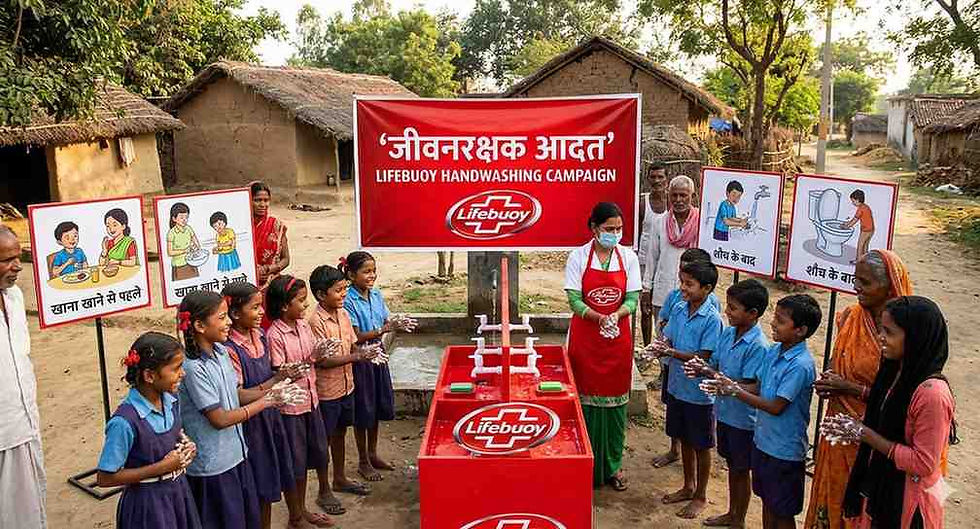
Formally launched in May 2002 across eight Indian states — described as the first single-largest rural health and hygiene education programme in India. The campaign deployed Health Development Facilitators (HDFs) alongside trained health promoters to visit rural schools and communities. Signature activation included the "Glow Germ" UV demonstration kit, which made invisible germs on hands visible under UV light to challenge the consumer misconception that "visibly clean is hygienically clean." The programme recruited school children and parents on a voluntary basis, using quizzes, games, songs, and pictorial health guides to communicate with largely illiterate rural populations. Creative agency Ogilvy worked with HUL on direct communication campaigns designed specifically for this audience. On the occasion of World Health Day, April 7, 2006, the Government of India's Department of Posts released a special "Lifebuoy Swasthya Chetna Postal Cover" — HLL became India's first brand to be featured on an Indian postal cover — reflecting official government recognition of the programme's public health contribution.
Phase 02A · Feb 2013
Roti Reminder — Kumbh Mela Activation
Executed at the Maha Kumbh Mela 2013 in Allahabad — the largest religious congregation on Earth — where 100 million+ visitors were expected. Lifebuoy partnered with activation agency OgilvyAction to create a specialised edible heat stamp capable of printing the message "Did you wash your hands with Lifebuoy?" (in Hindi) directly onto fresh rotis. One hundred trained promoters were deployed across 100 dhabas and hotel kitchens at the Mela site. Over 30 days, 2.5 million rotis were stamped. Soap was placed at wash basins in partner restaurants to enable immediate behaviour follow-through. The campaign was developed by OgilvyAction (National Creative Director: Vipul Salvi; Agency President: Samir Gupte). The activation won a Bronze award in the PR category at the Cannes Lions (Spikes Asia) festival, as documented in the official Spikes Asia entry. Total campaign investment: $36,000 (approximately ₹20 lakh at 2013 exchange rates).
Phase 02B · 2013
Help a Child Reach 5 — Thesgora Village Adoption
Lifebuoy "adopted" Thesgora, a village in Madhya Pradesh identified as having one of the highest rates of child diarrhoea in India. The campaign was anchored by a three-minute digital film titled "Gondappa" — created by Lowe Lintas (R. Balki, Chairman and CCO) — depicting a father walking on his hands to a village temple to fulfil a vow in gratitude that his son turned five, with the narrative underlining that 2 million children die annually before age five from preventable infections. The film accumulated over 25 million YouTube views and generated 16 million pledges of support. The campaign was subsequently extended to Bihar state in partnership with the Children's Investment Fund Foundation (CIFF) and the Bihar State Government. A subsequent film, "Chamki," targeted new mothers and midwives in the first 28 days post-birth, following the Gondappa success. An independent evaluation by Nielsen India, conducted in September 2013 in 1,485 households with children under 12, measured outcomes in Thesgora.
Phase 03 · 2015–2017
School of 5 — Bihar State-Wide Scale-Up
A scaled institutional programme co-funded by Unilever India and the Children's Investment Fund Foundation (CIFF), with an independent impact evaluation commissioned by CIFF from the London School of Hygiene and Tropical Medicine (LSHTM). The programme aimed to reach at least 9 million schoolchildren across Bihar state — India's state with the lowest GDP per capita, the highest rate of open defecation, and the third highest diarrhoeal death rate. The campaign deployed promoter teams for four school visits over 21 days, using interactive stories, games, songs, and behavioural sticker diaries. A separate teacher-led version, tested in 20 villages of Patna district's Masauhri block, found that children in treatment schools reported 15.1% more handwashing with soap at key occasions versus control (35.2% vs 20.1%, RR: 1.77, p = .003), published in PLOS ONE (2020). The LSHTM cluster-randomised trial across Samastipur and Vaishali districts (April 2016–January 2017) found that 67.5% of intervention children could unambiguously describe the campaign, but found only limited evidence of household behaviour change, leading to the campaign's termination after Phase 2 in Bihar.
Positioning & Consumer Insight
The strategic consumer insight at the core of all Lifebuoy campaigns is consistent and verifiable: the "visibly clean equals hygienically clean" fallacy. Rural Indian consumers believed that rinsing hands with water was sufficient to remove germs. This misconception, not poverty or lack of access, was identified as the primary behavioural barrier to soap usage. The Glow Germ UV demonstration — a signature Swasthya Chetna tool — was designed specifically to make this invisible threat visible, exploiting the psychological trigger of disgust and contamination aversion to drive behaviour change. This is a textbook application of the COM-B (Capability, Opportunity, Motivation — Behaviour) model of behaviour change, adapted for low-literacy, low-income rural audiences. Lifebuoy's positioning architecture has consistently operated at the junction of emotional fear (child mortality, preventable disease) and self-efficacy (handwashing with soap as an affordable, accessible solution). The Gondappa film crystallises this insight: it does not show product features, germs, or product performance claims. Instead, it depicts the emotional relief of a father whose child survived to age five — connecting the brand to one of the most primal emotional drivers in Indian culture, the safety and survival of one's child. The positioning is thus simultaneously protective (fear-based) and aspirational (celebratory). Significantly, the Roti Reminder campaign exploited a different insight layer: contextual and habitual. Rather than communicating about germs or disease in the abstract, it delivered the message precisely at the moment of highest relevance — during meal preparation and consumption, when hands are used as the primary eating utensil. This is a practical application of "moment of truth" marketing — intercepting consumer behaviour at the decision point closest to the desired action, with minimal cognitive load. "Our goal is to change the handwashing behaviours of a billion people by 2015." — Samir Singh, Global Brand Vice President, Lifebuoy (MxMIndia, February 2013)
Media & Channel Strategy
6.1 On-Ground / Direct Contact Programmes
The foundational channel for all three campaign phases was direct contact programming — deploying trained health promoters to rural schools, homes, and community gathering points. Swasthya Chetna used a Health Development Facilitator (HDF) model, recruiting school children and their parents on a voluntary basis and conducting house visits with pictorial health guides. School of 5 used promoter-visit models (four visits over 21 days per school) and a teacher-led delivery variant. This channel was chosen for its ability to drive genuine behaviour change rather than brand recall alone — though the LSHTM evaluation indicates that the transition from awareness to habitual behaviour change at scale remains a significant challenge.
6.2 Radio and Local Media
For rural media penetration, HUL promoted Lifebuoy through radio programming including sponsorships of "Krishi Darshan" and "Aap Ka Swasthya" — programmes with strong rural reach. Wall paintings with the Lifebuoy brand were deployed in rural areas. Local institutional partnerships included Gram Panchayats and Swasthya Parishads, embedding Lifebuoy messaging within trusted community governance structures.
6.3 Digital and Earned Media
The Gondappa film represented Lifebuoy's deliberate entry into digital-led emotional storytelling. The brand had, according to industry observers, embraced digital earlier than most FMCG brands in its category. The "Help a Child Reach 5" Facebook pledge mechanic drove 16 million pledges, demonstrating scale of digital engagement unusual for an FMCG brand in 2013. The Roti Reminder activation at Kumbh Mela — while experiential in execution — generated extensive earned media, with national dailies voting it among the most innovative campaigns of the year, widespread Facebook sharing, and YouTube views. Per the verified Spikes Asia entry, the campaign generated an earned media turnover of $59.3 million against a total investment of $36,000 — an ROI figure that was independently cited in the official awards submission.
6.4 Institutional Partnerships
The campaign architecture progressively elevated the institutional credibility of Lifebuoy's health programmes through formal partnerships. Swasthya Chetna aligned with the Global Public-Private Partnership for Handwashing with Soap (GPPP-HW) and PSI (Population Services International). School of 5 was co-funded and independently evaluated in partnership with Children's Investment Fund Foundation (CIFF) and the London School of Hygiene and Tropical Medicine (LSHTM). In 2020, Lifebuoy partnered with the Shakti Foundation and the Women and Child Development Ministry of Gujarat to facilitate a handwashing world record involving 5,30,290 women across 53,029 Anganwadis in 33 districts of Gujarat.
Business & Brand Outcomes
⚠All metrics below are sourced from verified public documents — official Unilever/HUL communications, peer-reviewed academic publications (PMC, PLOS ONE), Spikes Asia official award submissions, CSRWire press releases, and credible media. Where outcomes are ambiguous or disputed, this has been explicitly noted. The documented business and health outcomes of the Lifebuoy handwashing campaigns span commercial, brand, and public health dimensions, and must be assessed separately because the methodological rigour behind each category varies significantly.
7.1 Commercial Outcomes
In FY2003–04 — the first full operational year of Swasthya Chetna — sales of Lifebuoy grew by 20 per cent, with particularly strong performance in the eight states where the programme was operational. HUL's own documentation describes this as the direct commercial outcome of the campaign, making it the most clearly verified commercial result in the public record. The Roti Reminder campaign at Kumbh Mela 2013 generated, per the Spikes Asia official awards submission, $40 in incremental sales for every $1 invested. Spontaneous brand awareness increased by 4 per cent following the campaign. These figures are from the official creative awards entry submitted by OgilvyAction — they are cited here as reported figures, not independently audited data.
7.2 Brand Outcomes
Lifebuoy achieved three years of double-digit volume growth to become the world's number one anti-bacterial brand by volume, as stated by Unilever's Global Brand Vice President Samir Singh in a CSRWire press release dated April 2014. Lifebuoy's handwashing education programmes reached more than 60 million people through in-school campaigns globally, and more than 1 billion people cumulatively through TVC and on-ground programmes by 2019 — a year ahead of Unilever's stated target. Per Unilever's Global Brand Lead Khim-Yin Poh (HUL official communication, 2022), "Lifebuoy's handwashing campaigns continue to raise awareness and have contributed to a large increase in brand power — a measure of brand attractiveness."
7.3 Public Health Outcomes
In Thesgora (Madhya Pradesh), an independent evaluation by Nielsen India of 1,485 households in September 2013 found that diarrhoea incidence fell from 36 per cent to 5 per cent over the period of Lifebuoy's village-level intervention — a reduction of 75 per cent. This outcome was announced via a verified CSRWire press release issued by Unilever in 2014. A peer-reviewed study published in PLOS ONE (2020) evaluating the teacher-led "School of Five" programme in Bihar found that children in treatment schools reported 15.1 percentage points more handwashing with soap at key occasions than control children (RR: 1.77, 95% CI: 1.22–2.58, p = .003). In contrast, the LSHTM cluster-randomised trial of the wider Bihar scale-up (April 2016–January 2017), published in the American Journal of Tropical Medicine and Hygiene (2018), found no statistically significant improvement in observed handwashing with soap at household level — a result that led to the campaign's termination after Phase 2. Both outcomes are in the public record and must be presented together for analytical integrity.
Strategic Implications
The Lifebuoy campaigns collectively offer one of the most analytically rich bodies of evidence in Indian FMCG for the proposition that purpose-driven marketing, when structurally integrated into brand identity rather than deployed as episodic CSR, generates durable brand equity and measurable commercial return.
Implication 01
Behaviour Change as Market Creation
Lifebuoy did not target existing soap users — it targeted non-users in rural India whose soap usage behaviour was suppressed by a specific misconception ("visibly clean = hygienically clean"). Correcting this belief through hygiene education was simultaneously a public health act and a new-consumer acquisition strategy. This "market creation through behaviour change" model is applicable beyond FMCG to any category where adoption barriers are cognitive rather than economic.
Implication 02
Transparent Dual-Purpose Strategy Builds Credibility
HUL's explicit public framing of Swasthya Chetna as a "marketing programme with social benefit" — not philanthropy — is strategically sophisticated. By removing the pretense of altruism, HUL made the programme's logic internally consistent and externally credible. Brands that claim social purpose while obscuring commercial motivation are more vulnerable to credibility attacks than those that integrate both openly.
Implication 03
Contextual Insight Unlocks Disproportionate Efficiency
The Roti Reminder's cost-effectiveness ($36,000 for 5 million contacts) was not a function of scale but of insight — choosing the precise moment (mealtime), medium (the roti itself), and setting (the largest congregation on Earth) where the message would be maximally relevant. This is a model for FMCG brands in emerging markets where mass media ROI is declining: precision contextual activation at culturally significant moments.
Implication 04
Institutional Partnerships Amplify Brand Authority
Each campaign phase elevated Lifebuoy's institutional legitimacy: from Gram Panchayat tie-ups (Swasthya Chetna) to Government of India postal recognition (2006) to CIFF and LSHTM partnerships (School of 5). These partnerships transform a commercial soap brand into a public health actor with government endorsement — a positioning that is exceptionally difficult for competitors to replicate through advertising alone.
Implication 05
Scale Does Not Guarantee Behaviour Change — Rigour Matters
The Bihar "School of 5" scale-up illustrates a critical strategic tension: awareness reach and behaviour change are not the same outcome. The LSHTM CRT found 67.5% of children could describe the campaign, yet found no significant improvement in household handwashing with soap. The willingness to commission and publish an independent evaluation that returned negative results is exemplary — and the finding itself is a critical caveat for any FMCG brand evaluating large-scale behaviour change programmes.
Implication 06
Children as Peer-to-Peer Change Agents
Multiple campaign phases used schoolchildren not merely as message recipients but as hygiene advocates to their parents. The "School of 5" design explicitly aimed to create peer pressure through social norms. This approach exploits the "influence inversion" in rural households where children with school education act as information conduits for parents, compounding reach beyond direct programme contacts — a cost-effective amplification mechanism in low-media-penetration markets.
Discussion Questions
Q1
HUL explicitly described Lifebuoy Swasthya Chetna as "a marketing programme with a social benefit" rather than a CSR or philanthropic initiative. Using the frameworks of Shared Value Creation (Porter & Kramer, 2011) and Cause-Related Marketing (CRM), evaluate whether this framing is strategically superior to pure cause-marketing in terms of long-term brand equity, stakeholder trust, and commercial sustainability. What are the risks of this transparent dual-purpose framing?
Q2
The Roti Reminder campaign at Kumbh Mela 2013 achieved a cost-per-contact of less than 1 cent with a $36,000 budget. Deconstruct this campaign using the "Moment of Truth" and "Contextual Insight" frameworks. What are the transferable strategic principles for FMCG brands operating in rural emerging markets where conventional media ROI is declining? How does this activation model differ from typical rural BTL execution?
Q3
The Bihar "School of 5" scale-up, evaluated by the London School of Hygiene and Tropical Medicine via a cluster-randomised trial, found that 67.5% of children could describe the campaign but produced no statistically significant improvement in household handwashing with soap. Using the COM-B (Capability, Opportunity, Motivation–Behaviour) behaviour change model, analyse why awareness reach did not translate into habitual behaviour change at scale, and what modifications to campaign design this evidence suggests for future large-scale hygiene programmes.
Q4
Lifebuoy's brand identity is built at the intersection of commercial FMCG and public health. By 2013, Dettol (Reckitt) launched its competing "Dettol Banega Swachh India" programme with NDTV, Facebook, and Amitabh Bachchan. Conduct a comparative brand positioning analysis of Lifebuoy versus Dettol in the health soap category, evaluating their respective positioning strategies, institutional partnership models, and the durability of their competitive advantages. Which brand's strategy is more defensible in the long term, and why?
Q5
Lifebuoy used schoolchildren not only as message recipients but as peer-to-peer hygiene change agents — exploiting "influence inversion" in rural Indian households where children act as knowledge conduits for parents. Critically evaluate this strategic choice using network diffusion theory and social norms theory. What are the ethical implications of using children as commercial-public health messengers, and how should a brand navigate the line between genuine behaviour change programming and what critics might characterise as child-targeted commercial influence?


Comments