Mamaearth’s Digital Advertising and Influencer Integration
Industry & Competitive Context
The Indian beauty and personal care (BPC) market has undergone a structural shift over the past decade, driven by the rapid adoption of e-commerce, rising digital media consumption, and increased consumer awareness around ingredients and sustainability. According to multiple reports cited by publications such as Economic Times and Mint, the “clean beauty” and “natural products” segment has been one of the fastest-growing subcategories within the broader BPC industry.
Within this evolving landscape, digital-first brands have challenged incumbents by bypassing traditional retail and building direct relationships with consumers online. Companies such as Honasa Consumer Ltd. (the parent company of Mamaearth), Nykaa, and Sugar Cosmetics have leveraged digital channels not only for distribution but also for brand-building.
A defining characteristic of this new competitive context is the centrality of influencer marketing and content-led discovery. Platforms such as Instagram and YouTube have become critical touchpoints in shaping purchase decisions, especially among younger consumers. As documented in industry coverage by Business Standard and Economic Times, influencer recommendations increasingly serve as substitutes for traditional advertising credibility in the beauty segment.
Brand Situation Prior to Campaign
Mamaearth was launched in 2016 by Varun Alagh and Ghazal Alagh with a focus on toxin-free, natural personal care products. Public statements and company disclosures indicate that the brand initially targeted young parents seeking safe products for babies, a niche that was relatively under-served in India at the time.
According to coverage in Mint and Economic Times, Mamaearth adopted a direct-to-consumer (D2C) model early on, selling primarily through its website and online marketplaces. This approach required the brand to build awareness without relying heavily on traditional retail visibility.
Publicly available company filings and investor disclosures from Honasa Consumer Ltd. indicate that digital channels formed a core part of the company’s early growth strategy. The company has consistently emphasized content, community, and digital engagement as foundational pillars of its brand-building approach.
However, the broader category was also becoming increasingly crowded, with both legacy FMCG players (such as Hindustan Unilever and Procter & Gamble) and emerging startups entering the natural and chemical-free segment. This intensified the need for differentiated communication and scalable consumer acquisition strategies.
Strategic Objective
Based on publicly available statements from company leadership in credible outlets such as CNBC-TV18 and Economic Times, Mamaearth’s strategic objective was to build a trusted, digitally native brand that could scale rapidly while maintaining authenticity.
A key element of this objective was to:
Drive awareness among digitally active consumers.
Build trust in product safety and efficacy.
Create a strong emotional connection with consumers around themes such as sustainability and transparency.
The company also emphasized the importance of community-building and word-of-mouth amplification, as reflected in its repeated focus on customer engagement and user-generated content in public disclosures.
Campaign Architecture & Execution
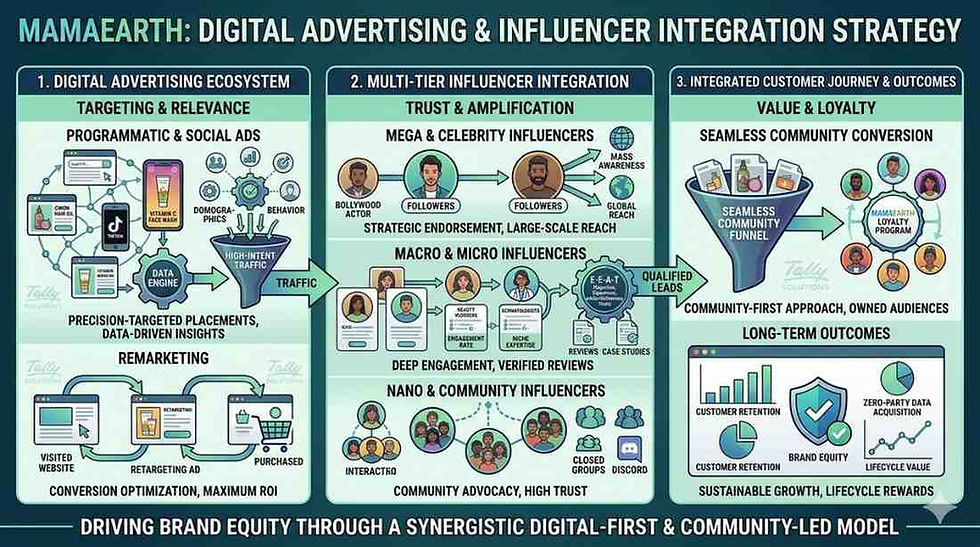
Mamaearth’s digital advertising and influencer integration strategy has been widely documented in business media as a central pillar of its growth model.
Rather than relying predominantly on traditional advertising formats, the brand invested heavily in influencer collaborations across platforms such as Instagram and YouTube. According to coverage in Economic Times and Business Insider India, the company worked with a large number of micro- and macro-influencers, including parenting bloggers, beauty creators, and lifestyle content producers.
A distinctive aspect of the brand’s execution was its emphasis on scale and diversity of influencer partnerships. Public reports indicate that Mamaearth collaborated with thousands of influencers over time, spanning different audience segments and geographies within India. This allowed the brand to localize messaging and reach niche consumer cohorts.
In addition, Mamaearth integrated influencer content into its broader digital advertising ecosystem. As reported in Mint, influencer-generated content was often repurposed for paid media campaigns, enabling the brand to blend organic authenticity with paid amplification.
The brand also leveraged storytelling formats, including product demonstrations, testimonials, and educational content about ingredients. This aligns with the company’s publicly stated emphasis on transparency and consumer education.
Another notable element, highlighted in multiple media reports, was the use of cause-driven campaigns. Mamaearth’s “Plant Goodness” initiative, which commits to planting a tree for every order, was frequently integrated into its digital communication. This helped reinforce the brand’s positioning around sustainability.
Positioning & Consumer Insight
Mamaearth’s positioning has been consistently described in company materials and media coverage as “toxin-free,” “natural,” and “safe.” The brand targeted a specific consumer insight: increasing concern among Indian consumers—particularly millennials and young parents—about harmful chemicals in personal care products.
This insight is supported by broader industry research cited in publications like Mint and Economic Times, which note a growing preference for ingredient transparency and clean-label products.
The use of influencers played a critical role in translating this positioning into consumer trust. Influencers, particularly those perceived as relatable and authentic, acted as intermediaries who could validate product claims in a more personal and credible manner than traditional advertising.
By working with parenting influencers, for example, the brand reinforced its credibility in the baby care segment. Similarly, collaborations with beauty influencers helped expand its appeal to a wider audience beyond its initial niche.
Media & Channel Strategy
Publicly available information confirms that Mamaearth adopted a digital-first media strategy, with significant reliance on:
Social media platforms such as Instagram and YouTube
E-commerce marketplaces such as Amazon and Flipkart
Its own direct-to-consumer website
According to statements reported in Economic Times, the company allocated a substantial portion of its marketing budget to digital channels. However, specific percentages or budget allocations are not consistently disclosed in publicly verifiable documents.
“No verified public information is available on exact channel-wise budget allocation or spend efficiency metrics.”
The company has also expanded into offline channels in later years, but digital remains a primary driver of brand discovery and engagement, as indicated in investor presentations.
Business & Brand Outcomes
According to Honasa Consumer Ltd.’s filings and media coverage:
Mamaearth became one of the fastest-growing D2C brands in India, as reported by Economic Times and Mint.
The company achieved unicorn status in 2022, as widely reported by credible outlets including Reuters and Bloomberg.
Its portfolio expanded significantly beyond baby care into categories such as skin care, hair care, and wellness.
Additionally, the company’s IPO in 2023 was covered extensively by CNBC-TV18, Mint, and Economic Times, highlighting its growth trajectory and digital-first strategy.
However:
“No verified public information is available on the direct causal impact of influencer marketing on specific revenue or conversion metrics.”
Similarly:
“No verified public information is available on campaign-level ROI, customer acquisition cost (CAC), or lifetime value (LTV).”
Strategic Implications
Mamaearth’s approach illustrates how digital-native brands can leverage influencer ecosystems not merely as promotional tools but as integral components of brand-building strategy.
First, the company’s extensive use of influencers reflects a shift from centralized messaging to distributed storytelling. By engaging a wide network of creators, Mamaearth effectively crowdsourced brand advocacy, increasing both reach and relatability.
Second, the integration of influencer content into paid advertising highlights a convergence between organic and paid media. This hybrid model allows brands to scale authentic content without losing credibility.
Third, the emphasis on cause-driven messaging—such as sustainability initiatives—demonstrates how digital campaigns can reinforce brand purpose. This is particularly relevant in categories where trust and transparency are critical purchase drivers.
Finally, Mamaearth’s trajectory underscores the importance of aligning channel strategy with consumer behavior. In a market where discovery increasingly occurs on social platforms, influencer integration becomes not just a marketing tactic but a strategic necessity.
At the same time, the lack of publicly disclosed performance metrics points to a broader challenge in evaluating the effectiveness of influencer marketing at scale. While brand growth is evident, the precise contribution of individual channels remains difficult to quantify based on available public data.
Discussion Questions
How does Mamaearth’s use of influencer marketing differ from traditional celebrity endorsement models in terms of scalability and credibility?
What strategic risks are associated with heavy reliance on influencer-driven brand building in the beauty and personal care industry?
How can digital-first brands like Mamaearth balance authenticity with the need for paid amplification at scale?
In the absence of publicly disclosed performance metrics, how should investors evaluate the effectiveness of influencer-led growth strategies?
Can Mamaearth’s digital and influencer integration model be effectively replicated by legacy FMCG companies such as Hindustan Unilever or Procter & Gamble? Why or why not?


Comments