Maruti Suzuki's Dealer Network-Led Growth Strategy
- Feb 20
- 8 min read
Executive Summary
Maruti Suzuki India Limited has built India's largest automotive distribution network, with the company operating 3,086 sales outlets across 1,976 cities as of March 2023, according to its Annual Report 2022-23. This case study examines how the company's dealer network strategy has supported its market leadership position, which stood at 43.4% market share in the passenger vehicle segment during FY 2022-23, as reported in the same annual report. The analysis focuses on the structural elements of Maruti's distribution strategy, dealer engagement initiatives, and the evolution of its retail network based on publicly disclosed information.
Company Background
Maruti Suzuki India Limited was established in 1981 as a joint venture between the Government of India and Suzuki Motor Corporation of Japan, according to the company's official website. The company launched its first product, the Maruti 800, in 1983. Suzuki Motor Corporation became the majority shareholder in 2003 when the Government of India diluted its stake, as documented in the company's historical timeline. As of March 2023, Maruti Suzuki had a production capacity of 2.25 million units per annum across its manufacturing facilities in Gurgaon and Manesar in Haryana, and at its subsidiary Suzuki Motor Gujarat in Gujarat, according to the Annual Report 2022-23. The company had sold 1.85 million vehicles in FY 2022-23, as stated in the same report.
The Dealer Network Architecture
Network Scale and Geographic Penetration
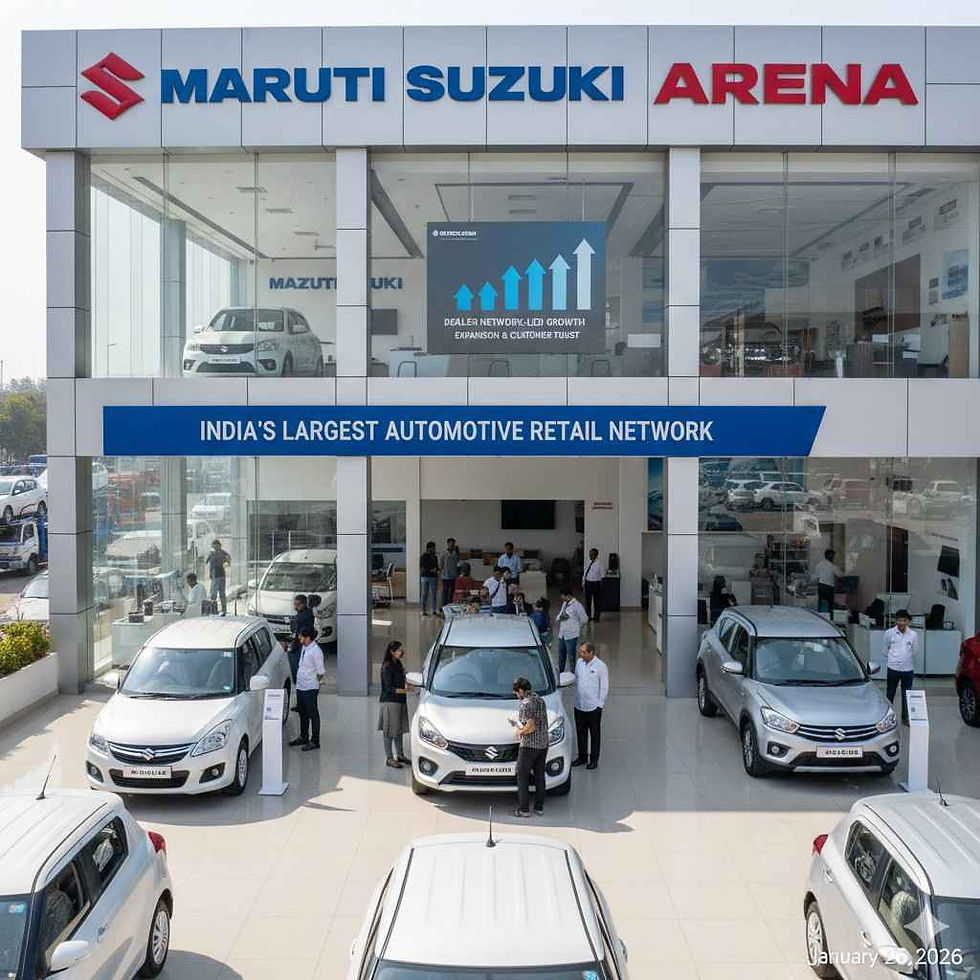
Maruti Suzuki's distribution strategy has emphasized extensive geographic coverage. The company's Annual Report 2022-23 states that its 3,086 sales outlets spanned 1,976 cities, with a presence in both urban and rural markets. The network included both NEXA premium retail channels and ARENA mass-market channels, representing a dual-channel strategy implemented to serve different customer segments. According to a press release dated September 21, 2015, Maruti Suzuki launched NEXA as a premium retail channel for its premium products. The Economic Times reported on September 22, 2015, that NEXA was designed to offer differentiated customer experiences for models like the S-Cross. By March 2023, the company operated 477 NEXA showrooms, as documented in the Annual Report 2022-23. The ARENA network, serving the mass-market segment, comprised the larger portion of the distribution network. The company's investor presentation for Q4 FY 2022-23 indicated that ARENA outlets numbered 2,609 as of March 2023.
Service Network Expansion
Beyond sales outlets, Maruti Suzuki developed an extensive service network. The Annual Report 2022-23 documented 4,388 service outlets across 1,967 cities as of March 2023. This service network included both dealer-operated workshops and standalone service centers. The company also operated "NEXA Service" facilities specifically for its premium segment customers, providing specialized service experiences aligned with the premium positioning of NEXA vehicles, according to information on the company's official website.
Dealer Engagement and Support Systems
Training and Capability Development
Maruti Suzuki has invested in dealer capability development through structured training programs. The Annual Report 2022-23 mentions the "Maruti Suzuki Technician Skill Enhancement Training" program, though specific metrics on the number of dealers or employees trained were not disclosed in this document. According to a press release dated April 18, 2022, Maruti Suzuki announced the inauguration of "Skill Enhancement and Training Centers" (SETCs) to train technicians and service personnel. The press release stated that these centers were designed to enhance technical skills and customer service capabilities across the dealer network.
Technology Enablement
The company has implemented digital tools across its dealer network. The Annual Report 2022-23 references the "Maruti Suzuki Smart Finance" platform, a digital financing solution deployed across dealerships to streamline the vehicle financing process for customers. However, specific adoption rates or transaction volumes were not publicly disclosed. Mint reported on January 10, 2023, that Maruti Suzuki had digitized its sales processes, with dealers using tablets and digital systems to assist customers in vehicle configuration and financing options. The article quoted company executives describing these initiatives but did not provide quantitative metrics.
Dealer Business Model
No verified public information is available on the specific commercial terms, margin structures, or profitability metrics of Maruti Suzuki dealers. While dealer arrangements are fundamental to the distribution strategy, detailed financial terms between the company and its dealer partners are not disclosed in annual reports or public filings. The Economic Times reported on August 29, 2019, that Maruti Suzuki dealers had expressed concerns about profitability amid declining vehicle sales, indicating that dealer economics were impacted by market conditions. However, specific margin percentages or dealer-level revenue data were not included in this reporting.
Rural Market Penetration Strategy
Rural Network Development
Maruti Suzuki has emphasized rural market expansion as a strategic priority. The Annual Report 2022-23 states that rural markets accounted for 42.7% of the company's sales in FY 2022-23, demonstrating the significance of non-urban areas to the overall sales volume. According to a Business Standard article published on May 8, 2022, Maruti Suzuki operated approximately 1,500 sales outlets in rural areas. The article quoted Shashank Srivastava, Senior Executive Officer (Marketing & Sales) at Maruti Suzuki, stating that the company planned to increase rural penetration further.
True Value Used Car Network
The company developed "True Value," a used car business operating through dedicated outlets. The Annual Report 2022-23 documented 589 True Value outlets as of March 2023. This used car network served as an additional distribution channel and facilitated vehicle exchange programs that supported new car sales. The Hindu Business Line reported on July 14, 2021, that Maruti Suzuki's used car business handled approximately 500,000 used cars annually, making it one of India's largest organized used car businesses. The article cited company statements but did not provide detailed operational metrics.
Challenges and Market Dynamics
Inventory Management During Market Volatility
The automotive industry experienced significant disruption during the COVID-19 pandemic. Maruti Suzuki's Annual Report 2020-21 acknowledged production and sales disruptions due to lockdowns and supply chain constraints, though the specific impact on dealer inventory levels was not quantified in the report. The Economic Times reported on April 13, 2021, that Maruti Suzuki dealers were operating with lower inventory levels due to semiconductor shortages affecting production. The article quoted dealer body representatives but did not provide specific inventory day metrics.
Electric Vehicle Strategy and Distribution
As of March 2023, Maruti Suzuki had not launched a fully electric passenger vehicle in the Indian market, according to its product portfolio listed in the Annual Report 2022-23. The report stated that the company was developing electric vehicle products and related infrastructure. Regarding distribution strategy for future electric vehicles, no verified public information is available on specific dealer preparation programs, charging infrastructure deployment plans, or the intended sales channel structure for electric vehicles.
Comparative Market Context
Market Share Position
Maruti Suzuki maintained a dominant position in the Indian passenger vehicle market. The Annual Report 2022-23 stated the company held a 43.4% market share in FY 2022-23. This represented a decline from 50.9% in FY 2018-19, as documented in the Annual Report 2018-19, indicating increasing competitive intensity. Hyundai Motor India, the second-largest passenger vehicle manufacturer, held approximately 15% market share in 2023, according to Reuters reporting dated January 24, 2024. Tata Motors held approximately 14% market share in the same period, as reported by Bloomberg on April 10, 2023.
Distribution Network Comparisons
No verified public information is available on detailed comparative analyses of dealer network sizes, outlet counts per manufacturer, or productivity metrics across competing automotive manufacturers in India. While various manufacturers disclose their own network statistics, standardized comparative data is not published in a consolidated format by industry bodies or credible research organizations in publicly accessible reports.
Strategic Initiatives and Evolution
Multi-Channel Retail Strategy
Beyond traditional dealerships, Maruti Suzuki experimented with alternative retail formats. The company's Annual Report 2021-22 mentioned "Arena Exclusive" outlets, a compact retail format for smaller towns, though specific counts or performance metrics were not disclosed. The Financial Express reported on October 18, 2022, that Maruti Suzuki was testing smaller-format showrooms to expand into tier-3 and tier-4 cities with lower investment requirements. The article cited company sources but did not provide quantitative expansion targets.
Digital Sales Channels
Maruti Suzuki launched online sales initiatives. The company's press release dated October 6, 2020, announced "Maruti Suzuki Subscribe," a vehicle subscription service offering flexible usage terms. The service was made available through select dealers, according to the press release. The Hindu Business Line reported on November 2, 2020, that the subscription service was initially launched in select cities through participating dealers, with plans for wider rollout. However, no verified public information is available on adoption rates, subscription volumes, or the current operational status of this program.
Dealer Consolidation Trends
No verified public information is available on whether Maruti Suzuki has actively pursued dealer consolidation, encouraged multi-outlet dealer groups, or implemented policies regarding dealer ownership structures. While such considerations are common in automotive distribution strategies, specific policies or initiatives by Maruti Suzuki on this topic have not been disclosed in public documents.
Customer Experience and Service Quality
Customer Satisfaction Metrics
The Annual Report 2022-23 states that Maruti Suzuki achieved a score of 868 points in the J.D. Power 2023 India Customer Service Index (CSI) Study, ranking among the top performers in the mass-market segment. The report noted this as evidence of service quality across the dealer network. However, no verified public information is available on internal customer satisfaction scores, net promoter scores, or detailed customer feedback metrics at the dealer level or network level beyond the J.D. Power study citation.
Service Standardization
Maruti Suzuki has implemented service process standards across its network. The company's official website describes "Service Passport," a standardized service process covering vehicle check-in, service execution, and delivery. However, compliance metrics or audit results regarding adherence to these standards are not publicly disclosed.
Network Expansion During Growth Phases
Historical Expansion Pattern
While current network size is documented, no verified public information is available on year-by-year dealer addition rates, specific expansion targets over historical periods, or detailed geographic prioritization frameworks used in network planning. Annual reports provide point-in-time network statistics but do not consistently track year-over-year additions by region or format. The Annual Report 2018-19 documented 2,929 sales outlets, compared to 3,086 in the Annual Report 2022-23, indicating net additions of 157 outlets over this four-year period. However, the reports do not break down additions and closures separately or provide geographic detail on expansion patterns.
Analysis and Strategic Observations
Maruti Suzuki's dealer network strategy exhibits key characteristics. The company prioritizes extensive geographic coverage, with presence in nearly 2,000 cities, enabling market access across urban and rural segments and supporting its high market share. The dual-channel strategy through ARENA and NEXA caters to different customer segments, with NEXA's growth to 477 outlets by March 2023 highlighting investment in the premium market. The integration of service network expansion with sales outlets supports customer engagement, with 4,388 service outlets exceeding 3,086 sales outlets, enhancing service accessibility and likely boosting retention and loyalty. The focus on rural markets, accounting for 42.7% of sales in FY 2022-23, targets less competitive areas with lower vehicle penetration, supported by approximately 1,500 rural outlets. However, limited public information on dealer economics, operational metrics, and electric vehicle transition strategies constrains deeper analysis. These gaps hinder assessment of financial sustainability, network efficiency, and preparation for future challenges.
Conclusion
Maruti Suzuki has constructed India's largest automotive distribution network, with over 3,000 sales outlets and more than 4,000 service points as documented in the company's latest annual report. This network has supported sustained market leadership, though market share has declined from above 50% to 43.4% over recent years based on annual report data. The distribution strategy combines scale, geographic breadth, channel segmentation, and service infrastructure. The dual-channel approach through ARENA and NEXA, rural market focus, and integrated service network represent observable strategic elements based on publicly disclosed information. However, significant aspects of the dealer strategy remain undisclosed in public documents, including dealer economics, detailed operational metrics, network productivity measures, and future planning for electric vehicle distribution. These information gaps limit comprehensive evaluation of the network strategy's effectiveness and efficiency. The sustainability of the dealer-led distribution model in an evolving automotive landscape marked by electric vehicles, digital sales channels, and changing customer preferences remains an open question that cannot be fully addressed based on currently available public information.
Discussion Questions for MBA-Level Analysis
Network Density vs. Profitability Trade-offs: Given that Maruti Suzuki operates 3,086 sales outlets across 1,976 cities while maintaining 43.4% market share (down from historical highs above 50%), what frameworks would you apply to evaluate whether the current network density is optimal? Consider the tension between market coverage and per-outlet productivity, and discuss what additional data you would require to make this assessment. How might the optimal network density differ across market share positions, and what implications does this have for competitors with smaller networks?
Multi-Channel Strategy Effectiveness: Maruti Suzuki operates two distinct retail channels (ARENA and NEXA) serving different customer segments, alongside digital initiatives like vehicle subscriptions. Drawing on multi-channel retail theory, analyze the potential benefits and risks of channel proliferation in automotive distribution. What metrics would you establish to evaluate whether channel segmentation creates value or complexity? How should the company balance investments across physical and digital channels given incomplete public information on channel-specific performance?


Comments