NoBroker’s Lead Monetization Strategy
- 35 minutes ago
- 5 min read
Industry & Competitive Context
India’s residential real estate market has historically been characterized by information asymmetry, fragmented listings, and heavy dependence on brokers for property discovery and transactions. For tenants, buyers, and property owners, brokerage fees represented a significant transaction cost, particularly in major urban markets.
The emergence of digital property platforms transformed the discovery process by aggregating listings and improving search efficiency. However, many platforms continued to depend on lead-generation models in which brokers remained central participants within the ecosystem.
NoBroker entered the market in 2014 with a differentiated proposition: directly connecting property owners and seekers while eliminating brokerage fees. This positioning allowed the company to challenge traditional real estate intermediation models and build a platform around direct consumer participation.
As competition intensified across India’s proptech sector, the strategic challenge evolved from acquiring users to monetizing platform engagement without compromising the brand’s “No Brokerage” positioning.
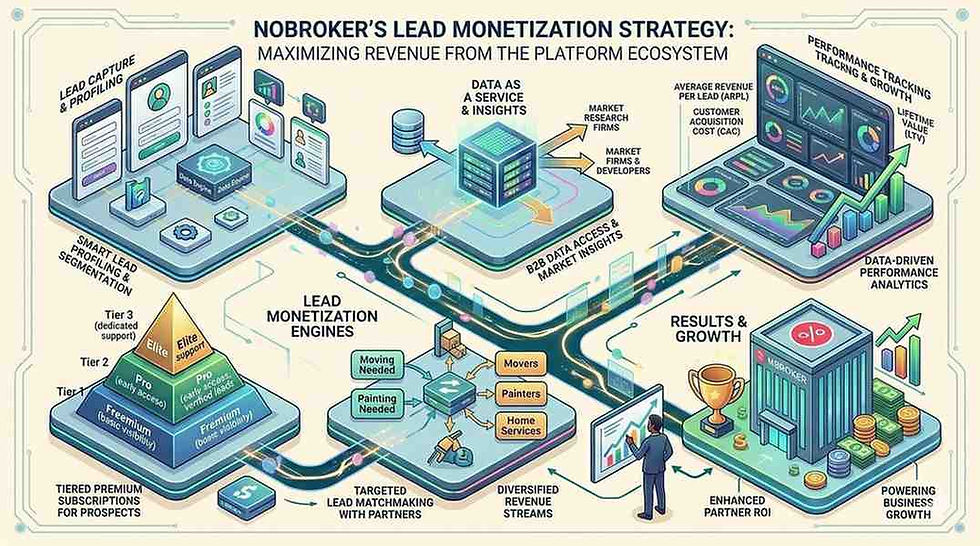
The company’s response was the development of premium subscription-based services that monetized property-seeking and property-listing leads through assisted experiences rather than traditional brokerage commissions.
Brand Situation Prior to Campaign
NoBroker’s initial market positioning was built around a clear consumer pain point: brokerage costs.
Urban tenants and property owners frequently incurred substantial fees during rental transactions, while buyers and sellers often faced additional intermediary charges.
By offering a platform where owners and seekers could connect directly, NoBroker created a value proposition centered on cost savings and transparency.
However, like many digital marketplaces, the company faced the challenge of generating sustainable revenue while preserving its core brand identity.
Charging brokerage would have conflicted directly with its positioning. As a result, the company needed alternative monetization mechanisms that could create revenue without fundamentally altering the platform’s promise.
This requirement became increasingly important as the company expanded across cities and invested in platform growth.
Strategic Objective
NoBroker’s strategic objective was to monetize user intent rather than brokerage transactions.
Instead of earning revenue through commissions on completed deals, the company developed premium services designed to help users navigate the property search and property listing process more efficiently.
The strategy focused on monetizing high-intent leads—users actively seeking tenants, buyers, rental properties, or homes for purchase.
This approach allowed the company to generate revenue from assistance, visibility enhancement, lead access, and managed services while maintaining its zero-brokerage positioning.
The broader objective was to convert platform activity into subscription revenue through value-added services that addressed consumer friction points within property transactions.
Campaign Architecture & Execution
NoBroker’s lead monetization model was built around premium plans offered to both property seekers and property owners.
According to the company’s publicly available plan structures, tenants can purchase assisted subscription packages that provide access to owner contacts, personalized support, property recommendations, appointment scheduling assistance, and negotiation support.
The company’s tenant plans include services such as dedicated relationship managers, qualified owner contacts, property alerts, and assistance throughout the search process.
Publicly available descriptions indicate that some plans offer up to 50 owner contacts along with relationship manager support and money-back guarantees under specified conditions.
For property owners, NoBroker offers paid plans that provide enhanced listing visibility, lead management support, relationship manager assistance, property marketing, phone number privacy, and tenant acquisition services.
Premium owner plans additionally include services such as professional photography, field assistance, and guaranteed tenant programs subject to plan terms.
Commercial property owners and tenants are offered similar premium subscription structures tailored to business property requirements.
A key characteristic of the model is that revenue is generated before transaction completion through subscription purchases rather than after deal closure through commissions.
This structure shifts monetization toward access, assistance, and lead facilitation.
Positioning & Consumer Insight
The effectiveness of NoBroker’s monetization strategy is rooted in a central consumer insight: while users want to avoid brokerage fees, many still require assistance during property transactions.
Property discovery often involves multiple stages, including search, shortlisting, owner communication, visit scheduling, negotiation, and documentation.
NoBroker identified an opportunity to monetize these friction points without positioning itself as a broker.
The company’s premium services effectively transform convenience into a paid offering.
For tenants, the value proposition centers on reducing search effort and improving access to relevant property options.
For owners, the proposition focuses on increasing visibility and simplifying tenant acquisition.
This strategy reflects a broader platform-economy trend in which access, convenience, and process support become monetizable assets independent of transaction commissions.
The company’s positioning remains anchored in brokerage elimination while simultaneously generating revenue through service-layer enhancements.
Media & Channel Strategy
Publicly available information indicates that NoBroker’s lead monetization strategy is integrated directly into its digital platform ecosystem.
Premium plans are promoted within the company’s website and application interfaces as part of the user journey.
The company’s owned channels function as both acquisition and monetization platforms.
Property seekers encounter premium assistance offerings while conducting searches, while property owners are presented with visibility-enhancement and lead-management plans during listing processes.
This model reduces dependence on separate monetization campaigns because premium offerings are embedded into core platform interactions.
The company has also invested in broader brand-building efforts around its “No Brokerage” proposition.
Public reporting and company communications consistently emphasize direct owner-user connections and cost savings as foundational elements of the brand.
This positioning supports premium plan adoption by framing paid services as convenience enhancements rather than brokerage substitutes.
Business & Brand Outcomes
NoBroker has achieved significant scale within India’s proptech sector.
Public reporting describes the company as India’s first proptech unicorn and notes that it has raised substantial institutional funding from investors including Tiger Global, General Atlantic, and Elevation Capital.
According to publicly reported company statements, NoBroker expected to reach approximately ₹1,000 crore in revenue during FY24 and stated that its topline had been doubling since 2020.
Industry reporting also documented continued expansion across property transactions and adjacent home-service categories.
Publicly available financial reporting indicates that NoBroker recorded revenue exceeding ₹888 crore in FY24.
The company’s premium plan ecosystem represents a visible and publicly documented monetization layer across residential and commercial property categories.
No verified public information is available on lead conversion rates, customer acquisition cost, customer lifetime value, retention metrics, premium-plan conversion percentages, or the precise revenue contribution attributable specifically to individual lead monetization products.
Strategic Implications
NoBroker’s monetization model demonstrates how platform businesses can generate revenue without directly charging for the core transaction value proposition that initially attracts users.
Rather than monetizing completed property deals through commissions, the company monetizes intent, urgency, and convenience.
This distinction is strategically significant because it allows the brand to preserve its core identity while expanding revenue opportunities.
The case also highlights the growing importance of service-layer monetization within digital marketplaces.
As digital platforms mature, access to users alone may not be sufficient to sustain business growth. Premium assistance, enhanced visibility, managed services, and workflow support increasingly become critical revenue drivers.
Another implication involves consumer willingness to pay for efficiency.
Although users may seek to avoid brokerage costs, publicly available subscription offerings indicate that many are willing to pay for services that reduce search complexity and transaction friction.
The model therefore challenges the assumption that low-cost positioning necessarily limits monetization opportunities.
At the same time, the strategy requires maintaining consumer trust.
Because monetization occurs through premium service offerings embedded within a platform positioned around transparency and cost savings, perceived service quality becomes central to long-term brand credibility.
The broader lesson for marketplace businesses is that monetization can be built around problem-solving services rather than transaction commissions when the platform successfully identifies high-friction consumer moments.
MBA Discussion Questions
How does NoBroker’s lead monetization model differ from traditional brokerage-based revenue models in real estate?
What consumer insights enabled NoBroker to charge for premium assistance services while maintaining a zero-brokerage positioning?
How does monetizing user intent differ strategically from monetizing completed transactions?
What risks emerge when premium services become a major revenue source within a platform originally positioned around cost savings?
Can service-layer monetization become a sustainable competitive advantage for digital marketplaces operating in highly competitive categories?


Comments