Nykaa's Focus on Aspiring Beauty Consumers
- Feb 26
- 10 min read
Executive Summary
Nykaa, India's leading omnichannel beauty and personal care retailer, has strategically positioned itself to capture the aspirational segment of Indian beauty consumers. Founded in 2012 by Falguni Nayar, the company went public in November 2021, becoming one of India's few profitable internet companies at the time of listing. This case study examines Nykaa's approach to serving aspiring beauty consumers through its product curation, content strategy, and omnichannel expansion, based exclusively on verified public information.
Company Background
Falguni Nayar, a former managing director at Kotak Mahindra Capital Company, founded Nykaa in 2012 at the age of 50. The company's name derives from the Sanskrit word "Nayaka," meaning one in the spotlight. Nykaa launched as an online beauty retail platform, initially offering approximately 850 products from around 50 brands, according to company disclosures. The company listed on the National Stock Exchange of India in November 2021, with its initial public offering raising approximately ₹5,352 crore ($722 million). According to its Draft Red Herring Prospectus (DRHP) filed with SEBI in October 2021, Nykaa reported being profitable at the time of listing, a rarity among Indian internet companies pursuing IPOs during that period. As disclosed in the company's FY2024 annual report, Nykaa's portfolio includes the flagship beauty and personal care (BPC) platform Nykaa.com, the fashion platform Nykaa Fashion, and owned brands including Nykaa Cosmetics, Kay Beauty, Dot & Key, and others.
Market Context: India's Beauty and Personal Care Industry
India's beauty and personal care market has experienced significant growth driven by rising disposable incomes, increasing urbanization, and growing aspirations among consumers. According to a RedSeer report cited in Nykaa's DRHP, India's BPC market was estimated at $15.8 billion in fiscal year 2020 and was projected to grow to $28 billion by fiscal year 2025, representing a compound annual growth rate (CAGR) of approximately 12-13%. The same RedSeer report, as referenced in the DRHP, noted that online penetration in India's BPC market stood at approximately 5-6% in FY2020, significantly lower than developed markets, suggesting substantial room for growth in e-commerce penetration. A report by Bain & Company and Flipkart, released in 2022, identified that Indian consumers increasingly sought premium and international beauty brands, with the prestige beauty segment growing faster than the mass segment. The report noted that younger consumers, particularly millennials and Gen Z, were driving this premiumization trend.
Defining the Aspiring Consumer Segment
While Nykaa does not publicly disclose detailed internal segmentation models, public statements from company leadership and analyst reports provide insight into the aspiring consumer profile the company targets. In an interview with Economic Times in October 2021, shortly before Nykaa's IPO, Falguni Nayar stated: "We are targeting the aspirational Indian consumer who wants access to genuine products and expert advice." The company's DRHP further elaborated that Nykaa positioned itself as a "lifestyle destination for beauty and personal care needs," suggesting a focus on consumers seeking experiential retail rather than purely transactional purchases. According to a Morgan Stanley research note published in November 2021 (publicly available through financial news outlets), Nykaa's average order value (AOV) at the time of IPO was approximately ₹1,400-1,500, significantly higher than general e-commerce platforms, indicating a consumer base willing to spend on premium products. A CLSA report from 2022, cited in The Economic Times, noted that Nykaa's customer base skewed toward women aged 18-35 in tier 1 and tier 2 cities, with growing penetration in tier 3 cities. These consumers were characterized as digitally savvy, brand-conscious, and seeking authentic products with credible information to guide purchase decisions.
Strategic Pillars for Aspiring Consumers
1. Product Curation and Authenticity
Nykaa differentiated itself in the Indian market by guaranteeing 100% authentic products, a significant value proposition in a market plagued by counterfeit beauty products. According to the company's DRHP, Nykaa maintained direct relationships with brand principals and authorized distributors, ensuring product authenticity. As of March 31, 2024, according to the company's FY2024 annual report, Nykaa offered over 4,500 brands and approximately 4.8 lakh (480,000) SKUs across its beauty and personal care vertical. The report noted that the company carried both international prestige brands and emerging indie brands, catering to diverse consumer preferences within the aspirational segment. In an interview with Mint in July 2022, Anchit Nayar, Executive Director and CEO of Nykaa's beauty e-commerce business, stated: "Our curation focuses on bringing brands that Indian consumers aspire to own but may not have had easy access to. We've democratized access to premium beauty." The company's brand portfolio expansion illustrates this strategy. According to various press releases and news reports, Nykaa has introduced brands such as Charlotte Tilbury (2022), Huda Beauty (2017), MAC Cosmetics (available on platform), and numerous Korean beauty brands, previously difficult to access for Indian consumers outside of international travel or gray market channels.
2. Content and Community Building
Nykaa invested significantly in content creation to educate and engage aspiring beauty consumers. The company's content strategy, as described in its DRHP, included product reviews, tutorials, beauty guides, and trend reports published on its website and mobile application. According to SimilarWeb data cited in a June 2023 report by The Ken (a business publication), Nykaa's content pages generated substantial organic traffic, with beauty tutorials and product review pages ranking highly in search engine results for beauty-related queries in India. In an interview with Campaign India in March 2023, Nykaa's then-Chief Marketing Officer stated: "Content is not a marketing expense for us; it's a consumer education and engagement tool. Our aspiring consumers want to learn before they buy." The Nykaa Network, a beauty influencer and content creator program launched in 2019, was designed to leverage user-generated content. While specific metrics are not publicly disclosed, multiple media reports from 2020-2021 noted that Nykaa collaborated with both macro and micro-influencers to create relatable content for its target audience.
3. Omnichannel Expansion: Physical Retail
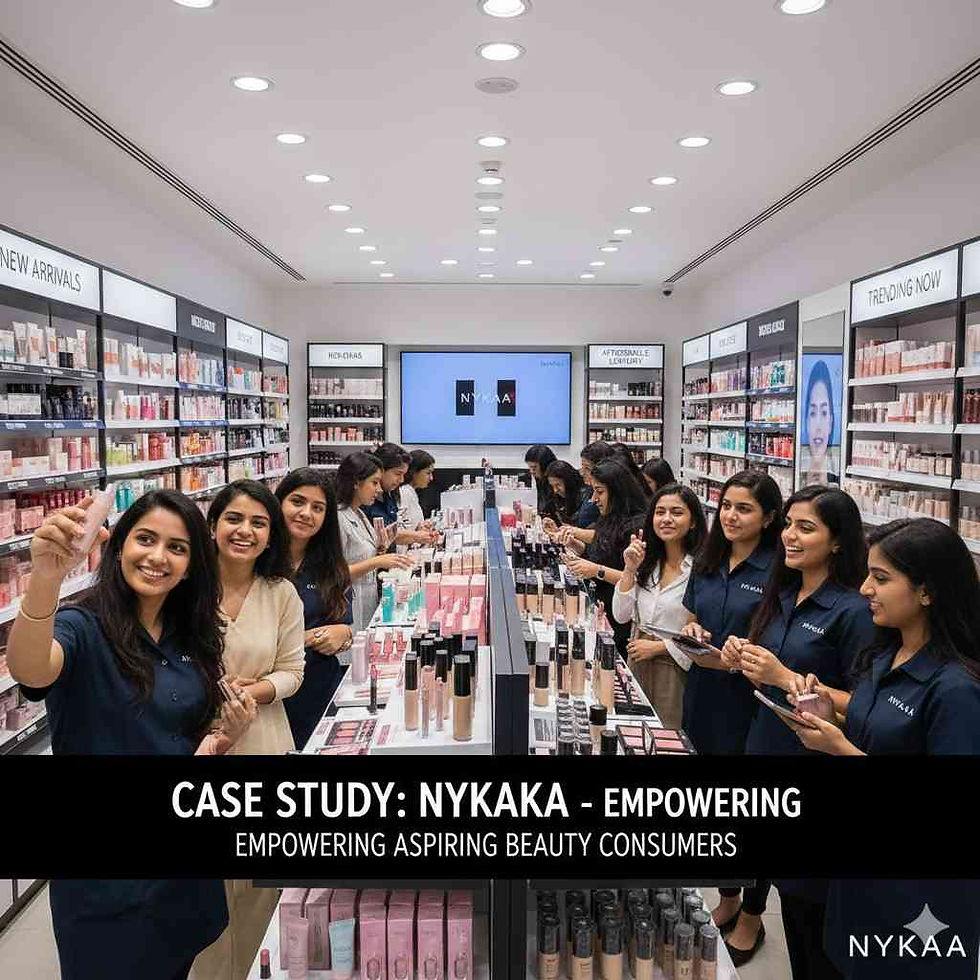
Despite starting as a pure-play online retailer, Nykaa strategically expanded into physical retail, recognizing that aspiring consumers valued experiential shopping, particularly for beauty products where trial and consultation are important. According to Nykaa's FY2024 annual report, the company operated 186 physical stores as of March 31, 2024, including Nykaa Luxe stores (focused on prestige beauty), Nykaa On Trend stores (general beauty and personal care), and Nykaa Kiosk formats. In an interview with Business Standard in August 2023, Falguni Nayar explained the rationale: "Physical stores serve as discovery centers for our aspiring consumers. They want to touch, feel, and experience products, especially in categories like fragrance and color cosmetics where personal preference is paramount." A RedSeer report from 2023, cited in Financial Express, noted that Nykaa's omnichannel approach—allowing consumers to browse online, try in-store, and purchase through either channel—addressed a key friction point for Indian beauty consumers who were transitioning from traditional retail to digital commerce. The company's store locations, according to publicly available store locator information and news reports, concentrated in malls and high-street locations in metro and tier 1 cities, reinforcing the aspirational positioning through premium retail environments.
4. Private Label Development
Nykaa developed a portfolio of owned brands targeting different price points within the aspirational segment. According to the FY2024 annual report, the company's owned brands included Nykaa Cosmetics (launched 2015), Kay Beauty by Katrina Kaif (2019), Nykaa Naturals (2016), and others acquired brands like Dot & Key and Twenty Dresses. In a press release from November 2019 announcing the Kay Beauty launch, Nykaa stated the brand was "created for the modern Indian woman who is confident, expressive, and unapologetic." The collaboration with Bollywood actress Katrina Kaif represented a strategic approach to aspirational branding—leveraging celebrity appeal while maintaining accessibility through moderate pricing. According to Nykaa's DRHP, owned brands contributed approximately 11% of the company's BPC Gross Merchandise Value (GMV) in FY2021. While the company does not regularly disclose updated percentages, its FY2024 annual report emphasized continued investment in owned brand development as a strategic priority. A Goldman Sachs research note from 2022, cited in Bloomberg Quint, observed that Nykaa's private labels were priced at a 15-30% discount to comparable international brands while maintaining positioning as premium products relative to mass-market Indian brands, effectively targeting the "masstige" (mass prestige) segment of aspiring consumers.
5. Technology and Personalization
Nykaa leveraged technology to enhance the shopping experience for aspiring consumers, though specific details about algorithms and systems are not publicly disclosed in detail. The company's mobile application, according to the DRHP, featured product recommendations, personalized homepage layouts, and a "Beauty Book" section with curated content. The app was designed to facilitate discovery and education, key needs of aspiring consumers navigating an expanding universe of beauty products. In a panel discussion at the Economic Times Retail Summit in September 2022 (covered by ET Retail), Anchit Nayar mentioned: "We use data to understand what our consumers aspire to buy next, not just what they've bought before. It's about aspiration modeling, not just replenishment." While Nykaa does not publicly detail its data science methodologies, the company's annual reports consistently cite technology infrastructure and data analytics as areas of ongoing investment.
6. Customer Service and Expert Consultation
Nykaa positioned customer service as a differentiator for aspiring consumers seeking guidance. According to the DRHP, the company operated customer care centers providing pre-sales consultation and post-sales support. The introduction of Nykaa Beauty Advisors in physical stores, referenced in multiple retail industry publications including Images Retail in 2022, provided personalized consultation, skincare analysis, and product recommendations—services typically associated with premium beauty retail globally but less common in the Indian mass market. A company blog post from 2021 described the training program for beauty advisors, emphasizing product knowledge and consultation skills to serve customers "aspiring to build sophisticated beauty routines."
Challenges and Limitations
Competition Intensification
Nykaa's market position faced increasing competition from multiple fronts. According to various news reports from 2022-2024, competitors included Amazon India and Flipkart (expanding beauty offerings), Purplle (a direct competitor focused on beauty), Tata Group's entry into beauty e-commerce, and quick commerce players like Blinkit and Swiggy Instamart adding beauty products. A Bernstein research report from January 2024, cited in Moneycontrol, noted that quick commerce platforms were capturing share in replenishment categories, potentially impacting Nykaa's frequency of purchase from existing customers.
Profitability Pressures
While Nykaa was profitable at the time of its IPO, subsequent quarters showed variability. According to publicly filed financial results with stock exchanges, the company's consolidated net profit margins fluctuated across FY2022-FY2024, influenced by increased competition, customer acquisition costs, and expansion investments. No verified public information is available on specific customer acquisition costs, retention metrics, or cohort-based profitability, as these operational metrics are not regularly disclosed in regulatory filings or earnings calls.
Tier 2 and Tier 3 Penetration
While aspiring consumers exist across tier 2 and tier 3 cities, penetration challenges persist. A report by Redseer and Amazon India from 2023, cited in Business Standard, noted that beauty e-commerce penetration in tier 3+ cities remained significantly lower than tier 1 cities, driven by factors including lower digital payment adoption, preference for in-person trials, and different brand preferences. Nykaa's store expansion strategy, as evidenced by locations published on its website and covered in retail news, remained concentrated in larger cities as of 2024, suggesting potential limitations in serving aspiring consumers in smaller towns through physical retail.
Strategic Outcomes and Market Position
Despite competitive pressures, Nykaa maintained a leading position in India's beauty e-commerce market. A RedSeer report from 2023, cited in The Hindu BusinessLine, estimated Nykaa held approximately 45-50% market share in the online beauty and personal care segment in India, though such estimates should be considered approximate given the lack of official industry-wide data. According to Nykaa's FY2024 annual report, the company served approximately 28.3 million annual transacting customers as of March 31, 2024, representing growth from previous years (specific prior-year numbers available in respective annual reports). In terms of geographic expansion, the same FY2024 report noted that the company operated across 4,600+ pin codes in India, indicating broad distribution reach while maintaining focus on urban and semi-urban areas with higher concentrations of aspiring consumers.
Brand Perception and Positioning
While detailed brand perception studies are not publicly available, several analyst reports and media coverage suggest Nykaa successfully established itself as a trusted destination for aspiring beauty consumers. A Nielsen Brand Equity survey result, shared in an Economic Times article from December 2022, indicated that Nykaa ranked as the most recalled beauty retail brand among urban Indian women aged 18-40, suggesting strong brand awareness in its core demographic. The company's partnerships and exclusives with international brands continued through 2023-2024. Press releases announced launches including Rhode Skin by Hailey Bieber (2024) and other brands, indicating that global beauty companies viewed Nykaa as a relevant platform for reaching Indian aspirational consumers.
Lessons and Implications
1. Omnichannel as Competitive Advantage
Nykaa's integration of online and offline retail appears particularly relevant for aspirational consumers in the Indian context, where e-commerce adoption continues to grow but physical retail remains dominant. According to a BCG-RAI report from 2023 cited in Mint, omnichannel shoppers in India spent 2-3 times more than single-channel shoppers, validating the strategic rationale.
2. Content and Community as Moats
The company's investment in content creation and community building represents an approach to customer engagement beyond transactional retail. While return on investment metrics for content are not publicly disclosed, the sustained investment over multiple years suggests management views this as strategic rather than merely tactical.
3. Curation Over Catalog Breadth
Nykaa's approach emphasized curated selection over comprehensive catalog breadth, a distinction noted in various analyst reports. This strategy appears aligned with aspiring consumers who value expert selection and authentic products over unlimited choice, though no verified public information quantifies consumer preferences in this regard.
4. Premiumization Trend Alignment
The company's focus on premium and prestige beauty positioned it to benefit from India's premiumization trend. However, economic volatility and consumer spending pressures, as referenced in various macroeconomic reports and news coverage from 2023-2024, present ongoing risks to this positioning.
Conclusion
Nykaa's focus on aspiring beauty consumers represents a deliberate strategic choice, executed through product curation, content and community engagement, omnichannel expansion, and positioning as a premium yet accessible beauty destination. The company's success in building a profitable business and achieving market leadership in India's beauty e-commerce segment demonstrates the viability of this approach, at least through its first decade of operations. However, intensifying competition, evolving consumer behaviors, and the challenges of maintaining profitability while expanding suggest that Nykaa's strategy will continue to be tested. The company's ability to deepen engagement with existing aspiring consumers while expanding to new cohorts and geographies will likely determine its long-term competitive position. No verified public information is available on detailed customer lifetime value metrics, cohort retention rates, or internal strategic planning beyond what executives have shared in public forums and regulatory filings.
MBA-Style Discussion Questions
Market Segmentation and Positioning: Evaluate Nykaa's focus on "aspiring consumers" as a segmentation strategy. How sustainable is this positioning given (a) the entry of horizontal e-commerce platforms and quick commerce players into beauty retail, and (b) the potential market saturation as more consumers move from aspiring to mainstream premium consumption? What alternative segmentation approaches could Nykaa consider?
Omnichannel Strategy Economics: Nykaa transitioned from pure-play e-commerce to an omnichannel model with physical stores. Given the capital intensity of retail expansion and the lower margins typically associated with physical retail, analyze the strategic rationale for this move. Under what conditions does an omnichannel approach create sustainable competitive advantage versus merely increasing complexity and costs? How should management evaluate the optimal physical store footprint?


Comments