Ola’s Multi-Service Mobility Platform Strategy
- 14 minutes ago
- 6 min read
Industry & Competitive Context
India’s urban mobility sector underwent major transformation during the 2010s with the rapid adoption of app-based transportation services. Rising smartphone penetration, digital payments growth, GPS-enabled mapping systems, and increasing urban commuting challenges created favorable conditions for ride-hailing platforms.
Within this environment, Ola emerged as one of India’s largest mobility platforms. Founded as a cab aggregation business, Ola expanded beyond ride-hailing into multiple transportation and mobility-adjacent services including auto-rickshaws, bike taxis, electric mobility, vehicle financing, cloud kitchens, and financial services at various stages of its growth journey.
The Indian mobility market differed structurally from several global markets because transportation demand was fragmented across multiple vehicle formats. Unlike markets heavily dependent on private cars or traditional taxis, Indian urban transport relied on a combination of cabs, auto-rickshaws, two-wheelers, buses, and informal transit systems.
This fragmentation created opportunities for platform-based aggregation models capable of integrating multiple transport categories into a unified digital interface.
Competition in the sector intensified with the expansion of global and domestic players, including Uber and various regional transportation platforms. Simultaneously, regulatory scrutiny around pricing, driver welfare, and platform governance increased across Indian states.
Against this backdrop, Ola’s strategy increasingly evolved from a single-service ride-hailing company into a broader mobility ecosystem platform.
Brand Situation Prior to Multi-Service Expansion
Ola initially built its business around app-based cab aggregation, focusing on improving accessibility, convenience, and booking transparency in urban transportation.
Publicly available company statements and media coverage from its early years consistently emphasized:
Real-time cab booking.
GPS-enabled ride tracking.
Digital payment integration.
Wider availability compared to traditional taxi systems.
As the company scaled, it faced several structural realities within the Indian market.
First, transportation demand varied significantly by price sensitivity and trip purpose. Different consumer segments relied on different transportation formats based on affordability, city infrastructure, and commuting distance.
Second, ride-hailing alone exposed the company to intense competition, operational volatility, and regulatory pressure.
Third, India’s transportation ecosystem remained underpenetrated in several categories outside premium taxi usage. Auto-rickshaws and two-wheelers represented substantial urban commuting volume.
These factors created incentives for Ola to expand beyond a single transportation category and develop a broader platform strategy.
Strategic Objective
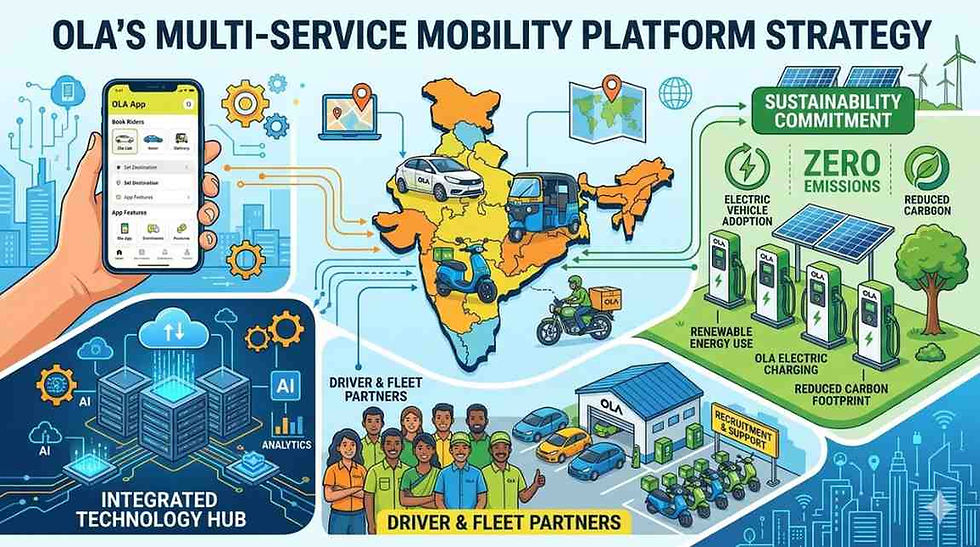
Ola’s multi-service strategy aimed to position the company not merely as a taxi-booking application, but as an integrated mobility platform capable of addressing diverse transportation and mobility-related needs.
Publicly available company announcements, investor communications, and media reports suggest several broad strategic objectives behind this expansion.
First, the company aimed to increase consumer engagement frequency by offering multiple transportation options within a single application ecosystem.
Second, Ola sought to improve market penetration across varied income groups by introducing services spanning premium and mass-market mobility segments.
Third, the company attempted to diversify beyond dependence on traditional cab aggregation revenue streams.
Fourth, Ola increasingly aligned its strategy with India’s broader electric mobility transition through investments in electric vehicles, charging infrastructure, and manufacturing initiatives.
Finally, the platform approach attempted to create operational and behavioral integration between mobility, payments, vehicle ownership ecosystems, and urban transportation infrastructure.
Campaign Architecture & Execution
Ola’s expansion strategy involved multiple service integrations executed over several years.
Multi-Modal Transportation Integration
One of Ola’s most visible strategic moves was the integration of multiple transportation formats into a single app ecosystem.
Beyond cabs, Ola introduced:
Auto-rickshaw booking services.
Bike taxi services in select markets.
Shared mobility offerings.
Rental and outstation ride categories.
This enabled the platform to address a wider range of urban mobility scenarios.
Publicly available company communication frequently emphasized convenience and transportation choice as central value propositions.
Ola Electric Expansion
A major component of the company’s platform evolution involved electric mobility.
Ola Electric expanded into electric two-wheelers and charging infrastructure. The company publicly announced investments in manufacturing facilities, battery technology initiatives, and EV ecosystem development.
According to company announcements and public filings, Ola Electric launched electric scooters including the Ola S1 series and established direct-to-consumer sales infrastructure supported by digital ordering systems and experience centers.
The electric mobility expansion represented a significant strategic broadening beyond ride aggregation into vehicle manufacturing and mobility infrastructure.
Financial and Driver Ecosystem Services
Publicly available reports also documented Ola’s expansion into driver-focused and financial ecosystem services at various stages.
These initiatives included:
Vehicle leasing programs.
Financial partnerships.
Driver support initiatives.
Digital payment integration.
No verified public information is available on proprietary internal driver monetization frameworks or platform optimization algorithms unless officially disclosed.
Hyperlocal and Adjacent Service Experiments
At different periods, Ola explored adjacent categories including food delivery and hyperlocal services. Some initiatives were later scaled down or discontinued according to public reporting.
These experiments reflected the broader platform economy trend in which digital consumer companies attempted to increase ecosystem engagement through multi-service integration.
Positioning & Consumer Insight
Ola’s platform strategy reflected several observable consumer realities in Indian urban transportation.
A central insight was that Indian mobility behavior is highly contextual rather than uniform. Consumers often switch between transportation modes depending on:
Trip distance.
Cost sensitivity.
Traffic conditions.
Time availability.
Urban infrastructure limitations.
Instead of positioning itself solely as a premium taxi solution, Ola increasingly positioned itself as a flexible mobility access platform.
This approach aligned with India’s heterogeneous transportation ecosystem where users may rely on auto-rickshaws for short trips, cabs for airport travel, and bikes for congestion-heavy routes.
The company also recognized that affordability plays a major role in transportation choice across Indian cities. Multi-modal integration allowed broader participation across income segments.
The electric mobility push additionally aligned with growing consumer awareness around sustainability, fuel economics, and government support for EV adoption.
Through Ola Electric, the company attempted to position itself not only as a mobility intermediary, but also as a participant in India’s future transportation infrastructure.
Media & Channel Strategy
Ola relied heavily on digital-first communication channels throughout its growth journey.
Publicly visible campaigns across television, outdoor advertising, digital media, and app ecosystems consistently highlighted:
Convenience.
Accessibility.
Technology-enabled transportation.
Urban commuting simplification.
The company also localized campaigns across Indian cities and languages, reflecting regional transportation usage patterns.
App-Centric Engagement
The Ola application itself functioned as a central customer engagement platform. Promotions, loyalty initiatives, notifications, and service integrations were primarily delivered digitally.
Performance and Event Marketing
Ola frequently used event-linked promotions, city-specific campaigns, and pricing-led acquisition strategies during high-demand periods.
However, no verified public information is available on internal campaign attribution systems, proprietary user segmentation frameworks, or undisclosed performance marketing metrics unless officially released.
Electric Mobility Branding
Ola Electric adopted a more technology- and future-oriented branding approach compared to the transportation platform business.
Public launches, product unveilings, manufacturing announcements, and digital-first product showcases formed major components of the EV communication strategy.
The company also utilized direct-to-consumer digital sales channels and experience centers to support electric scooter adoption.
Business & Brand Outcomes
Ola became one of India’s most widely recognized mobility technology brands.
Public reports and company announcements documented substantial expansion across Indian cities over multiple years. The platform integrated multiple ride formats and expanded transportation accessibility across urban markets.
Platform Diversification
Ola successfully broadened its brand identity beyond taxi aggregation. Public perception increasingly associated the company with broader urban mobility services.
Electric Vehicle Market Presence
Ola Electric emerged as a major participant in India’s electric two-wheeler market according to publicly reported vehicle registration data and industry coverage.
The company also attracted significant investor attention through funding rounds and public market activity.
Brand Recognition
Ola established strong national brand visibility through sustained digital engagement, city-level expansion, and category diversification.
The company became closely associated with app-based mobility transformation in India’s urban transportation sector.
Operational and Regulatory Challenges
Publicly documented reports also highlighted operational challenges including:
Regulatory disputes in certain states.
Competition pressures.
Driver-related concerns.
Service quality fluctuations.
EV service and customer support criticisms during certain periods.
These issues reflected the complexity of managing large-scale multi-service mobility ecosystems.
Strategic Implications
Ola’s evolution demonstrates how digital platforms in emerging markets may expand horizontally across adjacent consumer needs rather than remaining confined to a single service category.
First, the case highlights the strategic importance of ecosystem thinking in platform businesses. By integrating multiple transportation formats, Ola attempted to increase platform relevance across varied consumer contexts.
Second, the Indian market structure influenced platform design. Unlike transportation systems dominated by one vehicle category, India’s fragmented urban mobility ecosystem favored multi-modal integration.
Third, the transition into electric mobility reflected an attempt to move upstream within the transportation value chain. Rather than functioning solely as a service intermediary, Ola entered manufacturing and infrastructure-linked businesses.
Fourth, the case illustrates the operational complexity associated with platform diversification. Expanding across transportation modes, EV manufacturing, financing, and mobility infrastructure significantly increases execution demands.
Fifth, the company’s journey demonstrates that mobility platforms increasingly compete not only on transportation access, but also on ecosystem integration, affordability, and long-term infrastructure participation.
Ola’s multi-service strategy therefore represents a broader shift from ride aggregation toward integrated urban mobility platform development within the Indian digital economy.
MBA Discussion Questions
Why was a multi-service mobility strategy particularly relevant in the Indian transportation market?
How did Ola’s platform expansion differ from a traditional single-category ride-hailing model?
What strategic advantages and risks emerged from Ola’s expansion into electric mobility?
How does India’s fragmented transportation ecosystem influence platform business design?
What operational challenges are likely to arise when scaling a multi-service mobility ecosystem across transportation, EV manufacturing, and infrastructure categories?


Comments