OYO: Reputation Challenges and Brand Repositioning Efforts
- Jan 24
- 14 min read
Executive Summary
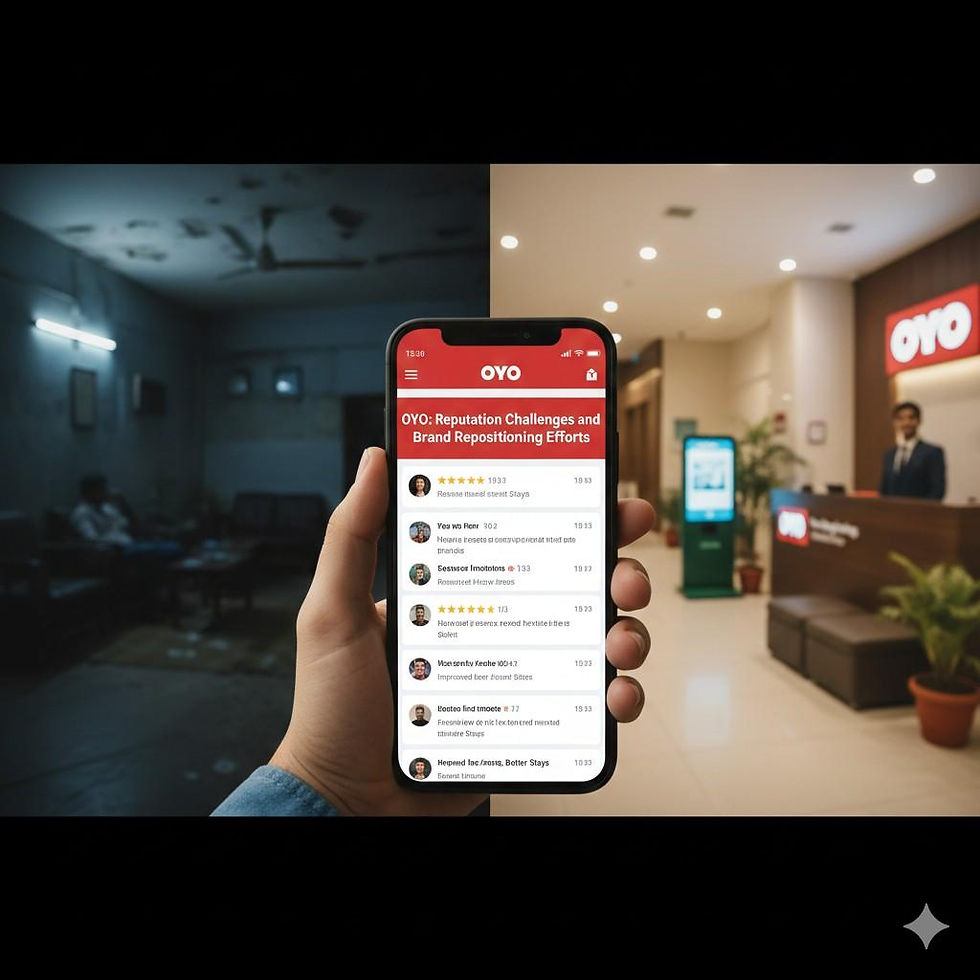
OYO Rooms (Oravel Stays Private Limited), founded in 2013 by Ritesh Agarwal, emerged as one of India's fastest-growing hospitality startups, expanding rapidly across India and internationally. According to reports in The Economic Times, Business Standard, and TechCrunch, OYO positioned itself as a budget hotel aggregator and franchisee model that standardized budget accommodations through technology and branding. However, the company faced significant reputation challenges from approximately 2018 onward, including complaints from hotel partners, customers, and employees, as extensively documented in Indian and international business media. This case study examines OYO's reputation challenges, their sources, and the company's subsequent brand repositioning efforts based solely on verified public information from credible sources.
Company Background and Business Model
Founding and Initial Concept (2013-2015)
OYO was founded in 2013 by Ritesh Agarwal, then 19 years old, as documented in profiles published in Forbes India, The Economic Times, and Business Standard. According to these sources, Agarwal received funding from Thiel Fellowship, a program supporting young entrepreneurs, and subsequently raised venture capital from investors including Lightspeed Venture Partners and Sequoia Capital, as reported in TechCrunch and VCCircle.
The initial concept involved aggregating budget hotels and standardizing their quality through branding, design guidelines, and technology systems, as described in company communications and early media coverage in The Economic Times and Mint. According to reports in these publications, OYO provided hotels with signage, linen, toiletries, and technology infrastructure while taking bookings through its platform and sharing revenue with hotel partners.
Rapid Expansion Phase (2016-2019)
OYO pursued aggressive expansion across India and internationally. According to reports in The Economic Times, Business Standard, Reuters, and TechCrunch, the company raised substantial funding from investors including SoftBank Vision Fund, Sequoia Capital, Lightspeed Venture Partners, and others. Multiple media reports from this period documented rapid growth in the number of hotels, rooms, and cities where OYO operated.
The Economic Times, Business Standard, and Mint reported that OYO expanded internationally to China, Southeast Asia, Europe, and the United States during 2017-2019. According to company announcements covered in these publications, international expansion included partnerships and acquisitions such as the acquisition of Amsterdam-based @Leisure Group in 2019, reported by Reuters and The Economic Times.
The company announced various room count milestones during this period, with reports in TechCrunch, The Economic Times, and Business Standard citing company claims of operating hundreds of thousands of rooms globally by 2019, though independent verification of these numbers was limited in media coverage.
Business Model Evolution
According to reports in The Economic Times, Business Standard, and hospitality trade publications, OYO's business model evolved over time, operating through various structures:
Franchise Model: Hotels operated under OYO branding with standardization requirements, with OYO managing bookings and taking commissions, as described in media coverage and company communications.
Lease and Management Model: In some cases, OYO reportedly leased hotel properties or took on management contracts with guaranteed minimum payments to property owners, as reported in The Economic Times and Business Standard.
Revenue-Sharing Arrangements: Various partnership structures involving revenue sharing between OYO and hotel partners, as mentioned in business media coverage of partner relationships.
The specific terms and prevalence of different models varied by market and property, with comprehensive details not publicly disclosed. Media reports and later disputes (discussed below) revealed tensions around contract terms and model structures.
Emergence of Reputation Challenges
Hotel Partner Complaints (2018-2019
From approximately 2018 onward, media reports) began documenting complaints from hotel partners about their relationships with OYO. The Economic Times, Business Standard, Mint, and The Hindu published multiple reports detailing grievances:
According to reports in The Economic Times and Business Standard in 2019-2020, hotel partners formed associations in various Indian cities to voice complaints against OYO. These associations alleged issues including unilateral contract changes, delayed payments, aggressive discounting that reduced partner revenues, and lack of transparency in booking data, as documented in multiple news reports citing partner statements and association representatives.
The Hindu and Business Standard reported on protests by hotel partners in cities including Gurugram, Bengaluru, and other locations, with partners holding demonstrations and filing complaints with authorities. According to these reports, partners claimed that promised revenues were not materializing and that OYO's practices were financially damaging to their properties.
In 2019, the Federation of Hotel and Restaurant Associations of India (FHRAI) issued public statements and communications critical of OYO's business practices, as reported by The Economic Times, Business Standard, and hospitality trade publications. According to reports in The Economic Times and Mint, FHRAI alleged predatory pricing and unfair business practices, calling for regulatory intervention.
Customer Service Issues
Multiple consumer complaints about OYO appeared in business media and consumer forums during this period. Reports in The Economic Times, Mint, and Business Standard documented customer grievances including:
Discrepancies between hotel photos/descriptions on the OYO platform and actual property conditions, as reported in consumer complaint coverage. According to reports in Mint and consumer-focused media, customers complained about misleading representations.
Issues with bookings, including alleged unauthorized cancellations, overbookings, and difficulties obtaining refunds, as documented in consumer complaint reports published in The Economic Times and Business Standard.
Customer service responsiveness problems, with reports in business media citing customer complaints about difficulty reaching OYO support and resolving issues.
Consumer protection authorities in various states reportedly received complaints about OYO's practices, as mentioned in reports in The Hindu and Business Standard, though specific regulatory actions and outcomes varied by jurisdiction.
Employee Relations and Work Culture Concerns
Reports in The Economic Times, Business Standard, and Inc42 documented employee grievances and workplace culture concerns at OYO:
In 2019-2020, multiple media reports covered layoffs at OYO across India and international markets, with The Economic Times, Reuters, and TechCrunch reporting on workforce reductions. According to these reports, employees and former employees raised concerns about the process and terms of layoffs.
Anonymous employee reviews and complaints posted on platforms like Glassdoor were referenced in media coverage, though such platforms involve unverified user submissions. However, credible business media including The Economic Times and Business Standard reported on workplace culture concerns based on interviews with current and former employees (where reporters verified employment status).
Reports in Inc42 and The Economic Times cited employee complaints about aggressive targets, high-pressure work environment, and alleged delays in salary payments or reimbursements in some cases.
Brand Reputation Impact
The accumulation of complaints from multiple stakeholder groups—hotel partners, customers, and employees—created negative media coverage and brand perception challenges, as evident in the volume and tone of business media reporting during 2019-2020.
Social media sentiment, while difficult to quantify from verified sources, was referenced in business media reports as turning negative, with hashtags critical of OYO trending on platforms, as mentioned in The Economic Times and Business Standard coverage of the company's reputation challenges.
Industry analysts quoted in The Economic Times, Business Standard, and Mint commented on OYO's reputation challenges, with some questioning the sustainability of the business model and the company's stakeholder management approaches.
Specific Controversies and Disputes
Legal and Regulatory Issues
Multiple legal disputes and regulatory issues were documented in credible media:
Partner Lawsuits: The Economic Times, Business Standard, and Mint reported on lawsuits filed by hotel partners against OYO in various jurisdictions, alleging breach of contract, non-payment, and other grievances. According to these reports, cases were filed in multiple Indian cities.
FHRAI Regulatory Complaints: According to reports in The Economic Times and Business Standard, FHRAI filed complaints with India's Competition Commission, alleging anti-competitive practices by OYO. The Economic Times reported in 2020 that the Competition Commission ordered an investigation into OYO's practices, based on FHRAI's complaint.
Consumer Protection Cases: Reports in The Hindu and Business Standard mentioned consumer protection cases and complaints filed against OYO in various jurisdictions, though comprehensive outcomes were not uniformly reported across all cases.
China Operations Challenges
OYO's China expansion, one of its largest international markets, faced significant challenges according to international business media:
Reuters, Bloomberg, and The Economic Times reported that OYO scaled back China operations significantly in 2019-2020, citing the challenging competitive environment and operational difficulties. According to these reports, the company reduced headcount and closed or exited numerous properties in China.
South China Morning Post and other publications covering Chinese technology reported on disputes with Chinese hotel partners and operational challenges similar to those reported in India.
COVID-19 Pandemic Impact
The COVID-19 pandemic severely impacted the hospitality industry globally, with OYO facing particular challenges given its existing reputation issues and stakeholder tensions.
Reuters, The Economic Times, and Business Standard extensively covered OYO's pandemic response, including further layoffs, property exits, and disputes with hotel partners over contract terms during lockdowns and travel restrictions.
According to reports in The Economic Times and Business Standard in 2020, disputes arose between OYO and hotel partners regarding payment obligations during pandemic-related closures, with partners alleging OYO failed to meet guaranteed payment terms while OYO reportedly cited force majeure clauses.
Brand Repositioning and Recovery Efforts
Operational Changes and Partner Relations
According to reports in The Economic Times and Business Standard from 2020 onward, OYO announced various changes to address partner concerns:
The company stated it would move toward more partner-friendly contract terms and reduce aggressive expansion in favor of consolidating existing operations, as reported in The Economic Times and Business Standard citing company statements.
OYO announced initiatives to improve transparency with partners regarding booking data and revenues, as mentioned in reports in The Economic Times, though specific implementation details were limited in public disclosures.
The company reportedly settled some disputes with hotel partners and renegotiated contracts, as mentioned in business media coverage, though comprehensive data on dispute resolutions was not publicly available.
Technology and Quality Improvements
According to company communications and reports in The Economic Times and TechCrunch, OYO announced initiatives to improve technology systems and quality control:
The company described investments in property management systems, partner dashboards, and customer service technologies, as mentioned in press releases and media coverage.
OYO announced quality assurance programs and audits of properties to ensure consistency with brand standards, as reported in The Economic Times and hospitality trade publications.
The company emphasized contactless technologies and hygiene protocols during the pandemic period, as documented in press releases and media coverage.
Customer-Facing Improvements
According to reports in The Economic Times and statements from company executives quoted in business media, OYO implemented various customer service improvements:
The company announced enhanced customer service capabilities including expanded support teams and improved refund policies, as mentioned in The Economic Times and Business Standard.
OYO described efforts to improve accuracy of property listings and photographs on its platform, addressing a key customer complaint area, as reported in business media.
The company introduced loyalty programs and membership offerings to build customer retention, as announced in press releases and covered in The Economic Times.
Leadership and Governance Changes
According to reports in The Economic Times, Business Standard, and Reuters, OYO made leadership and governance adjustments:
The company brought in senior executives with hospitality industry experience for key positions, as reported in business media coverage of executive appointments.
OYO added independent directors and advisors to its board, as mentioned in reports in The Economic Times and Business Standard, though comprehensive board composition details were not consistently disclosed publicly.
Founder and CEO Ritesh Agarwal gave interviews to media including The Economic Times and Forbes India acknowledging challenges and describing corrective actions, as documented in published interviews.
Strategic Refocusing
According to reports in The Economic Times, Business Standard, and Reuters from 2020-2022, OYO shifted strategic priorities:
The company emphasized profitability over growth, with reports indicating a move away from aggressive expansion toward operational efficiency, as stated in company communications quoted in business media.
International operations were scaled back significantly, with exits from various markets reported in The Economic Times, Reuters, and TechCrunch. According to these reports, OYO exited or significantly reduced operations in several countries to focus on core markets.
The company announced focus on technology products for hotels rather than just aggregation, as reported in The Economic Times, positioning itself more as a technology solutions provider to the hospitality industry.
IPO Filing and Disclosure
OYO filed draft papers for an initial public offering (IPO) in India with the Securities and Exchange Board of India (SEBI) in 2021, as reported by Reuters, Bloomberg, The Economic Times, and Business Standard. The IPO filing provided additional disclosures beyond what the private company had previously shared.
According to reports analyzing the IPO documents published in The Economic Times, Mint, and Business Standard, the filings disclosed various risk factors, legal proceedings, and business challenges, providing more transparency into the company's operations and issues.
The IPO process was subsequently put on hold, with reports in Reuters and The Economic Times in 2022-2023 indicating the company withdrew or delayed the offering, citing market conditions and the need for further operational improvements.
Analysis of Reputation Challenges
Sources of Reputational Risk
OYO's reputation challenges stemmed from multiple sources identifiable in public reporting:
Rapid Growth Prioritization: The company's aggressive expansion, well-documented in media coverage, appears to have prioritized speed and scale over stakeholder relationship management and operational quality, based on the pattern of complaints emerging across markets.
Business Model Tensions: The franchisee/partnership model created inherent tensions where OYO's interests (maximizing bookings and commissions) could conflict with partner interests (maintaining room rates and profitability), as discussed in business media analysis of the model.
Multi-Stakeholder Complexity: Operating a platform connecting hotel partners and customers while managing employees created complexity in balancing competing interests, with challenges in satisfying all stakeholder groups simultaneously evident in documented complaints.
Communication and Transparency: Reports of contract disputes, payment delays, and unclear terms suggest communication and transparency gaps between OYO and stakeholders, based on grievances documented in media coverage.
Industry Context and Competitive Dynamics
The budget hotel aggregation model faced challenges beyond OYO's specific execution. According to industry analysis published in The Economic Times, Business Standard, and hospitality trade publications, the model involves structural challenges including:
Low margins in budget hospitality limiting financial flexibility for all parties, as discussed in analyst commentary published in business media.
Difficulty standardizing diverse independent properties under a unified brand promise, as noted in hospitality industry analysis.
Competition from other aggregators and platforms including MakeMyTrip, Goibibo, Treebo, and others, creating pressure on pricing and terms, as documented in competitive landscape coverage in business media.
Direct booking channels and other distribution options available to hotels, limiting platform power, as discussed in hospitality technology coverage.
Comparison to Platform Economy Challenges
OYO's reputation challenges shared characteristics with other platform economy companies that faced stakeholder tensions, as discussed in business and technology media analysis:
Gig economy labor concerns, regulatory scrutiny of platform business models, and tensions between platform economics and partner/worker interests have affected companies globally, as documented in business media coverage of the platform economy.
Rapid growth funded by venture capital, with pressure to scale quickly, sometimes created tensions with sustainable stakeholder relationships, as analyzed in venture capital and startup coverage in business publications.
Effectiveness of Repositioning Efforts
Measurable Outcomes
Assessing the effectiveness of OYO's brand repositioning efforts is challenging with available public information, as the company as a private entity (with the IPO on hold) does not disclose comprehensive operational metrics.
Some indicators from credible public sources:
Media Tone Shift: A review of business media coverage from 2021-2024 shows somewhat less negative coverage compared to 2019-2020, though challenges continue to be reported. This suggests some reputation stabilization, though media coverage alone is an imperfect measure.
Continued Operations: OYO continues to operate in India and select international markets, as evidenced by ongoing business media coverage and company communications, indicating survival despite reputational challenges.
Legal Resolution Progress: Some reports in The Economic Times mention settlements of specific disputes with partners, though comprehensive data on all legal matters is not publicly available.
Remaining Challenges
Reports in business media from 2022-2024 indicate ongoing challenges:
The Economic Times and Business Standard continue to report occasional disputes with hotel partners and operational challenges, suggesting relationship issues persist albeit perhaps at reduced levels.
The delayed IPO, as reported in Reuters and The Economic Times, suggests the company may still face investor skepticism related to business model sustainability and past reputation issues.
Competition in budget hospitality remains intense, as documented in ongoing business media coverage of the sector, creating continued pressure on the business.
No verified public information is available on comprehensive customer satisfaction metrics, partner satisfaction levels, or employee engagement scores that would enable systematic assessment of reputation recovery.
Lessons and Implications
Stakeholder Management in Platform Models
OYO's experience illustrates challenges in multi-sided platform businesses where the platform operator must balance competing stakeholder interests. According to business model analysis published in academic journals and business publications, platforms face inherent tensions when:
Platform revenue optimization may conflict with partner economics, as evident in OYO's pricing and commission disputes.
Rapid scaling can strain quality control and relationship management, as demonstrated by complaints across markets.
Power asymmetries between platforms and fragmented partners can lead to relationship tensions, as discussed in platform economy research.
Growth vs. Sustainability Trade-offs
The case demonstrates tensions between venture capital-funded rapid growth strategies and sustainable stakeholder relationships, a theme discussed in startup ecosystem analysis published in business media and academic research.
OYO's pivot toward profitability focus and slower growth, as reported in business media, represents a strategic shift from prioritizing scale to emphasizing operational quality and stakeholder sustainability.
Brand Reputation in the Digital Age
OYO's reputation challenges spread rapidly through digital channels, social media, and online reviews, as evidenced by media coverage referencing online sentiment. This illustrates how digital connectivity accelerates both positive and negative brand information flow.
Recovery from reputation damage requires operational improvements, not just communications, as demonstrated by the need for OYO to make substantive changes to contracts, service quality, and stakeholder management rather than merely improving messaging.
Transparency and Governance
The move toward greater transparency through IPO filing (even though ultimately delayed) provided stakeholders with more information about operations and challenges, as noted in media analysis of the disclosures.
Private companies funded by venture capital face less disclosure requirement than public companies, potentially allowing problems to accumulate before becoming widely visible, as discussed in corporate governance literature and media commentary on startup accountability.
Conclusion
OYO's trajectory from rapid growth startup to facing significant reputation challenges and subsequently attempting brand repositioning illustrates the complexities of platform business models, stakeholder management, and sustainable scaling in the hospitality industry. Based on verified public information from credible sources, the company encountered documented complaints from hotel partners, customers, and employees during its rapid expansion phase from approximately 2018-2020, creating substantial negative media coverage and brand perception challenges.
The company's subsequent efforts from 2020 onward included operational changes, strategic refocusing, leadership adjustments, and enhanced stakeholder engagement, as documented in business media reports and company communications. While some stabilization appears evident in reduced negative media coverage and continued operations, comprehensive assessment of reputation recovery effectiveness is limited by the absence of publicly disclosed systematic metrics on stakeholder satisfaction and brand perception.
OYO's experience provides insights into the risks of prioritizing growth speed over stakeholder relationship quality, the challenges of managing multi-sided platforms with competing interests, and the difficulty of recovering from reputation damage in digitally connected markets. The case remains ongoing, with the company's future success depending on sustained operational improvements, stakeholder trust rebuilding, and business model refinement—developments that will continue unfolding beyond currently available verified public information.
Discussion Questions
Growth Strategy and Stakeholder Trade-offs: OYO pursued aggressive expansion funded by substantial venture capital, prioritizing rapid scaling over stakeholder relationship development. Evaluate the strategic logic of this approach. Under what conditions might prioritizing growth speed over stakeholder satisfaction be justified? What are the long-term risks of such strategies in platform business models where reputation and network effects are critical? How should venture capital-backed companies balance investor pressure for rapid growth against the need for sustainable stakeholder relationships?
Multi-Sided Platform Economics and Incentive Alignment: OYO operates a platform connecting hotel partners and customers while managing its own workforce, creating potential conflicts of interest. Analyze the inherent tensions in this model: when OYO maximizes bookings through aggressive discounting, it may benefit customers and its own commission volume but harm hotel partner economics. How should platform operators design business models and contract structures to better align incentives across stakeholder groups? What governance mechanisms or structural changes could reduce such conflicts?
Reputation Recovery Strategy and Effectiveness: After facing significant reputation damage documented in media coverage and stakeholder complaints (2018-2020), OYO implemented various corrective measures. Evaluate the comprehensiveness and likely effectiveness of these efforts based on available information. What elements appear missing from the repositioning strategy? How can companies measure reputation recovery effectiveness, and what metrics should OYO track? What timeline is realistic for recovering from reputation damage of this magnitude, and what factors determine recovery speed?
Transparency and Accountability in Private vs. Public Companies: OYO operated as a private company during its most challenging period, with limited disclosure requirements compared to public companies. The IPO filing process provided greater transparency but was subsequently delayed. Discuss the implications: Does the private company structure enable problems to accumulate without sufficient stakeholder visibility? What accountability mechanisms beyond market listing could apply to venture capital-backed companies affecting numerous stakeholders (hotel partners, customers, employees)? Should regulation of platform companies be enhanced regardless of public/private status?
Business Model Viability and Strategic Alternatives: Given the documented challenges in OYO's aggregation and franchising model, evaluate the fundamental viability of this approach in budget hospitality. What structural changes to the business model might better address stakeholder tensions—for example, different contract structures, revenue-sharing models, quality control mechanisms, or partner selection criteria? Should OYO pivot more fundamentally toward different models such as pure technology provider, full asset ownership, or other alternatives? What does OYO's experience suggest about the applicability of platform/aggregation models to different industries?


Comments