Paytm Karo: Engineering a Mass-Adoption Moment
- Apr 16
- 10 min read
Executive Summary
In the hours following India's historic demonetisation announcement on November 8, 2016 — which invalidated 86% of currency in circulation overnight — Paytm executed one of the fastest and most consequential brand mobilisations in Indian marketing history. Its "Paytm Karo" campaign cluster, anchored by the tagline Ab ATM nahi, Paytm Karo (Now Paytm, not the ATM), deployed print, television, and ground-level media in eleven regional languages within 24 hours. This case examines the strategic context, campaign architecture, and documented business outcomes of that campaign, drawing exclusively on publicly verifiable sources.
Industry & Competitive Context
India's payments landscape in the early 2010s was defined by structural cash dependence. The country's vast unorganised retail sector — comprising tens of millions of street vendors, kirana stores, and small-format merchants — operated almost entirely outside formal financial infrastructure. Traditional Point-of-Sale (POS) terminals were prohibitively expensive for this segment: hardware costs, merchant discount rates, and administrative burden placed card-based acceptance beyond reach for the majority of India's retail outlets. Against this backdrop, the mobile wallet segment emerged as a credible low-friction alternative. By late 2016, the primary competitors in India's digital wallet space were Paytm, Mobi Kwik, and Free Charge. While Paytm had established a meaningful lead in registered users, the competitive distance between these players remained modest. As reported by Zee Business in December 2016, Paytm was "just a little ahead of competitors Free Charge and Mobi Kwik" immediately prior to demonetisation. A structural market inflection was also underway. The Reserve Bank of India's launch of the Unified Payments Interface (UPI) in April 2016 introduced a real-time, interoperable payment rail that would eventually threaten the closed-loop wallet model all three players depended upon. The competitive landscape was therefore in a period of technological transition precisely when the macro policy shock arrived.
Brand Situation Prior to the Campaign
Paytm was founded in 2010 by Vijay Shekhar Sharma under the parent entity One97 Communications Ltd. It launched initially as a mobile recharge and bill payment platform. The Paytm Wallet — its core consumer product — was introduced in January 2014, with Indian Railways and Uber adopting it as a payment option shortly thereafter. By 2015, China's Alibaba Group and its affiliate Ant Financial had increased their combined stake in the company to 40%, becoming Paytm's largest shareholders (Wikipedia / One97 Communications). Operationally, Paytm had made a pivotal pre-campaign decision: in October 2015 it began rolling out payment solutions for offline merchants, becoming — per its own CFO Madhur Deora in an interview published by Euromoney — "the only company outside the card networks that was doing so in India at the time." By the eve of demonetisation, Paytm had signed up approximately 850,000 offline merchant entities across 1,200 Indian cities (Source: research published via ResearchGate, September 2017). Its wallet user base stood at approximately 125 million (Source: Euromoney, November 2017). From a capital standpoint, the company was well-resourced. In August 2016 — three months before demonetisation — One97 Communications raised a $60 million funding round from MediaTek at a valuation of over $5 billion (Inc42, 2017). One97's total revenue for the fiscal year ending March 2017 was reported at approximately ₹813.8 crore (approximately $126 million at period rates), per filings with India's Ministry of Corporate Affairs reviewed by Inc42.
Strategic Objective
No verified public document articulates a single, formally stated campaign objective from Paytm's leadership. However, the company's stated marketing posture and the observable character of its campaign execution reveal a coherent three-part strategic ambition that can be reconstructed from public sources. First, user base maximisation in a compressed window: the demonetisation shock created an unprecedented forced-adoption moment. India's consumers needed an alternative to cash within hours, and every day without a solution created urgency. Paytm's campaign sought to capture this demand surge before it dispersed or migrated to competitors. Second, merchant-network deepening: the QR-code-based acceptance model Paytm had been building since 2015 needed mass merchant awareness to reach its network effects threshold. The campaign explicitly targeted merchants — including vegetable vendors and grocery stores — rather than stopping at consumer-facing messaging. Third, brand lexicalisation: by constructing the tagline as an imperative verb — "Paytm Karo" — the company pursued the rare brand-strategy goal of embedding its name into everyday language as a synonym for digital payment, in the tradition of "Google it" or "Xerox."
Campaign Architecture & Execution
The "Paytm Karo" campaign was not a single, pre-planned creative execution but rather a rapid-response cluster of activations launched in sequence over approximately two weeks following the November 8, 2016 announcement. Its architecture can be understood in three phases:
Phase 1 — Print Blitz: "Ab ATM nahi, Paytm Karo"
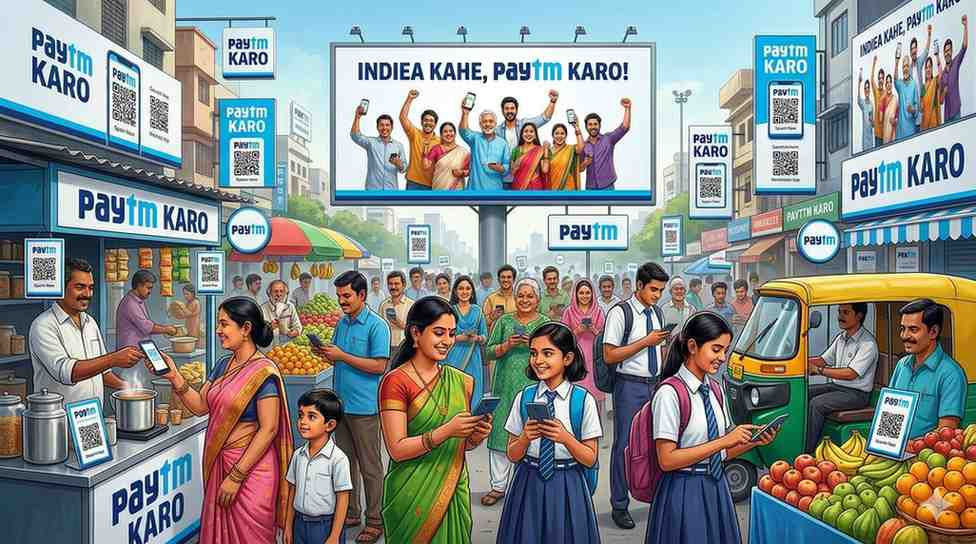
Within hours of the demonetisation announcement, Paytm — in coordination with its ad and media agencies — placed front-page advertisements in major national dailies. The copy congratulated Prime Minister Narendra Modi for "taking the boldest decision in the financial history of independent India," and deployed the tagline Ab ATM nahi, #Paytm Karo. Critically, these ads ran simultaneously in eleven regional languages, extending linguistic reach beyond English- and Hindi-literate urban consumers to the regional merchant base. (Sources: Zee Business, December 2016; Exchange4media, November 2016.)
Phase 2 — Television: "Drama Bandh Karo, Paytm Karo" (revised to "Chinta Nahi, Paytm Karo")
The television campaign, created in partnership with McCann Delhi, aired on November 12. The original execution — "Drama Bandh Karo, Paytm Karo" — depicted a domestic worker asking her employer to stop lamenting the cash shortage and simply use Paytm. The ad provoked significant social media criticism for appearing to trivialise the genuine hardship faced by citizens dependent on cash, including daily wage workers and small merchants. Within 24 hours, Paytm revised and re-released the campaign with the modified tagline "Chinta Nahi, Paytm Karo" (No worry, use Paytm). This episode represents a documented instance of real-time brand risk management during the campaign. (Sources: Scroll.in, December 2016; Exchange4media, November 2016.)
Phase 3 — Ground-Level Merchant Activation
The company's sales teams undertook direct merchant-enrolment drives, assisting retailers — including street food stalls, puncture shops, and vegetable vendors — with account creation and app installation. This activation, reported in multiple contemporaneous sources (Medium, ResearchGate), transformed the Paytm QR code into a pervasive physical-media presence. Each QR sticker placed at a merchant's counter served simultaneously as a payment instrument and a brand impression. On marketing budget allocation: Zee Business reported in December 2016 that Paytm had allocated ₹600 crore for branding and marketing in fiscal year 2016–17, and that the company's senior marketing leadership confirmed increased spend following demonetisation, though the specific incremental amount was not publicly disclosed. The campaign's campaign tagline architecture also bears note. "Paytm Karo" functions grammatically as a second-person imperative in Hindi — a directive, not an invitation. This construction is strategically distinct from descriptive taglines and positions the brand not merely as a payment option but as the obvious, default action in a cash-constrained world.
Positioning & Consumer Insight
The strategic insight underlying the campaign was a precise reading of a previously underserved segment: India's informal economy merchant. Prior to Paytm's QR-code rollout, digital payment acceptance had been structurally inaccessible to this segment — not for want of customers willing to pay digitally, but because no product had been designed to serve them at zero hardware cost and zero complexity. Paytm's QR model addressed this gap directly by eliminating the POS terminal entirely. The demonetisation crisis amplified this insight to a national scale. The campaign's multi-language architecture — eleven regional languages across print — was a strategic signal that Paytm's network was designed for all of India's retail geography, not merely its metropolitan tier. This positioning placed Paytm as an equaliser between the vegetable vendor and the organised retailer. The campaign's verbal register ("Karo" — do it) also reveals a consumer insight about the psychological friction of technology adoption: formal banking and card-network language is passive and transactional; "Paytm Karo" is active and directive, collapsing the cognitive distance between intent and action. The goal was to make Paytm feel less like a product and more like a natural behaviour.
Media & Channel Strategy
The campaign's media architecture was notable for its simultaneous deployment across channels at a speed that reflected genuine operational readiness rather than pre-planned media scheduling. Three channel types have been documented in credible sources:
Print: Front-page placements in India's major national dailies on the morning of November 9, 2016 — less than twelve hours after the Prime Minister's announcement. The eleven-language deployment across regional publications extended reach beyond the urban English-language readership that typically dominates print media planning in India.
Television: Analytic firm Silver Push, as cited by Zee Business, recorded that TV advertising spots for the e-wallet category increased to 1,386 post-demonetisation from 734 in the period immediately preceding the announcement — a near-doubling of category TV presence, with Paytm at the forefront. Online searches for e-wallets also grew from just above 10 million to over 20 million in the same period (Silver Push data, as reported by Zee Business, December 2016).
Ground / Field: The merchant activation programme — direct sales team deployment to onboard small and informal sector merchants — constituted an unconventional but strategically critical channel. The physical QR code sticker became ambient advertising at point-of-payment: a media impression that occurred precisely at the moment of maximum behavioural relevance. No verified public information is available on Paytm's specific media spend allocations by channel, programmatic or digital media buying strategy, or the specific reach and frequency targets set for the campaign period.
Business & Brand Outcomes
The following metrics are drawn exclusively from credible published sources and official or attributable corporate statements. Internal metrics not confirmed through public channels are excluded. The seven-million-transactions-per-day figure reported within two weeks of demonetisation is particularly significant in competitive context: Scroll.in reported at the time that this surpassed the combined average daily usage of India's 24.5 million credit cards and 661.8 million debit cards — a data point that illustrates the scale of the behavioural shift Paytm captured. The medium-term user trajectory continued upward. Euromoney, writing in November 2017, confirmed that Paytm's wallet user base grew from 125 million pre-demonetisation to 185 million within three months, and to 280 million by November 2017. Bloomberg, reporting in May 2017, cited an Paytm company statement confirming a user base of 220 million at the time of SoftBank's $1.4 billion investment — a round that valued the company at over $8 billion (Bloomberg, May 2017). This valuation represented a substantial step up from the $5 billion valuation at the August 2016 MediaTek round, six months prior. By 2021, a RedSeer report cited by One97 Communications' annual filings confirmed Paytm's position as India's largest payments platform, with a Gross Merchant Value (GMV) of ₹4,033 billion for FY2021. In November 2021, One97 Communications listed on Indian stock exchanges through an IPO that raised ₹18,300 crore — at the time the largest IPO in India's history (Wikipedia / One97 Communications).
Strategic Implications
1. Crisis as catalytic opportunity — the pre-condition of readiness. The conventional narrative of the "Paytm Karo" campaign frames it as a story of opportunistic brilliance. A more analytically precise reading reveals that the campaign's speed and effectiveness were only possible because Paytm had made consequential infrastructure investments before the crisis — most notably, the offline merchant QR ecosystem deployed from October 2015. As CFO Madhur Deora noted publicly, the product and sales infrastructure already existed; demonetisation simply provided the demand that filled it. The strategic implication is that opportunity capture is a function of preparedness, not just reflexes.
2. Multi-language deployment as genuine inclusion strategy. The decision to run eleven-language print campaigns on the morning of November 9 was not merely a media efficiency choice. It was a brand positioning signal: Paytm was explicitly declaring itself a network for all of India's commercial geography, not just its English-literate urban core. This choice aligned with the merchant-activation strategy and reinforced the claim that Paytm's network effects would extend to the informal economy.
3. The imperative verb as brand architecture. "Paytm Karo" achieved what few campaign taglines accomplish: lexicalisation. The brand name became a verb in everyday Hindi usage, collapsing the distinction between brand recall and behavioural action. This is the rarest form of brand equity — one that is embedded in language rather than merely in awareness — and represents a durable competitive asset that media spend alone cannot replicate.
4. Real-time brand risk management. The swift withdrawal and revision of the "Drama Bandh Karo" television execution illustrates that the same speed that created Paytm's competitive advantage also created reputational exposure. Within 24 hours of broadcast, the campaign had generated enough social media backlash that the company revised its messaging — a documented instance of the brand paying a short-term credibility cost for its aggressive timing. The episode is instructive: crisis campaigns that position a brand as a solution to public hardship must navigate with precision the line between empathy and exploitation.
5. The limits of the wallet model. The campaign's mass-adoption success was ultimately captured by a payment instrument — the closed-loop wallet — that faced structural disruption from UPI. Paytm integrated BHIM UPI onto its platform only in November 2017 (Wikipedia), a full year after the campaign. One97 Communications' revenue from operations declined from ₹3,350 crore in FY2020 to ₹2,802 crore in FY2021 (One97 annual report, per Wikipedia). The "Paytm Karo" campaign built extraordinary top-of-funnel scale; the deeper strategic challenge — converting that scale into durable monetisable engagement as the payments market commoditised — remained the company's defining post-campaign problem.
Discussion Questions
Paytm's ability to execute its campaign within hours of the demonetisation announcement was predicated on offline merchant infrastructure built 13 months earlier. How should firms systematically build for optionality and crisis-readiness in platform businesses, and what organisational conditions make such preparation possible?
The "Drama Bandh Karo" television ad was withdrawn within 24 hours following social media backlash — yet Paytm's user growth continued strongly. To what extent does short-term reputational risk matter during a demand-surge event, and how should firms weigh speed of execution against message sensitivity in crisis campaigns?
The brand achieved partial lexicalisation — "Paytm Karo" became a colloquial verb for digital payment in India — yet this did not prevent UPI from commoditising the payment layer. What is the strategic value and limitation of lexical brand equity in platform markets where the underlying technology standard may shift?
Paytm's competitor Mobi Kwik operated in the same market with the same demonetisation tailwind, yet did not achieve comparable user growth. Using Porter's framework and the network effects literature, construct an argument for why Paytm's pre-existing merchant network was more decisive than its campaign creative in determining the outcome.
One97 Communications' IPO in 2021 — India's largest ever — was followed by significant stock price underperformance in subsequent years. Does the mass adoption achieved by the "Paytm Karo" campaign represent a durable source of competitive advantage, or primarily a first-mover advantage that proved difficult to monetise? What does this case imply about the relationship between brand-building and business model sustainability in zero-MDR payment environments?

Comments