Razorpay's Payment Gateway Strategy for Indian Startups
- May 6
- 12 min read
Industry & Competitive Context
India's digital payments landscape is among the most consequential in the global economy. According to data cited by the Union Finance Ministry, India processed over 91 billion digital payment transactions in 2023, positioning the country as the world's fastest-growing fintech market. The National Payments Corporation of India (NPCI) reported that UPI alone processed over 14,000 crore transactions in FY 2023–24, reflecting the scale of infrastructure-level transformation underway. According to Mordor Intelligence, the India payment gateway market was estimated at USD 1.21 billion in 2024 and is projected to reach USD 2.66 billion by 2029, growing at a compound annual growth rate of approximately 17 percent. Structurally, the competitive landscape divides into two segments. The first comprises consumer-facing UPI platforms — PhonePe, Google Pay, and Paytm — which dominate person-to-person and person-to-merchant consumer transactions. The second, where Razorpay operates, comprises B2B payment infrastructure providers — gateways and aggregators — that power the back-end acceptance, reconciliation, and financial management stack for merchants, startups, and enterprises. Key competitors in this segment include Pay U, CC Avenue, Cash free Payments, Bill Desk, and, more recently, Stripe following its India entry. Among these, Pay U operates across 50-plus countries with USD 55 billion in annual processing (as cited in industry profiles), while CC Avenue processes over 1 billion transactions annually for traditional businesses. Prior to Razorpay's emergence, India's B2B payment gateway market was dominated by incumbents — CC Avenue, Bill Desk, and bank-owned gateways — that were architected for large, established businesses rather than agile startups. Onboarding required physical office documentation, security deposits, operational history, and multi-week approval timelines. Low credit card penetration (approximately 21 million credit cards for a 1.3 billion population by end-2014, as documented by Contrary Research) meant that international gateway models like Stripe, designed for credit-card-dominant Western markets, had no viable India strategy at the time. The structural void was significant, and Razorpay entered it with deliberate precision.
Brand Situation Prior to Strategic Launch
Harshil Mathur and Shashank Kumar met at IIT Roorkee, where they co-founded SDS Labs, the institution's software development unit. After graduation, their paths diverged — Kumar joined Microsoft in the United States, and Mathur joined Schlumberger in the Middle East — before they reunited in 2013 to attempt building a crowdfunding platform in India. It was through this experience that they directly encountered the structural failure of India's payment gateway market: incumbents demanded past operational records, physical offices, security deposits, and high setup fees before a startup could even accept its first rupee online. Pivoting from crowdfunding, the founders established Razorpay in 2014, originally operating out of Jaipur with support from Startup Oasis — an incubator set up by Rajasthan Industrial Investment Corporation and IIM Ahmedabad's CIIE. The company was incorporated as Razorpay Software Private Limited. The initial product was a payment gateway explicitly designed for startups and SMEs: clean REST APIs, multi-modal payment acceptance (cards, net banking, UPI, wallets), fully digital KYC onboarding, and a transparent pricing structure. The founders attempted multiple early channels, including a direct pitch to schools for a fee-collection product; that effort produced minimal traction and clarified that startups — not traditional institutions — were the right customer segment.
In 2015, Razorpay was accepted into Y Combinator's Winter 2015 batch, making it only the second India-focused company to be selected by the programme, as documented by YourStory and the official YC blog. The programme provided USD 120,000 in seed capital and mentorship from figures including Paul Buchheit, creator of Gmail. YC's framing of Razorpay at launch was explicit: it described the company as offering "Stripe-style payments focused squarely on Indian e-commerce plays," positioning it as a developer-first gateway architected for India's distinct regulatory and payment method environment.
Strategic Objective
Razorpay's stated founding mission — as documented across its official Y Combinator profile and public founder communications — was to democratise digital payments for startups and SMEs by providing "a simple, affordable, and secure way for businesses to accept payments online." The strategic objective, however, evolved in three measurable phases over the decade following launch. Phase one (2014–2017) was market-entry and segment capture: build a frictionless payment gateway for a segment that incumbents structurally ignored, establish a developer-first reputation, and grow the merchant base among India's expanding startup ecosystem. Phase two (2017–2020), triggered by the launch of Razorpay 2.0 in September 2017, shifted the objective to platform expansion: move beyond payment acceptance into the broader financial operating system of a business, addressing cash flow management, disbursements, payroll, and lending. Phase three (2020–present) targets category leadership and international expansion: achieve dominant market share in India's digital payments processing segment, expand into Southeast Asia, diversify revenue toward non-transaction-fee models (neobanking, lending, SaaS), and prepare for a public market listing. Each phase was announced through product launches and investor communications, ensuring verifiability. Critically, Razorpay's strategic objective has never been to displace consumer payment apps such as PhonePe or Google Pay; the company has consistently and publicly articulated a B2B positioning, targeting businesses as the customer rather than end consumers.
Go-to-Market Architecture & Execution
Razorpay's go-to-market strategy rested on three documented pillars: developer-led distribution, segment-specific product design, and a platform expansion model that deepened customer dependency over time.
Developer-Led Distribution. Unlike incumbents who sold through banking relationships and enterprise sales cycles, Razorpay made product discoverability a form of distribution. The company's API documentation, developer SDKs, and self-serve onboarding were designed to allow a startup founder to integrate payments in a single afternoon without speaking to a salesperson. As the company's own case narrative documents, early adopters at Startup Oasis signed up independently — no outbound sales was required. This product-led growth dynamic was structurally self-reinforcing in the startup ecosystem, where developers are often decision-makers. Y Combinator's public description of Razorpay explicitly noted that "using Razorpay's APIs, a company can add payments with a few lines of code."
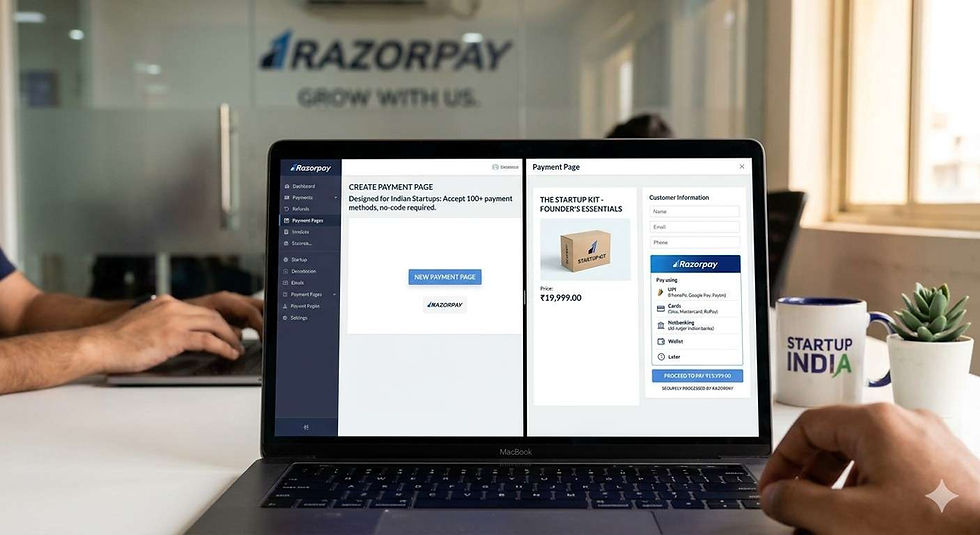
Segment-Specific Product Architecture. Razorpay was documented as the first payment gateway in India to launch a completely digital onboarding process for startups — a structural response to the industry norm of requiring physical documentation, office visits, and operational history. According to its official Y Combinator profile, Razorpay was also the first to launch UPI support among payment gateways, the first to support Bharat QR, and the first to introduce recurring payments for businesses through Razorpay Route. These firsts were not coincidental; they reflect a deliberate strategy of anticipating the needs of the digitally native startup and SME segment and moving before incumbents could adapt.
Platform Expansion (Razorpay 2.0 and Beyond). In September 2017, Razorpay publicly rebranded its product suite as Razorpay 2.0, adding Routes (split payouts), Smart Collect (automated payment reconciliation), Subscriptions, Payment Links, and Invoices. As co-founder Harshil Mathur explained in a public Y Combinator Q&A, the expansion was driven by customer feedback revealing that "payment acceptance is not their only problem." In 2018, the company launched RazorpayX (a neobanking platform for business banking, including corporate credit cards and current accounts) and Razorpay Capital (a lending platform providing working capital loans in partnership with banks and NBFCs). These launches were publicly announced and represent the documented shift from a single-product payment gateway to what Razorpay has publicly called "India's first full-stack financial solutions company."
Acquisitions as Platform Accelerators. Between 2019 and 2022, Razorpay executed eight acquisitions as publicly documented through company press releases and credible news coverage. Thirdwatch (2019), an AI-powered fraud and return-reduction company, was integrated into the core gateway. Opfin (2019), a cloud-based payroll management startup, formed the basis of the HR automation product. TERA Finlabs (2021) strengthened its B2B credit infrastructure. In 2022 alone, Razorpay acquired Curlec (a Malaysian fintech for Southeast Asia expansion), IZealiant Technologies (payment solutions for banks), Ezetap (India's leading offline POS company, enabling omnichannel payments), and Posh Vine (loyalty and rewards management). Each acquisition was publicly disclosed and served a documented strategic logic: either deepening the financial stack for Indian businesses or expanding geographical coverage.
Positioning & Market Insight
Razorpay's positioning success is best understood through the lens of a structural market insight that the founders documented publicly: Indian startups were experiencing two simultaneous conditions. The first was explosive growth — the rise of Flipkart, Ola, Snapdeal, and Zomato had created a visible template for digital business at scale and was catalysing thousands of early-stage ventures seeking to replicate it. The second was institutional exclusion — the very financial infrastructure those startups needed to accept money was designed for, and accessible only by, established corporations.
This is what made Razorpay's positioning strategically defensible rather than merely opportunistic. By targeting the startup segment at a moment of its maximum growth but minimum infrastructure access, Razorpay built lock-in through timing. Startups that onboarded in their earliest days — when payment processing was existentially urgent but alternatives were prohibitive — grew into the unicorns and enterprises of later years. The asymmetry between ease of adoption at the startup stage and the cost of switching at the enterprise stage created structural retention without requiring any explicit loyalty mechanisms. The company publicly noted in its December 2021 Series F announcement that 34 of the 42 Indian startups that had achieved unicorn status that year were Razorpay customers — a figure verified by TechCrunch's reporting on the funding round.
Razorpay also made a documented positioning choice to remain entirely B2B. As CEO Harshil Mathur stated publicly to TechCrunch at the time of the Series F: "We might do some consumer-focused stuff, but we want to stay away from pure consumer offerings." This strategic restraint is analytically significant. It prevented Razorpay from entering the intense, capital-destructive consumer payments wars (where PhonePe, Google Pay, and Paytm compete on zero-MDR UPI volumes) and maintained the focus on the B2B merchant stack where unit economics are more favourable and differentiation more durable.
Media & Channel Strategy
No verified, detailed media expenditure data is publicly available for Razorpay's marketing spend or channel allocation. What is documentable from public sources is the nature of the content marketing and developer education — producing technical documentation, blog content on fintech trends, product tutorials, and integration guides that served simultaneously as educational resources and organic search assets. As documented in third-party analyses of the company's go-to-market approach, this content strategy positioned Razorpay as a thought leader in the developer and startup community, converting informational demand into product adoption without direct selling. The company also built community presence through participation in startup events, hackathons, and tech conferences across India. Co-founders Harshil Mathur and Shashank Kumar spoke regularly at industry forums and on podcasts, lending credibility to the brand in a segment where trust in financial infrastructure providers is a decisive purchase criterion. The company launched its own flagship event, FTX (Fintech Festival by Razorpay), which by its fifth edition in February 2024 brought together over 2,000 founders, CFOs, product managers, and banking executives, as documented in the company's official press release from that event. Razorpay also ran a documented Venture Investment Programme in collaboration with Peak XV Partners (formerly Sequoia Capital India) and Lightspeed, committing to fund 10–15 early-stage startups annually across fintech, healthcare, education, logistics, and hospitality, with investments of up to USD 1 million per startup. This programme served a dual function: direct venture activity and an embedded channel for acquiring the next generation of payment gateway customers at the moment of their formation.
Business & Brand Outcomes
The following outcomes are drawn exclusively from publicly documented sources, including official press releases, TechCrunch reporting, and Razorpay's own announcements.
Scale of Merchant Base. Razorpay grew from 10,000 partner businesses in 2017 to over 5 million by the time of its Y Combinator profile update, and to over 8 million by December 2021, as reported by TechCrunch in its Series F coverage. The company's official blog and press releases have cited the merchant base at over 10 million as of 2023.
Total Payment Volume. In 2019, Razorpay processed USD 5 billion in transactions annually (per TechCrunch's Series D coverage). By December 2021, at the time of its Series F announcement, the company stated it was processing USD 60 billion annually — a 12x increase in two years. In February 2024, at the FTX event, Razorpay announced it had crossed an annualised TPV of USD 150 billion, and stated in the official press release that this milestone made it India's market leader in the digital payments processing category.
Funding and Valuation Trajectory. Razorpay raised total funding of USD 742 million across Series A through Series F rounds, with investors including Peak XV Partners (formerly Sequoia Capital India), Tiger Global Management, GIC (Singapore's sovereign wealth fund), Y Combinator, Ribbit Capital, Matrix Partners, TCV, Alkeon Capital, and Lone Pine Capital. The Series D round in October 2020 (USD 100 million, co-led by GIC and Sequoia India) conferred unicorn status at a valuation "a little more than USD 1 billion," as Mathur stated to TechCrunch. The Series F in December 2021 (USD 375 million, co-led by Lone Pine Capital, Alkeon Capital, and TCV) valued the company at USD 7.5 billion. Tracxn documented a valuation of USD 9.2 billion as of June 2025.
Unicorn Customer Penetration. As of December 2021, Razorpay publicly stated — and TechCrunch independently verified through its Series F reporting — that 34 of the 42 Indian startups that achieved unicorn status that year were Razorpay customers. Documented enterprise clients include Swiggy, Zomato, Cred, Flipkart, Oyo, Facebook India, Byju's, Yatra, Goibibo, Airtel, and the National Pension System.
Regulatory Milestone. Razorpay received in-principle approval from the Reserve Bank of India for its Payment Aggregator licence in July 2022, as reported by multiple Indian financial news outlets. The full licence was granted in 2023, as documented in business model analyses citing official regulatory filings.
RBI-Noted IMPS Contribution. Industry sources have cited Razorpay as powering more than 5 percent of India's IMPS (Immediate Payment Service) transactions at the time of the figure's last public reporting.
Strategic Implications
1. The Timing Moat. Razorpay's most durable competitive advantage was not technology — it was timing combined with segment specificity. By targeting startups at the earliest stage of their payment infrastructure need, Razorpay installed itself as the default financial layer before switching costs had yet materialised. As those startups scaled into unicorns and enterprises, they remained on Razorpay's infrastructure. This is a textbook example of riding the growth curve of a customer segment from birth, a strategy that is only replicable when a company correctly identifies the segment at its inflection point — something Razorpay did in 2014 when India's startup ecosystem had visible momentum but minimal payment infrastructure support.
2. The Platform Expansion Logic. The transition from payment gateway (Razorpay 1.0) to full-stack financial platform (Razorpay 2.0 and beyond) illustrates a recurring pattern in B2B infrastructure plays: begin with the highest-friction pain point (payment acceptance), earn trust, then expand into adjacent financial workflows where the distribution relationship is already established. Razorpay's documented sequential launches — Subscriptions, Routes, Smart Collect, RazorpayX, Razorpay Capital — each addressed the next highest-friction problem in a business's financial life cycle. This architecture increases average revenue per merchant and dramatically raises switching costs without requiring coercive lock-in.
3. The Developer-as-Customer Insight. Razorpay's decision to architect its go-to-market around developers — through clean APIs, rich documentation, and self-serve onboarding — represents a canonical example of bottom-up SaaS distribution applied to fintech. In the startup segment, developers are often co-founders or engineering leads who make infrastructure decisions without procurement committees. A product that a developer could adopt, integrate, and demonstrate value from in a single working session required no enterprise sales cycle, no RFP, and no procurement approval. This structural advantage allowed Razorpay to scale to tens of thousands of merchants before building a formal sales organisation.
4. B2B Restraint as Competitive Discipline. Razorpay's documented refusal to enter the consumer payments segment — despite operating the infrastructure that powers consumer transactions — reflects strategic discipline that competitors like Paytm notably lacked. Paytm's sprawl across consumer wallets, banking, insurance, and payments created regulatory complexity and capital intensity that contributed to its well-documented market cap decline. Razorpay's B2B focus maintained sharper resource allocation and a cleaner regulatory profile, enabling the company to concentrate capital on merchant-facing product innovation.
5. The Regulatory Moat in Payment Aggregation. The RBI's draft Master Directions on Payment Aggregators, which require non-bank aggregators to maintain a net worth of INR 25 crore, effectively raise the barrier to entry and consolidate the market around well-capitalised incumbents. Razorpay's early receipt of Payment Aggregator licence approval — ahead of many smaller players — represents a documented regulatory moat that is structural rather than market-derived. As noted by Mordor Intelligence's 2024 market analysis, compliance readiness "provides a moat" in this market, and players meeting the net-worth requirement gain early RBI approval while sub-scale aggregators face "exit or acquisition."
Discussion Questions
Segment Timing and Lifecycle Risk: Razorpay's growth is structurally tied to the fortunes of India's startup ecosystem. If the pace of new startup formation slows — as Indian venture funding contracted sharply in 2023–24 — what are the strategic risks to Razorpay's merchant acquisition flywheel, and how should the company's product and market expansion strategy be evaluated in this context?
Platform Expansion vs. Core Depth: Razorpay has expanded from a single payment gateway into neobanking (RazorpayX), lending (Razorpay Capital), payroll, POS (via Ezetap), and loyalty (via Posh Vine). Using the documented acquisition history, assess whether this expansion represents coherent platform deepening or strategic sprawl. What criteria should a business use to distinguish between the two?
The Zero-MDR UPI Dilemma: The RBI's mandate of zero merchant discount rate on UPI transactions eliminates the traditional ad-valorem revenue line for payment aggregators on their highest-volume payment method. Given that UPI accounts for an overwhelming share of India's digital transactions, evaluate the long-term sustainability of Razorpay's business model and identify which revenue streams — based on publicly available information — are most strategically critical to the company's path to profitability.
International Expansion Architecture: Razorpay's Southeast Asia strategy (Curlec acquisition in Malaysia, 2022) replicates a localised, regulatory-compliant gateway model. However, the documented competitive context in Southeast Asia differs materially from India — fragmented across national payment rails, different UPI analogues, and distinct regulatory regimes. What framework should Razorpay use to decide between a full-platform international entry and a gateway-only beachhead strategy in each new market?
IPO Readiness and Redomiciling: Razorpay has publicly stated its intention to pursue an IPO on Indian markets (as reported by Money control in 2026) following a redomicile to India from its prior Singapore holding structure. Analyse the strategic logic of this redomicile from a capital markets, regulatory, and customer perception standpoint. What are the specific risks and benefits of Indian public market listing for a B2B infrastructure company whose revenues are structurally tied to the health of India's startup and SME sector?


Comments