Relaxo Footwears: Brand Portfolio Strategy Across Price Segments
Executive Summary
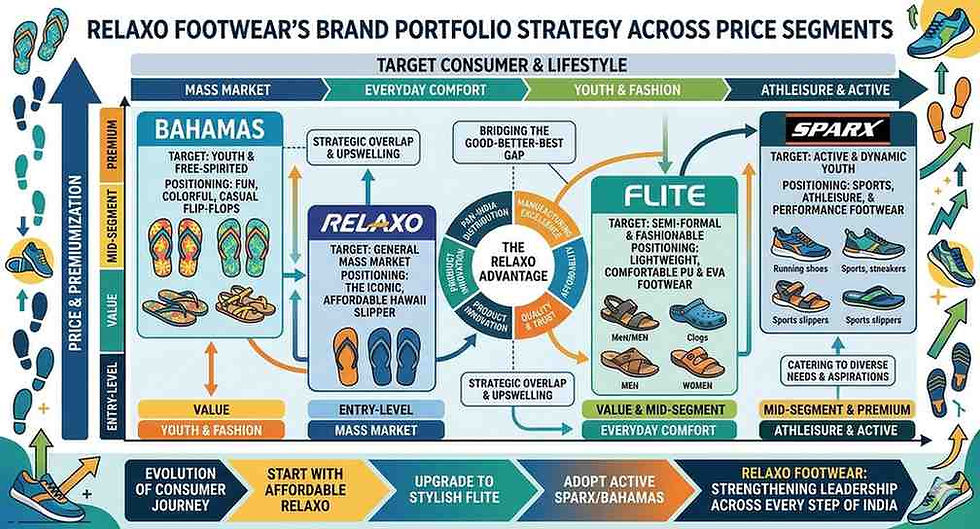
Relaxo Footwears Limited has constructed one of the most deliberately segmented brand portfolios in Indian consumer goods — spanning the bottom-of-pyramid utility buyer, the value-conscious mass consumer, the aspirational youth, and the casual lifestyle segment. Each of its brands — Relaxo Hawaii, Flite, Sparx, and Bahamas — occupies a distinct price-perception tier, targets a separate consumer archetype, and is supported by differentiated celebrity endorsements and positioning narratives. This case examines how Relaxo has used multi-brand architecture as a strategic tool to simultaneously compete with unorganised players at the base and aspirationally challenge global sports brands at the top, all while protecting margin and building mass mental availability.
1. Industry & Competitive Context
The Indian footwear market is structurally fragmented, with unorganised players historically accounting for over 85–91% of total volume (IKON Marketing Consultants; Rajshila Industry Report). This dominance by the informal sector is enabled by lower tax compliance, flexible labour costs, and proximity to local retail. For organised players like Relaxo, competing in this environment requires achieving price parity with the unorganised tier while justifying a brand premium through quality perception, distribution scale, and marketing investment.
Within the organised segment, Relaxo holds the leading position — with a reported market share of approximately 3.23% of the total Indian footwear market — followed by Bata India at approximately 2.34% (IKON Marketing Consultants). When measured within the organised sector alone, Relaxo's relative dominance is significantly higher. The company is the largest non-leather footwear manufacturer in India by volume, producing approximately 19 crore pairs annually (ICICI Direct Research). The competitive landscape is stratified. At the base, Relaxo competes with thousands of unorganised manufacturers. In the mid-segment, it contends with Liberty Shoes, Khadim, and Bata. In the youth sports and athleisure space, competition extends to Campus Activewear, and at the aspirational tier, to global brands like Nike, Adidas, Reebok, and Puma — all of which have progressively reduced their price floors to access the Indian mass market (StockAxis Research Report, 2018). A structural tailwind emerged through formalisation pressures. Demonetisation, the introduction of GST, and BIS quality standards have incrementally eroded the pricing advantage of unorganised players. As Gaurav Dua, Executive Director, Relaxo Footwears, noted in a published interview with afaqs! (2021): "With all this coming in, the unorganised sector is facing several difficulties in terms of new regulations. The government is also keen to shift the informal sector to the formal economy. All this has given the organised space an edge." In September 2025, the GST Council further narrowed this gap by revising footwear taxation to 5% for items up to ₹2,500, directly benefiting Relaxo's large sub-₹1,500 portfolio (Business Standard, September 2025).
2. Brand Situation: The Challenge of Multi-Segment Relevance
Relaxo's origins lie in a single product category — the rubber Hawaii slipper — which it began producing in 1976. The company was incorporated in 1984 and listed in 1995. For years, its identity was synonymous with affordable, durable, mass-market footwear. While this built scale, it also created a ceiling: the Relaxo master brand could not credibly extend into premium sports or fashion without risking equity dilution or consumer dissonance. The strategic problem was threefold. First, anchoring identity to utility alone left the company exposed to commoditisation from low-cost unorganised competitors. Second, evolving consumer aspirations — driven by urbanisation, rising incomes, and the influence of global sports culture — demanded products that carried fashion and identity value, not just functional benefit. Third, operating a single brand across all price segments creates positioning incoherence; a consumer who pays ₹80 for a Hawaii slipper and one paying ₹2,000 for a Sparx sports shoe cannot be held under the same brand promise. Relaxo's response was a structured multi-brand portfolio — separate brands, separate personalities, separate celebrity spokespeople, each serving a distinct consumer job-to-be-done.
3. Strategic Objective
Based on publicly available analyst reports and management commentary, Relaxo's portfolio strategy pursued three interconnected objectives: First, volume defence at the base: retaining dominance in the high-volume, price-sensitive rubber slipper segment against unorganised players, preventing share erosion from below. Second, margin enhancement through premiumisation: growing revenue contribution from higher-ticket brands like Sparx, which — despite lower unit volumes — contributes disproportionately to revenue. According to Stock Axis Research (2018), Sparx contributed approximately 25–30% of company revenues despite commanding higher per-unit price points than Hawaii. ICICI Direct Research subsequently noted Sparx contributing approximately 38% to revenues at its peak. Third, brand equity building through segmentation: creating aspiration at a price point that the Indian mass consumer could access, while preventing the master brand from being associated with a single utility-only identity.
4. Brand Portfolio Architecture & Positioning Logic
Relaxo's brand architecture is best understood as a vertically differentiated house-of-brands model, where each label serves a distinct price-perception tier with minimal brand overlap.
Relaxo Hawaii (Base Tier — Utility & Durability) Hawaii is the company's flagship volume driver. As documented in multiple analyst reports, Hawaii slippers account for approximately 40% of total company revenues (Stock Axis Research). Its consumer proposition is built around durability and reliability — articulated through the brand communication concept of "mazbooti" (strength). The brand signed Salman Khan as ambassador, with the TVC positioning Hawaii as a symbol of strength: "Relaxo Hawaii hai mazboot" (BesthaiMediaInfo, July 2012). The Salman Khan association was strategically coherent: his mass-market appeal, physical strength persona, and wide recognition across SEC B and C demographics directly mapped to Hawaii's target consumer.
Flite (Mid-Tier — Lightweight, Fashion-Forward Casual) Flite targets the everyday casual and fashion-conscious segment — primarily women and younger consumers seeking lightweight comfort with aesthetic appeal. The brand recruited Katrina Kaif as its ambassador in 2012 (Campaign India, September 2012), positioning around youthful vibrancy and women's style. This was a deliberate signal of upward aspiration: associating Flite with a Bollywood celebrity synonymous with style and glamour elevated the brand's perceived value beyond its functional "lightweight" proposition. More recently, the Flite PUG 111 product launch campaign featured actor Dheeraj Dhoopar and accumulated over 5 million YouTube views (IIDE Case Study, 2026).
Sparx (Aspirational Tier — Sports, Youth, Self-Expression) Sparx is Relaxo's most strategically ambitious brand — explicitly positioned to compete with international sports brands at an accessible Indian price point. When originally launched, the brand's price range of ₹1,000–₹3,000 was framed as value-premium relative to Nike, Adidas, and Reebok (Fashion United, September 2012). The initial brand ambassador was Neil Nitin Mukesh; he was replaced in 2012 by Akshay Kumar, whose athletic, action-hero persona was seen as better aligned with the brand's performance ambitions (Campaign India, BestMediaInfo, September 2012).
Sparx has undergone the most significant evolution within the portfolio. Its original tagline "Add Sparx to your life" positioned the brand as an enabler — a product one acquires to enhance lifestyle. In 2021, the brand repositioned to "#ItsInMe," shifting the locus of brand ownership from the company to the consumer. As Gaurav Dua explained in the published afaqs! interview: "Instead of the brand saying 'Add Sparx to your life' the new tagline is like a consumer saying 'It's in me'... We want to say that even you are like him [Akshay Kumar]. If you take on challenges and believe in yourself, you can achieve everything you desire." This shift — from product-centric to identity-centric communication — represents a maturation in brand thinking consistent with how successful sports brands globally (Nike's "Just Do It," Adidas' "Impossible is Nothing") have created emotional ownership. Sparx's capacity constraints further reflect its strategic priority: ICICI Direct Research (Q3 FY23) noted that Sparx's sports shoe and sandal capacity was near fully utilised at 50,000 pairs per day, leading management to announce an expansion of another 50,000 pairs per day. This production investment is a documented indicator of category demand and the brand's centrality to Relaxo's growth strategy.
Bahamas (Lifestyle Tier — Beach, Casual, Premium Leisure) Bahamas targets the lifestyle casual segment — consumers seeking relaxed, beach-inspired footwear with a premium leisure connotation. Campaigns for Bahamas, including "Stress Ko Do Rest" featuring Salman Khan, deploy humour and lifestyle associations to attract Gen Z and millennial consumers (IIDE Case Study, 2026). The brand offers a distinct brand personality from Hawaii — despite both using Salman Khan — by focusing on relaxation and style rather than utility and durability.
Schoolmate (Institutional / Kids) Schoolmate addresses the institutional and children's segment, capturing a consumer lifecycle entry point. No verified revenue contribution data is publicly available specific to this brand.
5. Celebrity Endorsement as a Positioning Architecture Tool
One of the most analytically instructive elements of Relaxo's strategy is the deliberate segmentation of celebrity endorsements across brands. Rather than appointing a single brand ambassador for the company, Relaxo assigned distinct celebrities to distinct brands — each chosen for alignment with the target segment's aspirational identity:
Salman Khan → Hawaii (mass strength, accessibility, male-skewed SEC B/C)
Katrina Kaif → Flite (women's style, lightweight fashion, aspiration)
Akshay Kumar → Sparx (athletic performance, youth, self-made resilience)
Salman Khan → Bahamas (leisure, humour, lifestyle)
This architecture serves two functions. Externally, it creates perceptual separation between brands that share manufacturing infrastructure and retail channels. Internally, it disciplines brand managers to maintain distinct briefs. The investment was material: at the time of the Akshay Kumar signing in 2012, Relaxo was investing approximately ₹12 crore in celebrity endorsement deals (FashionUnited, September 2012).
6. Distribution & Channel Strategy
Relaxo's distribution architecture is designed to reach both the mass rural consumer and the urban aspirational buyer through differentiated channel structures. As of the period covered in StockAxis Research (2018), the company operated through approximately 800 distributors and 50,000+ retailers, with 302 company-owned exclusive brand outlets (EBOs) concentrated in North India — Delhi, Rajasthan, Haryana, Punjab, Uttar Pradesh, Uttarakhand, and Gujarat. The company's geographic concentration in North India (contributing approximately 50% of sales) has been acknowledged as a strategic limitation, with management actively pursuing penetration in the South and West — markets identified as "growing at a better rate" with "a lot of empty space" (Jainam Research PDF, broker report). In 2012, the company targeted doubling its presence in multi-brand outlets from 15,000 points to 30,000+, alongside launching additional EBOs (FashionUnited, 2012). E-commerce was also initiated through the company's own website during this period. More recently, the appointment of a dedicated Head of Digital, Performance & D2C was reported (IIDE, 2026), signalling a formal shift toward performance marketing and direct-to-consumer channels. The geographic distribution skew toward North India creates both a defence and a vulnerability: it reflects the brand's origin story and deepest brand equity, but limits the company's ability to access the faster-growing southern and western markets where Sparx's own foothold is reportedly stronger (ICICI Direct, Q3 FY23).
7. Financial Context & Business Outcomes
Relaxo's revenue trajectory provides documented evidence of the portfolio strategy's commercial contribution: Sales grew from approximately ₹1,180 crore in FY2014 to ₹2,783 crore in FY2023 — representing an annualised growth of approximately 10% over the decade (Dr. Vijay Malik Fundamental Analysis). FY2024 saw operating revenue grow 4.7% year-on-year, with net profit increasing 29.8% YoY to a net margin of 6.9% (Equitymaster Annual Report Analysis, 2024). The company is also India's largest non-leather footwear manufacturer, with reported capacity of approximately 10 lakh pairs per day (ICICI Direct Research). A notable milestone was reached in FY2020, when Relaxo produced 100 million pairs — a volume figure documented as record-breaking at the time (Digitofy, February 2025). However, the period FY2022–FY23 also illustrates the portfolio's vulnerability to macro headwinds. In Q2 FY23, revenue declined to ₹670 crore from ₹714 crore a year earlier, with EBITDA falling sharply from ₹117 crore to ₹59 crore — attributed to high raw material prices (rubber, EVA, PU are all crude oil derivatives) and inflationary pressure reducing affordability in mass-market segments (MarketFeed Deep Dive; ICICI Direct Q3 FY23). The overall average selling price stood at ₹165 per pair in Q3 FY23 (ICICI Direct), indicating the continued dominance of low-ticket products in the revenue mix. The company's EBITDA margins have also fluctuated historically between 12–21% (Dr. Vijay Malik Analysis), reflecting the operating leverage dynamics inherent in a volume-driven business with commodity-linked input costs. Note: No verified public information is available on brand-wise net margins, marketing ROI, CAC/LTV ratios, or digital channel conversion rates. These are not disclosed in public financial filings or investor presentations.
8. Strategic Implications
Multi-brand architecture as a segmentation shield. Relaxo's house-of-brands model has allowed the company to operate across five consumer segments — from ₹80 rubber slippers to ₹3,000 sports shoes — without the equity contamination that a single master-brand extension strategy would risk. This is the fundamental structural advantage of the portfolio approach: each brand can optimise its own positioning without compromise.
The premiumisation imperative. Sparx's growing revenue contribution (from approximately 25% in 2018 to approximately 38% in peak quarters) illustrates the strategic logic of premiumisation for a mass-market company: higher-priced products deliver superior gross margin per unit, improving blended company profitability without necessarily requiring volume growth. As India's consuming middle class expands and sports-lifestyle culture deepens — particularly among Tier 2 and Tier 3 city youth — Sparx sits in the highest-growth structural position within the portfolio.
Mental availability vs. premium aspiration. Classic marketing theory (Byron Sharp, How Brands Grow) argues that mass reach and mental availability are the primary drivers of brand choice in low-involvement categories. Relaxo's TV-first, celebrity-heavy approach has prioritised mental availability effectively. However, the repositioning of Sparx from "Add Sparx to your life" to "#ItsInMe" signals an attempt to move beyond mere salience toward identity-based brand attachment — which supports pricing power and loyalty, particularly among younger consumers.
Raw material risk and the mass-market margin trap. The FY22–23 margin compression demonstrates a structural vulnerability: Relaxo's cost base is heavily exposed to rubber and crude oil derivative prices, while its revenue base is anchored in price-sensitive consumer segments with limited elasticity for price increases. Unlike premium brands that can absorb input cost hikes through pricing power, Relaxo's Hawaii and Flite segments face genuine resistance to price increases.
Geographic concentration as a strategic risk. With approximately 50% of sales from North India, Relaxo's portfolio is unevenly distributed relative to India's footwear consumption geography. The South and West — markets where urban consumers are increasingly aspiring to branded footwear — represent material growth white spaces, particularly for Sparx and Bahamas.
Formalisation as structural tailwind. The progressive formalization of the Indian economy — through GST, BIS standards, and demonetisation — structurally favours organised players like Relaxo by eroding the price advantage of unorganised competition. The September 2025 GST revision (footwear below ₹2,500 taxed at 5%) further strengthens Relaxo's price competitiveness relative to both unorganised rivals and foreign imports.
Discussion Questions
Q1. Relaxo operates a house-of-brands model, assigning distinct celebrities to distinct brands. Evaluate the trade-offs between this approach and a branded house (master brand) model for a company competing simultaneously in the ₹80 slipper and ₹2,000 sports shoe segments. Under what conditions would a master brand strategy become viable or desirable for Relaxo?
Q2. Sparx's positioning evolved from "Add Sparx to your life" (brand-as-enabler) to "#ItsInMe" (consumer self-identity). Using brand equity and consumer identity theory, analyse what this shift implies for brand strategy, target segment, and the role of Akshay Kumar's persona in sustaining this transition.
Q3. Approximately 40% of Relaxo's revenue is concentrated in Hawaii slippers — a product category under structural pricing pressure from unorganised players and a perceived utility category with low differentiation. What strategic options does Relaxo have to protect and grow this segment, and what are the risks associated with each?
Q4. Relaxo's sales are approximately 50% concentrated in North India. Using market development frameworks (Ansoff Matrix, geographic STP), design a market expansion strategy for Sparx or Bahamas in South India, identifying the key consumer insights, channel adaptations, and competitive barriers Relaxo would need to address.
Q5. Relaxo's margins are significantly exposed to rubber and crude oil derivative price volatility. How should a brand portfolio strategy be designed to provide a natural hedge against input cost cycles? Compare Relaxo's position with that of a competitor like Metro Brands, which operates in the leather and premium segment, and draw strategic implications.


Comments