Sulekha's Service Marketplace Model: Building India's Local Services Economy
- 6 hours ago
- 12 min read
Industry and Competitive Context
The local services market in India — encompassing categories such as home repair, packers and movers, tutors, event management, beauty services, and healthcare — is one of the largest and most structurally informal segments of the Indian economy. The overwhelming majority of service transactions in this space have historically been conducted through word-of-mouth referrals, neighbourhood networks, and unorganised aggregators operating without quality standards, price transparency, or consumer recourse mechanisms.
The scale of this opportunity attracted significant venture and strategic capital through the 2010s. Urban Company (formerly UrbanClap), Justdial, and Housejoy emerged as competing platforms attempting to organise different layers of this market. Justdial, which listed on Indian stock exchanges in 2013, built its model around directory-based discovery — connecting consumers to service providers through a searchable database without standardising the service delivery itself. Urban Company, founded in 2014, took the opposite approach — standardising service delivery through trained, vetted, and uniformly equipped service professionals operating under the Urban Company brand.
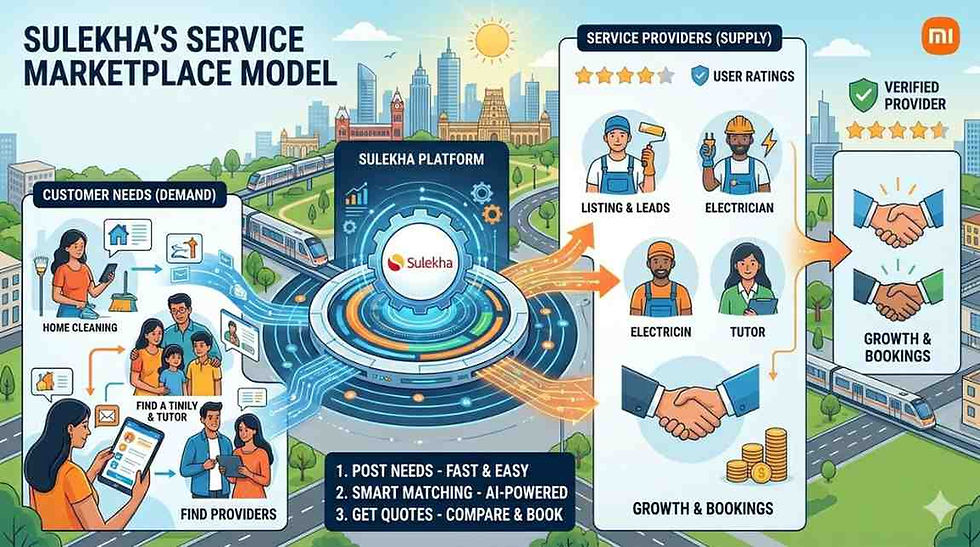
Sulekha occupied a distinct strategic position between these two models. Unlike Justdial, it moved beyond pure directory listing toward a lead-generation and matching marketplace. Unlike Urban Company, it did not own the service delivery layer. This intermediate positioning — a qualified lead marketplace rather than a managed service platform — defined both Sulekha's competitive advantage and its structural vulnerabilities.
The broader market context was shaped by two macro forces. The first was India's accelerating internet and smartphone penetration, which expanded the digitally addressable consumer base for online service discovery. The second was the persistent challenge of consumer trust in service quality — a challenge that directory-based models addressed inadequately and that managed platforms addressed at significantly higher operational cost.
Brand Situation Prior to Strategic Evolution
Sulekha was founded in 2000 by Satya Prabhakar in the United States as an online community platform serving the Indian diaspora. The platform initially functioned as a classifieds and community board, enabling users to post and discover local information. It subsequently pivoted toward the Indian domestic market, evolving into a local services discovery platform.
In its early phase, Sulekha operated primarily as an advertiser-funded directory — service providers paid to list their businesses, and consumers used the platform to discover them. This model was analogous to a digital version of the Yellow Pages, with search functionality and user reviews added as consumer-facing features. The platform accumulated a database of service providers across hundreds of service categories and Indian cities.
By the early 2010s, this model faced structural compression. Justdial had established strong brand recall in the telephone-based and online directory space through aggressive television advertising and a well-recognised helpline number. Google's local search capabilities increasingly substituted for directory platforms for basic discovery queries. The pure listing model, which generated revenue from provider subscriptions and featured placements, was under margin pressure as the supply of digital advertising alternatives expanded.
Sulekha's documented strategic response was to reposition the platform from a listing directory toward a qualified lead marketplace — a model in which the platform's value proposition to service providers shifted from visibility to verified, intent-demonstrated consumer leads, and in which the platform's value proposition to consumers shifted from information provision to facilitated matching.
This transition required investment in matching technology, consumer profiling capabilities, and quality signalling mechanisms — investments that Sulekha funded through multiple documented funding rounds.
Strategic Objective
Sulekha's strategic objectives through its marketplace evolution phase, as documented in official company communications, investor disclosures, and credible media reporting, centred on three interconnected priorities.
The first was to move up the value chain from information intermediary to transaction enabler. In platform economics, this transition is significant because it shifts the monetisation basis from advertising inventory — a model with structurally declining yields as digital advertising supply expands — to lead value, which is more directly tied to the commercial outcome of the consumer-provider interaction.
The second was to establish category depth rather than category breadth as the basis of competitive differentiation. Sulekha's communications and product evolution, as reported in technology and business media, reflected a focus on building dense supply and demand networks in specific service categories — particularly home services, relocations, tutoring, and event management — rather than attempting to match Urban Company's fully managed model across all categories simultaneously.
The third was to serve the Tier 2 and Tier 3 India market as a strategic priority, recognising that the hyperlocal services economy in smaller Indian cities was underserved by both Justdial's telephone-centric model and Urban Company's metro-focused managed service model. Sulekha's technology investment in vernacular language support and its documented geographic expansion into non-metro markets reflected this objective.
Positioning and Consumer Insight
Sulekha's core consumer insight, as articulated in its communications and reflected in its product architecture, was that the primary barrier to local service transactions in India was not discovery — most consumers could find service providers through informal channels — but qualified matching under conditions of information asymmetry and trust deficit.
This insight has two sides. From the consumer perspective, the problem was not locating a plumber or a tutor but identifying one whose quality, reliability, and pricing could be assessed before engagement. The absence of standardised quality signals — certifications, verified reviews, documented work history — made every service transaction a high-uncertainty decision. From the service provider perspective, the problem was acquiring customers efficiently in a market where word-of-mouth referrals were inconsistent and offline advertising was expensive relative to the average transaction value.
Sulekha's marketplace model addressed both sides of this asymmetry through a lead qualification mechanism. Rather than simply listing providers and leaving consumers to conduct their own due diligence, Sulekha's platform collected consumer requirement specifications — scope, timeline, budget, location — and matched them to a curated shortlist of providers. This structured requirement capture served multiple strategic functions: it improved the quality of the lead delivered to the provider, it gave consumers a structured framework for articulating their needs, and it gave Sulekha a data asset that could be used to improve matching quality over time.
The positioning derived from this insight was explicitly differentiated from both pure directory platforms and managed service platforms. Sulekha positioned itself as the platform that "gets you the right professional for the job" — a claim that rested on matching quality rather than supply breadth or price competition. This positioning was targeted at the urban and semi-urban Indian consumer who was comfortable with digital platforms for discovery but remained anchored to personal referral logic in final selection — a consumer who needed a platform that replicated the trust signals of a personal recommendation at scale.
Campaign Architecture and Execution
Sulekha's marketing execution has evolved significantly across its operational history, and the documented phases of its campaign strategy reflect the platform's shifting competitive priorities.
In its early phase, Sulekha's consumer acquisition was primarily driven by search engine optimisation and performance marketing — channels appropriate for a discovery platform whose primary use case was initiated by a consumer search query. The platform invested in building content and category pages indexed by Google, effectively positioning itself as the destination for long-tail local service queries.
As the platform evolved toward a marketplace model, Sulekha invested in brand advertising to build aided awareness — a necessary investment for a platform competing in a category where Justdial had established strong brand recall through years of mass media spending. Sulekha's television and digital advertising campaigns, documented in media industry coverage, focused on communicating the platform's matching and quality assurance proposition rather than its directory depth.
A significant and documented element of Sulekha's execution strategy was its investment in the "Sulekha Pro" layer — a service tier for verified and certified professionals who paid for premium lead access and visibility. This tiered provider model created a revenue architecture in which provider monetisation was tied to lead volume and quality rather than flat listing fees, aligning Sulekha's commercial incentives with provider outcomes. The Sulekha Pro programme has been referenced in official company communications and technology media coverage as a key product development initiative.
Sulekha has also been documented as investing in mobile app development and vernacular language capabilities, reflecting the strategic priority of reaching non-English-speaking consumers in Tier 2 and Tier 3 markets. The platform's mobile app and its support for regional language interfaces are referenced in product release communications and app store descriptions.
Media and Channel Strategy
Sulekha's documented channel strategy reflects the dual audience requirement of a marketplace platform — it must simultaneously acquire consumers and recruit and retain service providers.
On the consumer acquisition side, Sulekha's primary documented channels have been search engine marketing, organic search, and digital advertising — channels consistent with a platform whose use case is primarily intent-driven. The platform's investment in category-specific content and locality pages created a large organic search footprint, a strategy that has been noted in digital marketing industry analysis of Indian local services platforms.
On the provider acquisition side, Sulekha has historically relied on a direct sales force — a necessary channel given that many local service providers, particularly in non-metro markets, have limited digital marketing literacy and require in-person onboarding. The existence of a field sales organisation for provider acquisition has been referenced in Sulekha's hiring communications and in business media coverage of the company's operations.
Sulekha has participated in television advertising, particularly to build brand awareness in the broader Indian consumer market. Specific campaign details, creative direction, and media spend figures are not available in verified public disclosures. No verified public information is available on Sulekha's total media expenditure or agency relationships.
The company's social media presence, maintained across documented public accounts on major platforms, has been used for brand communication and consumer engagement, though specific performance metrics for these channels have not been publicly disclosed.
Business and Brand Outcomes
Sulekha's documented business outcomes are available through a combination of funding disclosures, official company communications, and credible business media reporting. The company has not been publicly listed, and therefore detailed financial performance data is not available in exchange filings.
Sulekha has completed multiple documented funding rounds. In 2015, Sulekha raised funding from investors including Norwest Venture Partners and Mitsui, with the round reported in business media including Economic Times and VCCircle. These disclosures confirmed the company's continued investor backing and provided context for its scale of operations during this period, though specific valuation or revenue figures from this round were not consistently disclosed in public reporting.
The company has publicly stated — in communications covered by credible technology and business media — that its platform connects millions of consumers with service providers across hundreds of service categories in over 40 Indian cities. Specific transaction volume and revenue figures have not been independently verified in public disclosures.
Sulekha's geographic expansion into Tier 2 and Tier 3 Indian cities, including Coimbatore, Jaipur, Indore, and Nagpur among others, is documented in official company communications and media coverage. This expansion represented a documented strategic differentiator relative to competitors whose operational intensity was concentrated in metro markets.
The platform's category expansion — adding verticals including matrimony, education, and healthcare services alongside its core home services offering — has been documented in product announcements and media coverage. The matrimony vertical, Sulekha Matrimony, has been referenced in company communications as a significant category.
No verified public information is available on Sulekha's net revenue, profitability, market share, or specific consumer and provider base size in audited or officially disclosed form.
Sulekha's founder Satya Prabhakar has been recognised in technology entrepreneurship forums and media coverage as one of India's early internet entrepreneurs, and the company is consistently referenced in discussions of India's local services economy in trade and business media — an indicator of category relevance, though not a quantified business outcome.
Strategic Implications
Sulekha's marketplace model generates several strategic implications that are relevant both for platform businesses in emerging markets and for brands operating in categories defined by high information asymmetry and fragmented supply.
The first implication concerns platform positioning in a category with multiple viable models. The Indian local services market has simultaneously supported a pure directory model (Justdial), a managed services model (Urban Company), and a lead marketplace model (Sulekha). The coexistence of these models reflects the diversity of consumer readiness within the market — different segments of consumers prioritise discovery, price comparison, quality assurance, and convenience in different proportions. Sulekha's intermediate positioning served a real consumer need, but it also created strategic exposure: the platform was potentially displaceable from above by managed service platforms as consumer willingness to pay for quality assurance increased, and from below by directory platforms as search quality improved. Sustaining intermediate positioning requires continuous investment in the quality of the matching mechanism — the platform's core differentiator — rather than in supply breadth alone.
The second implication concerns the monetisation logic of lead marketplaces. Sulekha's decision to monetise through lead sales to providers rather than consumer subscription or transaction commission is a model with documented advantages and constraints. The advantage is that it aligns Sulekha's revenue with provider commercial outcomes — a provider who receives a high-quality lead has a clear incentive to pay for continued access. The constraint is that lead quality is difficult to verify from the provider's perspective until after purchase, creating an information asymmetry that requires reputation management and refund mechanisms to sustain provider trust. The Sulekha Pro tiered model — in which higher-tier providers receive priority lead access in exchange for higher fees — represents a documented attempt to address this constraint by creating verifiable quality signals within the provider ecosystem.
The third implication concerns the strategic challenge of trust architecture in service marketplaces. Unlike product e-commerce, where quality can be partially standardised through brand and specification disclosure, service quality is inherently variable, contextual, and difficult to assess in advance. Sulekha's matching model addressed pre-transaction information asymmetry but did not eliminate post-transaction quality variance. Platforms that have moved further toward managing the trust gap — through provider training, insurance, standardised pricing, and post-service guarantees — have been able to capture higher consumer willingness to pay. Sulekha's strategic challenge was to determine how far up the trust management stack to move without crossing into the higher operational cost structure of a managed service model.
The fourth implication concerns geographic strategy in platform businesses. Sulekha's documented investment in Tier 2 and Tier 3 markets represents a strategic bet that the local services economy in non-metro India is large enough to support a platform business model with lower consumer acquisition costs and less intense competitive pressure than metro markets. This bet is consistent with the documented trajectory of Indian digital commerce, in which Tier 2 and Tier 3 cities have grown in digital transaction volume faster than metro markets through the late 2010s and early 2020s, as reported in multiple RedSeer and BCG reports on Indian digital economy growth. However, non-metro market development also requires investments in provider literacy, field sales infrastructure, and vernacular technology that are not required in metro-digital markets — costs that compress the unit economics advantage of lower competition.
The fifth implication is methodological and concerns the limits of platform business model durability in markets undergoing rapid structural change. Sulekha's evolution from directory to marketplace coincided with the emergence of Google's local services features, WhatsApp's adoption as an informal business communication tool, and the rapid growth of managed service platforms — each of which altered the competitive environment in which Sulekha operated. The strategic lesson is that platform businesses in emerging markets must continuously reassess the value of their intermediary layer as the market's information infrastructure evolves. Platforms that intermediated discovery in 2010 faced disintermediation risk from search quality improvements by 2015. Platforms that intermediate matching in 2015 face potential disintermediation from managed service quality improvements by 2020. Sustaining platform relevance requires identifying and investing in the next layer of consumer value creation before the current layer is commoditised.
Limitations and Scope Boundaries
This case study relies exclusively on publicly available information. Sulekha.com is a privately held company and has not published audited financial statements in the public domain. Market share, revenue, and consumer base figures cited in this case are drawn from official company communications and credible media reporting, neither of which constitutes audited disclosure. Readers should treat quantitative claims about Sulekha's business scale as directional indicators rather than verified financial data. The competitive analysis is based on publicly available information about competitor platforms and may not reflect current market conditions.
MBA Discussion Questions
Question 1: Sulekha operates an intermediate marketplace model — between pure directory platforms like Justdial and fully managed service platforms like Urban Company. Using Porter's Five Forces framework, evaluate the competitive pressure Sulekha faces from both ends of this spectrum. Under what market conditions would Sulekha's intermediate positioning become strategically untenable, and what strategic options would be available to the company in that scenario?
Question 2: The lead marketplace model — in which service providers pay for consumer leads rather than listings or transaction commissions — creates a specific set of incentive structures for platform participants. Analyse the incentive alignment and misalignment implications of this model for consumers, service providers, and Sulekha as a platform operator. How does the Sulekha Pro tiered programme attempt to address these misalignments, and what are its limitations?
Question 3: Sulekha's strategic expansion into Tier 2 and Tier 3 Indian cities represents a documented geographic prioritisation. Using the concept of the experience curve and network effects in platform economics, evaluate the conditions under which geographic density in non-metro markets creates durable competitive advantage versus conditions under which it creates operational complexity without proportionate strategic benefit.
Question 4: Consumer trust is the most significant structural barrier in the local services marketplace category. Compare the trust architecture strategies of Sulekha (lead matching with provider verification), Urban Company (managed service delivery with standardisation), and Justdial (directory with user reviews). Which model most effectively addresses the trust deficit in the Indian local services market, and what are the trade-offs of each approach in terms of scalability and unit economics?
Question 5: Sulekha has evolved its business model significantly since its founding in 2000 — from diaspora community platform to domestic classifieds to local services marketplace. Using the concept of strategic pivots and platform business model evolution, evaluate whether Sulekha's successive transitions represent coherent strategic adaptation or reactive repositioning. What organisational and brand equity costs does repeated strategic pivoting impose on a platform business, and how can these costs be minimised?


Comments