Sunfeast YiPPee! Noodles — Engineering Differentiation in a Monopolised Category
- 7 hours ago
- 9 min read
Industry & Competitive Context
When ITC entered the Indian instant noodles market in September 2010, it confronted one of the most entrenched monopolies in Indian FMCG. Nestlé's Maggi, which had been in India since 1982, commanded approximately 70% of the instant noodles category, a market then valued at roughly ₹1,200 crore. Consumer behaviour in this category was less a matter of preference than habit: for many Indian households, "noodles" and "Maggi" were synonymous terms, reflecting decades of brand equity and habitual purchase anchoring. The competitive dynamics of the category were characterised by low switching incentives, strong emotional associations (Maggi's nostalgic positioning around "2-Minute Noodles"), and limited functional differentiation among secondary players such as Nissin's Top Ramen. The residual 30% of the market was fragmented, primarily split between Top Ramen and several regional and imports brands, none of which had achieved meaningful scale or brand salience. For a new entrant, the strategic problem was not simply product development but the challenge of creating mental availability — the cognitive accessibility that drives purchase in low-involvement FMCG categories — in a space where the incumbent had achieved near-total share of mind. ITC brought significant structural advantages to this entry challenge. By 2010, its Sunfeast biscuit brand, launched in 2003, had established channel credibility and retail trust across the company's distribution infrastructure. The Sunfeast master brand already enjoyed meaningful equity with its core target audiences — mothers and children. Critically, ITC's sourcing and blending expertise in wheat, underpinning the Aashirvaad branded atta franchise, provided proprietary inputs that could be leveraged in noodle formulation. Three years of product R&D preceded the commercial launch, a development cycle that shaped the differentiated product architecture YiPPee! would take to market.
Brand Situation Prior to Launch
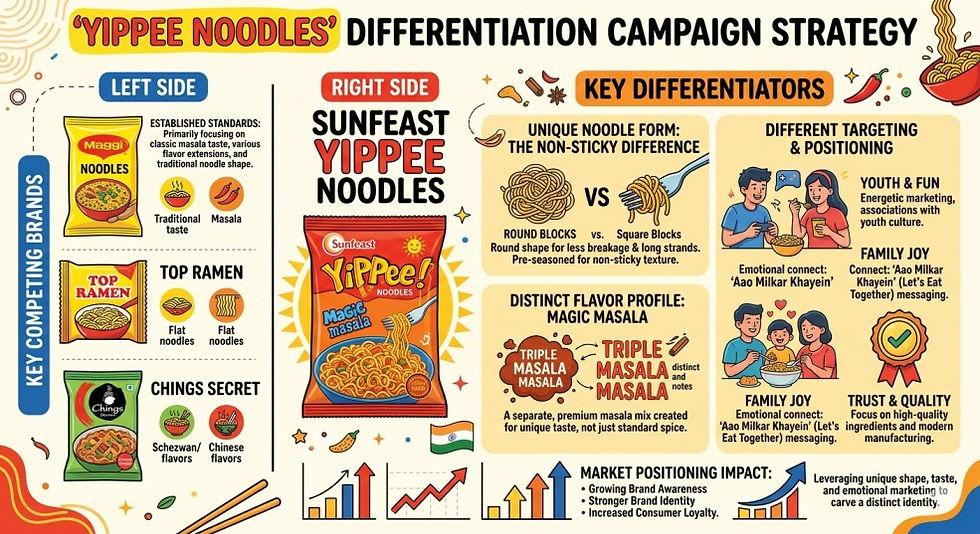
Sunfeast YiPPee! entered a market without any pre-existing brand equity in the noodles sub-category. While the Sunfeast parent brand provided a halo of trust — particularly among mothers already buying Sunfeast biscuits — the noodles segment required independent functional justification. ITC's challenge was to establish a new brand while simultaneously managing category education: consumers needed to be given a compelling reason to consider switching or diversifying from an emotionally embedded incumbent. The instant noodles category, while large, had also remained essentially a single-product-format market dominated by masala flavour variants. Competitive activity had not meaningfully expanded the category's consumption occasions or challenged its functional limitations. Consumer frustrations — such as noodles sticking together after cooking, the inconvenience of rectangular noodle blocks that required breaking before use, and limited flavour variety — were latent pain points that no incumbent had commercially addressed. These latent tensions represented the insight space ITC chose to exploit.
Strategic Objective
ITC's documented strategic objective at launch was to differentiate Sunfeast YiPPee! from Maggi and to achieve measurable market share within the first six months of commercial availability. The brand's approach to this objective reflected a deliberate choice to avoid direct head-on positioning against Maggi's taste and nostalgia equities — a battleground where the incumbent held an insuperable advantage — and instead to build a points-of-difference case rooted in functional superiority and greater consumer choice. This strategy is analytically consistent with Byron Sharp's principles of brand differentiation in mature categories: rather than competing on the same perceptual dimensions as the category leader, a challenger brand that creates genuinely distinctive associations — whether functional, sensory, or symbolic — can build its own memory structures among consumers, thereby growing mental availability without requiring head-to-head emotional displacement of the incumbent. ITC's campaign architecture directly operationalised this logic. Secondary strategic objectives included leveraging ITC's pre-existing distribution infrastructure across both urban and rural India to achieve rapid physical availability — a critical component of FMCG market share because mental availability without shelf presence cannot convert into purchase — and to use the Sunfeast parent brand's established trust to lower trial friction, particularly among the gatekeeping parent-purchaser segment.
Campaign Architecture & Execution
YiPPee!'s differentiation campaign was structured across two interlocking dimensions: product design as communication, and paid media as amplification. The brand's first-order differentiators were baked into the product itself, allowing the advertising to function as a demonstration vehicle rather than a persuasion exercise.
2010
Category Entry: Launch with round noodle cake format and two flavour variants (Classic Masala and Magic Masala). Core functional claim: non-lumping even 30 minutes after cooking. Initial TVC campaign via television, print, and in-store. Brand achieves ~6% market share within first six months.
2015
Crisis Capitalisation: Maggi's nationwide ban (June–November 2015) due to food safety allegations creates category vacuum. ITC launches a 360-degree communication campaign emphasising quality and safety credentials, including third-party NABL-accredited lab testing. Yippee accelerates market share gains.
2021
Product Innovation Wave: Launch of YiPPee! Saucy Masala — a red-coloured noodle block with tangy tomato flavour — supported by TVC campaign "Ki Saucy Googly" featuring brand ambassador MS Dhoni. Campaign emphasises product uniqueness through two taste elements in one pack.
2022–23
Mood Pack Innovation: Introduction of two-flavour-sachet packs ("Mood Masala" proposition). Digital campaign on Snapchat targeting the 13–16 age cohort using Story Ads, Snap Ads, and a Biddable Lens, achieving a documented 95% increase in brand association. YiPPee! crosses ₹1,000 crore in annual sales.
2023
Brand Proposition Refresh: Launch of overarching brand campaign "Why Just be Happy, When you can be YiPPee!" — developed with Ogilvy India — repositioning the brand beyond product functionality toward a lifestyle and emotional energy platform targeting youth, teens, and mothers.
2024
Cricket Cultural Integration: TVC campaign featuring Jasprit Bumrah and Suryakumar Yadav emphasising the brand's non-sticky texture USP through playful cricketing banter. Concurrent introduction of millet-based YiPPee! variants addressing health-conscious consumption trends. The campaign architecture reveals a disciplined three-stage evolution: functional credibility establishment (2010–2014), crisis-driven quality signalling (2015), and emotional brand building layered atop functional equity (2021–2024). This phasing is strategically sound — emotional brand platforms lack traction unless functional credibility has already been established, and YiPPee! correctly sequenced its communications accordingly.
Media & Channel Strategy
YiPPee!'s media strategy reflected a deliberate transition from mass reach to targeted engagement as the brand matured. At launch in 2010, the campaign relied on television as the primary reach vehicle — consistent with the media consumption patterns of both the target youth demographic and the mother-purchaser segment — supplemented by print and in-store activation to drive trial conversion at the point of purchase. The 2015 safety campaign, triggered by the Maggi controversy, was characterised by ITC itself in its quarterly communications as a "focused and integrated 360-degree communication campaign" — signalling that multiple touchpoints (television, print, digital, retail) were deployed simultaneously to reassure consumers. The urgency of the market opportunity during this period demanded breadth of reach rather than precision targeting. By 2022–23, a more sophisticated audience segmentation approach was evident in the documented Snapchat campaign. ITC identified that the 13–16 age cohort — characterised as seeking variety, novelty, and interactive experiences — was best reached through mobile-native, interactive formats. The campaign deployed three Snapchat formats in combination: Story Ads for contextual reach, Snap Ads for direct response, and a Biddable Lens for experiential brand interaction. Traffic was redirected to a curated recipe library hosted by the brand, combining product feature demonstration (non-lump texture, multiple flavours) with engagement depth. The Snapchat for Business case study documents a 95% increase in brand association as the verified outcome of this campaign. The cricket ambassador strategy — first MS Dhoni for Saucy Masala (2021), subsequently Jasprit Bumrah and Suryakumar Yadav (2024) — reflects ITC's recognition that cricket functions as a cultural meta-channel in India, providing associative brand credibility that transcends any single media platform. Kavita Chaturvedi, COO Snacks, Noodles & Pasta at ITC Foods, publicly stated that "cricket is an emotion in India" and positioned the 2024 campaign as connecting the brand's playful energy to the sport's cultural resonance.
Business & Brand Outcomes
Market Share at Launch: Within the first six months of launch in 2010, YiPPee! achieved approximately 6% of the Indian instant noodles market — a meaningful entry share in a category dominated by a single player with 70% share, indicating that the differentiation campaign successfully generated trial and early repeat purchase.
Market Share Progression: By the period captured in academic market analyses citing post-2015 data, YiPPee! had reached approximately 18–22% of the Indian instant noodles market, establishing itself as the confirmed second-largest brand in the category, behind only Maggi. This represents a three-to-four-fold increase in share from the launch position, achieved over roughly five to seven years.
Revenue Milestone: YiPPee! crossed ₹1,000 crore in annual sales — a significant threshold in Indian FMCG branding — as reported by trade publications. This milestone elevated the Sunfeast parent brand's total annual sales to approximately ₹4,500 crore at the time of reporting.
Category Market Size: The India instant noodles market grew from approximately ₹1,200 crore at YiPPee!'s 2010 entry to USD 1.95 billion (approximately ₹16,000+ crore) by 2023, reflecting a CAGR of approximately 13% from 2018 to 2023. YiPPee!'s presence as an active competitor is cited in market research as a structural factor in this category expansion.
FY2024 Revenue Growth: ITC Foods' Sunfeast YiPPee! brand recorded an 8.2% revenue increase in fiscal year 2024, attributed to vegetarian masala and curry variants catering to regional taste preferences.
Digital Campaign Outcome: The Snapchat campaign for the Mood Masala pack variant achieved a documented 95% increase in brand association among the 13–16 age target segment, as published in the Snapchat for Business case study. "We were gaining market share month-on-month even before the [Maggi] controversy happened and are continuing to grow even now. "ITC Foods executive, as reported by The Quint, January 2016
Strategic Implications
Functional differentiation as the foundation of challenger strategy. YiPPee!'s experience provides a textbook illustration of how a challenger brand can create genuine points of difference in a habitual purchase category without attempting to displace the incumbent's emotional territory. By engineering functional superiority into the product itself — non-lumping noodles, round cake format, longer strands — ITC ensured that its differentiation was tangible, demonstrable, and difficult to claim without product evidence. This approach has broader applicability: in categories where brand loyalty is primarily habitual rather than affective, functional credibility is the most viable entry mechanism for a well-resourced challenger.
Sequenced brand building: Function before emotion. YiPPee!'s communication strategy across 2010–2023 illustrates the importance of sequencing in brand building. The brand spent its first decade establishing functional credentials before investing in emotional brand territory with the "Why Just be Happy, When you can be YiPPee!" campaign. This sequencing reflects mature brand strategy: emotional platforms built without functional credibility tend to be fragile and easily displaced, whereas emotional equity built atop a proven functional base creates durable, multi-dimensional brand associations.
Opportunistic repositioning during competitor crisis. The Maggi crisis of 2015 offers a case study within the case study. ITC's decision to deploy a proactive 360-degree quality and safety campaign during the Maggi ban was strategically precise: it positioned YiPPee! not as an opportunistic beneficiary of a competitor's failure, but as a brand that could credibly stand on its own quality assurances. The documented response — highlighting NABL-accredited lab testing — converted a competitive opportunity into a brand credibility moment. The brand's COO confirmed continued month-on-month share gains even before the controversy, indicating that the safety messaging accelerated an already-positive trajectory rather than creating it.
Platform-native digital strategy as a youth acquisition channel. The Snapchat campaign's 95% brand association lift demonstrates the effectiveness of deploying interactive, platform-native formats for youth engagement, as distinct from simply repurposing television creative for digital distribution. ITC's approach — combining Biddable Lens experiential interaction with recipe content that demonstrated the product's functional features — created dual-purpose content that both entertained and informed. This model has become increasingly relevant as the 13–18 age cohort shifts primary media consumption to short-form and interactive digital platforms.
Brand architecture leverage as competitive cost advantage. ITC's ability to leverage the Sunfeast master brand's existing distribution infrastructure and trust equity significantly reduced the cost and risk of YiPPee!'s market entry. The brand's rapid retail availability — enabled by ITC's pre-existing trade relationships — provided physical availability that would have taken years to build independently. The strategic implication for FMCG brand portfolio management is that master brand architecture can confer genuine competitive advantages in challenger category entries, particularly when the master brand's functional associations (quality ingredients, trusted manufacturer) are relevant to the new category.
MBA-Level Discussion Questions
Q1 YiPPee!'s launch strategy prioritised functional differentiation over emotional positioning, deliberately avoiding a direct confrontation with Maggi's nostalgia-led brand equity. Evaluate this choice using the frameworks of Mental Availability (Byron Sharp) and Jobs-to-Be-Done (Christensen). Under what market conditions is functional differentiation a more durable basis for challenger brand entry than emotional positioning?
Q2 During the Maggi crisis of 2015, ITC faced a classic strategic dilemma: exploit the competitor's vulnerability aggressively, or build independent brand credibility. ITC chose a quality-signalling campaign rather than explicit comparative advertising. Assess this decision using competitive strategy theory. What are the long-term brand risks of aggressive competitive positioning during a rival's crisis, and how did ITC's approach mitigate these risks?
Q3 YiPPee!'s 2023 brand proposition shift to "Why Just be Happy, When you can be YiPPee!" represents a transition from product-centric to lifestyle-brand communication. Using brand equity frameworks (Keller's CBBE Model), analyse the risks and rewards of this transition for a brand that has built its equity primarily on functional credentials. When in a brand's lifecycle is it appropriate to invest in emotional territory?
Q4 The Snapchat campaign's 95% brand association lift was achieved through a combination of Story Ads, direct response Snap Ads, and a Biddable Lens targeting the 13–16 age cohort. Compare the strategic value of building brand salience through interactive digital formats versus traditional mass-reach TVC for an FMCG brand in this demographic. What measurement challenges arise in attributing long-term brand equity to short-form digital campaigns?
Q5 YiPPee! has reached approximately 22% market share in a category where the incumbent holds roughly 60–70%. Using the theory of competitive dynamics and market structure, evaluate whether YiPPee!'s current strategic objective should be (a) aggressive share capture from Maggi, (b) category expansion by growing the total instant noodles consumer base, or (c) premiumisation and portfolio diversification (as evidenced by the millet-based variant). What evidence from the case supports each strategic path?


Comments