The Creator Economy Framework for Brand Collaborations: How Brands Are Rebuilding the Architecture of Marketing Trust
Industry & Competitive Context
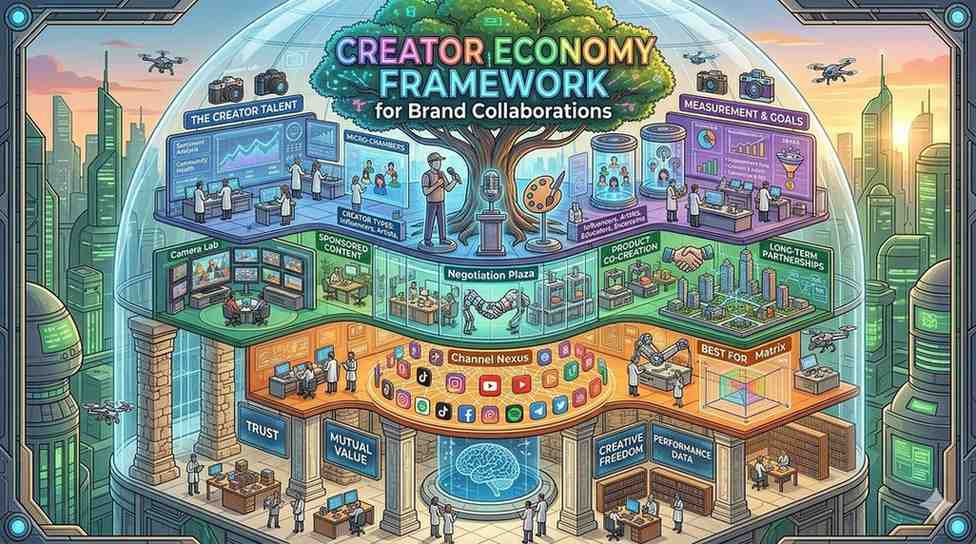
The creator economy represents one of the most structurally significant shifts in the history of marketing communications. At its foundation, it is an ecosystem in which individual content creators — social media influencers, YouTubers, podcasters, writers, and independent digital professionals — produce and distribute content directly to audiences via platforms, monetizing through advertising, sponsorships, affiliate programs, subscriptions, and product sales. What distinguishes this ecosystem from earlier forms of celebrity endorsement or mass media advertising is not merely its digital delivery mechanism but a fundamentally different relationship between the communicator and the audience: one built on personal trust, consistent interaction, and perceived authenticity rather than aspirational distance.
According to Grand View Research, the global creator economy was valued at approximately $205 billion in 2024 and is projected to reach $252 billion in 2025. Goldman Sachs has projected the market could exceed $480 billion by 2027. Over 207 million creators are estimated to be active globally across all platforms. Within this economy, brand collaborations represent the single largest monetization method — capturing 23.5 percent of total creator economy revenue in 2024, ahead of advertising revenue at 22.1 percent. Brand partnerships account for approximately 68.8 percent of creators' primary income, reflecting how decisively the financial architecture of the creator economy is oriented around brand relationships rather than platform-native monetization programs, which often provide insufficient income for most creators.
The influencer marketing segment — the direct brand-to-creator collaboration layer within the wider creator economy — grew to $24 billion globally in 2024 and reached $32.55 billion in 2025, representing a 35.6 percent year-on-year increase, according to published industry data from Influencer Marketing Hub and Mordor Intelligence. In India specifically, the influencer marketing industry was valued at ₹3,600 crore — approximately $432 million — in 2024, according to the India Influencer Marketing Report 2025 published by The Goat Agency, a WPP Media company, in partnership with Kantar. The same report projected 25 percent growth in 2025. A 2024 FICCI and EY study estimated the number of active creators in India at 2.8 million, reflecting 20 percent year-on-year growth. According to NITI Aayog, India had over 8 crore digital creators as of 2024. A May 2025 report by the Boston Consulting Group estimated that Indian creators currently influence over $350 billion in consumer spending annually — a figure BCG projected would surpass $1 trillion by 2030.
The competitive dynamics within this landscape have evolved significantly. Brands are no longer simply paying for follower reach; they are navigating a complex decision architecture involving creator tier selection, platform fit, content format, authenticity integrity, and increasingly, the legal and regulatory compliance environment. In India, the Advertising Standards Council of India issued disclosure guidelines for influencer content in 2021, requiring creators to label sponsored posts — a regulatory development that formalized what had previously been an informal, trust-based market.
Brand Situation Prior to Strategic Shift
The transformation that creator economy brand collaborations represent must be understood against the backdrop of what came before. Traditional brand communication was built on a broadcast model: brands spoke at audiences through mass media channels — television, print, radio, and outdoor — using professional creative agencies to produce polished, aspirational content. Celebrity endorsements were the premium tier of this model, buying borrowed equity from well-known figures whose image could attach positive associations to a brand. This architecture had three structural limitations that became progressively more visible in the digital era.
First, trust in traditional advertising declined consistently. As audiences became more sophisticated and advertising inventory became ubiquitous across digital environments, ad avoidance — through ad blockers, subscription platforms, and habituated disengagement — grew structurally. Second, the celebrity endorsement model operated on distance rather than intimacy: the aspirational gap between a celebrity and a consumer was a feature, not a bug, of the traditional endorsement system. The creator economy inverted this dynamic entirely. Third, attribution in traditional media was limited and largely inferential. Digital creator collaborations, by contrast, could be tracked through referral links, discount codes, and platform analytics to a much closer approximation of commercial outcome.
Within this context, two documented brand case studies — Gymshark and MrBeast's Feastables — represent the most analytically significant publicly documented examples of creator economy brand collaboration frameworks operating at scale, and will serve as the primary evidence base for this case study's strategic analysis.
Strategic Objective
The core strategic objective driving the creator economy brand collaboration framework is not simply audience reach — it is trust transfer at scale. When a creator recommends or partners with a brand, the relational equity they have built with their audience — accumulated over years of consistent, personal content — becomes available to the brand as a credibility asset. This is fundamentally different from borrowed celebrity equity. A mega-influencer's audience follows them for advice, education, entertainment, and identity expression; they have consented to an ongoing relationship in which recommendations carry genuine informational weight.
For brands, the strategic objectives within this framework operate across three distinct levels. The first is awareness and reach expansion into defined audience segments, particularly younger demographics that have migrated away from traditional media consumption. The second is credibility and trust construction, particularly for brands entering new categories, targeting new geographies, or seeking to establish authenticity in markets where they have none. The third, and most commercially advanced, is commerce enablement — using creator relationships to generate direct and measurable commercial outcomes, including product launches, limited drops, and affiliate-driven sales, often with real-time attribution.
Campaign Architecture & Execution
The Gymshark Model: Long-Term Ambassador Architecture
Gymshark, the British fitness apparel brand founded by Ben Francis in 2012, represents the most extensively documented example of a brand built entirely on the creator economy collaboration framework, without meaningful use of traditional advertising for the first eight years of its existence. Francis began by sending free apparel to fitness YouTubers he personally admired — content creators including Nikki Blackketter and Lex Griffin — whose audiences trusted their fitness advice and product recommendations. These were not transactional, one-post sponsorship arrangements. They were the beginning of long-term ambassador relationships built on genuine product affinity.
The brand's first major commercial proof point came at the BodyPower Expo in Birmingham in 2013, where Gymshark's booth generated £30,000 in revenue in thirty minutes — a moment that validated the commercial power of creator-led audience mobilisation at a physical event. By 2015 to 2017, Gymshark had established a structured athlete ambassador program, selecting creators not on the basis of follower count alone but on the basis of audience alignment, values fit, and authentic fitness credentials. The Gymshark ambassador roster, which by 2023 included over 125 creators across YouTube, TikTok, and Instagram according to Influencer Marketing Hub, spans athletes including CBum (Chris Bumstead, multiple-time Mr. Olympia champion), Whitney Simmons, David Laid, Francis Ngannou, and Katie Taylor — each bringing a distinct audience segment and a different type of fitness credibility to the Gymshark brand.
The strategic architecture of the Gymshark model rests on three documented principles. Creators were embedded into product development itself — co-designing collections that carried their name — rather than merely appearing in promotional content. Creator content was platform-specific and native to each channel's format and audience expectation, avoiding the generic, interchangeable content that audiences identify and discount as advertising. And creator relationships were maintained over multi-year periods, building compounding credibility that short-term paid posts could not replicate.
The outcomes of this architecture are publicly documented in company filings. Gymshark achieved unicorn status — a valuation exceeding £1 billion — in 2020 when General Atlantic acquired a 21 percent stake, valuing the company at approximately $1.45 billion. By fiscal year 2020, revenue had grown 78 percent to £261 million. By 2021, global sales reached £437.6 million. By fiscal year 2023, Gymshark reported record revenue of £556.2 million, representing 15 percent year-on-year growth. By fiscal year 2024, the company's revenue crossed £607.3 million. The company maintained 96 percent of sales through direct-to-consumer channels throughout this growth trajectory — a structural reflection of the creator economy's capacity to build brand-to-consumer relationships that bypass traditional retail intermediaries.
The MrBeast and Feastables Model: Creator as Brand Owner
The Feastables case represents an evolution beyond the brand collaboration framework into what might be termed creator-as-brand-architect: the model in which a creator does not partner with an existing brand but creates and owns a consumer product brand built directly on top of their audience relationship. MrBeast — Jimmy Donaldson — is the most-subscribed individual creator on YouTube, with over 460 million subscribers as of 2024 according to published reporting. Feastables, his chocolate bar brand, was launched in January 2022.
In the first 72 hours after launch, Feastables sold over one million chocolate bars, generating more than $10 million in sales, as reported by publicly available media coverage. By 2023, the brand was projected to reach $200 million in revenue, according to published industry analysis. Feastables became the Official Jersey Patch Partner for the Charlotte Hornets in the NBA — a documented first for a creator-led brand in major sports league partnership history — extending the brand's physical presence into the arena sports environment. The parent company, Beast Industries, was reported by published media to have generated over $400 million in total revenue in 2024 across its portfolio of ventures.
The Feastables architecture reflects a documented strategic logic that is analytically distinct from traditional influencer brand deals. MrBeast integrated Feastables into his YouTube content as narrative, not interruption — featuring the brand within challenges, competitions, and storylines in a way that made product engagement part of the entertainment rather than a pause in it. Each product purchase was simultaneously a form of audience participation. The brand's packaging, color palette, and identity were designed to be visually consistent with MrBeast's content aesthetic — creating a seamless extension of the creator's existing brand universe rather than an external product category being grafted onto an audience.
Positioning & Consumer Insight
The central consumer insight driving the creator economy brand collaboration framework is one of the most robustly documented in modern marketing research: audiences trust creator recommendations significantly more than they trust brand-originated advertising. According to Influencer Marketing Hub, 92 percent of consumers report trusting influencer endorsements more than traditional advertisements. According to The Goat Agency and Kantar's India Influencer Marketing Report 2025, 70 percent of Indian brands cite trust and credibility — not reach — as the primary reason they engage with influencers, signaling that even the brand side of the market has internalised this insight.
The behavioral mechanism underlying this trust differential is well-established in consumer psychology. Parasocial relationships — the one-sided relational bonds that audiences develop with creators they follow — activate the same cognitive heuristics as real-world social recommendations. When a creator whose content an audience has consumed regularly for years recommends a product, the audience processes that recommendation through a relationship filter rather than through an advertising scepticism filter. This is the architecture of trust that brand collaborations within the creator economy seek to access.
For India specifically, the creator economy's positioning advantage is amplified by the vernacular dimension. The BCG May 2025 report noted that Indian creators influence over $350 billion in consumer spending annually, driven in large part by regional language content that reaches audiences in cultural and linguistic contexts that brand-originated mass media advertising has historically failed to penetrate. ShareChat's "Creators of Bharat" initiative in 2024, enabling over 50,000 regional creators to monetize content in 15 Indian languages, represents a documented infrastructure investment in this vernacular trust dynamic.
Media & Channel Strategy
The documented media and channel strategy of creator economy brand collaborations reflects a platform-specific architecture that differs fundamentally from the channel-neutral broadcast logic of traditional advertising.
Instagram has remained the dominant platform for brand deal volume, with 42 percent of influencer campaigns occurring on Instagram in 2024 according to Collabstr's report based on analysis of 40,000 advertisers and 100,000 creators. TikTok followed with 41 percent, reflecting the platform's rapid maturation into a primary brand collaboration channel. YouTube, historically the dominant long-form creator platform, remains critical for categories requiring extended product explanation, demonstration, or narrative integration — functions that the short-form formats of Instagram Reels and TikTok Shorts cannot replicate with equal depth.
The format evolution most significant to brand strategy is the documented rise of user-generated content collaborations, which accounted for 15 percent of influencer partnerships in 2024. UGC campaigns commission creators to produce content that brands own and repurpose across their own paid media channels — a model that blends the authenticity signal of creator-produced content with the distribution control of brand-owned media. According to Sprout Social's 2025 report, sponsored creator content outperforms organic brand posts in both engagement and conversion across documented brand studies.
For India, Meta India reported in 2024 that over 1 million Indian creators had monetized content through Reels bonuses and brand partnerships, reflecting the scale at which the platform is operationalising the creator-brand relationship. YouTube's documented payout in India across 2022, 2023, and 2024 totaled approximately $2.5 billion in creator revenue, confirming the platform's role as a primary economic infrastructure for the Indian creator economy.
No verified public information is available on specific media spend allocation methodologies used by individual brands across creator tiers, nor on standardised industry-wide benchmarks for creator compensation by category in the Indian market.
Business & Brand Outcomes
The documented business outcomes of creator economy brand collaboration strategies range from brand valuation growth to product launch performance, with publicly available evidence concentrated primarily around the two case studies examined in this analysis.
Gymshark's documented trajectory — from zero revenue in 2012 to £607.3 million in fiscal year 2024 revenue, achieved without retail distribution or traditional advertising for the majority of its growth phase — represents the most extensively documented long-form proof of the creator economy collaboration model's commercial validity as a primary brand-building mechanism. The General Atlantic investment in 2020, which valued the company at $1.45 billion, was explicitly positioned in published reporting as a validation of Gymshark's creator-first growth model.
Feastables' documented first-72-hour launch performance — over one million units sold and $10 million in sales — represents the most publicly cited example of creator economy demand activation at product launch. The Charlotte Hornets jersey patch partnership, confirmed in publicly available sports media reporting, extended the brand into mainstream commercial credibility.
At the industry level, brands participating in influencer marketing reported an average return of $5.78 for every dollar spent, with top campaigns reaching returns of $11 to $18, according to published industry data from Influencer Marketing Hub. In India, 70 percent of brands plan to increase creator marketing budgets by 1.5 to 3 times over the next two to three years, according to BCG findings published in May 2025.
No verified public information is available on specific campaign-level ROI, conversion rates, or attribution data for individual brand-creator collaboration programs at major Indian consumer companies.
Strategic Implications
The creator economy brand collaboration framework carries several analytically significant implications for brand strategy, marketing planning, and the structural future of the marketing communications industry.
Trust as a traded asset, not merely a communication outcome.
The creator economy has effectively created a market in which audience trust — accumulated through consistent, personal creator-audience relationships — can be accessed by brands through collaboration. This reframes influencer marketing from a media channel to a trust exchange mechanism. The strategic implication for brand planners is that creator selection should be evaluated first on the depth and authenticity of audience trust, and only secondarily on follower scale. The documented migration of Indian brands from reach-first to credibility-first selection criteria — as reflected in the 70 percent trust-prioritisation figure from the Goat Agency and Kantar report — confirms that the market has already begun to operationalise this insight.
The creator as brand co-architect, not advertising vessel.
The Gymshark and Feastables models both illustrate that the highest-value creator collaborations are those in which creators participate in product development, brand narrative construction, and community building — not merely content distribution. Brands that treat creators as media vehicles will generate commodity reach. Brands that treat creators as genuine co-owners of brand identity will generate structural equity. The key differentiator is whether the creator's personal credibility is being borrowed or whether the creator's judgment is being genuinely integrated into brand decisions.
Platform concentration risk and the multi-channel imperative.
The documented concentration of brand deal volume across Instagram and TikTok — representing 83 percent of influencer campaigns in 2024 — creates platform dependency risk for brands and creators alike. TikTok's regulatory challenges in the United States in 2025 demonstrated concretely how platform policy risk can disrupt creator-brand relationship infrastructure. Brands building creator economy strategies need to consider cross-platform resilience, ensuring that creator relationships are portable across platforms rather than structurally dependent on any single platform's operational continuity.
The democratisation of brand access and the fragmentation of attention.
With over 207 million creators globally and 2.8 million active creators in India alone, the creator economy has simultaneously lowered the barrier to brand reach for small and mid-size brands and fragmented audience attention to a degree that makes stand-out collaboration increasingly difficult. The documented rise of micro-influencer and nano-influencer strategies — creators with highly engaged niche audiences rather than mass followings — reflects market-level recognition that engagement depth often generates more commercial value than follower breadth. For Indian brands operating in category-specific or regionally-defined markets, this fragmentation is an opportunity rather than a challenge.
The regulatory and disclosure dimension as a brand integrity signal.
The Advertising Standards Council of India's mandatory disclosure guidelines for sponsored creator content, combined with SEBI's more recent guidance on financial influencer conduct, signal that India's creator economy brand collaboration environment is entering a phase of regulatory maturation. Brands that build disclosure-compliant creator collaboration frameworks proactively will not only protect themselves from regulatory risk but will also benefit from the audience trust dividend that transparent disclosure increasingly delivers in markets where audiences have developed sophisticated recognition of undisclosed commercial content.
MBA Discussion Questions
1. The Gymshark case demonstrates that a brand can achieve billion-dollar valuation using creator economy collaborations as its primary and almost exclusive marketing channel for eight years. Using relevant frameworks from brand equity theory and platform economics, evaluate the specific conditions — industry, product category, target audience profile, and digital platform maturity — that made this model viable for Gymshark. Are these conditions replicable for a comparable brand entering the fitness apparel category in India in 2025, given a market structure significantly different from the 2012–2020 UK digital environment?
2. The transition from influencer-as-media-channel to creator-as-co-architect — illustrated by both Gymshark's ambassador program and MrBeast's Feastables model — implies a fundamentally different brand governance and intellectual property structure than traditional advertising. What are the strategic risks of deep brand-creator integration, particularly around personal reputation dependency, creator contract disputes, and brand coherence across a portfolio of creator voices? How should a brand's legal and strategic leadership structure creator collaboration agreements to balance authenticity with brand protection?
3. BCG's May 2025 report estimates that Indian creators influence over $350 billion in consumer spending annually, a figure projected to exceed $1 trillion by 2030. However, the same ecosystem reports that 90 percent of Indian creators earn less than ₹18,000 per month, and only a small fraction have access to monetization training. Using the lens of platform economics and market structure theory, analyse how the extreme income concentration within India's creator economy affects the quality, sustainability, and diversity of brand collaboration supply. What structural interventions — from platforms, brands, or regulators — could address this imbalance without distorting market incentives?
4. The documented rise of user-generated content campaigns — where brands commission creators to produce content that brands own and repurpose as paid media — represents a hybrid model sitting between traditional advertising production and authentic influencer marketing. Critically evaluate this model from both the brand's perspective and the audience's perspective. Does UGC campaign content retain the trust signal of organic creator content once deployed in paid media environments, or does the combination of creator authenticity and paid distribution produce a paradox that undermines both? What does existing documented evidence on sponsored content engagement suggest?
5. The creator economy brand collaboration framework has been validated primarily in D2C, fashion, fitness, and consumer packaged goods categories. Evaluate the framework's applicability and limitations for categories characterised by high regulatory scrutiny — such as financial services, pharmaceuticals, and edtech in the Indian market. What adaptations to the collaboration architecture would brands in these categories need to implement to leverage creator trust signals while remaining compliant with SEBI's influencer guidelines, FSSAI advertising regulations, and ASCI disclosure requirements? Use at least one documented Indian brand example to anchor your analysis.


Comments