TradeIndia's SME-Focused Marketplace Strategy: From Digital Directory to Full-Stack B2B Ecosystem
Industry & Competitive Context
India's B2B digital marketplace sector sits at a compelling strategic intersection — a largely offline, fragmented, and trust-deficit trade economy gradually migrating to digital discovery and commerce. The sector's foundational challenge is structural: India has over 63 million MSMEs, contributing approximately 30% to GDP and nearly 45% of total exports, yet the vast majority have historically relied on personal networks, trade fairs, and physical intermediaries to discover buyers and suppliers. The digital penetration of B2B commerce has lagged significantly behind B2C, creating a market that is both massive and structurally underserved.
Within this context, the competitive landscape for India's B2B digital marketplaces is effectively a two-player duopoly at scale. IndiaMART, which went public in 2019, commands the dominant position, describing itself as a "Digital Growth Partner" for Indian SMEs and hosting over 200 million buyers and 8 million supplier storefronts by early 2025. TradeIndia, founded in 1996 and operated by Infocom Network Pvt. Ltd., is the second major platform — older in origin but smaller in registered scale, and still privately held. The competitive dynamic between the two is not merely about listings volume; it is about which platform can more credibly become the operating infrastructure for SME commerce, not just a discovery tool.
Beyond IndiaMART, TradeIndia faces a second layer of competitive pressure from global platforms such as Alibaba, which targets the cross-border trade segment, and from emerging vertical-specific B2B marketplaces that compete on category depth rather than breadth. The entry of large e-commerce ecosystems — Amazon Business, for instance — into B2B procurement adds a further structural threat that requires differentiation beyond the directory model.
Brand Situation Prior to Strategic Evolution
TradeIndia's origins are rooted in the pre-internet trade information economy. The company began publishing Exporters Yellow Pages on 7 September 1990, before launching the web portal tradeindia.com in 1996 — making it one of India's earliest digital trade infrastructure plays. Bikky Khosla, the founder, built the platform with an explicit mandate to serve India's trade community through digital channels at a time when internet adoption was nascent and the market largely unreceptive.
The platform's early model was classically directory-oriented: businesses could list themselves and their products across categories, enabling buyers to discover suppliers. This model was functional but inherently limited. It produced information asymmetry reduction but did not address deeper MSME pain points — namely, trust verification, access to working capital, payment infrastructure, and operational digitization. By the early 2010s, TradeIndia had crossed 3 million registered users, of which over 2 million were SMEs, and positioned itself as the first Indian B2B portal to reach this milestone. However, the gap between "registered users" and "active, transacting businesses" remained a structural challenge across the category.
The platform's early revenue model was subscription-based, offering paid listings and enhanced catalog visibility to SMEs willing to invest in digital presence. This model, while generating revenue, created a split between paying suppliers and non-paying ones — a dynamic that over time risked commoditizing the marketplace and weakening trust signals for buyers. The competitive pressure from IndiaMART's aggressive field sales expansion and eventual IPO only intensified the need for TradeIndia to articulate a differentiated strategic identity.
No verified public information is available on TradeIndia's historical revenue figures, EBITDA margins, or precise paid subscriber counts.
Strategic Objective
The central strategic challenge facing TradeIndia from approximately 2019 onwards was one of platform evolution: how to transition from a B2B discovery marketplace — essentially a digital Yellow Pages — into a full-stack business enablement ecosystem for Indian MSMEs. This transition involved three interlocking strategic objectives, each verifiable through the company's publicly documented moves.
The first objective was deepening digital trust and transaction infrastructure on the platform. A marketplace that merely lists businesses generates leads, but one that enables verified identity, digital payments, and account management creates stickiness and genuine switching costs. The second objective was addressing the single most cited barrier to MSME growth: access to working capital. By becoming an enabler of credit and lending, TradeIndia could extend its value proposition from discovery to financial empowerment. The third objective was geographic and segment expansion — reaching MSMEs in Tier 2 and Tier 3 cities and strengthening presence in state-level clusters, where the majority of India's manufacturing and trading base resides but where digital adoption remains low.
Together, these objectives reflect a platform strategy shift from "marketplace as listing service" to "marketplace as growth infrastructure" — a move that has significant implications for pricing, partnership architecture, and brand positioning.
Strategic Architecture & Execution
TradeIndia's strategy unfolded through a series of documented, publicly announced moves across multiple capability layers.
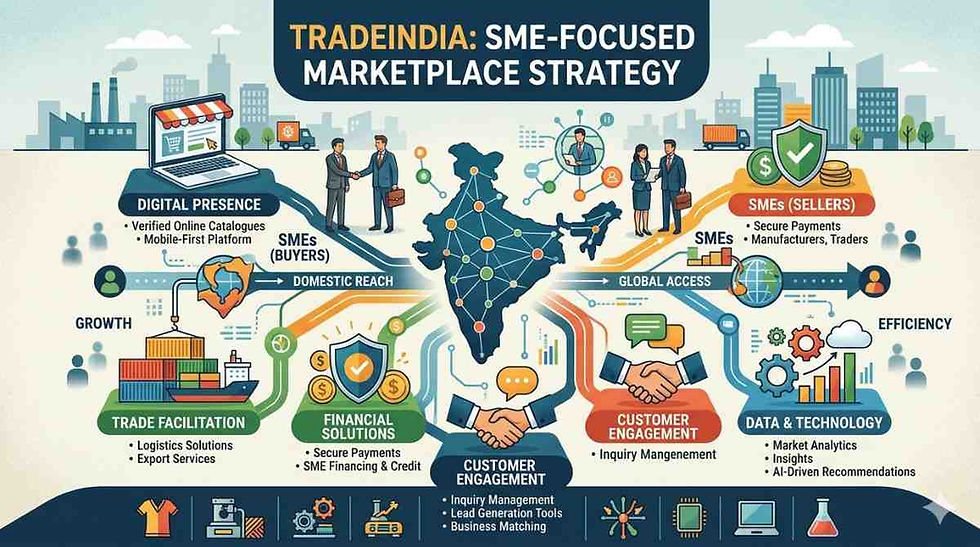
The first and most operationally significant layer was the introduction of TradeKhata, a business accounting and invoicing tool designed for SMEs operating on the platform. The Cashfree partnership, announced in November 2020, was explicitly structured around TradeKhata — enabling digital payment collection through UPI, cards, and other channels, as well as automating invoicing, bulk payouts, and customer data management. Sandip Chhettri, then COO of TradeIndia, stated publicly that the platform was looking to enable its 5.5 million registered SMEs with online payments through this partnership. This move was strategically significant because it transformed TradeIndia from a passive discovery layer into an active operational tool in a seller's daily workflow. The more frequently an SME uses a platform for invoicing and collections, the higher the engagement depth and the stronger the case for premium subscription renewal.
The second layer was the launch of a digital lending solution. In July 2022, TradeIndia announced what it described as a sector-first digital lending solution for SMEs through a partnership with Biz2X. This was followed in May 2023 by the formal launch of TradeUdhaar, a 100% subsidiary of TradeIndia, which provides unsecured working capital loans to MSMEs across India. TradeUdhaar's architecture is partnership-led rather than balance-sheet lending — it works with ICICI Bank, Axis Bank, IIFL, Arthmate, Flexi Loans, Indifi, Mintifi, and Neo Growth to disburse loans. The headline value proposition is a 48-hour disbursement turnaround time (TAT) with loan amounts ranging from Rs 50,000 to Rs 50 lakh and minimal documentation requirements. Within six months of the initial lending launch in 2022, the platform disclosed disbursing over Rs 500 million in loans to SMEs.
This lending move was strategically motivated by a well-documented structural gap. According to the investment banking firm Avendus Capital, a credit gap of $530 billion exists in India's MSME sector, with only 14% of over 64 million MSMEs having access to formal credit. By inserting itself into the credit flow of its merchant base, TradeIndia simultaneously created a new revenue stream, deepened platform dependency, and strengthened its claim to being an MSME growth partner rather than just a marketplace.
The third layer was the Google partnership and digital marketing services. TradeIndia formalized its association with Google India as a Premier SME Partner (PSP), announced in October 2012 and subsequently expanded into a Google My Business partnership by December 2020. This gave the platform a credible co-branding and capability layer for helping SMEs establish a verifiable digital presence beyond the TradeIndia platform itself — an important signal to SMEs that investment in the platform translated to broader digital visibility. The company also publicly positioned itself as offering 360-degree digital marketing solutions exclusively among Indian MSME marketplaces.
The fourth layer was geographic expansion and state-level cluster outreach. By early 2023, TradeIndia's CEO Sandip Chhettri publicly cited the platform's presence in Tamil Nadu, reporting the empowerment of 8 lakh MSMEs in the state. The platform, headquartered in Noida, maintains branch offices across 35 cities in India and claims presence in 10-plus countries, supporting Indian exporters in reaching global buyers.
Positioning & Consumer Insight
TradeIndia's positioning is built around a foundational consumer insight that distinguishes it meaningfully from IndiaMART: the Indian MSME does not merely need a buyer-supplier connection — it needs an integrated operating partner that understands the cash flow, compliance, and credibility challenges unique to small business ownership in India.
The platform's brand narrative, as articulated through official communications, positions it as "the only marketplace offering 360-degree digital marketing solutions to MSMEs." This is a deliberate differentiation from a pure-discovery or pure-transactions model. The "360-degree" framing signals intent to own the full marketing and operations lifecycle for an SME — from digital presence and product listing to payment collection, invoicing, credit access, and trade intelligence.
Bikky Khosla's dual role as platform founder and editor of SME Times — a trade-focused media property — also reflects a brand-building strategy rooted in authentic advocacy rather than advertising. This positions TradeIndia as a voice of the SME community, not just a commercial infrastructure provider. ASSOCHAM's e-commerce committee chairmanship by Khosla further lends institutional credibility to the platform's advocacy positioning.
The platform's Jobs-to-Be-Done (JTBD) framing, read through its product architecture, encompasses at least five distinct jobs for its target segment: find buyers and suppliers at scale; establish a credible and searchable digital identity; manage day-to-day business invoicing and payments; access working capital without collateral; and stay informed about trade trends, regulations, and market developments. Each of these jobs corresponds to a product or partnership that TradeIndia has publicly built or announced.
Media & Channel Strategy
No verified public information is available on TradeIndia's advertising spend, media mix allocation, or performance marketing metrics.
However, the company's publicly visible channel strategy reflects a combination of field sales, digital presence, and institutional partnerships as its primary go-to-market levers. The branch office network across 35-plus cities in India functions as a direct sales and SME activation engine, consistent with the B2B marketplace model's reliance on feet-on-street adoption rather than consumer advertising.
The Google Premier SME Partner status, and the subsequent Google My Business partnership, gave TradeIndia co-marketing access and credibility that functions as both a trust signal and an acquisition channel. The TradeIndia platform itself, with over 12,000 product categories and sub-categories, is a significant organic search asset — a long-tail SEO repository that continuously attracts SME buyer and seller queries.
Participation in domestic and global trade shows, documented as a regular corporate practice, constitutes a direct awareness channel in the trade community, particularly valuable for reaching manufacturers, exporters, and importers who are high-intent but digitally underserved.
Business & Brand Outcomes
The following outcomes are drawn exclusively from publicly disclosed or officially reported data.
The platform has crossed 10 million registered users, of which a substantial proportion are MSMEs, per the company's own official communications. The Cashfree partnership covered 5.5 million registered SMEs at the time of its announcement in November 2020. Even during the COVID-19 lockdown period — a period of severe business disruption — the TradeIndia platform recorded a transactional invoice value of Rs 1,800 crore, according to officially cited figures in the Cashfree partnership announcement. This figure, while not a GMV equivalent, demonstrates material transaction activity on the platform during adverse conditions.
In the lending vertical, TradeIndia's own press releases confirm that within six months of the initial lending launch in 2022, the company disbursed over Rs 500 million (approximately Rs 50 crore) in loans to SMEs. By May 2023, TradeUdhaar was formally constituted as a separate NBFC-linked subsidiary with banking partnerships covering a range of institutional lenders.
The Tamil Nadu outreach, cited by CEO Sandip Chhettri in March 2023, confirmed engagement with 8 lakh MSMEs in the state — a regional metric indicative of the platform's Tier 2 and Tier 3 penetration strategy. The company employs over 1,200 professionals per Wikipedia's documented figure, though Tracxn estimates a higher count of approximately 3,717 employees as of January 2026, reflecting organizational growth.
No verified public information is available on revenue figures, profitability, market share percentages, paid subscriber count, net promoter scores, or gross merchandise value (GMV) for TradeIndia.
Strategic Implications
TradeIndia's evolution offers several analytically rich implications for B2B platform strategy, particularly in the context of emerging market digital infrastructure.
The first implication concerns the platform expansion thesis. TradeIndia's strategic trajectory — from directory to marketplace to operating system — mirrors what is broadly described in platform economics as "vertical integration of the stack." By owning invoicing (TradeKhata), payments (Cashfree integration), credit (TradeUdhaar), and marketing services (360-degree digital), TradeIndia is constructing switching costs that pure-discovery platforms cannot replicate. Each additional service layer makes platform exit more costly for the SME, creating compounding retention economics even if individual service margins are modest.
The second implication is about the MSME credit gap as a strategic moat. The $530 billion credit gap in India's MSME sector, per Avendus Capital, is not merely a fintech opportunity — it is a marketplace loyalty opportunity. An SME that receives a working capital loan through TradeUdhaar's lending ecosystem is meaningfully more likely to renew its marketplace subscription, maintain its product listing, and activate payments through the platform. Credit access creates a fundamentally different relationship between platform and merchant than catalog listing ever could.
The third implication relates to the competitive positioning challenge vis-à-vis IndiaMART. TradeIndia's differentiation narrative — "360-degree digital marketing solutions," exclusive to its category — requires consistent execution across its service layers to be credible. IndiaMART's publicly known investments in AI-driven matchmaking, its large field sales force of over 4,000 representatives, and its post-IPO capital access represent execution advantages that are difficult to match without equivalent organizational scale. TradeIndia's strategic response has been partnership-led scaling — leveraging Cashfree, ICICI Bank, Axis Bank, Google, and others rather than building capability internally. This is a rational capital-efficient approach for a private company but also limits the degree of strategic control over the customer experience.
The fourth implication is geopolitical and economic: TradeIndia's MoU with Thailand's Department of International Trade Promotion and its previous partnership with the Korea International Trade Association (KITA) indicate a deliberate push toward cross-border trade facilitation. As India's export economy matures and Make in India manufacturing deepens, B2B platforms that can credibly connect Indian SME suppliers to global buyers will derive disproportionate value. This is the original vision behind TradeIndia's founding in 1996 — and it remains the most structurally differentiated opportunity available to the platform if executed with modern capabilities.
MBA Discussion Questions
TradeIndia has chosen a partnership-led model (Cashfree, ICICI Bank, Axis Bank, Google) rather than building owned financial and payments infrastructure. Evaluate the trade-offs of this approach against IndiaMART's comparatively more integrated model. Under what market conditions does a partnership-led stack become a competitive liability rather than an asset?
The launch of TradeUdhaar positions TradeIndia as a financial services intermediary within a marketplace. Using the Jobs-to-Be-Done (JTBD) framework, assess whether credit access constitutes a genuine unmet job for the platform's target SME segment, or whether it introduces mission drift from the core marketplace proposition.
TradeIndia's Google Premier SME Partner status and its "360-degree digital marketing solutions" positioning are its two most visible differentiators. How defensible are these differentiators in a market where IndiaMART, Amazon Business, and vertical-specific platforms are rapidly building comparable MSME-facing capabilities?
India's MSME sector is estimated to include over 63 million enterprises, the vast majority of which are micro-enterprises with fewer than 10 employees. Given the structural heterogeneity of this segment, how should TradeIndia define and prioritize its Segmentation-Targeting-Positioning (STP) strategy to maximize platform stickiness and revenue per user?
TradeIndia was founded before IndiaMART yet commands a smaller publicly visible user base and has not pursued a public listing. Critically analyze the strategic implications of remaining privately held in a capital-intensive marketplace sector where public competitors can invest at scale in technology, field sales, and brand building. What strategic options — including partnership, acquisition, or IPO — should TradeIndia's leadership consider to sustain long-term competitive relevance?


Comments