Zepto's Micro-Warehouse Model in Quick Commerce
- Mar 25
- 12 min read
1. Industry & Competitive Context
India's quick commerce market — defined as grocery and essentials delivery completed within one hour or less — had reached an estimated gross merchandise value (GMV) of $6 to $7 billion by 2024, according to industry analysis published by Redseer and cited across multiple credible financial publications. The same consensus projects roughly 40% compound annual growth through 2030, with Morgan Stanley estimating the market could reach $42 billion by that year. Within this category, sub-30-minute delivery — the segment Zepto pioneered at scale — represents the highest-frequency, highest-expectation tier. The market consolidated rapidly around three dominant players: Blinkit (owned by Eternal, formerly Zomato), Swiggy Instamart, and Zepto. According to CLSA's 2024 App-racadabra report, cited by Medianama, Blinkit held approximately 39% market share, with Zepto at approximately 28%, ahead of Swiggy Instamart. By September 2025, Eternal's disclosures indicated Blinkit had crossed 50% share in certain metrics, with Zepto and Instamart contesting second position. The sector experienced notable shake-outs: Dunzo shut down, while global analogues including Gorillas (Europe), Getir (Middle East), and GoPuff (United States) struggled or contracted after initially achieving multi-billion-dollar valuations. This global pattern of rapid growth followed by unsustainable losses provides the essential comparative frame for evaluating Zepto's model. Structurally, the quick commerce category operates on a unit economics principle that differs fundamentally from traditional e-commerce. Platforms typically recognise approximately 15 to 20 percent of gross merchandise value as revenue, as documented across filings and analyst reports. Average order values are low, delivery radii must be small to ensure speed, and each delivery involves a complete logistics sequence — pick, pack, and last-mile — with no economies of consolidation. The category's strategic logic is therefore one of density: enough orders per store per day, concentrated within a tight geographic cluster, can make individual dark stores viable even at low margins per order.
2. Company Situation at Founding & Early Model
Zepto was founded in July 2021 by Aadit Palicha and Kaivalya Vohra, who were 17 years old when they first began working on the concept under the name KiranaKart in 2020, according to Wikipedia and Y Combinator's public company profile. The original KiranaKart model attempted to facilitate grocery delivery by partnering with existing kirana stores, but the founders determined that this approach did not produce the operational consistency or speed required for a differentiated value proposition. The company rebranded to Zepto and pivoted to a vertically integrated dark store architecture, participating in Y Combinator's accelerator program during this transition. The competitive landscape when Zepto launched included Swiggy Instamart (launched 2020), which initially operated from larger warehouses covering wider urban areas — an approach modelled closer to Swiggy's food delivery infrastructure. Blinkit (then Grofers) had been in the grocery delivery market since 2013. Dunzo had backing from Google. All of these incumbents had head-starts in brand recognition, customer base, and funding. Zepto entered with no legacy delivery infrastructure, no customer relationships, and no established supplier contracts — making its choice to build a proprietary micro-warehouse network from scratch a particularly capital-intensive and strategically audacious one.
3. Strategic Objective
Zepto's founding strategic thesis, as expressed in its Y Combinator profile and corroborated by co-founder Aadit Palicha's documented public statements, was that faster delivery would produce better — not worse — unit economics. This was a direct inversion of the conventional wisdom that had prevailed among global quick commerce investors, who observed that high burn rates accompanied rapid delivery promises. The prevailing assumption was that speed was expensive and therefore value-destructive at scale. Zepto's counter-argument was that speed, if engineered through correct infrastructure design rather than subsidised through discounting, would increase order frequency, raise customer retention, improve store throughput, and ultimately make each dark store profitable at a meaningful scale. The strategic objective was therefore not merely to deliver groceries quickly, but to architect a fulfillment system in which hyper-proximity of inventory to the consumer — achieved through dense, small-format dark stores within a two-to-three kilometre delivery radius — could create an order density effect that made individual stores economically self-sustaining. This structural bet distinguished Zepto's model from hub-and-spoke grocery delivery, which prioritised inventory breadth and coverage area over delivery speed, and from asset-light models that relied on existing retail partners at the cost of operational consistency.
4. Model Architecture & Execution: The Dark Store Network
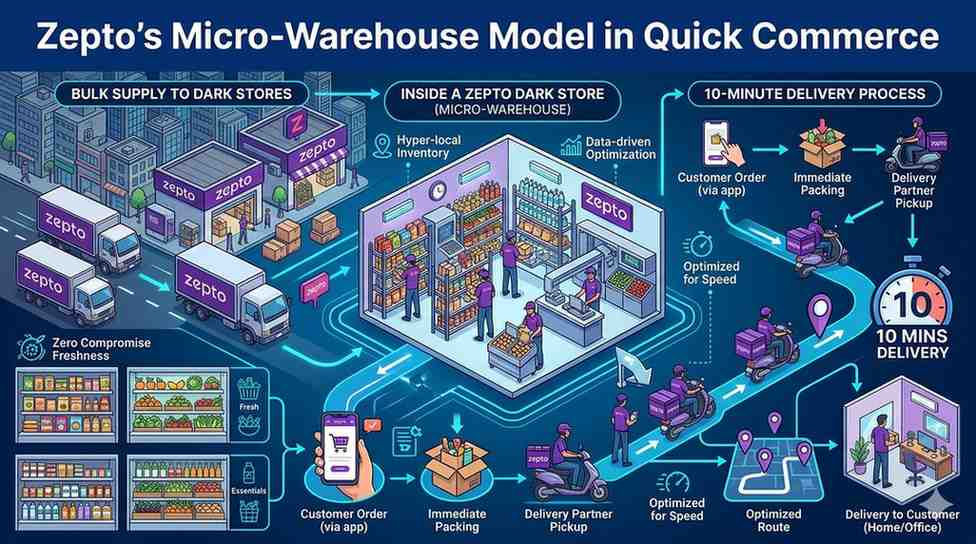
The operational heart of Zepto's model is its network of dark stores — small, customer-inaccessible micro-warehouses located within residential and commercial neighbourhoods. According to Zepto's own public descriptions (via Y Combinator's company profile) and confirmed across multiple credible reports, each dark store is purpose-designed for fulfillment speed rather than retail experience: no signage, no customer access, and no checkout counters. The layout prioritises order-picking velocity, with fast-moving products — milk, bread, eggs, packaged snacks, beverages — positioned closest to packing stations. Restocking occurs multiple times daily, with suppliers delivering directly to dark stores rather than to central warehouses. According to a Business Standard interview with Aadit Palicha published in November 2024, Zepto turned approximately 70 percent of its dark stores to full EBITDA free-cash-flow positivity, including all back-end supply chain and software costs. Palicha disclosed that the time for a new store to reach profitability had decreased from 23 months to approximately 8 months, and that the capital required to make a store profitable had fallen from ₹3.9 crore to ₹1.5 crore. Separately, in a statement cited in a TechCrunch report from October 2025, Palicha noted that the key metric for a recent funding round was Zepto's ability to turn dark stores profitable while simultaneously acquiring over 10 million new monthly transacting users. As of late 2025, Zepto operated more than 1,000 dark stores across more than 80 cities, according to TechCrunch's published reporting. The category selection within each dark store reflects a deliberate curation strategy. Rather than attempting comprehensive SKU coverage, Zepto stores stock a curated assortment concentrated in high-frequency, low-consideration purchase categories. This constraint is simultaneously an operational efficiency mechanism and a demand-shaping tool: by making the curated assortment instantly available at unmatched speed, the model conditions consumers to treat the platform as a reflex purchase channel rather than a considered shopping destination. Over time, the company has expanded category scope — a CLSA and JM Financial analysis of the sector noted that quick commerce platforms began extending into home decor, electronics, lifestyle, and seasonal gifting through 2024, raising average order values and improving category economics across the industry.
5. Positioning & Consumer Insight
Zepto's core positioning — ten-minute grocery delivery — is not, analytically, a product benefit claim. It is a behaviour change thesis. As Palicha articulated in multiple documented public appearances, the founders' hypothesis was that instant availability of groceries would generate consumer behaviours that did not previously exist in the Indian market: impulse purchases of fresh produce, same-session replenishment of household staples, and micro-mission shopping for single-occasion items. A Redseer analysis, cited in a JM Financial sector report published in February 2024, found that approximately two-thirds of total consumer purchases in urban India are unplanned and of low-to-moderate order value — a finding that directly supports the strategic logic of ultra-fast delivery as a demand creation mechanism, not merely a service improvement. This consumer insight repositioned quick commerce within the broader retail competitive frame. The relevant competitors for Zepto were not primarily traditional supermarkets or e-commerce platforms offering next-day delivery. The primary competitive alternative was the decision not to purchase at all — or to substitute the purchase with a nearby physical kirana store visit. Zepto's model collapsed the friction that had previously made in-home ordering impractical for small, urgent, or unplanned grocery needs. When delivery time becomes approximately equal to the time required to walk to a nearby store, the digital channel becomes the default rather than the exception. The positioning also carried a deliberate geographic targeting dimension. As of 2024, India's metro cities contributed more than 90% of sales on quick commerce platforms, according to Redseer data cited by Inc42. Zepto concentrated its early expansion in tier-1 cities — Mumbai, Delhi, Bengaluru, Hyderabad, Pune — where population density, smartphone penetration, and average household income created the most favourable conditions for the dark store density model. Expansion into tier-2 cities (Nashik, Ahmedabad, and others) was documented as a later-stage strategy pursued once metro operations had demonstrated store-level profitability pattern
6. Funding Architecture & Strategic Capital Deployment
Zepto's funding history is a documented matter of public record, verifiable through Wikipedia, TechCrunch, Inc42, and company statements. The progression from pre-seed to a $7 billion valuation within four years reflects not merely investor appetite but the sequential demonstration of specific model milestones that justified successive re-ratings. Sources: Wikipedia (Zepto company page), TechCrunch, Inc42, and Tracxn data cited by CNBC. Total disclosed funding exceeds $2.8 billion. The participation of CalPERS — a $500+ billion U.S. pension fund that typically invests in venture through intermediary funds rather than directly — as lead investor in the October 2025 round was specifically noted by TechCrunch as reflecting institutional confidence in India's quick commerce sector and CalPERS's growing appetite for direct venture investments in emerging markets.
7. Revenue Diversification & Platform Strategy
Zepto's original revenue model — a combination of product sales margin (estimated at 15 to 20 percent take rate on GMV), delivery fees, and a subscription product (Zepto Pass, priced at ₹99 per month) — was structurally constrained by the same low-margin economics that characterise the broader category. Recognising this, the company systematically developed alternative revenue streams that leverage the platform's data infrastructure and consumer engagement density rather than its logistics throughput. The most significant of these is Zepto's advertising business. The company's in-app advertising platform, Jarvis, launched in late 2024 according to Campaign India's published reporting, enables brands to run campaigns within the Zepto app itself. According to a statement by co-founder Palicha reported by Storyboard18 in May 2025, advertising contributes over ₹130 crore per month to Zepto's revenue, and the annualised advertising revenue had crossed ₹1,000 crore as of November 2024 per YourStory's reporting. This figure places Zepto's advertising business within a meaningful scale relative to its total FY24 revenue of ₹4,454 crore. In May 2025, Zepto launched Zepto Atom, a paid subscription analytics platform for consumer brands, priced at ₹30,000 per quarter or 0.5% of the subscribing brand's monthly GMV, whichever is higher, according to YourStory's published pricing disclosure. The platform provides PIN-code-level brand performance data, minute-by-minute sales and conversion metrics, and an in-house NLP assistant (Zepto GPT) trained on Zepto's dataset, according to Business Standard and Inc42 reporting. Palicha announced the product via LinkedIn and in a closed-door briefing for brand partners, stating publicly that Zepto Atom intends to disrupt the ₹1,000 crore consumer analytics industry in India — currently dominated by legacy multinationals such as Nielsen and Kantar. A third product, Zepto Cafe, extends the dark store model into prepared food and beverages delivered from dedicated kitchens within select dark stores. TechCrunch reported Zepto Cafe as a business with a run rate exceeding $110 million and growing rapidly as of October 2025, though the company had paused the service in 44 cities due to staffing challenges before resuming. Zepto also launched a private-label food and meat brand, Relish, which carries structurally higher gross margins (reported as 25 to 40 percent for private-label products by multiple analyst sources) than branded FMCG. These diversification moves collectively signal a strategic intent to transform Zepto from a low-margin logistics platform into a multi-revenue ecosystem in which data monetisation, advertising, and private-label products supplement — and eventually may dominate — the economics of the core delivery business.
8. Business & Brand Outcomes
Zepto's revenue trajectory from FY22 through FY25 is among the most rapid documented in Indian internet commerce. According to audited financial statements reported by Business Standard, Outlook Business, and Inc42, operating revenue grew from ₹140.7 crore in FY22 to ₹2,025.7 crore in FY23 — a 14.3x increase — and further to ₹4,454 crore in FY24 (120% YoY growth) and ₹9,668.8 crore in total sales in FY25 (129% YoY growth). The loss trajectory, however, moved in a different direction: net losses declined marginally in FY24 (from ₹1,272 crore in FY23 to ₹1,249 crore), leading Palicha to state on LinkedIn that the ratio of losses to revenue improved from -63% in FY23 to -28% in FY24. In FY25, losses reversed the improving trend sharply, rising 177% to ₹3,367 crore — equivalent to approximately 35% of total sales — as the company prioritised aggressive dark store expansion and customer acquisition spend. CNBC reported these FY25 loss figures in December 2025. At the store level, Palicha disclosed in a November 2024 Business Standard interview that approximately 70% of dark stores had achieved full EBITDA positivity inclusive of back-end supply chain and software costs. This store-level profitability is analytically important: it suggests the model works operationally in mature markets, even as the aggregate company-level losses reflect the cost of deploying capital into new stores and geographies that are not yet at maturity. The time-to-profitability for a new dark store improved from 23 months to approximately 8 months and the capital required per store to reach profitability fell from ₹3.9 crore to ₹1.5 crore, according to Palicha's documented disclosures. On the competitive displacement dimension, the dark store model's influence extended beyond Zepto's own operations. According to multiple credible published accounts, Swiggy Instamart adopted the dark store model in response to Zepto's success, converting from its original larger-warehouse format. Blinkit (formerly Grofers) similarly shifted from a hub-and-spoke model to dark stores. This competitive convergence, while not uniquely attributable to Zepto, represents a documented structural change in how the Indian quick commerce category is now organised at the fulfillment level. No verified public information is available on Zepto's gross margin by product category at company level, customer acquisition cost, lifetime value metrics, or absolute delivery cost per order beyond the per-category estimates published in the CLSA App-racadabra report (which disclosed that long-haul warehouse transport costs fell from ₹1.7 per order in March 2022 to ₹0.8 in February 2024, and last-mile delivery costs fell 20% between December 2023 and February 2024).
9. IPO Context & Strategic Implications
Zepto filed its draft red herring prospectus (DRHP) with SEBI on a confidential basis on December 26, 2025, as confirmed by CNBC's reporting. The targeted primary fund raise for the IPO is approximately ₹9,000 to ₹11,000 crore, with Goldman Sachs and Morgan Stanley as noted advisors. The IPO preparations carry several strategic implications that extend beyond capital-raising. Zepto has been documented as actively seeking to raise domestic shareholding to approximately 50% — partly as a regulatory preparation requirement — through secondary transactions, including a reported $100 million secondary deal involving Motilal Oswal and Raamdeo Agrawal, reported by Inc42. The IPO will require Zepto to demonstrate a credible and near-term path to profitability in a way that private capital markets have not yet demanded with equivalent rigour. The strategic implications of the Zepto model are substantial across multiple dimensions. First, Zepto demonstrated that an infrastructure-first strategy — building proprietary logistics from scratch rather than aggregating existing supply — can generate faster competitive differentiation than an asset-light approach, but requires patient capital and a long time horizon to justify. The model forced the entire category to converge on dark stores, effectively validating Zepto's original architectural thesis while simultaneously raising the category-wide capital intensity bar. Second, Zepto's revenue diversification strategy — from delivery margins to advertising, data analytics subscriptions, and private-label products — reflects a platform business model logic that is analytically more durable than a pure logistics play. If advertising and Atom revenues scale as disclosed, the underlying unit economics of the dark store network improve without requiring changes to delivery pricing or margin — a path toward profitability that does not depend on either volume dominance or price increases. Third, the Blinkit CEO's documented warning to Bloomberg about a potential bubble — attributing the sector's financial position to "relentless fundraising" covering steep losses — represents a publicly articulated risk scenario for the category as a whole, including Zepto. The structural tension between the model's demonstrated store-level economics and its aggregate net loss position is the central financial narrative that Zepto's IPO will need to resolve for public market investors. Finally, the kirana displacement debate deserves analytical scrutiny. Palicha addressed this directly in a Business Standard interview, citing Datum Intelligence data showing that while quick commerce may have taken $5 billion in sales from kirana stores, $46 billion in new consumption was added to India simultaneously — arguing that quick commerce is predominantly additive to the consumption base rather than substitutive. This framing has regulatory implications: CAIT (Confederation of All India Traders) has publicly raised concerns about quick commerce's impact on small traditional retailers, and the outcome of any regulatory scrutiny would directly affect the model's geographic expansion capacity.
Discussion Questions
Zepto's dark store model was designed on the thesis that faster delivery would produce better — not worse — unit economics at scale. Evaluate this thesis using the documented financial trajectory from FY23 to FY25. Under what conditions does the thesis hold at the store level, and what structural factors prevent it from translating to company-level profitability during expansion phases?
Zepto's competitive moat is anchored in its dark store network density — a form of physical infrastructure advantage. How durable is this moat given that Blinkit and Swiggy Instamart have adopted identical fulfillment architectures? Using frameworks such as Porter's Five Forces or resource-based view, assess which elements of Zepto's model are genuinely defensible and which are subject to replication.
Zepto has sequentially launched advertising (Jarvis), data analytics subscriptions (Zepto Atom), prepared food (Zepto Cafe), and private-label products (Relish) as supplementary revenue streams. Critically evaluate the strategic coherence of this portfolio: do these products reinforce the core dark store proposition, or do they introduce operational complexity and focus risk at a moment when the core model is still not company-level profitable?
The CalPERS decision to lead Zepto's October 2025 funding round — the first such direct investment by the U.S. pension fund in an Indian quick commerce company — has been cited as a signal of institutional confidence. What due diligence framework would you recommend to a large institutional investor evaluating a pre-IPO position in a quick commerce platform with strong GMV growth but widening net losses? What specific financial milestones would be necessary to justify the investment thesis
Zepto's co-founder has publicly argued that quick commerce growth is additive to the Indian consumption base rather than substitutive for kirana stores. The Confederation of All India Traders disputes this. Assess the likely outcome of increased regulatory scrutiny on Zepto's business model, and propose a stakeholder strategy that allows the company to continue urban expansion while managing regulatory and reputational risks associated with small-retailer displacement narratives.


Comments