Adani Group's Brand Strategy Across Infrastructure and Consumer-Facing Verticals
- Mar 23
- 14 min read
Executive Summary
The Adani Group's brand journey between 2019 and 2025 is one of the most consequential — and contested — corporate brand stories in modern Indian business history. The group entered this period as India's largest infrastructure conglomerate by market capitalisation, anchored by the corporate positioning platform "Nation Building" and the guiding principle "Growth with Goodness." It then executed a series of landmark acquisitions — Ambuja Cements and ACC ($10.5 billion, 2022), NDTV (2022), and six major airports (2020 onward) — that dramatically extended its brand's consumer touchpoints beyond B2G infrastructure into everyday consumer experience. In January 2023, the Hindenburg Research short-seller report triggered the single largest market capitalisation collapse of any Indian conglomerate in history, erasing over ₹16 trillion in market value within weeks. The group's subsequent brand management response — denying allegations, invoking nationalism, continuing acquisitions, and systematically reducing debt — provides a rich case in how a conglomerate brand behaves under conditions of existential reputational stress. This is a study not merely in brand strategy execution but in the structural limits of corporate brand positioning when institutional trust is the challenged variable.
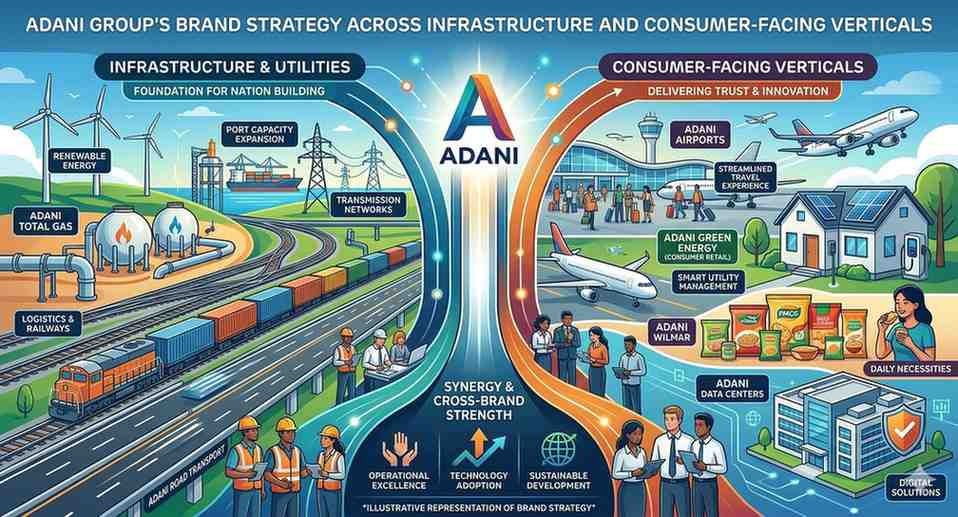
I. Industry & Competitive Context
The Adani Group operates across what it formally classifies as two portfolio categories — Transport & Logistics (ports, airports, roads, rail) and Energy & Utilities (power generation, transmission, gas distribution, renewables) — alongside a newer cluster of consumer-proximate businesses including FMCG (Adani Wilmar, now divested), cement (Ambuja Cements, ACC), media (NDTV), and data infrastructure. As of 2022, the group comprised 11 publicly listed companies with a combined market capitalisation of ₹23 trillion — at its September 2022 peak, the largest of any Indian conglomerate, surpassing the Tata Group per Wikipedia's documented contemporaneous data. The Indian diversified conglomerate landscape is governed by a distinctive brand logic that differs from consumer goods brand management. Companies like the Tata Group, Reliance Industries, and the Mahindra Group have spent decades building what brand theorists would call institutional equity — the diffuse, multi-stakeholder trust that a conglomerate's name confers across all subsidiary businesses regardless of sector. For Tata, this institutional equity was built over 150 years and is characterised by governance credibility, ethical conduct, and consumer empathy. Reliance's brand equity, post-Jio, is characterised by digital access and value democratisation. Adani's brand equity, as explicitly articulated in its own corporate documents, is built on the positioning of national relevance — the claim that Adani's businesses are not merely commercially significant but essential to India's sovereign development. This distinction matters: a brand built on national relevance is inherently more dependent on policy proximity and state legitimacy than a brand built on consumer trust or product quality.
II. Brand Situation Prior to the Strategic Expansion
Between 2014 and 2021, Adani Group's corporate brand was predominantly B2B and B2G — ports, power plants, and resource extraction were its primary revenue generators, and its brand communication was largely confined to investor relations, government procurement contexts, and internal employee communications. The Adani name was well known in financial markets and policy circles but had limited salience with the mass Indian consumer. The exceptions were Adani Wilmar's Fortune brand — India's top-selling edible oil, with nationwide household penetration — and Adani Gas's city gas distribution business, which served residential consumers in select cities. The group's corporate brand platform had been formally articulated as "Nation Building" driven by "Growth with Goodness," as documented on adani.com's About Us page. The corporate brochure, filed publicly, describes this as the group's "core philosophy" and "guiding principle for sustainable growth." The identity architecture assigned every business to one of three pillars: Resources, Logistics, and Energy. A new visual identity, developed in partnership with London-based Wolff Olins (an Omnicom Group agency), was launched to communicate "integration in a simple and modern style." DDB Mudra's Ahmedabad branch won the creative mandate for corporate brand communications through a multi-agency pitch, with the mandate covering internal and external communications, corporate brochures, and motivational campaigns, as documented in The Advertising Club's coverage. The strategic challenge by 2019–2020 was identifiable in two dimensions. First, the group's extraordinary market capitalisation growth — driven by share price appreciation across its listed companies — required a more sophisticated investor-facing brand narrative that could justify premium valuations. Second, the group's planned expansion into consumer-proximate sectors (airports, cement, FMCG expansion, media) meant it was about to gain consumer touchpoints at scale, and a purely infrastructure-oriented "Nation Building" brand platform would be insufficient to generate mass consumer trust in those categories.
III. Strategic Objective
Adani Group's brand strategy across the 2019–2024 period pursued three intersecting objectives, all documented through official communications. The primary objective was to establish the "Nation Building" and "Growth with Goodness" platforms as the unified thematic architecture governing the brand identity of the entire group — from its infrastructure businesses serving government clients to its consumer-facing subsidiaries serving retail buyers. Every major acquisition and business communication between 2020 and 2024 is explicitly anchored to this language in official press releases. The Ambuja Cements acquisition press release, issued May 15, 2022 through PR Newswire, quotes Chairman Gautam Adani stating: "Our move into the cement business is yet another validation of our belief in our nation's growth story" — and concludes with the formal positioning statement: "Adani owes its success and leadership position to its core philosophy of 'Nation Building' and 'Growth with Goodness.'" The secondary objective was to build consumer brand equity through three specific vectors: sports sponsorship and athlete development (Adani Sportsline, launched 2019), airport experiential transformation (operating 23 airports by 2024), and media ownership (NDTV acquisition, 2022). Each of these vectors creates direct, daily consumer touchpoints at a scale that infrastructure or energy assets never could. The tertiary objective, identifiable through Adani Wilmar's documented strategy prior to its 2025 divestment, was to build a multi-category FMCG platform anchored by the Fortune brand — with an explicitly stated long-term goal of deriving 25–30% of total revenue from consumer-facing sectors, as reported by Business Standard in September 2024. This ambition was subsequently abandoned with the December 2024 divestiture of the Adani stake in Adani Wilmar for over USD 2 billion.
IV. Campaign Architecture & Execution
Pillar 1 — Corporate Visual and Narrative Identity
The foundational layer of Adani's brand architecture is its corporate positioning: the group describes itself as "a leading integrated business conglomerate enriching lives, creating sustainable value, and empowering India through #GrowthWithGoodness." The official corporate brochure, filed publicly on adanienterprises.com, explicitly frames every business vertical under the single purpose of "Nation Building" — stating that the group has "diverse businesses to meet our core objective of Nation Building" and that sustainability is not "a tick-in-the-box" but "an essential step toward the future and our goal of Nation Building." This language discipline — consistently deploying the same vocabulary across every press release, annual report, and acquisition announcement — represents a deliberately managed brand voice architecture across 11 listed entities. The use of a single thematic anchor despite extraordinary business diversity reflects the classic branded house strategy, where a master brand umbrella governs all sub-brands.
Pillar 2 — Acquisition-Led Consumer Touchpoint Expansion
Between 2020 and 2022, Adani Group made three acquisitions that transformed the group's brand from infrastructure-only to consumer-proximate. In 2020, it acquired six airports from the Airports Authority of India for ₹2,440 crore; in 2022, it acquired Mumbai Airport, making Adani Airport Holdings India's largest airport operator. Also in May 2022, it acquired Ambuja Cements and ACC from Holcim for $10.5 billion — India's largest-ever M&A transaction in the infrastructure and materials space at the time — making Adani India's second-largest cement manufacturer with a combined capacity of 67.5 MTPA. In August 2022, through AMG Media Networks Limited, the group acquired a controlling stake in NDTV. Each acquisition brought an established consumer-facing brand into the Adani portfolio — Ambuja (India's most trusted cement brand per its own positioning), NDTV (one of India's most recognised news broadcasters) — creating overnight consumer brand associations that decades of infrastructure execution could never have generated.
Pillar 3 — Sports Sponsorship as Mass Brand Legitimation
Adani Sportsline, established in 2019 as the group's formal sports investment arm, has been the most consistent consumer-facing brand communication vehicle the group has deployed. The programme has supported more than 28 athletes since 2016 across boxing, wrestling, tennis, shooting, and athletics, with documented medal winners at the Tokyo Olympics (2021) and Asian Games (2022 and 2023). The group served as the Principal Sponsor of the Indian contingent at the 2024 Paris Olympics, anchored by the #DeshKaGeetAtOlympics social media campaign — an inspiring film that encapsulates the relentless dedication of Indian athletes and reignites the feeling of patriotism among audiences. Additionally, the group has acquired sports franchises including Gujarat Giants (Pro Kabaddi League), Gulf Giants (UAE's International League T20), and a Women's Premier League team, and purchased franchises in the Legends League Cricket in 2022. This sports investment portfolio is coherent with the "Nation Building" brand architecture — athletics is a national development narrative; it is not product advertising.
Pillar 4 — Crisis Communication Response
On January 24, 2023, Hindenburg Research published a report accusing the Adani Group of "brazen stock manipulation and accounting fraud scheme over the course of decades." The Adani Group's brand management response — a documented 413-page rebuttal — was notable for its dual register: it denied the specific allegations as "nothing but a lie" while simultaneously framing the short-seller attack as "a calculated attack on India" — invoking the Nation Building brand positioning as a crisis communication defence. Hindenburg explicitly noted this, stating that the Adani response "predictably tried to lead the focus away from substantive issues and instead stoked a nationalist narrative." The brand strategy deployed in the crisis response was, in effect, an extension of the corporate positioning platform.
V. Positioning & Consumer Insight
The core positioning insight underlying Adani's "Nation Building" platform reflects an understanding of a specific dynamic in India's political-economic landscape: in a country where large-scale infrastructure development is widely perceived as a public good, association with national development generates social legitimacy that is structurally independent of product quality or consumer preference. This is a legitimacy-by-alignment strategy — the brand earns institutional trust not through service excellence or emotional resonance but through demonstrated alignment with sovereign development priorities. This strategy has a distinctive audience logic. The primary audiences of the "Nation Building" platform are not retail consumers — they are policymakers, institutional investors, global sovereign wealth funds (such as UAE's IHC, which invested $2 billion in three Adani entities in May 2022), and multilateral infrastructure financiers. For these audiences, alignment with a sovereign growth narrative is a credible investment signal. TotalEnergies' June 2022 acquisition of a 25% stake in Adani New Industries' green hydrogen subsidiary for $12.5 billion represents the most commercially significant validation of this brand positioning's effectiveness with global strategic investors. The consumer-facing brand insight, activated through the airports and sports sponsorship, is different: it leverages experiential proximity. An airport is not chosen by a consumer — they transact with whichever airport serves their departure city. Adani's 23-airport footprint means that millions of Indians encounter the Adani brand in a high-involvement, prolonged setting (an airport terminal) every time they fly. This is a forced-trial brand encounter with positive experiential potential that no amount of advertising could replicate.
VI. Media & Channel Strategy
Adani Group's brand communications operate across three documented and structurally distinct channels corresponding to its three primary audiences. For institutional and capital market audiences, communication occurs through press releases distributed via PR Newswire and BusinessWire, investor presentations filed with stock exchanges, and the corporate website's dedicated investor corner. Every major acquisition is announced through this channel with explicit invocation of the "Nation Building" / "Growth with Goodness" positioning language — creating brand narrative consistency across financial disclosure documents. For mass consumer and general public audiences, the primary vehicle is sports sponsorship — the #DeshKaGeetAtOlympics campaign was distributed as a social media film, activated on digital platforms, and supplemented by event-based media coverage of athlete achievements. The acquisition of NDTV in December 2022, completing a 64.71% stake acquisition, gave the group direct access to a nationally broadcast news platform with established editorial credibility — though the editorial independence implications of this acquisition, documented by Reuters, Bloomberg, and The Economist, represent a separate dimension of brand risk. For B2B and trade audiences, the cement businesses (Ambuja, ACC) maintain their own established trade marketing communications, which operate semi-independently under the Adani Group corporate umbrella with their own product brands intact. No verified public information is available on the specific advertising expenditure Adani Group allocated to its corporate brand communications between 2019 and 2024, nor on any centralised media planning mandates for the group's multi-entity brand ecosystem.
VII. Business & Brand Outcomes
Market Capitalisation Peak and Collapse: The combined market capitalisation of listed Adani companies stood at a record ₹23 trillion on September 20, 2022, but plunged to a low of ₹6.82 trillion on February 27, 2023, following Hindenburg's allegations of accounting irregularities, excessive leverage, and opaque offshore ownership structures. This represents a ₹16 trillion erosion — the largest single-conglomerate market cap destruction in Indian stock market history. The loss of brand trust was so acute that Adani Enterprises axed its $2.5 billion follow-on public offering (FPO) on February 1, 2023, citing "unprecedented" market conditions. S&P removed Adani Enterprises from the Dow Jones Sustainability Index the same week.
Recovery and Stabilisation: By May 2024, the Adani Group's market capitalisation had returned to over $200 billion, aided by the Indian Supreme Court's direction to SEBI to expedite — but not expand — its investigation, providing partial institutional relief. The group's debt-to-EBITDA ratio was documented to have improved substantially by late 2024, per Economic Times coverage.
FMCG Ambition Abandoned: On December 30, 2024, Adani Group announced the divestment of its entire stake in Adani Wilmar — selling its 43.94% stake to Singaporean partner Wilmar International and in the open market for over USD 2 billion. This strategic exit, coming less than three years after Adani Wilmar's IPO, represents the formal abandonment of the group's consumer FMCG ambition — and a strategic retreat to infrastructure as the brand's defensible core.
Adani Wilmar Fortune Brand Scale (Pre-Divestiture): As documented in Business Standard's September 2024 report, the Fortune brand reached 113 million households. Revenue from the food and FMCG segment grew 40% year-on-year in Q1 FY2025. Despite this operational success, the Adani Group chose to exit the business entirely.
Cement Consolidation: Following the $10.5 billion acquisition of Ambuja and ACC, the group subsequently acquired Sanghi Industries (December 2023) and Penna Cement (August 2024), systematically consolidating India's cement sector under the Adani brand umbrella. The group is documented to be the second-largest cement producer in India as of these acquisitions, with capacity expansion targets publicly disclosed in investor communications.
Airport Infrastructure Scale: Adani Airport Holdings became India's largest airport operator, managing 23 airports by 2024 — the most extensive consumer touchpoint portfolio in the group's history.
VIII. Strategic Implications
1. The Structural Fragility of Legitimacy-by-Alignment Brand Strategy
Adani's "Nation Building" positioning is powerful in conditions of stable policy alignment and undisputed governance credibility — it generates institutional access, capital market premium, and social licence simultaneously. However, it is structurally brittle under conditions of reputational attack. When Hindenburg's report was published, Adani's brand defence was to reassert the nationalist narrative — framing the attack as an attack on India — rather than to respond on the specific financial governance claims. This response failed: the 413-page rebuttal did not prevent a ₹16 trillion market cap loss. The lesson is that legitimacy borrowed from national sentiment is not transferable to investor trust, which requires transparent financial disclosure rather than patriotic framing. A brand built on national alignment is simultaneously elevated and constrained by that alignment.
2. Forced-Trial Consumer Touchpoints as Brand Strategy
Adani's airport portfolio represents one of the most strategically underanalysed brand assets in Indian corporate history. Twenty-three airports — including Mumbai, Ahmedabad, Lucknow, Mangaluru, Jaipur, Guwahati, and Thiruvananthapuram — mean that a substantial proportion of India's 200+ million annual air travellers encounter the Adani brand in an immersive, multi-hour experience. Unlike FMCG, where trial is voluntary, or infrastructure, where the brand is invisible to consumers, an airport is an involuntary brand encounter of high duration and sensory richness. The quality of the airport experience — cleanliness, wayfinding, retail mix, digital services — is, by definition, the quality of the Adani brand for the traveller. This creates a brand-building opportunity and risk simultaneously: excellent execution builds mass consumer trust; poor execution damages a brand that the consumer cannot choose to avoid.
3. The FMCG Divestiture as Brand Strategy Revelation
The December 2024 exit from Adani Wilmar is the single most strategically revealing decision in the group's recent brand history. The Fortune brand reached 113 million households, revenue grew 40%, and profitability had recovered — yet the group exited the business. The strategic reason, as documented across multiple credible sources, was capital reallocation to the infrastructure core in the context of post-Hindenburg pressure, the US DOJ bribery indictment of November 2024, and the need to reduce debt and rebuild investor confidence. The brand implication is that Adani's consumer ambitions were always subordinate to its infrastructure thesis — the FMCG business was a portfolio diversification bet, not a brand identity commitment. The Tata Group's FMCG expansion (Tata Consumer Products, Tata Salt, Tetley) by contrast reflects a values-driven brand extension grounded in a consumer trust legacy. Adani did not have equivalent consumer trust capital; when the infrastructure core came under pressure, the consumer periphery was liquidated.
4. Media Ownership as Brand Risk, Not Brand Asset
The NDTV acquisition in 2022 was widely covered as a brand strategy move — giving Adani Group editorial influence over one of India's most credible news platforms. However, the acquisition has generated net negative brand outcomes for the group in documented public discourse. The Economist's reporting that NDTV had been "critical of the government but is now supine" following Adani's takeover, combined with the controversy over the acquisition process (executed without founders' consent or notice, per NDTV's own documented statement) and the Delhi Police's alleged intimidation of a journalist who covered the group — these events converted an asset intended to build institutional credibility into a liability that amplified governance concerns. For brand strategists, this outcome illustrates that media ownership is not a substitute for reputational integrity — and that audiences' trust in a media brand is destroyed, not transferred, when the media brand's independence is seen as compromised.
5. The Conglomerate Brand Aggregation Problem
The Adani case exposes a fundamental challenge of the branded-house architecture for diversified conglomerates: reputational events in any one business unit contaminate the master brand across all business units simultaneously. When the Hindenburg report accused Adani Enterprises of financial irregularities, the stock prices of Adani Ports, Adani Green Energy, Adani Transmission, and Adani Wilmar — all structurally independent businesses with their own financial profiles — all declined sharply. Adani Ports and Ambuja Cements recorded significantly negative Cumulative Abnormal Returns, as documented in the peer-reviewed Atlantis Press event study (Nikule and Shaw, 2025). The brand architecture that generates scale efficiency in normal conditions generates contagion risk in crisis conditions. For conglomerate brand managers, this finding demands explicit planning for brand firewall architecture — the degree to which sub-brand identities can be maintained independently from the master brand in reputational emergencies.
Discussion Questions
Branded House vs. House of Brands: Adani Group employs a classic branded-house architecture in which the "Adani" master brand governs all 11 listed entities. The Hindenburg report demonstrated that this architecture creates systemic reputational contagion — a financial allegation against Adani Enterprises immediately damaged Adani Wilmar, Adani Ports, and Ambuja Cements. Using brand architecture theory (Aaker and Joachimsthaler's Brand Relationship Spectrum), evaluate whether Adani should maintain its branded-house architecture, migrate toward an endorsed brand or house-of-brands model, or pursue a hybrid approach — and what the specific financial and strategic trade-offs of each path are for a conglomerate of this scale.
Legitimacy-by-Alignment as Brand Strategy: Adani's "Nation Building" positioning generates institutional access and policy proximity but proved ineffective as a crisis communication defence when Hindenburg published its report. Using Suchman's (1995) legitimacy theory (pragmatic, moral, and cognitive legitimacy), diagnose which form of legitimacy the "Nation Building" platform was building, which form it failed to maintain during the crisis, and what a more structurally resilient brand positioning strategy for a state-adjacent conglomerate would look like.
FMCG Exit as Brand Strategy Decision: Adani divested its stake in Adani Wilmar in December 2024, abandoning a consumer FMCG business where the Fortune brand had reached 113 million households and had recently returned to profitability. Analyse this exit as a brand portfolio strategy decision. What does the divestiture reveal about the conditions under which a conglomerate should pursue consumer brand extension versus maintaining infrastructure specialisation? Compare Adani's approach with Tata Group's FMCG strategy (Tata Consumer Products, Tata Salt, Tetley) and identify the key brand equity preconditions that made FMCG expansion sustainable for Tata but not for Adani.
Airport Experience as Consumer Brand Building: Adani Airport Holdings manages 23 Indian airports — creating an involuntary, high-duration consumer brand encounter for millions of annual travellers. Design a brand experience measurement framework that Adani Airports could use to assess the contribution of airport management quality to the Adani master brand's consumer equity. What specific experience dimensions (wayfinding, retail, digital services, cleanliness, staff interaction) generate the strongest brand association transfer, and how should Adani balance revenue maximisation (commercial lease optimisation) with brand quality investment at its airports?
The US Indictment and Brand Recovery: In November 2024, US court filings disclosed bribery allegations involving the Adani Group in connection with solar energy contracts, and the US Securities and Exchange Commission moved to seek court permission to personally email summons to Gautam Adani. These events caused a further sharp decline in Adani Group stocks. Drawing on documented cases of conglomerate brand recovery following founder-level legal challenges (e.g., Samsung Group, Hyundai, Volkswagen's Dieselgate), construct a phased brand rehabilitation framework for the Adani Group. What sequencing of governance reform, communication strategy, and business restructuring is required for the group to restore institutional investor trust — and what are the structural limits of brand management when legal proceedings against the founding chairman remain active?


Comments