Bata India: Repositioning Toward Casual and Youth Segments
- Apr 10
- 11 min read
Executive Summary
Bata India, one of the oldest and most widely distributed footwear brands in the country, entered the 2010s carrying the weight of a powerful but limiting identity: the school shoe brand. With over 85 years of presence in India, Bata had achieved near-ubiquitous distribution, but its brand image had calcified around utility, formality, and an older consumer. Facing an accelerating competitive threat from global athletic brands, domestic challengers, and a digital-native consumer cohort, Bata embarked on a deliberate, multi-year strategic repositioning—shifting from a legacy footwear retailer to a casual, fashion-forward, youth-relevant brand. This case study examines the strategic logic, execution architecture, and documented business outcomes of that transformation.
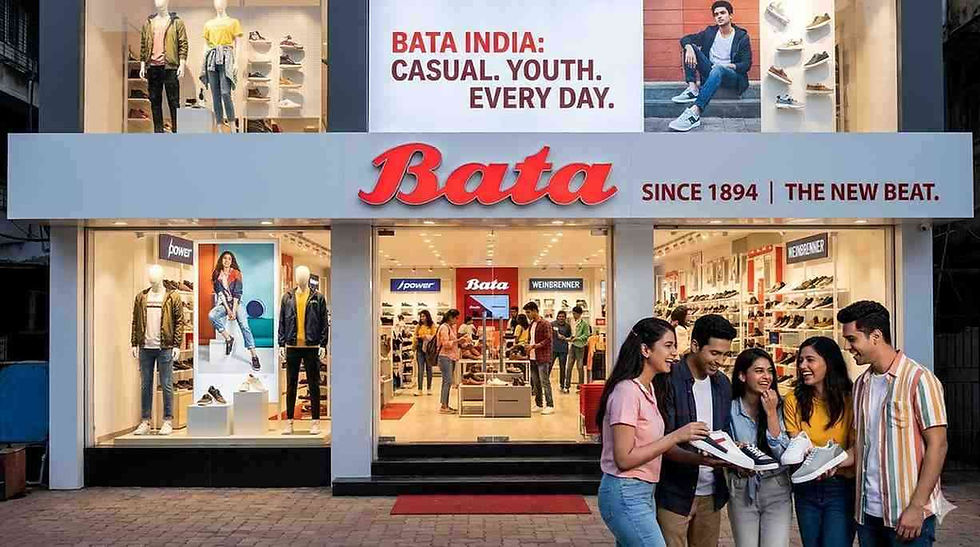
1. Industry & Competitive Context
India's organised footwear market entered a period of structural disruption in the 2010s. The rise of e-commerce aggregators—Flipkart, Amazon, Myntra, and Ajio—democratised consumer access to global brands and intensified price comparison behaviour. Simultaneously, the sneaker segment emerged as a high-growth category, driven by athleisure trends, increasing youth purchasing power, and shifting workplace dress codes toward casual attire. Brands such as Nike, Adidas, Puma, and Skechers aggressively expanded their Indian retail and digital presence, directly competing in the ₹1,000–₹5,000 price band that Bata historically occupied. The broader structural shift, confirmed by Bata's own annual report disclosures, was the "casualisation" of footwear consumption—a macro trend wherein demand for casual, sneaker, and comfort-oriented footwear began to outpace formal categories. This shift was particularly pronounced among millennials and Gen Z consumers, who prioritised self-expression, versatility, and comfort-led design. Bata's Directors' Report for FY2024–25 explicitly acknowledged: "Demand for casual footwear continues to be ahead of the curve, due to growing preference for comfortable and versatile footwear. Trends like athleisure, streetwear and casual dressing boost demand for sneakers, flip-flops and slip-ons." Within this context, Bata occupied a structurally disadvantaged perception position. Despite being India's largest footwear retailer by store count, it was not the consumer's first instinct when buying casual or youth-oriented footwear—the very segments driving category growth.
2. Brand Situation Prior to Repositioning
By the mid-2010s, Bata India's brand perception challenge was well-documented internally and visibly understood by management. The brand's equity was strong on trust, reach, and value, but weak on fashion, aspiration, and youth relevance. As publicly noted by Bata India's VP-Marketing, Anand Narang, in multiple press interactions, the company faced a self-acknowledged perception problem: consumers largely associated Bata with school shoes, leather formals, and family utility purchases. This was not merely a creative challenge—it was a structural positioning problem. The brand sat in an uncomfortable middle ground: too "old" for youth audiences, not premium enough for metro fashion consumers, and increasingly squeezed by fast-fashion footwear at the lower end. The sub-brands in Bata's portfolio—Power, North Star, Weinbrenner, Hush Puppies—had not broken through strongly enough to reshape the parent brand's image. As a PTI report from 2017 noted, Bata was "renewing focus on the young generation by lining up new launches in youth-oriented space through its sub-brands," while also doubling its advertising budget for 2017—an early public signal of strategic urgency. An important historical reference point is Bata's earlier turnaround under MD Marcelo Villagran from 2005 to 2010, which transformed the company from near-bankruptcy into profitability through store modernisation, supply chain restructuring, and portfolio rationalisation. This Phase 1 turnaround restored operational health. The post-2017 repositioning represents a Phase 2 challenge: transforming not just operations but brand perception.
3. Strategic Objective
Based on documented public communications—annual reports, AGM disclosures, and official press releases—Bata India's repositioning strategy was built around two clearly articulated axes: casualisation and premiumisation of its product portfolio. These terms appear consistently in the company's annual reports and investor communications from FY2022 onward and represent official strategic language, not inference. The underlying objective was to increase the Average Selling Price (ASP), expand the addressable market share in the premium and casual segments, and make the brand perceptually relevant to younger consumer cohorts—millennials and Gen Z—without abandoning the brand's heritage equity with older, loyal consumers. This dual-axis strategy is significant from a brand management perspective because it involves simultaneous upward and lateral movement: premiumisation implies a price-tier migration, while casualisation implies a product-category migration. Managing both without creating brand incoherence is a non-trivial strategic problem—one that Bata addressed, in part, through its multi-brand architecture.
4. Campaign Architecture & Execution
Bata's repositioning campaign architecture can be understood in three overlapping phases, each documented through official press releases and credible media sources.
Phase 1 — "Surprisingly Bata" (2018–2020): In 2018, Bata India appointed Bollywood actress Kriti Sanon as its brand ambassador—the first Bollywood face for the brand in 21 years, according to published reports. The campaign, conceptualised by Contract Advertising, was built on a single consumer insight: that the brand's fashion range was unknown to younger audiences because their perception had frozen at "school shoes." The campaign's creative construct was deliberate: rather than use Sanon as a conventional endorser, she was cast as a young consumer surprised by what she finds at a Bata store—with the line "Yeh Bata hai?" The campaign was explicitly positioned to target the Red Label collection at women consumers. Anand Narang confirmed in a published interview with Afaqs: "The Red Label-Kriti Sanon 360 campaign is aimed at inviting younger consumers into the refreshed Bata stores to shop from our latest fashion-forward collections." The creative rationale from Contract Advertising's CCO was to make Sanon "a young consumer who is surprised to see Bata in an all new fashionable avatar"—not a brand spokesperson, but a surrogate for the skeptical target audience. In 2018–19, Bata extended this architecture by adding Sushant Singh Rajput as a second brand ambassador, deploying him in a campaign where he too begins by dismissing Bata as party-inappropriate and ends up pleasantly surprised. Bata India CEO Sandeep Kataria confirmed in an official statement that the intent was to make Bata "more relatable to the youth." The "Surprisingly Bata" campaign ran across television, digital, and retail touchpoints. A subsequent campaign in 2019 deployed the same platform for Bata's 9-to-9 collection for working women, confirming the brand's intent to expand the Bata Red Label sub-brand's positioning as a fashion-forward label.
Phase 2 — Kartik Aaryan and Youth-First Brand Communication (2021–2023): In March 2021, Bata India signed Bollywood actor Kartik Aaryan as its national brand ambassador. The significance of this move is confirmed in the official press statement: VP-Marketing Anand Narang stated, "At Bata, we have been transforming the brand by making our stores more inviting and changing our portfolio to have more casuals, sneaker and fashion styles to attract more millennials. Kartik with his positive energy and easy-going approach relates very well with the youth today." The move was simultaneously about brand communication and sub-brand visibility—specifically to promote Bata Red Label, North Star, Power, and Hush Puppies. The same year, Bata launched its "Relaxed Workwear" collection campaign, aligning with post-pandemic hybrid work consumption trends.
Phase 3 — "Make Your Way" / "Celebrate Every Step" Global Alignment (2024): By 2024, Bata's campaign architecture was integrated with its global brand positioning. The festive campaign "Celebrate Every Step," featuring Kartik Aaryan and co-featuring youth icons such as designer Masaba Gupta, musician Lisa Mishra, comedian Urooj Ashfaq, and actress Alaya F, was positioned as a chapter of Bata's global "Make Your Way" initiative. The campaign's official brief, as stated by Deepika Deepti, Head of Marketing at Bata India: "Today's India is about individuals who dare to change their trajectories and make their own way." Critically, the campaign was creative-directed by FCB India's National Creative Director as a "dramatized mixed media biography" rather than a conventional product advertisement—a deliberate departure from transactional advertising into brand storytelling.
5. Positioning & Consumer Insight
The consumer insight underpinning Bata's repositioning is visible across multiple verified communications. At its core, the brand identified a perception-reality gap: the product portfolio had evolved meaningfully, but consumer awareness of that evolution lagged significantly. The strategic task was not product innovation per se, but closing the perceptual distance between what Bata now offered and what consumers believed it offered. A secondary and more forward-looking insight—confirmed in a published interview by Bata India's MD & CEO Gunjan Shah's management communications—centred on the hybrid footwear opportunity: the consumer desire for formal-looking shoes with sneaker-level comfort. Bata's Directors' Report acknowledges the Victoria ballerina collection as a product response to this insight: "combining comfort, design, and fashion relevance." Similarly, the Power Easy Slide collection was explicitly designed around the "convenience-first consumer"—a hands-free design that eliminates the need to bend down. From a theoretical lens, this repositioning follows a perceptual repositioning model (altering consumer beliefs about a brand without necessarily changing the brand's core offering) combined with a portfolio extension strategy (using sub-brands to enter new perceptual territory while protecting the parent brand's equity base). The multi-brand house architecture—where Power, North Star, Floatz, and Red Label operate as distinct fashion identities under the Bata umbrella—allowed the company to pursue youth relevance without risking alienation of its traditional consumer base.
6. Media & Channel Strategy
Bata India's channel strategy during this period combined physical retail transformation with digital acceleration. The following are documented through official communications:
Retail Store Format Transformation: Bata introduced a new concept store format—referred to in The Drum's published interview with Anand Narang as the "Red European" format—alongside a dedicated "Sneaker Studio" concept within existing stores. As documented in official quarterly results, Sneaker Studios were deployed at scale: reaching 655 stores in Q3 FY2024, 698 stores by Q4 FY2024, and expanding to over 750 Bata and franchise stores in FY2024–25 per the Directors' Report.
Digital and Omnichannel: Bata's digital strategy involved deployment of AI-based personalisation tools, in-store QR code scanning for product discovery, and what Narang described in The Drum as "customer single view"—a technology allowing store staff to access customer shopping history for personalised recommendations. The company confirmed its omni-channel network covered 1,700-plus stores. E-commerce, spanning bata.com and marketplace channels including Myntra, Amazon, and Flipkart, was stated to have grown significantly, with quick commerce added as an additional growth channel in FY2024–25.
Campaign Media Mix: The "Surprisingly Bata" campaign used television, digital, social media, influencer marketing, retail activations, print, outdoor, and CRM channels—confirmed by Contract Advertising's published campaign touchpoint disclosure. The "Celebrate Every Step" campaign used film-format storytelling, deployed across digital and television channels. The brand additionally worked with celebrity and micro-influencers for sub-brand promotion.
7. Business & Brand Outcomes
The following outcomes are drawn exclusively from official filings, AGM disclosures, and company press releases:
Revenue Recovery and Growth: Bata India's revenue from operations in Q1 FY2023 reached ₹943 crore—its highest-ever quarterly sales at that point—which the company's official earnings statement attributed directly to "the continued focus on key thrust areas of franchise and MBO expansion, consumer relevant communication, portfolio casualisation and digital footprint expansion." For FY2022–23, Bata India reported revenue of ₹3,451.5 crore and net profit of ₹319 crore, up from ₹100 crore in the prior year, as disclosed by Chairman Ashwini Windlass at the company's 90th AGM. For FY2024, reported revenue was approximately ₹34.96 billion.
Floatz Sub-Brand Performance: The Directors' Report confirmed that Floatz, Bata's casual washable footwear line, crossed ₹1,000 million in sales during FY2024–25 and was expanded to 1,500-plus store doors. Q3 FY2024 results confirmed Floatz business grew 65% in that quarter alone.
Sneaker Studio Scale: Sneaker Studios—the in-store format dedicated to the casualisation strategy—reached over 750 Bata and franchise stores in FY2024–25, per the Directors' Report, up from 655 in Q3 FY2024.
Network Expansion: As per Bata India's MD & CEO Gunjan Shah's message to shareholders in the FY2024 Annual Report, the company's retail network spanned over 1,850 stores including over 500 franchise stores and 650-plus Sneaker Studios.
Power Brand Development: The Power brand, Bata's athletic and athleisure play, launched its first Power Exclusive Brand Outlet (EBO) in Noida. Power apparel was expanded to 100-plus stores.
Brand Recognition: As documented in Bata's 2019 Annual Report, the company received the IMAGES Most Admired Footwear Brand of the Year 2019 and the Reader's Digest Most Trusted Brand Award in the same period. No verified information is available on specific metrics for brand perception shift scores, Net Promoter Score changes, social media engagement rates, or digital sales as a percentage of total revenue unless publicly disclosed in the above sources.
8. Strategic Implications
8.1 The Limits of Multi-Brand Architecture for Parent Brand Repositioning
Bata's case raises a fundamental brand management tension: when a company uses sub-brands to access new consumer segments, the parent brand may benefit from halo effects, but the sub-brand's equity does not automatically flow back upstream. Published analysis (including Open The Magazine's April 2026 deep-dive) notes that consumers may perceive Power or North Star as distinct from Bata itself—limiting how much the sub-brand investment reshapes the parent's core perception. For brand strategists, this is the classic "house of brands vs. branded house" strategic dilemma. Bata's architecture sits somewhere in between: it leverages the parent brand's distribution and trust while building sub-brand fashion credentials. The long-term risk is that fashion-forward consumers eventually migrate to the sub-brands while the parent brand remains anchored to utility associations.
8.2 The "Perception Lag" Problem in Heritage Brand Repositioning
Bata's "Surprisingly Bata" campaign creative logic—using celebrity surrogates who begin with the audience's own outdated perception—is a theoretically sound but inherently slow mechanism for perception change. It acknowledges the gap rather than leap-frogging it. This approach works well for awareness and initial trial, but sustained perception shift requires consistency across multiple brand touchpoints over multiple years. Bata's documented commitment to this strategy across 2018–2024 suggests management understood this and made the necessary long-term investment. The risk, however, is that the "surprise" narrative has a finite shelf life: once a consumer knows Bata sells fashion-forward footwear, the next communication must deepen aspiration, not re-surprise.
8.3 Casualisation as a Structural Tailwind, Not Just a Brand Choice
Bata's strategic timing appears well-aligned with macro consumption trends. The shift toward casualisation in footwear—confirmed in its own Directors' Reports as a category-wide trend—means that Bata's portfolio pivot is not merely a brand choice but a structurally-motivated response to consumption migration. This distinguishes Bata's case from a classic brand vanity exercise: the strategy has both defensive logic (protecting against loss of relevance) and offensive logic (capturing a growing segment). The risk lies in execution—specifically, whether Bata's price positioning and brand associations can compete with category-dominant players like Nike, Adidas, and Skechers in the aspirational sneaker segment.
8.4 Digital Transformation as a Repositioning Enabler, Not a Strategy in Itself
Bata's documented digital investments—AI personalisation, omnichannel integration, QR-based discovery, marketplace presence—represent important infrastructure for reaching younger consumers who prefer digital-first discovery and purchase. However, these are enablers of the repositioning, not the repositioning itself. The company's own communications frame digital correctly: as an expansion of reach and experience, not a substitute for product and perception strategy.
Discussion Questions
The Heritage-Aspiration Paradox: Bata's repositioning leverages heritage trust while simultaneously building aspirational fashion equity. Under what conditions does a brand's legacy become a strategic asset versus a perceptual liability? How should brand managers calibrate this trade-off in sectors where consumer identity is closely tied to brand choice, such as footwear and apparel?
Sub-Brand vs. Parent Brand Equity Transfer: Bata uses a multi-brand architecture (Power, North Star, Floatz, Red Label) to access youth and casual segments. Evaluate the strategic trade-offs between a "house of brands" model and a "branded house" model in the context of Bata's repositioning. Under what conditions would consolidating these sub-brands under a unified Bata identity accelerate or hinder the repositioning objective?
The "Surprisingly Bata" Creative Strategy: The campaign's central insight is the perception-reality gap between Bata's actual product range and consumer belief. Is this a sustainable positioning platform or a transitional communication device? Once the perception gap is closed, what should the brand's next strategic narrative be to maintain relevance with youth consumers?
Casualisation vs. Premiumisation: Managing Dual-Axis Strategy: Bata's official strategy language simultaneously pursues casualisation (category migration toward sneakers and casual wear) and premiumisation (price-tier migration toward higher ASP products). Analyse the inherent tension between these two objectives in terms of target consumer, retail format, and communication strategy. Can a single brand credibly pursue both axes, or does this require structural separation?
Competitive Positioning in the Sneaker Category: Bata's Sneaker Studio concept and the Power brand represent its primary response to the athleisure and sneaker megatrend. Given the brand equity dominance of Nike, Adidas, and Puma in this category, evaluate Bata's competitive positioning strategy. What theory of competitive advantage underpins its approach—is it cost leadership, differentiation, or a hybrid? What would you recommend as a five-year strategic priority for Bata in this segment?


Comments