BigBasket’s Insight into Monthly Grocery Planning Behavior
- 21 minutes ago
- 5 min read
Industry & Competitive Context
India’s grocery retail market has historically been dominated by unorganized neighborhood stores and traditional trade formats. However, rising internet penetration, smartphone adoption, digital payment infrastructure, and urban consumption growth accelerated the development of online grocery commerce during the 2010s and early 2020s. Companies including BigBasket, Blinkit, Swiggy, and Zepto competed across convenience, assortment, delivery speed, and pricing.
Within this evolving landscape, grocery consumption behavior remained structurally different from categories such as fashion or electronics. Grocery purchases were recurring, necessity-driven, and often linked to household planning cycles. Industry reports from firms including RedSeer and McKinsey & Company identified that Indian urban consumers frequently combined large planned purchases with smaller top-up orders.
This distinction became strategically important as online grocery companies sought to balance operational efficiency with consumer convenience. Monthly or periodic bulk purchasing behavior represented higher basket-value opportunities compared to purely impulse-led commerce models.
Brand Situation Prior to Campaign
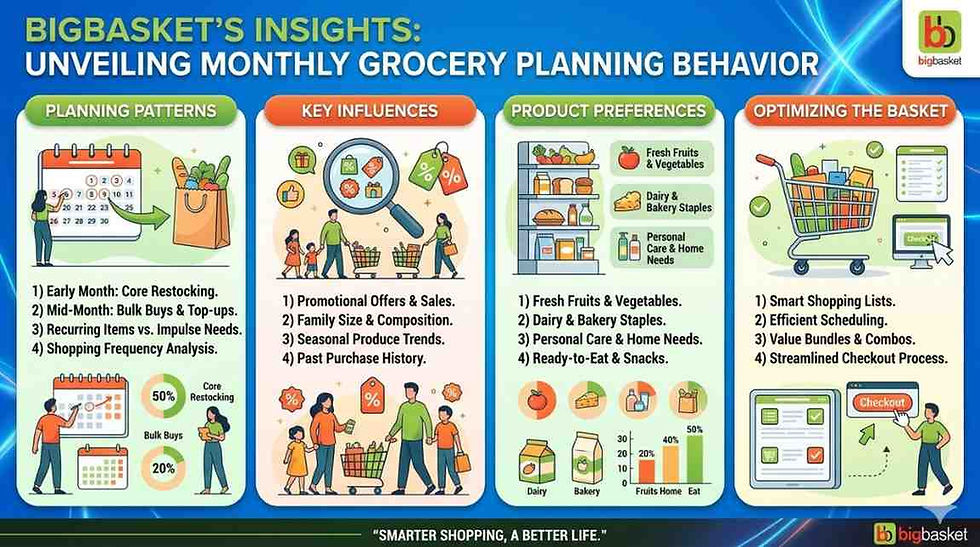
Before the rise of quick commerce, BigBasket positioned itself primarily around assortment depth, planned grocery purchasing, scheduled delivery, and household convenience. The company focused on categories including staples, fruits and vegetables, packaged food, beverages, personal care, and household essentials.
Publicly available company communication and media coverage consistently described BigBasket as a full-basket grocery platform rather than an immediate-delivery convenience service. This differentiated the company from emerging ultra-fast delivery competitors whose positioning centered more heavily on instant fulfillment.
As competition intensified, especially after the expansion of quick commerce platforms during and after the COVID-19 pandemic, consumer expectations around delivery speed increased significantly. However, large household purchases still required assortment breadth, inventory reliability, and value-based purchasing structures that differed from rapid convenience-led orders.
This created a strategic tension within online grocery retail: whether to optimize primarily for immediacy or for planned household consumption behavior.
Strategic Objective
BigBasket’s publicly observable strategy suggested an attempt to strengthen its relevance in routine household grocery planning while simultaneously adapting to changing delivery expectations.
The strategic objective appeared to focus on three verified market realities documented through company statements, investor commentary from parent company Tata Group entities, and credible media reporting.
First, Indian households continued purchasing staples and essentials in recurring cycles rather than exclusively through impulse buying.
Second, grocery purchasing remained strongly linked to trust, availability, and consistency.
Third, increasing competition from quick commerce players required differentiation beyond delivery speed alone.
Rather than positioning solely around instant delivery, BigBasket maintained emphasis on comprehensive grocery management and household planning convenience.
No verified public information is available on a formally disclosed internal strategic framework specifically labeled “Monthly Grocery Planning Behavior.”
Campaign Architecture & Execution
BigBasket’s execution approach consistently reflected planned household purchasing behavior across multiple operational and marketing dimensions publicly documented in company communication and media reporting.
One important element involved assortment strategy. The platform consistently emphasized broad category availability, including staples, bulk packs, home essentials, fresh produce, and private-label offerings. This aligned with larger household basket construction rather than isolated convenience purchases.
Another major executional component involved scheduled delivery systems. Unlike pure instant-commerce positioning, BigBasket historically promoted slot-based delivery models that enabled consumers to organize recurring purchases around household consumption planning.
The company also expanded private-label brands including Fresho and BB Royal. Public reporting indicated that private labels became important components of BigBasket’s differentiation strategy. These offerings supported value perception and category standardization across repeat purchases.
Subscription-oriented services also reflected recurring consumption insight. BigBasket introduced BB Daily, focused on recurring household essentials including milk, bread, eggs, and other frequently replenished items. This service aligned directly with routine consumption management rather than one-time transactional behavior.
During the COVID-19 pandemic, grocery reliability became especially important. Media coverage from Reuters, Economic Times, and Mint documented significant increases in online grocery demand. In this environment, BigBasket’s positioning around essential household supply continuity strengthened its role within planned consumption behavior.
The company later expanded into faster delivery formats through BB Now, reflecting adaptation to evolving market expectations without completely abandoning planned-purchase positioning.
Positioning & Consumer Insight
The core observable consumer insight underlying BigBasket’s market approach was that grocery shopping in India was not purely convenience-driven. It was also habit-driven, routine-oriented, and linked to household management behavior.
Unlike categories characterized by discretionary purchasing, grocery consumption involved repeat patterns shaped by monthly salary cycles, family budgeting, inventory replenishment, and predictable consumption needs.
BigBasket’s positioning reflected this insight through emphasis on reliability, assortment breadth, and recurring household utility rather than solely emotional branding or urgency-based messaging.
The platform’s communication frequently focused on convenience for families, access to comprehensive grocery selection, and reduction of routine shopping friction. This differentiated the brand from platforms positioned primarily around immediate gratification or emergency purchases.
Importantly, BigBasket’s model aligned with an interpretation of grocery retail as an operational trust business rather than purely a logistics-speed business.
The strategic implication was significant. While instant delivery could solve urgent needs, planned grocery management addressed recurring household behavior with potentially larger order structures and higher shopping frequency stability.
No verified public information is available on proprietary consumer research methodologies specifically focused on “monthly grocery planning behavior.”
Media & Channel Strategy
Verified public information suggests that BigBasket relied heavily on digital-first media distribution, app-based engagement, performance marketing, and brand advertising across television and digital platforms.
The company conducted multiple integrated campaigns over the years emphasizing household convenience and online grocery adoption. During high-demand periods such as the COVID-19 pandemic, media visibility increased substantially through earned coverage related to supply chain continuity and essential service operations.
BigBasket also leveraged app ecosystem engagement through notifications, repeat-order features, category reminders, subscription services, and promotional pricing mechanisms commonly associated with recurring purchase categories.
Its integration within the broader Tata Digital ecosystem after Tata Group’s majority acquisition further expanded strategic digital integration opportunities through platforms including Tata Neu.
No verified public information is available on exact media allocation, channel-wise spending breakdowns, or campaign-level conversion performance unless officially disclosed.
Business & Brand Outcomes
BigBasket achieved several publicly documented business milestones during the expansion of India’s online grocery sector.
In 2021, Tata Digital acquired a majority stake in BigBasket, signaling strategic confidence in digital grocery commerce and recurring household consumption demand.
The company expanded across multiple Indian cities and strengthened its presence within organized online grocery retail. Public reporting consistently identified BigBasket among India’s leading online grocery platforms by scale and market presence.
BigBasket also diversified its operating model through BB Daily and BB Now, indicating adaptation across both recurring planned purchasing and faster fulfillment demand segments.
Industry reports and public commentary frequently cited grocery as one of India’s fastest-growing digital commerce categories during the pandemic and post-pandemic period.
However, no verified public information is available on:
Exact revenue contribution from monthly grocery planning behavior
Customer segmentation linked specifically to planned monthly baskets
Internal retention impact from recurring purchase models
Proprietary household consumption analytics
Campaign-specific ROI tied to grocery planning behavior
Strategic Implications
BigBasket’s market evolution illustrates an important distinction within digital commerce strategy: all e-commerce categories do not operate according to identical consumer decision frameworks.
In grocery retail, recurring household behavior creates structural importance for trust, consistency, availability, and replenishment planning. BigBasket’s positioning historically reflected these realities more strongly than purely speed-oriented commerce models.
The company’s trajectory also demonstrates how operational models influence brand identity. Scheduled delivery systems, recurring subscriptions, and broad assortment depth reinforced perceptions of BigBasket as a household grocery management platform rather than merely a rapid-delivery application.
As competition intensified through quick commerce expansion, BigBasket adapted by introducing faster delivery capabilities while still maintaining broader grocery infrastructure.
This hybrid evolution reflects a broader strategic lesson in retail marketing: consumer convenience is multidimensional. Speed matters, but so do reliability, assortment, affordability, and routine integration.
The case also highlights how recurring consumer behavior can become a defensible strategic foundation in categories driven by habitual purchasing rather than episodic transactions.
MBA-Style Discussion Questions
How does grocery retail differ strategically from other e-commerce categories in terms of consumer behavior and purchase planning?
Evaluate BigBasket’s positioning relative to quick commerce competitors focused primarily on delivery speed.
Why are recurring household purchase categories structurally different from impulse-driven commerce categories?
How can online grocery platforms balance planned purchasing behavior with rising consumer demand for instant fulfillment?
What strategic advantages can subscription-based replenishment models create in digital grocery retail?


Comments