Nykaa’s Profitability in E-Commerce Strategy
- 15 minutes ago
- 6 min read
Industry & Competitive Context
India’s e-commerce industry expanded rapidly during the 2010s and early 2020s, driven by rising smartphone penetration, digital payments adoption, affordable internet access, and growing online consumption across urban and semi-urban markets. Major horizontal e-commerce companies such as Flipkart and Amazon competed aggressively across categories through discounting, logistics expansion, and customer acquisition spending.
Within beauty and personal care retail, digital commerce became increasingly important as consumers sought wider product selection, premium international brands, convenience, and content-led product discovery. Industry reports from firms including RedSeer and McKinsey & Company identified beauty and personal care as one of India’s high-growth digital retail categories.
However, the broader Indian e-commerce ecosystem was characterized by persistent profitability challenges. Many large internet businesses prioritized growth, market share expansion, and scale over short-term profitability. Investor discussions and financial reporting across the sector frequently highlighted losses linked to logistics costs, discounting intensity, and customer acquisition spending.
Against this backdrop, Nykaa emerged as a notable case because it publicly reported profitability before and after its public listing, differentiating itself from many internet-first commerce companies operating in India.
Brand Situation Prior to Strategy Focus
Founded in 2012 by Falguni Nayar, Nykaa initially positioned itself as a specialized beauty and personal care platform focused on authenticity, curated assortment, and premium shopping experience.
At the time of Nykaa’s expansion, India’s beauty retail market remained fragmented across offline stores, department chains, pharmacies, salons, and unorganized retail channels. Online beauty purchasing faced consumer concerns related to counterfeit products, inconsistent availability, and limited product education.
Nykaa differentiated itself by emphasizing authorized brand relationships, curated product selection, and content-driven commerce. Public company filings and investor presentations consistently highlighted the company’s focus on a “consumer technology platform” integrating commerce, content, and community engagement.
Before its IPO in 2021, Nykaa had already become notable within India’s startup ecosystem for achieving profitability. This became an important part of its strategic positioning among investors and industry observers.
Strategic Objective
Nykaa’s publicly documented strategy reflected a deliberate attempt to build a scalable digital commerce business while maintaining operational discipline and brand premiumization.
The company’s strategic objectives, as reflected in annual reports, investor presentations, and public statements, included:
Building leadership in India’s beauty and personal care market
Expanding omnichannel retail presence
Strengthening owned brand portfolio
Driving repeat consumer engagement through content and discovery
Maintaining sustainable business economics
Unlike several high-growth e-commerce companies that prioritized aggressive discount-led expansion, Nykaa consistently positioned itself around premium consumer experience, assortment quality, and category specialization.
Its approach suggested that category expertise and consumer trust could support stronger economics compared to generalized discount-heavy marketplace models.
Campaign Architecture & Execution
Nykaa’s profitability-oriented execution model relied on several interconnected strategic components documented in public filings and investor materials.
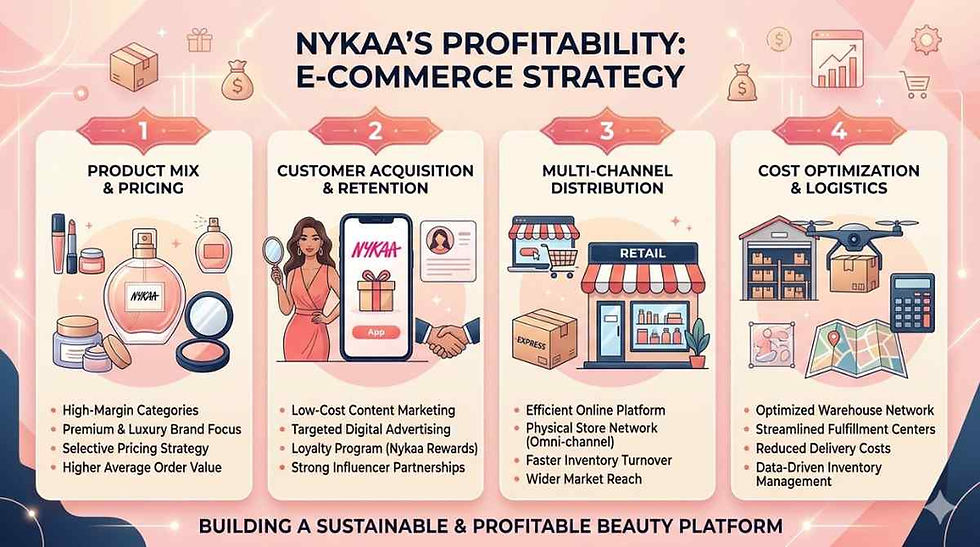
One major element involved inventory-led operations in core beauty categories. Unlike pure marketplace structures, Nykaa maintained greater control over product authenticity, merchandising, pricing consistency, and fulfillment quality through inventory ownership in many categories.
This operational structure reinforced consumer trust in a category where counterfeit concerns historically affected online purchasing behavior.
Another critical component was premium and luxury brand partnerships. Nykaa established relationships with global and domestic beauty brands including premium cosmetic and skincare companies. This enabled differentiated assortment and reduced dependence on commoditized pricing competition.
The company also invested significantly in content-commerce integration. Nykaa’s platform combined editorial content, tutorials, influencer engagement, beauty advice, and product education with transactional commerce. This supported consumer discovery behavior in beauty retail, where purchasing decisions are often influenced by education, trends, and experimentation.
Publicly available company communication also highlighted the role of owned brands such as Nykaa Cosmetics and Kay Beauty. These private-label and exclusive partnerships strengthened margin structures while reinforcing brand ecosystem control.
Omnichannel expansion formed another major strategic pillar. Nykaa expanded physical retail stores across India while continuing digital growth. According to company filings, the retail network included luxury and premium beauty formats in multiple cities. This hybrid strategy differentiated Nykaa from purely online competitors.
Importantly, the company’s execution did not rely exclusively on deep discounting as a primary positioning mechanism. Instead, it emphasized assortment credibility, premium experience, and category expertise.
Positioning & Consumer Insight
Nykaa’s positioning reflected a consumer insight that beauty purchasing behavior differs structurally from many other e-commerce categories.
Beauty and personal care purchases are often identity-linked, aspirational, and trust-sensitive. Consumers frequently seek guidance, tutorials, reviews, shade matching, and authenticity assurance before purchase decisions.
Nykaa’s platform architecture addressed these behaviors by integrating commerce with education and discovery. The company consistently positioned itself not merely as a transactional retailer but as a beauty destination.
Its premium-oriented positioning also aligned with rising demand for global beauty brands and premium personal care products among Indian urban consumers.
Another important insight underlying Nykaa’s strategy was that trust could become a competitive advantage in categories vulnerable to counterfeit concerns. Authorized sourcing and controlled inventory structures therefore supported both consumer confidence and long-term brand equity.
The company’s profitability orientation further reflected the idea that sustainable consumer businesses require stronger unit economics than perpetual subsidy-driven growth.
No verified public information is available on proprietary consumer segmentation models or undisclosed profitability frameworks beyond what was officially disclosed in company filings.
Media & Channel Strategy
Nykaa’s media and channel strategy combined digital content, influencer collaborations, social media engagement, app-led commerce, and offline retail expansion.
The company built strong visibility across platforms including Instagram and YouTube through beauty tutorials, product launches, influencer partnerships, and educational content.
Its annual reports and investor presentations consistently referenced content-led engagement as a strategic growth lever. Nykaa integrated video tutorials, editorial storytelling, and beauty advice directly within its commerce ecosystem.
Influencer marketing also played a visible role in category engagement, particularly within cosmetics and skincare segments where consumer discovery behavior is socially influenced.
Offline retail expansion strengthened omnichannel visibility and enabled experiential engagement with premium beauty products. This was particularly important in categories where product testing and sensory experience influence purchase decisions.
Nykaa additionally benefited from high levels of earned media coverage around its IPO, founder leadership, and profitability narrative within India’s startup ecosystem.
No verified public information is available on precise campaign-level media spending allocations unless officially disclosed.
Business & Brand Outcomes
Nykaa achieved several publicly documented business milestones that reinforced its positioning as a profitability-focused digital commerce company.
In 2021, Nykaa completed its IPO through parent company FSN E-Commerce Ventures. The IPO received substantial investor attention and was widely covered by major financial media outlets.
Company filings publicly documented profitability prior to listing, distinguishing Nykaa from several technology startups that remained loss-making at the time of their IPOs.
Nykaa also expanded significantly across categories including beauty, personal care, wellness, and fashion. Its omnichannel retail network grew across multiple Indian cities.
The company’s owned brands and exclusive partnerships became increasingly important parts of its portfolio strategy, according to investor presentations and annual disclosures.
Public financial disclosures also documented continued growth in gross merchandise value, order volumes, and customer base expansion over multiple reporting periods.
However, no verified public information is available on:
Exact profitability contribution from individual campaigns
Internal customer lifetime economics unless disclosed
Undisclosed acquisition efficiency metrics
Proprietary repeat purchase behavior data beyond official filings
Internal margin contribution by consumer cohort unless publicly reported
Strategic Implications
Nykaa’s evolution offers an important counterpoint to the “growth at all costs” approach historically associated with many e-commerce businesses.
Its strategy demonstrated that category specialization, premium positioning, controlled merchandising, and trust-oriented branding can support stronger commercial sustainability in digital commerce.
The company also highlighted the strategic value of integrating content and commerce. In beauty retail, product education and consumer engagement directly influence purchasing behavior, making content infrastructure commercially important rather than purely promotional.
Nykaa’s omnichannel expansion further reflected an understanding that physical and digital retail can function complementarily rather than competitively in experience-sensitive categories.
Another key implication concerns profitability as brand positioning. Nykaa’s profitability narrative itself became strategically important within investor and market perception, especially during periods of scrutiny toward loss-making internet companies.
The broader lesson is that e-commerce profitability may depend less on scale alone and more on category structure, consumer trust dynamics, pricing discipline, and ecosystem integration.
MBA-Style Discussion Questions
How did Nykaa’s category-focused strategy differ from horizontal e-commerce marketplace models in India?
Why is trust particularly important in online beauty and personal care retail?
Evaluate the role of content-commerce integration in Nykaa’s profitability-oriented strategy.
How can omnichannel expansion strengthen digital-first consumer brands?
What strategic lessons does Nykaa provide regarding profitability versus growth prioritization in e-commerce businesses?


Comments