BigBasket’s Understanding of Monthly Grocery Buying Behavior
Industry & Competitive Context
India’s grocery market represents one of the largest components of household consumption expenditure, a fact explicitly acknowledged in public statements by Tata Digital following its acquisition of BigBasket.
The e-grocery segment itself has experienced rapid growth, particularly during and after the COVID-19 pandemic. The market expanded significantly in 2020 as consumers shifted toward online purchasing due to safety and convenience considerations.
A critical structural characteristic of the Indian grocery market is the coexistence of:
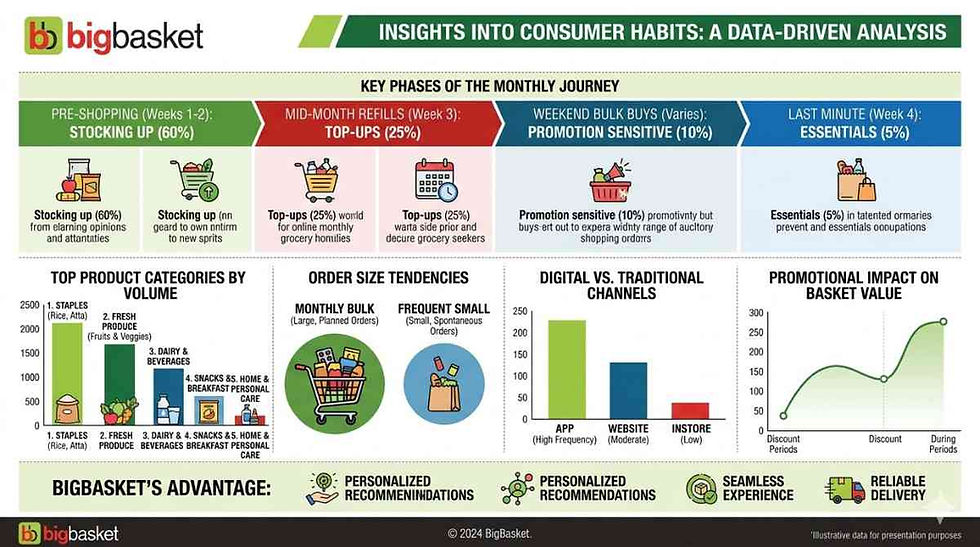
Monthly stock-up purchases (planned consumption)
Frequent top-up purchases (need-based consumption)
This dual behavior is explicitly acknowledged in industry reporting, which notes that households traditionally rely on kirana stores for both monthly purchases and replenishment, a behavior increasingly migrating online.
The competitive landscape reflects this bifurcation:
Scheduled delivery platforms (e.g., BigBasket)
Quick-commerce platforms emphasizing immediacy (e.g., Blinkit, Instamart)
Recent news coverage indicates that the rapid growth of quick commerce has begun reshaping consumer expectations toward faster delivery timelines, intensifying competitive pressure on traditional e-grocery models.
Brand Situation Prior to Strategic Reinforcement
BigBasket was among the earliest organized players to digitize grocery buying in India, entering a category historically defined by physical retail and trust-based purchasing.
Publicly available information highlights two core challenges in its early phase:
Consumer trust deficit in online grocery, particularly for fresh produce
Entrenched offline habits, including monthly stock-up shopping from local stores
BigBasket addressed these through:
Large assortment (over 50,000 SKUs reported publicly)
Scheduled delivery slots
Quality assurance mechanisms
Over time, the company became closely associated with planned, bulk grocery purchasing, differentiating itself from later entrants focused on speed.
However, the emergence of quick-commerce platforms introduced a new consumption paradigm centered on immediacy, forcing BigBasket to reassess its positioning without abandoning its core behavioral anchor.
Strategic Objective
The strategic intent of BigBasket can be interpreted through publicly documented actions and statements rather than internal disclosures.
At a high level, the company’s objective has been to:
Own the predictable, high-value monthly grocery mission while adapting to evolving consumption behaviors.
This aligns with the broader strategic rationale of Tata Digital, which identified grocery as a foundational category within a larger digital ecosystem due to its recurring nature.
The emphasis on grocery as a recurring consumption category suggests a deliberate attempt to:
Anchor customer engagement in habitual purchasing cycles
Build frequency through necessity rather than discretionary consumption
No verified public information is available on explicit internal KPIs or behavioral segmentation frameworks guiding this strategy.
Campaign Architecture & Execution
Unlike traditional marketing campaigns, BigBasket’s approach to monthly grocery behavior is embedded in product architecture and service design.
1. Scheduled Delivery Model
BigBasket’s early differentiation through scheduled delivery directly aligns with planned purchasing behavior. Consumers can select delivery slots in advance, reinforcing the notion of pre-planned grocery shopping.
2. Assortment Depth
The platform’s large SKU base supports bulk purchasing, allowing consumers to complete entire monthly shopping missions in a single transaction.
3. Subscription Programs
Programs such as BB Star (publicly acknowledged by the company) provide benefits like free delivery and exclusive pricing, encouraging repeat and planned purchases.
4. Private Labels
BigBasket has expanded its private label portfolio in staples and essentials—categories most associated with monthly buying cycles. Public reporting confirms private labels as a significant part of its offering strategy.
5. Pandemic Response as Behavioral Reinforcement
During COVID-19, demand for online grocery surged, with consumers relying on platforms like BigBasket for bulk purchases. This period reinforced digital adoption for monthly grocery buying.
6. Expansion into Quick Commerce
Recent developments show BigBasket entering rapid delivery segments, including plans for 10-minute delivery services using dark stores.
This indicates a dual-model execution strategy:
Core: Planned monthly grocery
Adjacent: High-frequency, instant needs
Positioning & Consumer Insights
The most critical insight underpinning BigBasket’s strategy is that:
Grocery consumption is governed by routines, not impulses.
Documented evidence shows that Indian households historically follow:
Budget-linked purchasing cycles
Stock-up behavior aligned with salary periods
Category-level predictability (e.g., staples vs perishables)
BigBasket’s positioning reflects three key dimensions:
1. Reliability Over Speed
In contrast to quick-commerce platforms, BigBasket emphasizes:
Availability
Quality consistency
Delivery predictability
2. Completeness of Basket
The platform enables “full basket” purchases rather than fragmented buying, aligning with monthly shopping missions.
3. Trust in Essentials
Given the importance of groceries in household consumption, trust becomes a central driver. BigBasket’s early focus on quality assurance directly addresses this.
No verified public information is available on proprietary consumer insight studies conducted by the company.
Media & Channel Strategy
BigBasket’s engagement strategy is primarily platform-centric, with its app and website serving as the main interface.
Following its acquisition, integration into the Tata Group ecosystem has enabled cross-platform synergies, particularly through super-app initiatives.
However:
“No verified public information is available on detailed media mix, customer acquisition channels, or campaign-level media performance.”
What is observable is a shift toward:
Ecosystem-driven traffic (via Tata platforms)
In-app engagement rather than external marketing dependency
Business & Brand Outcomes
Publicly available data provides directional insights into performance:
BigBasket has scaled operations across multiple cities and categories
The company continues to expand infrastructure, including dark stores for faster delivery
It remains a central asset in Tata Digital’s ecosystem strategy
However, recent financial reporting indicates challenges:
Reported revenue decline and increased losses in FY25
Strategic pressure due to quick-commerce competition
Additionally, news reports confirm:
Increasing competition from rapid delivery platforms
Shifting consumer expectations toward speed
Critically:
“No verified public information is available on the direct contribution of monthly grocery purchasing behavior to revenue, retention, or profitability.”
Strategic Implications
1. Behavioral Anchoring as Competitive Advantage
BigBasket’s strategy demonstrates that aligning with structural consumer behavior (monthly buying) can create long-term defensibility, particularly in essential categories.
2. Structural Tension: Planning vs Immediacy
The rise of quick commerce introduces a fundamental contradiction:
Efficiency favors planned purchases
Consumer expectation increasingly favors immediacy
BigBasket’s dual strategy reflects an attempt to resolve this tension.
3. Supply Chain Implications
Monthly purchasing behavior enables:
Better demand predictability
Inventory optimization
Reduced last-mile complexity
These advantages are critical in a low-margin category like groceries.
4. Ecosystem Leverage
Integration with Tata Digital suggests a broader strategy where grocery serves as a high-frequency anchor category within a multi-service platform.
5. Strategic Risk: Dilution of Core Value Proposition
Public reporting suggests that the shift toward quick commerce may dilute BigBasket’s original value proposition centered on reliability and value.
This highlights a key strategic dilemma:
Defend core positioning
Or adapt to emerging consumption patterns
Conclusion
BigBasket has built its strategy around one of the most fundamental truths of Indian consumption: grocery buying is habitual, cyclical, and necessity-driven.
By aligning its platform design, assortment strategy, and delivery model with monthly purchasing behavior, the company created a strong foundation in the e-grocery category.
However, the rapid emergence of quick commerce has introduced new dynamics that challenge this model. BigBasket’s current trajectory reflects an attempt to balance:
The predictability of monthly grocery shopping
The immediacy demanded by modern consumers
Discussion Questions
How does BigBasket’s focus on monthly grocery buying behavior create both strengths and vulnerabilities in a quick-commerce dominated market?
Should BigBasket double down on planned purchasing or aggressively pivot toward instant delivery models?
How can companies balance operational efficiency with evolving consumer expectations for speed?
What role does ecosystem integration (e.g., Tata Digital) play in reinforcing habitual consumption categories like groceries?
How should firms evaluate strategy effectiveness in categories where detailed behavioral data is not publicly disclosed?


Comments