Dunzo’s Hyperlocal Logistics Business Model
- Apr 16
- 5 min read
Industry & Competitive Context
India’s hyperlocal delivery and on-demand logistics sector has expanded significantly alongside the growth of digital commerce and smartphone penetration. The category includes food delivery, grocery delivery, and general-purpose logistics platforms that connect consumers with nearby merchants and service providers. Companies such as Swiggy, Zomato, and Zepto have contributed to the rapid evolution of this space.
Industry reports from firms such as RedSeer and McKinsey & Company have documented increasing demand for convenience-led services, particularly in urban centers. These reports highlight that hyperlocal logistics is becoming a critical infrastructure layer enabling multiple categories, including food, groceries, pharmaceuticals, and general retail.
Within this ecosystem, differentiation is driven by delivery speed, assortment, reliability, and network density. The emergence of quick commerce has intensified competition, with companies investing in dark stores and supply chain optimization. Against this backdrop, Dunzo developed a model focused on flexible, multi-category hyperlocal delivery rather than a single vertical.
Brand Situation Prior to Campaign
Dunzo was founded in 2014 as a task-based delivery platform, initially enabling users to outsource everyday errands. Publicly available information from company communications and media coverage indicates that Dunzo began as a concierge-style service before evolving into a broader logistics platform.
Prior to scaling its hyperlocal logistics model, the brand operated in a category without a clearly defined structure. Early operations focused on enabling peer-to-peer and merchant-to-consumer deliveries, addressing gaps in last-mile connectivity. Coverage in outlets such as Reuters and The Economic Times has noted that Dunzo’s early differentiation lay in its ability to deliver “anything within a city,” including groceries, medicines, and packages.
The brand faced the challenge of transitioning from a utility-focused service to a scalable business model within an increasingly competitive market. No verified public information is available on a single defined “campaign” marking this transition; rather, it reflects a gradual strategic evolution.
Strategic Objective
Dunzo’s strategic objective, as reflected in its public announcements and investor communications, has been to build a hyperlocal logistics infrastructure that supports both consumers and merchants. The company has positioned itself as a logistics enabler rather than a category-specific retailer.
According to press releases and credible media coverage, Dunzo has aimed to create a network that allows merchants to reach customers efficiently within defined geographic areas. This objective aligns with broader trends in digital commerce, where last-mile delivery is a critical determinant of customer experience.
The company has also emphasized enabling small and medium businesses to participate in online commerce by providing delivery capabilities. This positioning reflects a platform-oriented strategy, where logistics becomes a shared service across categories.
Campaign Architecture & Execution
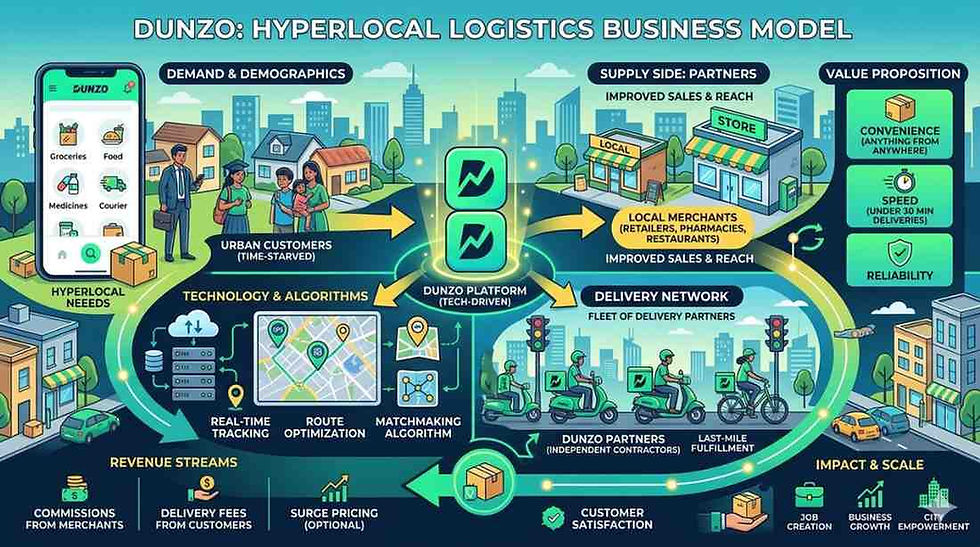
Dunzo’s business model execution is built around integrating demand aggregation, merchant partnerships, and delivery logistics into a single platform. Publicly available information indicates that the company operates through a mobile application that connects users with nearby stores and delivery partners.
The platform enables multiple use cases, including ordering from local merchants, sending packages, and completing errands. This multi-functional approach differentiates Dunzo from category-specific competitors. Media coverage has highlighted that the company leverages a network of delivery partners to fulfill orders, focusing on intra-city logistics.
Dunzo has also introduced services such as Dunzo Daily, which, according to company announcements and news reports, focuses on scheduled delivery of essential items. This initiative reflects an expansion from on-demand services to more predictable, repeat-use cases.
The company has received investment from Reliance Retail, as reported in Reuters and other credible outlets. This partnership has been positioned as a way to strengthen Dunzo’s logistics capabilities and expand its reach.
No verified public information is available on detailed operational processes such as routing algorithms or internal logistics optimization systems.
Positioning & Consumer Insight
Dunzo’s positioning is based on the insight that urban consumers value convenience and time savings in managing daily tasks. Publicly available information from company materials and media coverage indicates that the brand positions itself as a solution for “getting things done” within a city.
This positioning extends beyond food or grocery delivery to encompass a broader set of needs, including document delivery and personal errands. The underlying consumer insight is that fragmented urban services create friction, which can be reduced through a unified logistics platform.
Industry analyses by Boston Consulting Group have noted that convenience and speed are key drivers of adoption in hyperlocal services. Dunzo’s model aligns with this insight by offering a single interface for multiple delivery needs.
At the same time, the company’s focus on local merchants reflects an understanding that proximity and availability are critical in hyperlocal commerce. By integrating neighborhood stores into its platform, Dunzo positions itself as both a consumer utility and a merchant enabler.
Media & Channel Strategy
Dunzo’s primary channel is its mobile application, which serves as the central interface for user interaction. Publicly available information indicates that the company has relied on digital channels for customer acquisition and engagement, including app-based interactions and online marketing.
The brand has also gained visibility through coverage in credible media outlets such as Reuters, Mint, and The Economic Times, which have reported on its funding rounds, partnerships, and product launches. This earned media has contributed to building awareness of its business model.
No verified public information is available on detailed media spend allocation, campaign-level strategies, or channel-specific performance metrics.
Business & Brand Outcomes
Dunzo has raised funding from multiple investors, including Google and Reliance Retail, as reported in credible news outlets. These investments indicate investor confidence in its hyperlocal logistics model.
According to publicly available reports, Dunzo has expanded its operations across several Indian cities. The company has also introduced new service offerings, reflecting an effort to diversify its use cases and increase platform engagement.
However, media coverage has also documented operational and financial challenges faced by the company, including restructuring efforts and changes in service offerings. These developments highlight the competitive intensity and operational complexity of the hyperlocal logistics sector.
No verified public information is available on detailed financial performance metrics such as profitability at a granular level.
Strategic Implications
Dunzo’s hyperlocal logistics model illustrates the strategic potential of positioning logistics as a platform rather than a category-specific function. By enabling multiple use cases within a single network, the company seeks to achieve scale through versatility.
The case also highlights the importance of partnerships in building logistics infrastructure. The investment from Reliance Retail reflects a broader trend of collaboration between digital platforms and established retail players.
At the same time, the challenges documented in public sources underscore the difficulty of achieving sustainable economics in hyperlocal delivery. High operational complexity, competition from vertically integrated players, and the need for dense networks create significant barriers.
From a strategic perspective, Dunzo’s approach demonstrates that differentiation in hyperlocal logistics can be achieved through flexibility and breadth of services. However, it also suggests that long-term success may depend on the ability to integrate logistics with broader commerce ecosystems.
Discussion Questions
How does Dunzo’s multi-category hyperlocal logistics model differ from vertically integrated competitors in terms of strategic positioning?
What role do partnerships, such as the investment from Reliance Retail, play in strengthening Dunzo’s business model?
How does Dunzo’s focus on enabling local merchants influence its competitive advantage in the hyperlocal delivery market?
What operational challenges are inherent in managing a flexible, multi-use logistics platform, based on publicly available information?
How should Dunzo balance expansion and operational efficiency in a highly competitive and capital-intensive industry?


Comments