Blue Dart’s Premium Logistics Business Model
Industry & Competitive Context
India’s logistics sector has evolved rapidly with the expansion of e-commerce, globalization of trade, and increasing demand for time-sensitive deliveries. The industry includes a mix of integrated logistics providers, express parcel companies, and emerging technology-enabled platforms. Key players include Blue Dart Express, Delhivery, and Ecom Express.
Within this landscape, the express logistics segment—focused on time-definite delivery—has remained structurally differentiated from standard parcel delivery. Reports from organizations such as McKinsey & Company have highlighted that premium logistics services are driven by reliability, speed, and network integration rather than cost leadership.
India’s geographic diversity and infrastructure variability create operational challenges, making consistent service quality difficult to achieve at scale. As a result, companies that can deliver predictable, time-bound services across locations are able to command a premium positioning.
Blue Dart operates in this segment as a long-established express logistics provider, with a business model centered on time-sensitive shipments and integrated air and ground networks.
Brand Situation Prior to Campaign
Blue Dart, founded in 1983, built its reputation as a premium express logistics provider in India well before the rise of e-commerce. The company’s early focus was on time-definite delivery services for business customers, including critical documents and high-value shipments.
A significant development in its evolution was its strategic relationship with DHL, which became its majority shareholder. This partnership enabled Blue Dart to integrate with global logistics networks, enhancing its international reach and service capabilities.
Prior to the current competitive intensity in logistics, Blue Dart had already established strong brand equity associated with reliability and speed. Its positioning was distinct from traditional courier services that competed primarily on cost.
No verified public information is available on a single “campaign” that defined this positioning; rather, it has been built over decades through consistent service delivery and network investment.
Strategic Objective
Based on publicly available company disclosures and credible media coverage, Blue Dart’s strategic objective has been to maintain its leadership in the premium express logistics segment by offering time-definite, reliable, and secure delivery services.
A key objective has been to differentiate through service quality rather than price competition. The company has emphasized its capability to handle critical shipments, including time-sensitive documents and high-value goods.
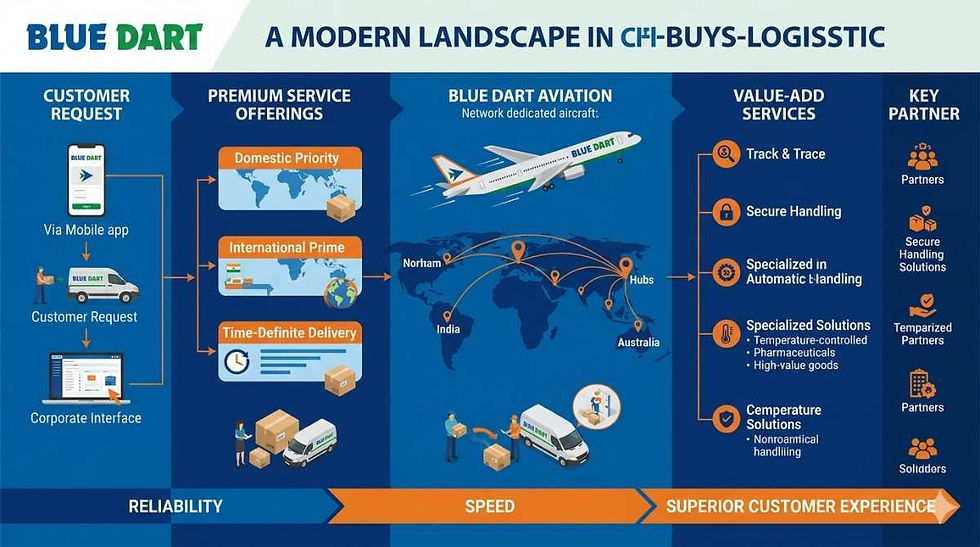
Another documented objective is to leverage its integrated air and ground network to provide consistent service across India. Blue Dart has publicly highlighted its ownership and operation of dedicated cargo aircraft as a core component of its value proposition.
Additionally, the company aims to serve both domestic and international logistics needs by leveraging its association with DHL’s global network.
No verified public information is available on specific internal targets or performance benchmarks related to these objectives.
Campaign Architecture & Execution
No verified public information is available on a discrete marketing campaign titled around Blue Dart’s premium logistics model. Instead, the company’s strategy is executed through operational infrastructure, service design, and brand consistency.
Blue Dart has publicly disclosed that it operates a dedicated air express network, including cargo aircraft, which enables time-definite deliveries across major cities. This capability is a key differentiator in the Indian logistics market, where many competitors rely primarily on third-party air capacity.
The company also operates an extensive ground network, including service centers and logistics facilities, to support last-mile delivery. Its integrated approach allows coordination between air and surface operations.
Blue Dart offers specialized services such as time-bound deliveries, temperature-controlled logistics, and secure handling of high-value shipments. These offerings are documented in company materials and public communications.
Technology integration has been highlighted as part of execution, including shipment tracking and customer interface systems that provide visibility into delivery status.
No verified public information is available on specific creative campaigns, messaging frameworks, or advertising timelines associated with these capabilities.
Positioning & Consumer Insight
Blue Dart’s positioning is centered on reliability, speed, and trust. Publicly available information indicates that the company targets customers who prioritize service quality over cost, including businesses with critical logistics needs.
The underlying consumer insight is that certain shipments—such as legal documents, medical supplies, and high-value goods—require guaranteed delivery timelines and secure handling. This creates a segment of customers willing to pay a premium for reliability.
This positioning aligns with broader industry observations from McKinsey that premium logistics services are driven by performance consistency rather than price sensitivity.
Blue Dart’s long-standing presence and association with DHL reinforce its brand perception as a trusted and globally connected logistics provider.
No verified public information is available on proprietary consumer research conducted by the company.
Media & Channel Strategy
Publicly available information suggests that Blue Dart’s marketing approach is primarily business-to-business, focusing on enterprise clients rather than mass consumer advertising.
The company’s brand visibility has been supported through corporate communications, service branding, and consistent presence in business media such as The Economic Times and Mint.
Blue Dart has also maintained a strong physical brand presence through its service centers, delivery fleet, and packaging, which function as touchpoints reinforcing its premium positioning.
Digital channels, including its website and tracking platforms, serve as key customer interfaces, providing functionality and reinforcing reliability.
No verified public information is available on detailed media spend, advertising campaigns, or channel-specific strategies.
Business & Brand Outcomes
According to publicly available company reports and credible media coverage, Blue Dart has maintained a strong position in the Indian express logistics market. Its financial disclosures have consistently reflected its focus on premium services rather than volume-driven growth.
The company’s integration with DHL has enabled it to offer international shipping services, contributing to its differentiated positioning.
Blue Dart has also been recognized in industry discussions for its operational capabilities, including its dedicated air network and service reliability.
No verified public information is available on specific market share figures in the premium segment or direct attribution of financial performance to marketing initiatives.
Strategic Implications
Blue Dart’s business model demonstrates how premium positioning can be sustained in a price-sensitive market through consistent service delivery and infrastructure investment. By focusing on reliability and speed, the company has differentiated itself from competitors pursuing scale and cost efficiency.
One key implication is the importance of asset ownership in enabling premium service. Blue Dart’s investment in dedicated air capacity provides control over delivery timelines, which is critical for time-definite logistics.
Another implication is the role of brand equity built over time. Unlike campaign-driven brands, Blue Dart’s positioning has been reinforced through operational performance and long-term consistency.
The case also highlights the segmentation of logistics markets. While e-commerce-driven players focus on high-volume, cost-sensitive deliveries, there remains a distinct segment that values premium service attributes.
Finally, the integration with a global network through DHL illustrates the strategic advantage of combining local expertise with international reach.
No verified public information is available on future strategic plans or shifts in positioning beyond what has been disclosed in company communications.
Discussion Questions
How does Blue Dart sustain a premium positioning in a market characterized by price competition?
What role does infrastructure investment play in supporting a premium logistics business model?
How can logistics companies balance cost efficiency with service reliability in time-definite delivery?
What competitive threats could challenge Blue Dart’s positioning in the premium segment?
How does the partnership with DHL influence Blue Dart’s strategic options in the Indian and global logistics markets?


Comments