Cleartrip’s Differentiation Strategy in Travel Booking
Industry & Competitive Context
The online travel booking industry in India has evolved into a highly competitive and price-sensitive market, driven by increasing internet penetration, smartphone adoption, and the digitization of travel services. Key players include MakeMyTrip, Yatra, and EaseMyTrip, alongside global entrants and airline-direct booking channels.
Competition in this sector has historically centered on price discounts, inventory aggregation, and convenience. Over time, as flight and hotel inventories became widely accessible across platforms, differentiation based purely on availability diminished. Public reporting from credible outlets indicates that user experience, brand trust, and ecosystem integration have become increasingly important factors in platform choice.
The industry also witnessed consolidation and strategic partnerships, including acquisitions by larger technology and e-commerce firms seeking to integrate travel into broader digital ecosystems. Within this context, Cleartrip pursued a differentiation strategy focused on simplicity, user experience, and curated offerings.
Brand Situation Prior to Campaign
Founded in 2006, Cleartrip positioned itself early on as a user-friendly alternative in a cluttered travel booking landscape. The platform emphasized a clean interface and streamlined booking flows at a time when many competitors offered feature-heavy but complex user experiences.
Despite this positioning, the company faced increasing competitive pressure as larger players expanded marketing spend and inventory partnerships. Publicly available information indicates that while Cleartrip maintained a strong brand recall among certain user segments, it did not consistently lead in overall market share compared to dominant players such as MakeMyTrip.
A significant shift occurred when Flipkart acquired Cleartrip in 2021. The acquisition was publicly announced as part of Flipkart’s strategy to strengthen its presence in the travel segment. This integration marked a new phase for Cleartrip, enabling it to leverage Flipkart’s user base, data capabilities, and distribution reach.
Strategic Objective
Following its acquisition by Flipkart, the observable strategic direction of Cleartrip was to differentiate itself not through price leadership alone but through a combination of simplicity, value integration, and ecosystem leverage.
Public announcements and product updates indicate a focus on:
Delivering a simplified and intuitive booking experience
Integrating travel offerings within a broader e-commerce ecosystem
Enhancing perceived value through bundled offers and partnerships
No verified public information is available on internal performance targets or proprietary KPIs associated with this strategy.
Campaign Architecture & Execution
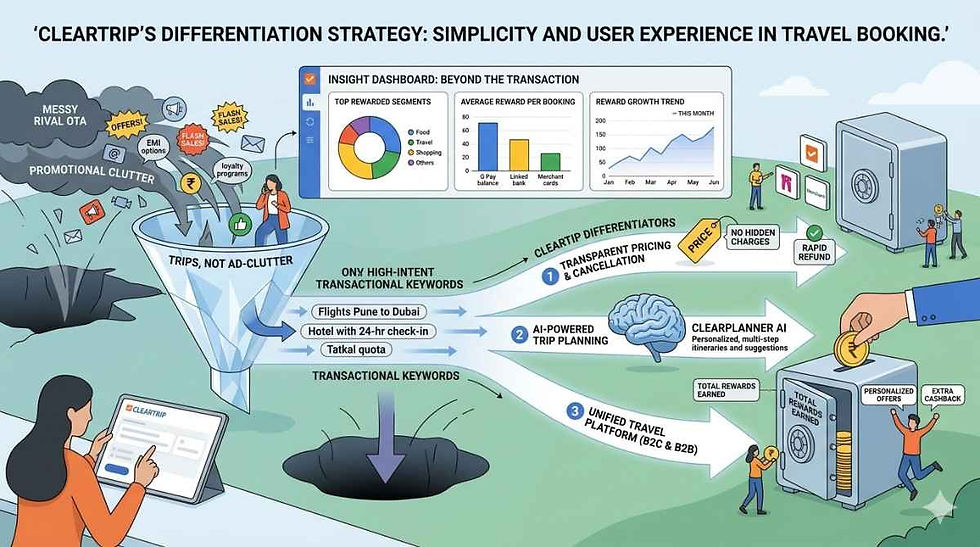
Cleartrip’s differentiation strategy has been implemented through a combination of product design, partnerships, and promotional initiatives rather than a single standalone campaign.
One of the most visible initiatives post-acquisition has been the integration of Cleartrip services within the Flipkart platform. This allowed users to access travel booking options alongside regular e-commerce activities, effectively embedding travel into everyday digital consumption behavior. Public announcements confirmed that this integration included flights and hotels being made available directly through Flipkart’s interface.
Additionally, Cleartrip introduced promotional events aligned with Flipkart’s flagship sales campaigns, such as The Big Billion Days. During these periods, travel bookings were bundled with discounts, offers, and loyalty incentives available to Flipkart users. This approach positioned travel not as a standalone purchase but as part of a broader value-driven shopping experience.
Cleartrip has also emphasized curated offerings and exclusive deals, including partnerships with airlines and hospitality providers. While such collaborations have been reported, no verified public information is available detailing the specific commercial structures or performance outcomes of these partnerships.
Positioning & Consumer Insight
The differentiation strategy of Cleartrip reflects a consumer insight that convenience and cognitive ease are critical in travel decision-making. Booking travel often involves multiple variables—dates, pricing, availability, and preferences—which can create friction in the user journey.
Cleartrip’s long-standing emphasis on a simplified interface suggests a deliberate attempt to reduce this friction. By minimizing clutter and focusing on essential decision points, the platform aimed to make the booking process more intuitive.
Post-acquisition, this positioning expanded to include value integration. By embedding travel within the Flipkart ecosystem, Cleartrip leveraged an insight that users may prefer consolidated digital experiences where multiple needs can be addressed within a single platform.
This dual positioning—simplicity and ecosystem convenience—distinguished Cleartrip from competitors that primarily emphasized pricing or inventory scale.
Media & Channel Strategy
No verified public information is available on a detailed standalone media strategy exclusively dedicated to Cleartrip’s differentiation initiatives.
However, it is publicly documented that Cleartrip has benefited from integration into Flipkart’s marketing ecosystem. This includes visibility during major promotional events and access to Flipkart’s digital channels, including app placements, notifications, and campaign integrations.
The primary channel for executing the differentiation strategy appears to be owned digital platforms, particularly the Flipkart app and website, along with Cleartrip’s own interface. This suggests a reliance on embedded distribution rather than large-scale independent advertising campaigns.
Business & Brand Outcomes
Following its acquisition, Flipkart publicly stated its intention to scale Cleartrip’s operations and increase its presence in the travel segment. Subsequent announcements indicated expansion in offerings, including flights, hotels, and other travel-related services.
However, no verified public information is available that directly quantifies the impact of Cleartrip’s differentiation strategy on market share, revenue growth, or user acquisition.
Similarly, while industry coverage acknowledges Cleartrip’s integration into Flipkart and participation in major sales events, there is no publicly disclosed data isolating the performance of these initiatives.
Strategic Implications
Cleartrip’s approach highlights an alternative pathway to differentiation in a commoditized digital marketplace. Instead of competing primarily on price or inventory breadth, the company has focused on user experience and ecosystem integration.
The integration with Flipkart represents a strategic shift from standalone platform competition to ecosystem-based competition. This aligns with broader trends in digital markets, where platforms seek to increase user engagement by offering multiple services within a unified interface.
At the same time, the absence of publicly available performance data underscores a key challenge in evaluating such strategies. While ecosystem integration offers clear theoretical advantages—such as increased visibility and cross-selling opportunities—its effectiveness depends on execution and user adoption, which are not fully transparent in public disclosures.
For the broader industry, the case suggests that differentiation may increasingly depend on how travel services are integrated into larger digital ecosystems, rather than how they compete as isolated platforms.
Discussion Questions
How does ecosystem integration differ from traditional competitive strategies in online travel booking?
In what ways can simplicity in user experience serve as a sustainable differentiator in a feature-rich category?
What are the potential advantages and risks of embedding travel services within an e-commerce platform?
How might Cleartrip’s strategy influence competitive responses from standalone travel platforms?
What alternative differentiation strategies could emerge in the online travel industry as ecosystem competition intensifies?


Comments