Ola’s Insight into Urban Mobility Needs
- 1 hour ago
- 5 min read
Industry & Competitive Context
The urban mobility sector in India has undergone significant transformation with the emergence of app-based ride-hailing platforms. Traditional transportation options—such as auto-rickshaws, taxis, and public transit—have increasingly been complemented by digital aggregators offering on-demand mobility services. The rise of smartphones, mobile internet, and digital payments has enabled rapid adoption of such platforms across major cities.
Key players in this space include Ola and Uber, alongside regional operators and public transport systems. Competition has historically centered on pricing, driver supply, geographic coverage, and service reliability. Over time, however, differentiation has increasingly been shaped by service diversification and localization.
Industry coverage from credible sources indicates that India’s urban mobility needs are highly heterogeneous, driven by factors such as traffic congestion, infrastructure gaps, varying income levels, and multimodal transport usage. This complexity has required platforms to move beyond a single-service model toward more segmented and context-specific offerings.
Brand Situation Prior to Campaign
Founded in 2010, Ola initially focused on aggregating taxi services through a mobile platform. Early growth was driven by convenience, improved availability, and the ability to book rides digitally. As the category matured, competition intensified, particularly with the expansion of Uber in India.
Publicly available information indicates that Ola expanded rapidly across cities, including tier-2 and tier-3 markets, and diversified its service portfolio. This included categories such as auto-rickshaws, shared rides, and premium vehicles. Despite this expansion, the company operated in a market characterized by price sensitivity and fluctuating demand-supply dynamics.
Ola’s positioning evolved in response to these conditions, reflecting a broader attempt to address varied urban mobility requirements rather than focusing solely on standard cab aggregation.
Strategic Objective
The observable strategic direction of Ola has been to align its service offerings with the diverse and evolving mobility needs of urban consumers in India.
Public announcements, product launches, and service expansions indicate a focus on:
Addressing multiple price points through differentiated service categories
Expanding beyond cars to include autos, bikes, and shared mobility
Enhancing accessibility across different city tiers
No verified public information is available on internal strategic targets or proprietary performance metrics associated with these initiatives.
Campaign Architecture & Execution
Ola’s approach to addressing urban mobility needs has been implemented through product and service design rather than a single identifiable marketing campaign.
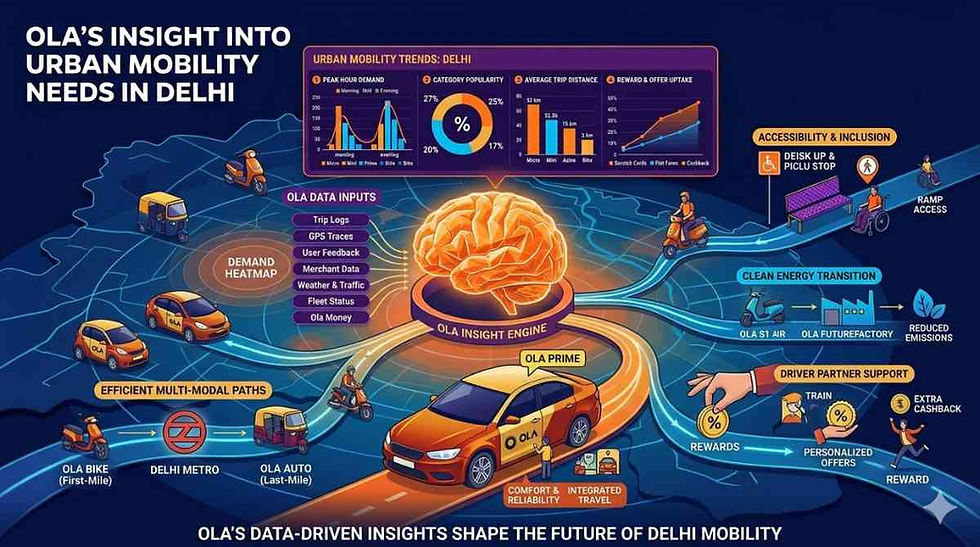
One of the most prominent elements of this strategy has been the introduction of multiple ride categories tailored to different use cases. These include budget options such as auto-rickshaws and micro-category vehicles, as well as premium offerings. Publicly reported product expansions also include shared ride formats designed to reduce costs for users.
In addition, Ola introduced bike taxi services in select markets, reflecting demand for faster and more affordable options in congested urban areas. The company has also expanded into electric mobility through Ola Electric, which has been publicly positioned as part of a broader push toward sustainable transportation.
Another dimension of execution has been geographic expansion. Ola’s presence across a wide range of Indian cities, including smaller urban centers, reflects an effort to address mobility gaps beyond metropolitan areas. This expansion has been documented in company announcements and media coverage.
While Ola has conducted multiple promotional campaigns over time, no verified public information is available that ties a single campaign directly to its broader insight into urban mobility needs.
Positioning & Consumer Insight
The strategic evolution of Ola reflects a core insight: urban mobility in India is not uniform, but fragmented across income levels, city infrastructure, and commuting patterns.
By offering a wide spectrum of services—from low-cost options to premium rides—Ola positioned itself as a platform capable of serving diverse consumer segments within a single ecosystem. This approach aligns with publicly observable product differentiation across categories.
The inclusion of auto-rickshaws and bike taxis indicates responsiveness to local commuting habits, particularly in cities where such modes are integral to daily transport. Similarly, shared ride options suggest an attempt to address price sensitivity and cost-sharing preferences among users.
The company’s expansion into electric mobility further reflects an alignment with emerging concerns around sustainability and regulatory direction, although no verified public information is available linking this directly to specific consumer insights.
Media & Channel Strategy
No verified public information is available on a unified media strategy specifically designed to communicate Ola’s insight into urban mobility needs.
However, it is publicly documented that Ola has utilized a combination of digital marketing, app-based engagement, and mass media advertising to promote its services. Campaigns have included television, online platforms, and partnerships, though detailed attribution to specific strategic objectives is not consistently disclosed.
The Ola app itself functions as a primary engagement channel, where service categories are presented based on user location, demand conditions, and availability. This interface plays a central role in communicating the platform’s range of offerings.
Business & Brand Outcomes
Ola has established itself as one of the leading ride-hailing platforms in India, with operations across numerous cities. Publicly available information confirms its continued presence as a major competitor in the market.
The company’s diversification into multiple ride categories and expansion into electric mobility have been widely reported. However, no verified public information is available that directly quantifies the impact of these initiatives on specific business outcomes such as revenue growth, profitability, or market share changes attributable to individual strategies.
Similarly, while Ola Electric has gained visibility as a separate entity within the mobility ecosystem, no publicly disclosed data directly links its performance to Ola’s ride-hailing strategy.
Strategic Implications
Ola’s approach illustrates the importance of contextual adaptation in platform-based businesses operating in complex and heterogeneous markets. Rather than relying on a single standardized offering, the company has pursued a multi-category strategy aligned with diverse urban mobility patterns.
This strategy highlights a shift from aggregation to ecosystem-building within the mobility space. By incorporating different vehicle types and service formats, Ola has positioned itself as a comprehensive mobility platform rather than a single-service provider.
At the same time, the absence of publicly available performance metrics limits the ability to assess the efficiency and long-term sustainability of this approach. While diversification can enhance relevance across segments, it may also introduce operational complexity.
For the broader industry, the case underscores the need to balance standardization with localization. As urban mobility continues to evolve, platforms may need to integrate multiple transport modes while maintaining a coherent user experience.
Discussion Questions
How does service diversification function as a differentiation strategy in the ride-hailing industry?
What challenges arise when addressing highly heterogeneous urban mobility needs within a single platform?
How can ride-hailing companies balance affordability and profitability in price-sensitive markets?
What role might electric mobility play in shaping the future positioning of ride-hailing platforms?
How should companies measure the effectiveness of multi-category mobility strategies in the absence of publicly disclosed metrics?


Comments