Content Benchmarking Grid: How Zomato Learned to Stop Worrying and Love the Data
- Jan 15
- 7 min read
Last Tuesday, I watched a junior content manager at a Mumbai-based fintech startup have an existential crisis. “Our engagement is down 40%,” she said. “But we’re posting daily. Using trending audio. Even did a reel on chai and coding.” Her team started guessing. Post more? Post less? Change timings? Better captions?
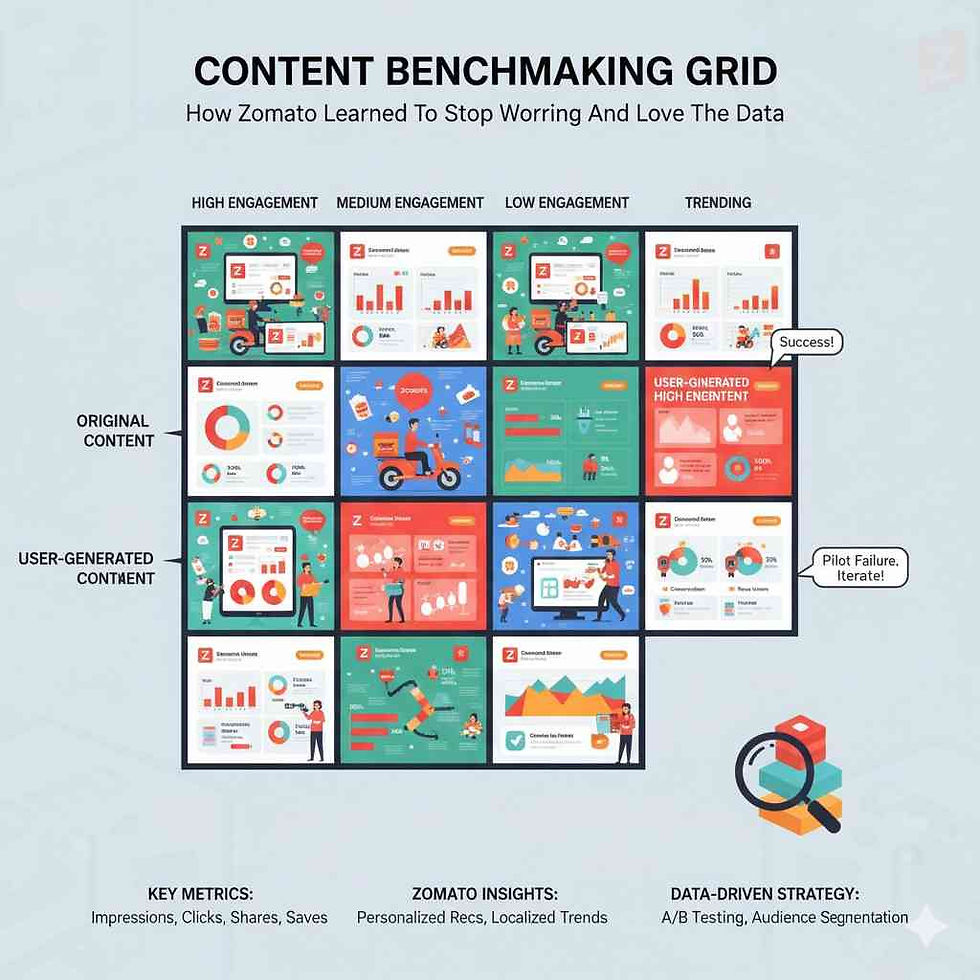
This is the reality inside marketing teams across India. Everyone is creating content. Almost no one knows if it’s actually working—relative to what success should look like. That’s why most teams don’t need more content ideas. They need a Content Benchmarking Grid. Because without clear benchmarks, every dip feels like failure—and every decision becomes guesswork.
The Problem With Flying Blind
Here's a story that might sound familiar. In 2019, a Bangalore-based D2C skincare brand was celebrating. Their Instagram following had crossed 50,000. Their engagement rate was 2.3%. The founders were thrilled. Until they hired someone who'd worked with similar brands before. "Wait," she said at her first meeting. "Your competitor with the same follower count is getting 6% engagement. Another one is converting 3.5% of their engaged audience to website visits. You're at 0.8%." Suddenly, 50,000 followers didn't feel like an achievement. It felt like 50,000 people they were somehow failing to reach effectively. This is what happens when you measure success in a vacuum. You might be doing well. You might be doing terribly. You have no frame of reference to know the difference.
Enter the Content Benchmarking Grid
The Content Benchmarking Grid isn't a complicated framework. In fact, it's almost embarrassingly simple. But simple doesn't mean ineffective. Think of it as a two-by-two matrix (yes, another one of those, but bear with me): The vertical axis: Your performance (low to high)The horizontal axis: Industry benchmark (low to high). This creates four quadrants, each telling you a completely different story about your content:
1. High Performance, High Benchmark (Competitive Battlefield)
2. High Performance, Low Benchmark (Dominant Position)
3. Low Performance, High Benchmark (Critical Gap)
4. Low Performance, Low Benchmark (Emerging Opportunity)
Let me show you how this plays out in the real world.
Quadrant 1: The Competitive Battlefield
Remember when Swiggy and Zomato were locked in their legendary social media battles? Both brands were posting multiple times daily. Both had massive engagement rates—often 5-8% on Instagram posts, well above the food delivery industry average. Both were getting hundreds of thousands of views on their reels. They were in Quadrant 1: High performance in a high-benchmark environment. If you plot Zomato's engagement rate against the food delivery industry benchmark during, say, 2021-2022, you'd see something interesting. Yes, they were doing well. But so was everyone else in their category. Swiggy was right there. Even smaller players like Faasos were punching above their weight on social. What this quadrant tells you: You can't rest. Success here isn't about maintaining—it's about constant innovation. Zomato understood this instinctively. They didn't just post food content. They created an entirely new category of brand content—the witty, self-aware, meme-fluent brand voice that spawned a thousand imitators. When everyone zigs, you need to zag. When everyone zags, you need to zig. And when everyone learns to zig-zag, you need to do something completely different. Strategy for this quadrant: Differentiation is everything. Find your unique angle. For Zomato, it was humor and cultural relevance. For your brand, it might be something else entirely.
Quadrant 2: The Dominant Position (And Why It's Dangerous)
In 2020, Cred was absolutely dominating the fintech social media space. Their engagement rates were through the roof—often 8-10% on Instagram. Their campaigns went viral. Their IPL ads became cultural moments. Meanwhile, the average fintech brand in India was struggling to break 2% engagement. Cred was in Quadrant 2: High performance, low benchmark. They were winning in a space where most players were barely competing. Here's the thing about Quadrant 2: it feels amazing. You're the big fish in a small pond. Your metrics look incredible compared to everyone else. But there's a trap. When you're dominating, it's easy to become complacent. It's easy to think your success is due to inherent brilliance rather than, perhaps, being in a category where most of your competitors simply aren't trying that hard. What this quadrant tells you: Enjoy your advantage, but prepare for competition. Low benchmarks don't stay low forever. By 2023-2024, other fintech brands had learned from Cred. Groww started creating better content. Jupiter built a strong social presence. Zerodha's Varsity content became a goldmine of educational engagement. The benchmark rose. And suddenly, Cred's dominance wasn't as clear-cut. Strategy for this quadrant: Build moats while you can. Develop proprietary formats, build community, create content that's impossible to replicate. Use your dominant position to establish standards that others will struggle to meet.
Quadrant 3: The Critical Gap (Where Most Brands Live)
Let me tell you about a conversation I had with a founder in Pune. His company makes excellent productivity software for small businesses. Genuinely good product. But their content? Let's just say it existed. "We post on LinkedIn three times a week," he told me proudly. "What's your engagement rate?" I asked. "About 0.5%." "And your competitors?" He paused. "I don't know." We looked it up together. Turns out, similar B2B SaaS companies in India were averaging 3-4% engagement on LinkedIn. Some were getting 6-7%. He was in Quadrant 3: Low performance, high benchmark. A critical gap. This is where most brands discover they have a problem. You're underperforming, and the benchmark proves it's not an industry issue—it's a you issue. The good news? There's a clear roadmap forward. Other companies have already figured out what works. For this Pune-based founder, the path was clear:
Study competitors who were succeeding (Zoho's content strategy became a gold mine of insights)
Analyze what content formats were driving engagement (case studies and founder stories, it turned out)
Identify where his content was fundamentally different from successful peers (he was talking about features; they were talking about transformation)
Six months later, his engagement rate had tripled. Not because he got lucky. Because he benchmarked, learned, and adapted. What this quadrant tells you: You're behind, but the path forward exists. Someone has already solved this problem. Learn from them. Strategy for this quadrant: Become a student of your category. Do competitive content audits. Identify the 3-5 brands doing it right. Analyze their content deeply—not to copy, but to understand the underlying principles. Then adapt those principles to your unique brand voice.
Quadrant 4: The Emerging Opportunity
In 2018, most Indian financial services companies weren't creating much social media content. The few that did were putting out boring, compliance-heavy posts. Then Zerodha's Nikhil Kamath started posting on Twitter (now X). His engagement rates were modest—maybe 1-2% initially. The industry benchmark? Basically non-existent. Most financial services firms weren't even on social media in any meaningful way. Quadrant 4: Low performance, low benchmark. An emerging opportunity. What this quadrant tells you: You're in an undeveloped space. Everyone is equally bad. The rules haven't been written yet. This is both exciting and terrifying. You don't have a roadmap. But you also don't have entrenched competition. Fast forward to 2024: Zerodha has built one of the most engaged financial communities in India. Their Varsity platform has millions of users. Nikhil Kamath's podcast is a cultural phenomenon. They didn't follow a playbook. They wrote the playbook. Strategy for this quadrant: Experiment fearlessly. Try formats that seem crazy. Be willing to fail repeatedly. Document what works. When you find something that resonates, double down hard before others catch on.
How to Actually Use This Framework
Here's where theory meets practice.
Step 1: Know Your Numbers
You can't plot yourself on a grid if you don't know where you stand. Pick your key metrics:
Engagement rate (likes + comments + shares / reach)
Click-through rate
Conversion rate from content
Video completion rate
Share of voice in your category
For a brand like Mamaearth, this might mean tracking engagement on Instagram beauty tutorials. For a B2B company like Freshworks, it might mean measuring LinkedIn post engagement and content-to-demo conversion.
Step 2: Find Your Benchmarks
This is harder than it sounds. Industry reports help (HubSpot, Rival IQ, and even Hootsuite publish annual social media benchmarks). But the best benchmarks are specific to your niche. A Mumbai-based fashion brand should benchmark against other Indian fashion brands, not against Zara's global numbers. A Bangalore tech startup should compare itself to similar-stage Indian startups, not to Microsoft. Use tools like:
Social Blade for follower growth
Manual tracking of competitor engagement rates
Industry reports specific to India (e.g., afaqs, Social Samosa's annual reports)
Step 3: Plot Your Position
Create an actual grid. Use Excel, Google Sheets, or even pen and paper. Let's say you're an Indian sustainable fashion brand:
Your Instagram engagement rate: 2.8%
Industry benchmark for sustainable fashion in India: 4.5%
You're in Quadrant 3. Critical gap. Time to learn from brands like Brown Living or No Nasties.
Step 4: Design Your Strategy
Each quadrant demands different tactics:
Quadrant 1 (Competitive Battlefield):
Innovation is your oxygen. Look outside your industry for inspiration. When chai brands compete on Instagram, maybe take a cue from how tech brands use LinkedIn, or how gaming brands use YouTube.
Quadrant 2 (Dominant Position):
Build moats. Create formats that are uniquely yours. Boat's celebrity-heavy launch strategy, for instance, became so associated with them that others couldn't easily replicate it.
Quadrant 3 (Critical Gap):
Become a student. The Pune software founder spent a month just analyzing competitor content before he posted anything new. Study, adapt, implement.
Quadrant 4 (Emerging Opportunity):
Experiment wildly. Try 10 different content formats. Keep the 3 that work. Refine relentlessly.
The Story You're Not Tracking
Here's what most brands miss: the grid is dynamic, not static. Noise, the fashion brand, was probably in Quadrant 4 (emerging opportunity) in 2015 when Indian fashion brands were barely on Instagram. By 2018, they'd moved to Quadrant 2 (dominant position). By 2021, with increased competition, they were likely in Quadrant 1 (competitive battlefield). Your position changes. Benchmarks evolve. What worked last year might not work today. The key is to re-plot yourself every quarter. Make it a ritual. The first Monday of every new quarter, spend two hours:
Calculating your metrics
Researching current benchmarks
Plotting your position
Adjusting your strategy
Real Lesson
That fintech content manager I mentioned at the beginning? Three months after her crisis, I ran into her at a marketing conference in Gurgaon. "How's it going?" I asked. She grinned. "We're still in Quadrant 3, but we've moved from the bottom left corner to the middle. Our engagement is up 60%. We're not where we need to be, but now we actually know where that is." That's the magic of the Content Benchmarking Grid. It doesn't make your content better by itself. But it gives you something invaluable in the chaotic world of digital marketing: clarity. You stop asking, "Is this good?" You start asking, "Is this good enough? And compared to what?"
Those are questions you can actually answer. What quadrant is your content in right now? Drop a comment below—I'm genuinely curious to hear where you think you stand and what you're planning to do about it.


Comments