Digital Habit Loop for Marketers
- Feb 11
- 6 min read
It's 7:32 AM in Mumbai. Priya hasn't even brushed her teeth yet, but she's already checked Instagram twice, scrolled through three WhatsApp groups, and added items to her Blinkit cart. By the time her coffee is ready, she's watched two YouTube Shorts and responded to a LinkedIn notification. This isn't addiction. It's architecture.
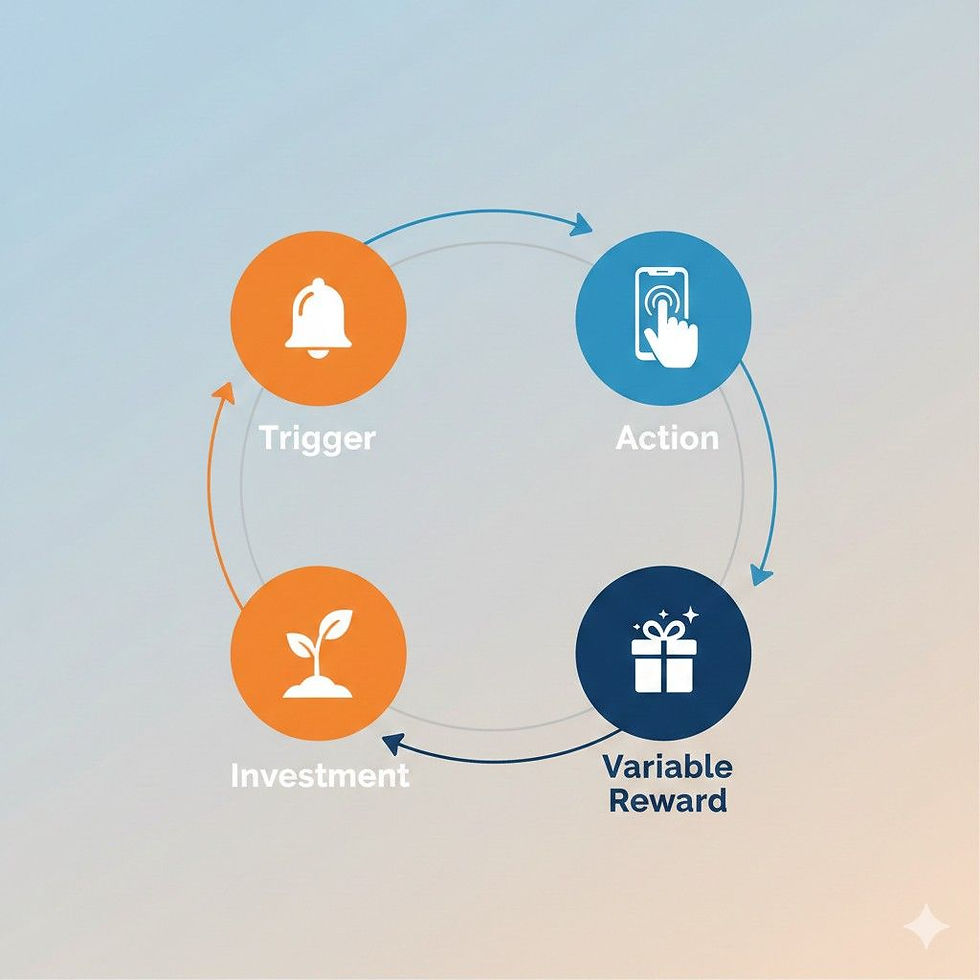
Every tap, swipe, and scroll Priya makes has been engineered through one of the most powerful frameworks in behavioral psychology—the Habit Loop. And if you're building a brand in 2025, understanding this loop isn't optional. It's foundational.
The Anatomy of a Habit
In 2012, Charles Duhigg's The Power of Habit introduced the world to a simple three-part structure that governs nearly 40% of our daily behaviors: Cue → Routine → Reward. A cue triggers a behavior. The routine is the behavior itself. The reward reinforces it. Over time, this loop becomes automatic—a habit. But here's where it gets interesting for marketers: digital products don't just use the habit loop. They manufacture it. They create cues, design routines, and engineer rewards so compelling that users return without thinking. The brands winning today aren't just selling products. They're building habits.
The Digital Upgrade: The Hook Model
Nir Eyal took Duhigg's framework and rebuilt it for the digital age in Hooked: How to Build Habit-Forming Products. His model adds a critical fourth element: Trigger → Action → Variable Reward → Investment. This isn't just theory. It's the blueprint behind every app you can't put down—and every brand that's successfully turned casual users into daily rituals.
Let's break it down with real examples from the Indian digital ecosystem.
1. The Trigger: What Pulls Users In
Triggers are the actuators of behavior. They come in two forms:
External triggers: are the notifications, emails, and ads that prompt action from outside. Internal triggers: are emotional—boredom, loneliness, uncertainty, FOMO. The most powerful products move users from external to internal triggers over time.
Swiggy's Mastery of the Trigger: Swiggy doesn't just wait for you to get hungry. It reminds you to get hungry. Their push notifications are a masterclass in external triggers:
"Raining outside? Hot pakoras are just a tap away 🌧️"
"Your favorite biryani spot has a new dish"
"It's 8 PM. Dinner sorted?"
Each message ties to an emotional state—comfort during rain, curiosity about newness, decision fatigue at the end of a long day. Over time, you don't need the notification. You feel hungry and open Swiggy. The internal trigger has formed.
Zomato: does this differently—through humor and cultural moments. Their notifications during cricket matches ("Caught out? Order in!") or Monday mornings ("Mondays are hard. Lunch doesn't have to be.") tap into shared emotional beats. The lesson? Triggers work best when they're contextual, timely, and emotionally resonant.
2. The Action: Making It Stupid Simple
Once triggered, the user must act. And according to BJ Fogg's Behavior Model, action happens when three elements converge: Motivation + Ability + Trigger. Even if motivation is high, friction kills action. The best digital habits are built on ease.
Paytm and the One-Tap Revolution: Remember when paying bills meant standing in queues, filling forms, and keeping receipts? Paytm turned that multi-step nightmare into a single tap. Their UPI-based payments removed every barrier:
No need to enter card details
No OTPs for small transactions
No app switching
The cognitive load dropped to near-zero. The action became so simple that it became automatic. Today, "Paytm karo" isn't just a phrase—it's a verb. Zepto and Blinkit took this further. Groceries in 10 minutes isn't just about speed. It's about eliminating the decision to plan. The action (ordering essentials) becomes so frictionless that it replaces the old routine (weekly grocery runs) entirely. Marketers often focus on why users should act. But the real question is: how easy have you made it?
3. The Variable Reward: The Dopamine Slot Machine
Here's where digital habits get addictive. Predictable rewards are fine. But variable rewards—outcomes that change each time—trigger dopamine in ways that fixed rewards never can. It's why slot machines work. It's why you refresh Instagram even when you just checked it.
Variable rewards come in three flavors:
Rewards of the Tribe (social validation)
Rewards of the Hunt (material gain)
Rewards of the Self (mastery, completion)
Zepto's Scratch Cards and CRED's Coins: Every time you complete a Zepto order, you get a scratch card. Sometimes it's ₹10 off. Sometimes ₹100. Sometimes nothing. You don't know—so you have to check.
CRED: weaponized this with CRED coins and their bizarre, high-production reward campaigns. Pay your credit card bill (a boring, necessary action) and you might win cash, gadgets, or experiences. The reward is variable. The anticipation is constant.
Myntra: uses mystery discounts during sales. Open the app, spin the wheel, get 10-80% off. The uncertainty drives repeat opens, even from users who weren't planning to shop.
The psychology is simple: the brain craves resolution. Variable rewards create an open loop that demands closure.
4. The Investment: Building Commitment Over Time
The final, most overlooked piece of the loop is investment. Every time a user invests effort, data, or content into a product, they increase the likelihood of return. Not because the product got better—but because they put something into it. This is the compounding moat of habit-forming products:
LinkedIn and the Profile Flywheel: When you first join LinkedIn, it's empty. But as you add your work history, skills, connections, and posts, the platform becomes yours. You've invested time. You've built social capital. Leaving means losing that.
LinkedIn's habit loop works because the investment phase strengthens the trigger phase. The more you invest, the more relevant your feed becomes. The more relevant the feed, the stronger the internal trigger to check it.
Grofers (now Blinkit) and Personalized Lists: Blinkit's "Buy Again" section is a quiet genius feature. It tracks what you order and surfaces it for re-ordering. You've invested your preferences into the system. Now, repurchasing staples takes one tap. This investment creates switching costs. Moving to another app means rebuilding that convenience from scratch. The question for marketers: What are users investing in your product that makes it harder to leave?
The Loop in Motion: Cred's Genius
Let's see how the full loop plays out in one of India's most habit-forming fintech products like CRED:
Trigger: Push notification on bill due date (external). Anxiety about missing payment (internal).
Action: Pay bill in under 30 seconds via saved card.
Variable Reward: CRED coins, spin-the-wheel games, mystery cashback, bizarre high-value prizes (laptops, trips, cash).
Investment: Users add more credit cards, link bank accounts, build coin balance, unlock higher reward tiers. Each cycle strengthens the next. The investment makes the action easier. The variable reward makes the trigger more anticipated. Over time, paying credit card bills—a task people used to dread—becomes something users look forward to. That's the magic of a well-designed habit loop.
What This Means for Marketers
You're not just competing for attention. You're competing with entrenched habits—many of which were engineered by billion-dollar companies. To win, you need to think like a product designer, not just a marketer. Ask yourself:
What's the trigger that brings users to your product? Is it external or internal? How can you shift from external to internal over time?
How easy is the first action? Can you reduce friction by even 10%? One less field in a form. One fewer click to checkout.
What's the reward—and is it variable? Can you introduce surprise, delight, or unpredictability without feeling manipulative?
What are users investing in your product that increases their commitment? Data, content, personalization, social proof, progress?
Ethical Edge
Here's the uncomfortable truth: the Habit Loop works. Sometimes too well. The same frameworks that help Duolingo teach languages can be used to exploit attention. The same variable rewards that make fitness apps engaging can be weaponized for mindless scrolling. As marketers, we have a choice. We can build habits that serve users—helping them save money (CRED), eat better (HealthifyMe), learn faster (Unacademy)—or we can build habits that extract value at their expense. The Loop is neutral. The intent is not.
Closing the Loop
Priya's morning routine didn't happen by accident. It was designed—cue by cue, reward by reward—by teams who understood behavior better than she understands herself. As marketers, that's both our opportunity and our responsibility. Build triggers that solve real problems. Design actions so simple they become second nature. Deliver rewards that feel earned, not exploited. Create investment mechanisms that respect user agency. Because in 2025, the brands that win won't be the ones that interrupt habits. They'll be the ones that become them.



Comments