Ecom Express’ Last-Mile Delivery Strategy: Building Reach in India’s E-Commerce Logistics Market
- 18 hours ago
- 5 min read
Industry & Competitive Context
India's e-commerce logistics industry expanded rapidly alongside the growth of online retail, digital payments, and internet penetration. As e-commerce volumes increased, logistics providers faced mounting pressure to deliver orders reliably across a geographically diverse country characterized by dense urban centers, small towns, and remote rural locations.
Within this environment, last-mile delivery emerged as one of the most strategically important components of the logistics value chain. The ability to reach customers quickly and consistently became a critical requirement for e-commerce platforms seeking nationwide expansion.
The competitive landscape included specialized logistics providers such as Delhivery, Blue Dart, XpressBees, Shadowfax, and Ecom Express. According to Ecom Express' public regulatory disclosures, the company operated as a pure-play business-to-consumer (B2C) e-commerce logistics provider, focusing on first-mile pickup, mid-mile transportation, last-mile delivery, reverse logistics, and fulfillment services.
The industry's growth created opportunities, but it also intensified competition around network coverage, delivery efficiency, and service reliability.
Brand Situation Prior to Campaign
No verified public information is available on a specific marketing campaign called "Ecom Express' Last-Mile Delivery Strategy."
However, publicly available company disclosures show that Ecom Express pursued a long-term operational strategy centered on building delivery coverage across India.
Founded in 2012, the company entered a market where e-commerce penetration was expanding beyond major metropolitan areas. Public filings indicate that Ecom Express differentiated itself by focusing on nationwide reach, particularly across Tier II, Tier III, and rural markets.
According to the company's draft red herring prospectus (DRHP) filed in connection with its proposed initial public offering, Ecom Express operated a pan-India logistics network and emphasized extensive coverage in non-metro regions. As of March 31, 2024, the company stated that it covered more than 27,000 PIN codes across India and had the widest coverage in Tier II+ regions among its identified peer group.
The company's strategic challenge was therefore not simply parcel transportation but extending reliable e-commerce access to underserved geographies.
Strategic Objective
Public disclosures indicate that Ecom Express sought to establish itself as a leading logistics partner for India's e-commerce ecosystem through extensive last-mile reach.
The company's regulatory filings describe a strategy focused on connecting digital retailers and e-commerce platforms with consumers across the country through a technology-enabled logistics network.
A recurring theme in company disclosures was geographic expansion. The company consistently highlighted network coverage as a strategic differentiator and emphasized the importance of reaching locations where logistics infrastructure was less developed.
Another documented objective was providing end-to-end logistics services, including forward logistics, reverse logistics, and fulfillment capabilities. This approach positioned last-mile delivery as part of a broader integrated logistics solution rather than an isolated operational activity.
Campaign Architecture & Execution
No verified public information is available on a discrete promotional campaign associated with Ecom Express' last-mile delivery strategy.
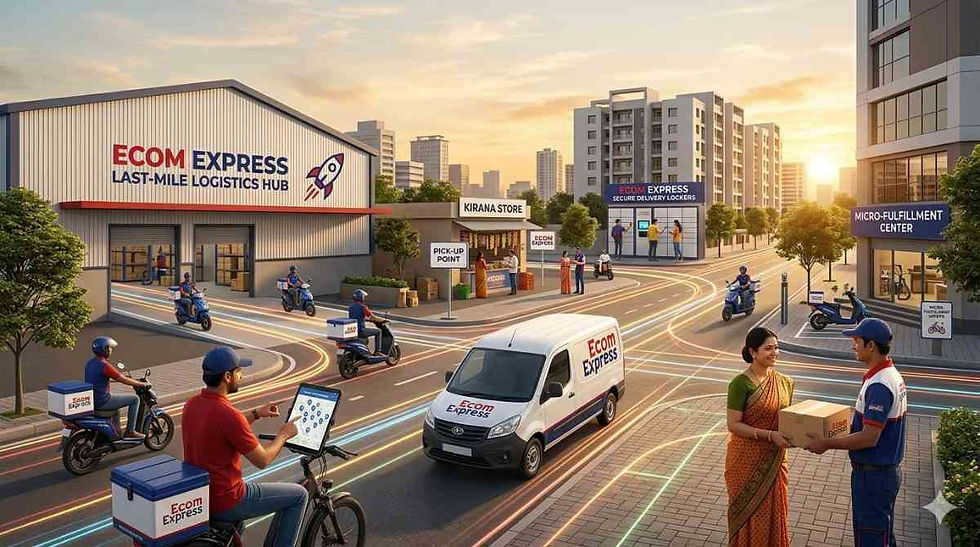
Instead, the company's approach was executed through network development, technology deployment, and operational infrastructure expansion.
According to company disclosures, Ecom Express built a nationwide logistics network that included delivery centers, processing facilities, and fulfillment infrastructure. Its service portfolio covered:
First-mile pickup
Mid-mile transportation
Last-mile delivery
Reverse logistics
Fulfillment services
The company's public filings also emphasized technology as an operational enabler. Ecom Express described itself as a technology-enabled logistics provider and highlighted investments in shipment visibility, tracking systems, and operational processes designed to support large-scale parcel movement.
In August 2024, Reuters reported that Ecom Express planned to use proceeds from its proposed IPO for new processing and fulfillment centers, information technology equipment, and debt repayment. This disclosure reinforced the strategic importance of infrastructure and technology within the company's operating model.
Execution therefore centered on expanding logistics capability rather than conducting a conventional marketing campaign.
Positioning & Consumer Insight
Ecom Express positioned itself as a logistics provider capable of serving India's expanding e-commerce market beyond major urban centers.
A key insight reflected in the company's public strategy was that future e-commerce growth would increasingly originate from smaller cities and non-metro regions. This understanding aligned with broader industry reports documenting the growing importance of Tier II and Tier III markets in India's digital economy.
The company's emphasis on extensive PIN code coverage suggests a strategic belief that network reach itself could become a source of competitive advantage.
Another observable insight involved the operational realities of Indian e-commerce. Public disclosures repeatedly highlighted reverse logistics capabilities. Returns management is a significant feature of online commerce, and Ecom Express integrated reverse logistics into its core service offering rather than treating it as a supplementary activity.
The company's positioning therefore focused on accessibility, coverage, and service integration rather than speed alone.
Media & Channel Strategy
No verified public information is available on a dedicated media strategy or advertising campaign specifically promoting Ecom Express' last-mile delivery capabilities.
The company's business model primarily operated in a business-to-business environment, serving e-commerce platforms, digital retailers, and enterprise clients.
Public visibility was generated largely through:
Company announcements
Regulatory filings
Industry conferences
Business media coverage
Investor communications
As a result, Ecom Express' market positioning appears to have been communicated primarily through operational performance, client relationships, and corporate communications rather than large-scale consumer advertising.
Business & Brand Outcomes
According to the company's public filings, Ecom Express achieved significant network expansion during its growth phase.
As of March 31, 2024, the company reported coverage of more than 27,000 PIN codes across India. The company also stated in its regulatory disclosures that it possessed the widest coverage in Tier II+ regions among its peer group.
Public filings further describe Ecom Express as a pan-India express logistics network serving the B2C e-commerce market through integrated logistics services.
Reuters reported in 2024 that the company served clients including Amazon and Nykaa and sought to raise approximately ₹26 billion through its proposed IPO. The company stated that part of the capital would be used to expand processing and fulfillment infrastructure.
No verified public information is available on customer satisfaction outcomes attributable specifically to the last-mile strategy.
No verified public information is available on brand awareness, consumer perception shifts, campaign ROI, customer acquisition metrics, retention metrics, or conversion outcomes resulting from the strategy.
Strategic Implications
The Ecom Express case illustrates how logistics companies can use network reach as a strategic differentiator in rapidly expanding digital markets.
First, the case demonstrates that last-mile delivery can function as a competitive positioning tool rather than merely an operational requirement. Ecom Express consistently highlighted geographic coverage as a strategic asset, suggesting that access to underserved markets represented a meaningful source of value.
Second, the company's approach underscores the importance of aligning logistics strategy with broader market evolution. As e-commerce adoption expanded beyond metropolitan areas, delivery coverage became increasingly important for both retailers and logistics providers.
Third, the integration of reverse logistics into the company's service model reflects a recognition that e-commerce fulfillment extends beyond delivery alone. Returns management became an important component of the customer experience and therefore a significant operational capability.
Fourth, the case highlights the role of technology in enabling large-scale logistics operations. Public disclosures repeatedly linked technology investments with network performance and operational effectiveness.
Finally, the Ecom Express experience demonstrates the challenges of sustaining competitive advantage in an industry characterized by rapid growth and intense competition. As logistics providers expanded networks and capabilities, scale alone became insufficient; operational efficiency, technology integration, and customer relationships also emerged as critical strategic factors.
MBA Discussion Questions
How can network coverage function as a source of competitive advantage in logistics-intensive industries?
Why might a logistics company prioritize geographic reach over diversification into multiple logistics segments?
What role does reverse logistics play in shaping customer experience within e-commerce ecosystems?
How can technology investments strengthen a last-mile delivery strategy without directly interacting with end consumers?
To what extent can operational excellence serve as a substitute for traditional marketing in business-to-business industries?


Comments