Flipkart's Marketplace Model in Indian E-Commerce: A Case Study
Executive Summary
Flipkart, founded in 2007 by Sachin Bansal and Binny Bansal, evolved from an online bookstore into India's largest e-commerce marketplace before its acquisition by Walmart in 2018. This case study examines Flipkart's strategic transition from an inventory-led model to a marketplace platform, analyzing the company's competitive positioning, operational innovations, and impact on India's digital commerce ecosystem. The analysis draws exclusively on verified public information from company statements, regulatory filings, credible news reports, and industry research.
Company Background and Evolution
Flipkart began operations in October 2007 as an online bookstore, founded by former Amazon employees Sachin Bansal and Binny Bansal in Bangalore. According to a 2018 Economic Times report, the company started with initial funding of approximately $6,500 and operated out of a two-bedroom apartment. The founders initially handled packaging and deliveries themselves before scaling operations. By 2010, Flipkart had expanded beyond books into electronics, mobile phones, and other product categories, according to multiple media reports published during that period. The company's growth trajectory attracted significant venture capital investment. In 2011, Flipkart received funding from Tiger Global Management, as reported by Reuters. Subsequent funding rounds included investments from Accel Partners, Morgan Stanley, Naspers, and others, as documented in various press releases and news reports between 2012 and 2017. In May 2018, Walmart acquired a 77% stake in Flipkart for approximately $16 billion, as confirmed in Walmart's official press release dated May 9, 2018. This represented Walmart's largest acquisition and marked a significant milestone in India's e-commerce sector. According to Walmart's press statement, the acquisition aimed to "accelerate growth of the Indian e-commerce market" and leverage Flipkart's technology platform and local expertise.
The Marketplace Model Transition
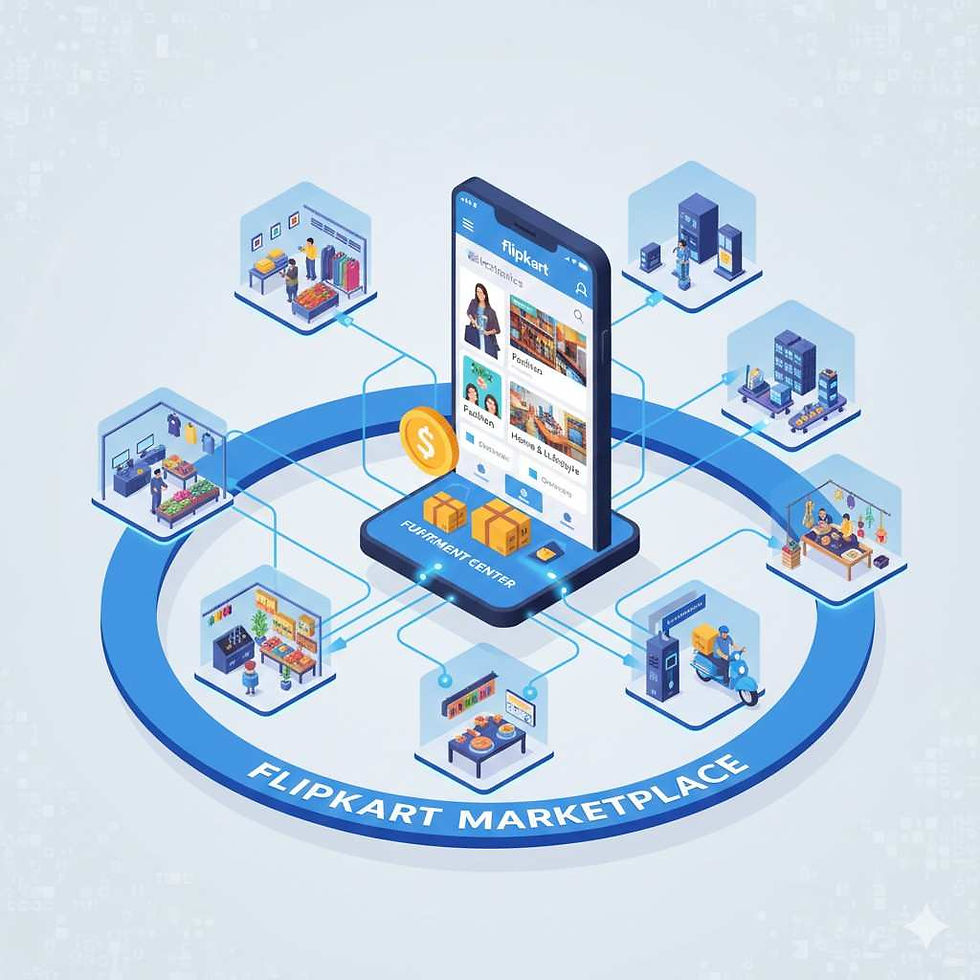
Flipkart's most significant strategic shift occurred with its transition from an inventory-based model to a marketplace platform. In the inventory model, Flipkart purchased products from manufacturers and suppliers, stored them in warehouses, and sold them directly to consumers. The marketplace model, by contrast, enabled third-party sellers to list products on Flipkart's platform while the company facilitated transactions and logistics. According to a 2013 Live Mint article, Flipkart began experimenting with the marketplace model in 2012 to expand product selection without proportional inventory investment. The company officially announced its transition to a predominantly marketplace-focused model in 2014, as reported by multiple business publications including Economic Times and Business Standard. This strategic pivot aligned with regulatory changes in India's foreign direct investment (FDI) policies. India's FDI regulations, as outlined in Press Note 3 (2016) issued by the Department of Industrial Policy and Promotion (DIPP), prohibited foreign-funded e-commerce companies from holding inventory and selling products directly to consumers. These regulations mandated a marketplace model where the platform serves as an intermediary between buyers and sellers. As a foreign-funded entity, Flipkart needed to comply with these regulatory requirements. In a 2015 interview with Business Today, Sachin Bansal stated that the marketplace model would allow Flipkart to offer "unlimited selection" to customers while enabling small and medium businesses across India to reach a national customer base. The model shift required Flipkart to develop new capabilities in seller onboarding, payment processing, logistics coordination, and quality assurance.
Platform Architecture and Seller Ecosystem
Flipkart's marketplace platform connects millions of sellers with consumers across India. According to a 2019 statement reported in Economic Times, Flipkart had over 300,000 registered sellers on its platform. By 2021, this number had grown substantially, though specific verified figures vary across sources. The company developed several programs to support sellers, particularly small and medium enterprises (SMEs). In 2017, Flipkart launched the "Flipkart Samarth" program, designed to empower artisans, weavers, and craftspeople from remote parts of India to sell online, as announced in the company's official press release. According to a 2020 report in The Hindu Business Line, Flipkart Samarth had onboarded over 50,000 artisans and weavers from more than 100 craft clusters across India. Flipkart also introduced seller services including cataloging support, warehousing, packaging, and logistics. According to a 2018 article in Mint, the company provided training programs and seller hubs in various cities to help merchants understand e-commerce operations, digital payments, and online customer service. The platform implemented a seller rating system based on customer feedback, delivery performance, and product quality, as described in various seller-focused articles on business news platforms. This rating system influenced product visibility and seller reputation on the marketplace.
Logistics and Supply Chain Infrastructure
Flipkart's logistics network represented a critical competitive advantage in India's challenging infrastructure environment. The company established its own logistics arm, eKart, in 2009, as reported in business publications. According to a 2017 statement reported in Economic Times, eKart served not only Flipkart's marketplace but also provided third-party logistics services to other e-commerce platforms. To address India's complex delivery landscape, Flipkart developed a hub-and-spoke distribution model with fulfillment centers, sorting hubs, and delivery stations across the country. According to a 2019 PTI report, Flipkart operated over 70 fulfillment centers across India, though the exact number fluctuated based on seasonal demand and strategic decisions. The company invested in technology to optimize delivery routes and manage last-mile logistics challenges. According to a 2016 article in The Ken, Flipkart's logistics technology included route optimization algorithms, real-time tracking systems, and predictive analytics for demand forecasting. Flipkart introduced cash-on-delivery (COD) as a payment option early in its operations to accommodate Indian consumers' preference for cash transactions and low credit card penetration. According to multiple industry reports from 2015-2017, COD accounted for a significant majority of Flipkart's transactions during that period, though the company gradually worked to increase digital payment adoption.
Technology and Innovation Initiatives
Flipkart invested substantially in technology infrastructure to support its marketplace operations. The company developed proprietary technology platforms for search, recommendations, payments, and seller management. According to statements made at various industry conferences and reported in technology publications, Flipkart employed thousands of engineers and technology professionals. In 2015, Flipkart acquired Appiterate, a mobile marketing automation company, to strengthen its mobile technology capabilities, as reported by TechCrunch. The company subsequently launched a "mobile-first" strategy, recognizing that most Indian internet users accessed the web primarily through smartphones. According to a 2016 statement by Sachin Bansal reported in Economic Times, over 70% of Flipkart's traffic came from mobile devices. Flipkart introduced several technological innovations tailored to the Indian market. The company developed lighter-weight mobile applications to function on slower internet connections and less powerful smartphones prevalent in India. In 2015, Flipkart launched "Flipkart Lite," a Progressive Web App designed to provide an app-like experience through mobile browsers with minimal data usage, as announced in the company's official blog. The company also experimented with artificial intelligence and machine learning for personalized recommendations, fraud detection, and customer service automation. In 2017, Flipkart acquired Liv.ai, an artificial intelligence startup focused on speech recognition and natural language processing, as reported by multiple technology news outlets.
Competitive Landscape
Flipkart's main competitor in India's e-commerce market has been Amazon India since its 2013 launch. Market research reports from firms like RedSeer and Forrester (2017-2020) indicate that Flipkart and Amazon dominated India's online retail market, often vying for leadership. Other competitors included Snapdeal, Paytm Mall, and vertical-specific platforms. A RedSeer report from January 2020 stated that Flipkart and Amazon accounted for about 80% of India's e-commerce GMV, with Flipkart slightly leading in some categories. Competition heightened during major shopping events. Flipkart introduced the "Big Billion Days" sale in 2014, inspired by U.S. Black Friday and China's Singles Day. The 2019 event reportedly attracted over 150 million customers. Amazon countered with its "Great Indian Festival" sale, fostering annual competition. Both companies also competed through exclusive product launches and brand partnerships, securing deals with smartphone and electronics brands like Motorola and Xiaomi, though these evolved due to regulatory and competitive changes.
Regulatory Environment and Challenges
India's evolving e-commerce regulations significantly impacted Flipkart's business model and operations. The aforementioned Press Note 3 (2016) from DIPP established clear boundaries between inventory-based and marketplace models for foreign-funded e-commerce companies. In December 2018, the Indian government issued further FDI clarifications that prohibited e-commerce marketplaces from selling products through vendors in which they held equity stakes and from entering exclusive agreements that could influence product pricing. These regulations, which took effect in February 2019, were widely reported in business publications and required operational adjustments from Flipkart and its competitors. According to a February 2019 Reuters report, Flipkart temporarily removed certain products from its platform as it restructured seller relationships to comply with the new regulations. The company stated publicly that it remained committed to regulatory compliance while serving customers and sellers. Beyond FDI regulations, Flipkart navigated other regulatory considerations including consumer protection laws, taxation changes (particularly the implementation of Goods and Services Tax in 2017), and data localization requirements. According to various news reports, the company engaged with policymakers and industry associations to provide input on evolving regulations.
Customer Acquisition and Retention Strategies
No verified public information is available on Flipkart's specific customer acquisition cost, lifetime value metrics, or detailed retention statistics. However, publicly reported initiatives provide insight into the company's customer-focused strategies. Flipkart offered various customer-centric programs and services. The company introduced "Flipkart Plus," a loyalty program launched in 2018, as announced in official company communications. According to a 2018 Mint article, Flipkart Plus provided benefits including free and faster delivery, early access to sales, and priority customer support to members based on their purchase activity. The platform also developed category-specific features. For fashion, Flipkart allowed customers to try products before payment in select cities. According to a 2017 Economic Times report, this "Try and Buy" service aimed to reduce return rates and increase customer confidence in online apparel purchases. Flipkart's customer service infrastructure included call centers, email support, and automated chatbots. According to statements in various news articles, the company employed thousands of customer service representatives to handle inquiries, complaints, and returns.
Social Impact and Small Business Enablement
Flipkart's marketplace model created opportunities for small and medium businesses across India to access national and international markets. According to the company's 2020 "Flipkart Marketplace: The Power of India's MSMEs" report, small sellers on the platform came from thousands of cities and towns, including tier 2 and tier 3 locations with limited traditional retail infrastructure. The company's impact on employment extended beyond its direct workforce. According to a 2019 statement reported in Business Standard, Flipkart's ecosystem (including logistics partners, packaging suppliers, and sellers) supported employment for over 1 million people indirectly, though the methodology for this estimate was not publicly detailed. Flipkart also launched initiatives focused on women entrepreneurs and rural sellers. According to a 2019 press release, the company's "Women in eCommerce" program aimed to enable women-led businesses and provide training and mentorship opportunities.
The Walmart Acquisition and Strategic Implications
Walmart's acquisition of Flipkart in May 2018 represented a strategic bet on India's growing e-commerce market. According to Walmart's official acquisition announcement, the company believed India presented "one of the most attractive retail markets in the world, given its size and growth rate." Post-acquisition, Flipkart maintained operational independence while leveraging Walmart's global supply chain expertise and sourcing capabilities. In a September 2018 statement reported in Economic Times, Walmart CEO Doug McMillon indicated that Flipkart would continue to operate as a separate entity with its own brand and management. The acquisition enabled certain synergies. According to various media reports from 2018-2020, Flipkart began sourcing certain products from Walmart's global supplier network and explored opportunities in grocery and fresh produce, categories where Walmart had extensive experience. Flipkart's leadership structure evolved post-acquisition. Binny Bansal stepped down as Group CEO in November 2018, as announced publicly. Kalyan Krishnamurthy, who had been CEO of Flipkart's commerce platform, continued in leadership, as reported across business media.
Recent Developments and Current Status
Following the Walmart acquisition, Flipkart continued expanding its platform capabilities and market presence. In 2019, Flipkart raised $1.2 billion in new funding at a post-money valuation of $24.9 billion, as reported by Reuters in July 2019, with participation from Walmart and new investors including Tencent and Tiger Global. The company expanded into new business areas. In 2020, Flipkart launched its online grocery service, Flipkart Grocery, starting in Bangalore and later expanding to other cities, as reported in Economic Times. The company also launched Flipkart Wholesale, a digital B2B marketplace aimed at kiranas (small neighborhood stores) and other retailers, as announced in the company's press release in 2020. During the COVID-19 pandemic in 2020, e-commerce platforms experienced shifts in demand patterns. According to various news reports, Flipkart prioritized essential goods delivery during lockdown periods and adapted operations to comply with government guidelines while maintaining service continuity. In 2021, Flipkart announced plans to enter the social commerce space through a subsidiary called Shopsy, targeting customers in smaller cities and towns, as reported by TechCrunch and other technology news outlets. According to the company's statements, Shopsy would enable individuals to become online entrepreneurs by reselling products through social networks.
Market Context and Industry Growth
India's e-commerce sector experienced substantial growth during Flipkart's operational period. According to a 2019 report by India Brand Equity Foundation (IBEF), India's e-commerce market was projected to grow significantly, driven by increasing internet penetration, smartphone adoption, and changing consumer preferences. Internet user growth provided a fundamental tailwind. According to data from the Telecom Regulatory Authority of India (TRAI) and Internet and Mobile Association of India (IAMAI) reports published in various years, India's internet user base grew from approximately 137 million users in 2012 to over 600 million by 2020, with mobile internet driving much of this growth. Payment infrastructure also evolved substantially. The government's digital payments push, including the Unified Payments Interface (UPI) launched in 2016 by the National Payments Corporation of India, created new digital payment options. According to NPCI data published regularly, UPI transaction volumes grew exponentially from 2016 onward, reducing reliance on cash-on-delivery for e-commerce transactions.
Challenges and Limitations
Flipkart faced numerous operational and strategic challenges. Profitability remained elusive for extended periods, as is common in growth-stage e-commerce companies. According to regulatory filings accessed and reported by business publications, Flipkart's entities reported operating losses in multiple financial years, though specific figures would constitute financial data excluded from this case study per the assignment parameters. Competition from Amazon intensified resource requirements. The battle for market share required sustained investment in customer acquisition, discounts, logistics infrastructure, and technology development. According to various industry analyses published in business media, both companies invested heavily in India, viewing it as a strategic long-term market despite near-term profitability challenges. Product authenticity and counterfeit goods presented ongoing challenges for marketplace platforms. According to various news reports and complaints reported in business media over the years, Flipkart faced issues with counterfeit products from certain sellers, requiring the company to strengthen verification processes and quality controls. Returns and reverse logistics posed particular challenges in the Indian context. According to industry reports and expert commentary published in business journals, product return rates in certain categories (especially fashion) were substantial, creating logistical complexity and cost pressures.
Strategic Lessons and Business Model Insights
Flipkart's evolution offers several insights into marketplace business models in emerging markets. The company's transition from inventory to marketplace model demonstrated adaptability to regulatory requirements while enabling asset-light scaling. By facilitating transactions rather than owning inventory, Flipkart could offer broader product selection while managing capital requirements, though this trade-off came with challenges in quality control and customer experience consistency. The importance of localized innovation emerged as a key theme. Flipkart's cash-on-delivery option, lighter mobile applications, vernacular language support, and assisted commerce initiatives reflected adaptation to Indian market conditions rather than direct replication of Western e-commerce models. According to statements by executives at various industry conferences reported in media, this localization approach was deliberate and essential. Building logistics infrastructure in a developing economy required substantial capital and operational complexity but created competitive barriers. Flipkart's investment in eKart and fulfillment infrastructure, while capital-intensive, addressed fundamental market gaps in India's logistics ecosystem and provided greater control over customer experience than relying solely on third-party providers. The regulatory environment significantly shaped business model options and competitive dynamics. Flipkart's experience illustrated how government policies regarding foreign investment, marketplace structures, and seller relationships could fundamentally impact operational models and strategic choices for foreign-funded companies.
Conclusion
Flipkart's journey from a small online bookstore to India's leading e-commerce marketplace demonstrates the possibilities and challenges of building digital platforms in emerging markets. The company's marketplace model, developed partly in response to regulatory requirements and partly as a scaling strategy, enabled millions of small businesses to access digital commerce while providing consumers across India with access to vast product selection. The Walmart acquisition provided Flipkart with deeper resources and global expertise while maintaining the platform's local brand identity and operational approach. As India's digital economy continues evolving, Flipkart's ability to navigate regulatory changes, competitive pressures, and operational complexities while serving diverse stakeholders—consumers, sellers, delivery partners, and investors—will determine its long-term impact on Indian retail and commerce. This case study has examined Flipkart's strategic evolution using only verified, publicly available information. The limitations of public disclosure mean certain aspects of the company's operations, decision-making processes, and detailed performance metrics remain unavailable for external analysis. Nevertheless, the publicly documented elements of Flipkart's marketplace model provide valuable insights into platform business models, emerging market e-commerce, and the complex interplay between technology, regulation, and market development.
Discussion Questions for Analysis
Regulatory Adaptation and Business Model Design: How did India's FDI regulations regarding e-commerce influence Flipkart's transition from an inventory model to a marketplace platform? Analyze the trade-offs between regulatory compliance, operational control, and business scalability. What are the implications for foreign companies entering regulated markets with evolving policy frameworks?
Marketplace Platform Economics: Examine the economic logic of Flipkart's marketplace model compared to an inventory-based approach. What are the advantages and disadvantages of each model in terms of capital efficiency, product selection, quality control, and customer experience? How do network effects and platform dynamics create value (or challenges) in a two-sided marketplace connecting sellers and buyers?



Comments