Google India's "Reunion" Campaign: Search as Storytelling
- Apr 1
- 10 min read
Executive Summary
In November 2013, Google India and Ogilvy & Mather Mumbai released a 3.5-minute digital film titled Reunion — a campaign that redefined how a technology brand could use emotional storytelling to articulate product utility. Rather than demonstrating search features through conventional product advertising, the campaign embedded Google Search invisibly into a deeply human narrative about the India-Pakistan Partition of 1947. The film became the most-viewed and most-shared piece in the history of Indian advertising at that time, earning Silver and Bronze Lions at Cannes 2014 and triggering real-world diplomatic conversation. This case examines why Reunion worked not merely as creative brilliance, but as a masterclass in consumer insight-led brand communication for a market at an inflection point.
1. Industry & Competitive Context
By 2013, Google held approximately 97% market share in the Indian search engine market, making it the de facto gateway to the internet for the country's then-growing online population. However, the competitive threat Google faced was not from rival search engines — it came from a structural shift in how Indian consumers were beginning to access and navigate the internet. Mobile internet adoption was accelerating rapidly in India, with mobile traffic already accounting for approximately 62.5% of total internet traffic compared to 37.5% for desktop. This was not a marginal trend — it represented a fundamental reorientation of user behavior. As smartphone penetration grew, consumers increasingly began bypassing the browser-based Google search experience entirely, favouring vertical apps such as Zomato (restaurants), MakeMyTrip (travel), and Flipkart (e-commerce) for category-specific queries. The risk was clear: if mobile-first Indian internet users built their discovery habits around vertical apps rather than Google Search, the brand's central position in the user's information-seeking journey would erode at the very moment the Indian internet was scaling. Simultaneously, a large segment of the Indian population — particularly in Tier 2 and Tier 3 cities and among first-generation internet users — had not yet developed a meaningful relationship with Google beyond rudimentary keyword queries. The brand was perceived as a technology tool, useful but emotionally neutral. The challenge was not market share in the traditional sense. It was mental availability: ensuring that when Indian consumers encountered a complex, emotionally loaded, or multi-step information need, Google Search — not a vertical app or word-of-mouth — was their first instinct.
2. Brand Situation Prior to the Campaign
Despite its dominant market position, Google India's marketing team, led by Marketing Director Sandeep Menon, identified a critical perception gap. As articulated by Sukesh Kumar Nayak, then Executive Creative Director at Ogilvy India (later Chief Creative Officer), Google's own brief acknowledged the limitation: "Everybody uses me every single day. I am a great technology brand but nobody uses me for anything more than just hunting for information." The brand brief, as reported by Storyboard18, explicitly stated that Google is a technology product but also an emotional brand, and that the campaign needed to show how meaningful search could be in real life. The internal framing, corroborated by Ogilvy's Abhijit Avasthi (then National Creative Director), was that Google was being used for basic search despite being capable of much more — capabilities that Indian users were simply unaware of. The strategic problem, therefore, was not awareness in the classic sense. Google was universally known. The problem was depth of relationship and functional breadth of use. Users did not conceive of Google Search as a tool for complex, emotionally significant life tasks — finding a long-lost person, planning a cross-border trip, navigating visa requirements. Bridging this gap between habitual utility and emotional significance was the mandate.
3. Strategic Objective
The campaign's strategic objective, as reconstructed from publicly documented agency and brand statements, operated on two interconnected levels. The first was functional: to demonstrate the breadth and depth of Google Search's capabilities beyond basic queries — showing use cases such as locating people, finding business addresses, checking visa procedures, sourcing weather information, and retrieving flight details. According to Avasthi, the film was part of a broader effort to showcase "people looking up weather conditions, flight arrivals, visas, etc., which people hardly used it for then." The second was emotional: to elevate Google Search from a transactional tool to a platform of human connection — to shift brand perception from functional utility to emotional resonance. As Nayak summarized: the goal was to make "the connection between real life and Google, magical." Critically, the campaign was designed as a digital-first initiative. The intent was to build organic distribution through social sharing before any television release, testing whether emotionally resonant content could earn media at scale in the Indian market.
4. Campaign Architecture & Execution
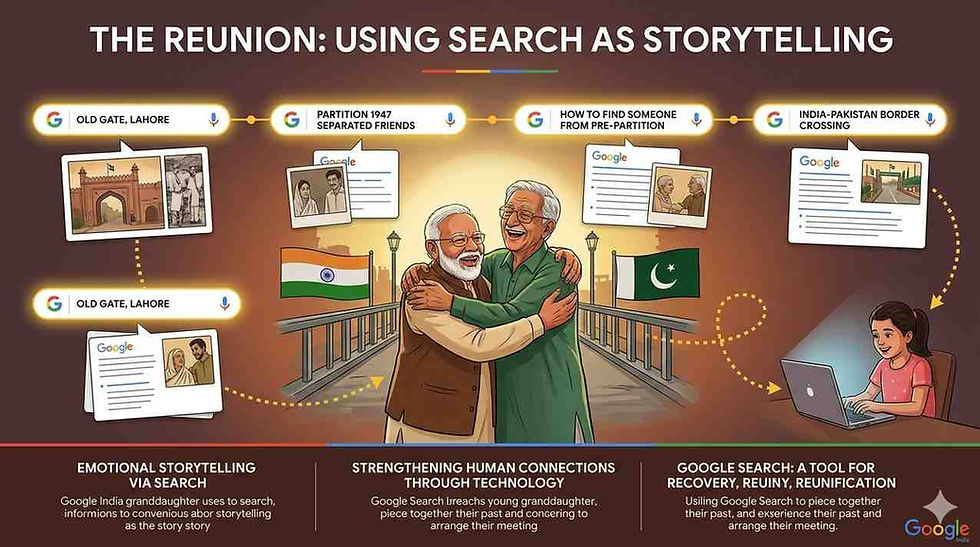
Reunion was directed by Amit Sharma and written by Sukesh Kumar Nayak. The background score was composed by Clinton Cerejo, with lyrics by Neelesh Mishra (also credited as Neelesh Jain in some sources), and narration by Piyush Mishra — a constellation of Indian creative talent that lent the film an authentic, literary quality rarely seen in commercial advertising. The narrative follows Suman, an Indian granddaughter, who discovers her elderly grandfather Baldev's longing for his childhood friend Yusuf — a Muslim boy he was separated from during the 1947 Partition when Baldev's family was forced to leave Lahore. Using Google Search, Suman traces Yusuf's family sweet shop in Lahore, connects with Yusuf's grandson Ali, and orchestrates a surprise reunion on Baldev's birthday. A crucial creative discipline underpinned the execution. According to Nayak, every piece of information shown in the film — the location of the sweet shop, the embassy details, visa procedures, weather, and flight information — was real and verifiable on Google. "The story had to match the data that came from Google," Nayak confirmed. This commitment to factual accuracy was not merely an ethical choice; it was a strategic one. By ensuring that all search results shown were authentic, the campaign demonstrated genuine product utility rather than aspirational fiction. The role of the actors added further authenticity. Baldev was played by Ramendra Goel (Badola), a renowned theatre actor, while Yusuf was portrayed by M.S. Sathyu — the celebrated director of the 1974 Partition film Garam Hawa — lending the film a cultural credibility that pure casting alone could not achieve. Reunion was the lead film in a five-part campaign series that also included Fennel, Cricket, Anarkali, and Sugar-free — all featuring recurring characters and showcasing distinct Google Search use cases. However, Reunion was the emotional anchor of the series and the one that drove mass organic distribution.
5. Positioning & Consumer Insight
The core consumer insight driving Reunion was a synthesis of cultural memory and behavioral psychology. The India-Pakistan Partition of 1947 is not a historical abstraction for large segments of the Indian (and Pakistani) population — it is a living wound carried across generations. Millions of families experienced violent displacement, separation, and irreversible loss of community. This shared cultural trauma created a latent emotional reservoir of longing, nostalgia, and the desire for reconnection. By choosing this narrative terrain, Ogilvy and Google anchored their product demonstration inside a universally recognized and deeply felt human experience. The search queries Suman performs are not abstract — they are acts of love. The insight was that Google Search, when used for what truly matters to people, is not a search engine; it is a bridge. From a brand positioning standpoint, the campaign executed a sophisticated pivot. Rather than positioning Google on product attributes (speed, accuracy, comprehensiveness) — rational claims already assumed by the market — it repositioned the brand on the territory of emotional significance. It answered not "what can Google do?" but "what does Google make possible?" The choice of the Partition as a backdrop also carried a secondary insight: the India-Pakistan relationship, despite sustained political tension between governments, is defined at the popular level by profound familial and cultural connection. As journalist Nilanjana Bhowmick observed in Time magazine, the film made the point that personal connections between Indians and Pakistanis run deeper than governmental tensions. This cross-border resonance was not incidental — it dramatically expanded the film's organic reach into Pakistan, an enormous unplanned audience that supercharged its viral distribution. The campaign also embedded an implicit Jobs-to-be-Done (JTBD) message: Google Search is not for finding information — it is for fulfilling human intentions that feel impossible.
6. Media & Channel Strategy
Reunion was conceived and launched as a digital-first campaign. The film was released on YouTube and distributed across digital platforms before being broadcast on television. According to publicly documented reporting, the film received over one million views on YouTube within 30 hours of release. In under a week, it became the third most viral video on the internet globally. The digital-first strategy served multiple objectives. First, it enabled organic measurement of the content's resonance before committing to television broadcast costs. Second, it allowed multilingual subtitling to be added in response to global traction — the Ogilvy team added subtitles in multiple languages after the unexpectedly large international response, including from Pakistan. Third, it positioned Google itself as a brand comfortable living natively in the digital ecosystem it helped build. Television broadcast followed on November 15, 2013, after the digital success was already established. This sequencing was strategically significant: television amplified a story already proven by the market, rather than using television to launch the story and then hoping for digital spillover.
The five-film series structure — with Reunion as the lead — ensured that the campaign had narrative continuity and gave audiences reasons to engage across multiple pieces of content, each demonstrating different search use cases.
7. Business & Brand Outcomes
The following outcomes are drawn exclusively from publicly documented and attributable sources:
Viewership: According to Ogilvy India's Cannes 2014 case submission (as reported by Indian Television), the film earned 52 years (273,344,441 minutes) of free viewing time, making it the most viewed and most shared film in the history of Indian advertising at that time. The film accumulated over 15 million views on YouTube and more than 50 million views across all digital platforms.
Awareness Lift: Ogilvy's Cannes case documented a 38% increase in awareness for new Google Search features following the campaign.
Industry Recognition: The campaign won a Silver Lion and a Bronze Lion at the Cannes Lions International Festival of Creativity 2014, in the PR category under the subcategory "Brand Voice (including strategic storytelling)." The campaign was entered by Ogilvy & Mather India, Mumbai.
Cultural Impact: The campaign's resonance extended beyond commercial metrics into documented public discourse. Journalist and activist Beena Sarwar linked the film to the Milne Do (Let People Meet) petition against India-Pakistan visa restrictions. Multiple credible international media outlets — including Time, The World from PRX, and the International Business Times — published coverage of the film's cross-border cultural significance. According to Social Samosa's documented reporting, the film is credited as having inspired the India-Pakistan government to ease visa procedures, though the causal link between the campaign and any specific policy change cannot be independently verified through official government documents.
Creative Validation: According to Nayak's statements as reported by Storyboard18, Google's founders Larry Page and Sergey Brin, as well as Bollywood megastar Amitabh Bachchan, were among those who publicly expressed appreciation for the film.
Note: No verified public information is available on paid media spend, CAC, LTV, conversion lift, or internal brand equity tracking metrics associated with this campaign.
8. Strategic Implications
8.1 — Emotional Positioning Is Not a Retreat from Functionality
The most significant strategic lesson of Reunion is that emotional advertising and functional product demonstration are not mutually exclusive. Every Google Search use case in the film — finding a Lahore sweet shop, checking visa procedures, searching for flight information — is shown accurately and deliberately. The emotion did not obscure the product; it elevated it. For brand strategists, this offers a template: embed product utility inside human truth, and the demonstration becomes memorable precisely because it is felt, not just understood.
8.2 — Digital-First Is a Testing and Sequencing Strategy, Not Just a Channel Choice
The campaign's release architecture — digital first, television second — was a strategic innovation in the Indian market context of 2013. It allowed the brand to validate resonance through organic behavior before amplifying through broadcast. This approach, now common, was early practice in India and demonstrated that earned media at scale was achievable for branded content if the underlying story possessed genuine cultural relevance.
8.3 — Cultural Insight Must Be Specific to Be Universal
Reunion was specific — deeply, precisely specific — to the India-Pakistan Partition. It did not attempt to be universally relatable through abstraction. Yet it became globally resonant. The paradox of highly specific cultural insight is that when a story is true to a real human experience in its full particularity, it reaches audiences who have no direct connection to that experience. The Partition narrative gave the campaign an emotional precision that a generic "reconnecting with old friends" story could never have achieved.
8.4 — Brand Salience in a Multi-App Ecosystem Requires Emotional Anchoring
The underlying strategic challenge — vertical apps displacing Google Search — is a problem of mental availability under conditions of abundant alternatives. Reunion addressed this not through comparative advertising or feature promotion, but by creating a memory structure: the association of Google Search with the resolution of emotionally significant, complex human needs. Byron Sharp's Mental Availability framework would interpret this campaign as a deliberate effort to build and refresh brand associations that make Google salient in high-stakes moments — precisely the moments most vulnerable to vertical app substitution.
8.5 — Authentic Storytelling Requires Authentic Production
The decision to cast M.S. Sathyu — a director who lived and worked through the Partition's cultural aftermath — was not merely a casting choice. It was a signal of the brand's commitment to authenticity in a story that could easily have collapsed into exploitation. The choice to shoot a small scene in actual Lahore, rather than recreating it in India, served the same function. In markets where consumers are acutely sensitive to cultural appropriation or superficiality, authentic production choices are a component of brand integrity.
9. Discussion Questions
Q1. Google held approximately 97% search market share in India at the time of the Reunion campaign. Given this dominant position, the conventional marketing logic might question the need for brand-building investment at scale. Using Byron Sharp's Mental Availability and Physical Availability framework, construct an argument for why Google India's decision to invest in emotional brand communication was strategically rational despite near-total market share.
Q2. The Reunion campaign embedded multiple Google Search use cases (visa procedures, location search, weather, flight information) within a single emotional narrative. Compare this integration approach to a conventional product demonstration strategy. What are the brand equity implications of each approach, and under what market conditions would you recommend one over the other?
Q3. The campaign's digital-first, television-second sequencing was a deliberate strategic choice. Analyze the risk and reward profile of this approach. What measurable signal would you look for — prior to committing to a television amplification spend — to determine that digital performance warranted broadcast investment?
Q4. Reunion gained significant unplanned organic reach in Pakistan, effectively extending the campaign to an audience Google India had not explicitly targeted. What does this outcome reveal about the relationship between cultural specificity and campaign scalability? How should brand planners think about designing for "unplanned resonance" in markets connected by shared cultural memory?
Q5. The campaign won recognition at Cannes Lions 2014 under the PR category ("Brand Voice including strategic storytelling") rather than under Film or Digital. What does this categorization reveal about the nature of the campaign's primary mechanism of impact? Discuss the distinction between a campaign that wins because of what it says versus one that wins because of what it causes — and evaluate Reunion against both criteria.


Comments