Quick Heal's Antivirus Software Distribution Strategy Building India's Largest Cybersecurity Channel from a One-Room Repair Shop
Industry & Competitive Context
The Indian cybersecurity software market emerged as a commercially significant category in the mid-to-late 1990s, coinciding with the rapid proliferation of personal computers in homes, small businesses, and educational institutions. Unlike in Western markets, where software retail was already digitally enabled through large format stores and online platforms, India's early software distribution ecosystem was almost entirely physical, fragmented, and intermediary-dependent. Hardware vendors, local computer assemblers, and small IT retailers were the primary points of consumer contact, and any software company seeking to build scale had to construct its distribution channel from scratch — inserting itself into an ecosystem not designed for software products.
The competitive environment that Quick Heal entered was dominated by global brands — Norton (Symantec), McAfee, and Kaspersky — that had global R&D investment, established international brand equity, and relationships with large enterprise clients. For an Indian-origin startup without any of these advantages, competing on product superiority alone was not a viable strategy. The only feasible path to scale was superior distribution reach, particularly into markets that global competitors either could not serve cost-effectively or did not prioritize. This structural reality shaped every distribution decision Quick Heal made across its first two decades.
The category itself presented a paradox: antivirus software was urgently necessary as internet and computer usage grew, but it was also invisible and intangible — a product whose value was realized only in the absence of a problem, making it difficult to sell to price-sensitive Indian consumers unfamiliar with the concept of purchasing software separately from hardware. Distribution, in this context, was not merely a logistics function — it was the primary marketing instrument. The channel partner who sold the hardware was also the most trusted technical authority in the consumer's purchase decision, which meant owning the channel relationship was equivalent to owning the consumer relationship.
Brand Situation Prior to Strategic Evolution
Quick Heal was incorporated in 1995 by brothers Kailash Katkar and Sanjay Katkar, operating initially under the name CAT Computer Services Private Limited from a modest computer repair workshop in Pune. Kailash had begun his working life as a radio and calculator repairman, eventually transitioning to computer repair and winning the annual maintenance contract for New India Insurance. Sanjay, then studying for his computer science degree, developed antivirus tools as part of his academic work — most notably a tool to address the Michaelangelovirus that was affecting client machines. Kailash distributed those tools for free to customers, received positive market response, and recognized the commercial potential of a formal antivirus product. The brothers released their first Quick Heal Antivirus for DOS in 1995.
The first five years were difficult by the founders' own account, as documented in publicly reported history of the company. The business operated only in Pune, struggled to attract investment or banking credit, and came close to shutting down in 1999. The turning point came when Kailash made a deliberate decision to pursue aggressive marketing: placing a half-page advertisement in the Times of India and systematically approaching hardware vendors in Pune to educate them on how to sell the software alongside their hardware products. This decision — to align distribution with the hardware vendor ecosystem rather than pursue independent retail — proved to be the foundational strategic insight that would define Quick Heal's channel architecture for the next two decades.
In 2002, the company recruited Abhijit Jorvekar as head of sales, who created a replicable model for expanding into new cities. The company opened its first branch in Nashik in 2003 and systematically replicated the Pune channel model in other Indian cities, converting hardware vendors into Quick Heal channel partners across each market it entered. Between 2002 and 2010, Quick Heal expanded from Pune to the major cities of India, building a branch-led distribution architecture that by the time of its IPO in February 2016 spanned 33 branches across India.
Strategic Objective
The documented strategic objectives of Quick Heal's distribution strategy can be read across two distinct phases, each of which is reflected in public filings and press accounts.
The first phase objective — covering roughly 1995 to 2015 — was to build the deepest and widest physical distribution network for antivirus software in India by converting the existing hardware vendor ecosystem into a dedicated channel partner base. The company explicitly used hardware vendors as its primary distribution vehicle, a strategic choice that aligned the antivirus sale with the hardware purchase decision — one of the highest-trust purchase moments in a first-time computer buyer's experience. This approach allowed Quick Heal to reach consumers at the exact point of device activation, before global competitors could intervene.
The second phase objective — from approximately 2015 onward — was to diversify the distribution architecture away from its heavy dependence on retail channel partners and toward enterprise and government channels, which commanded higher margins and more stable revenue streams. This strategic shift was explicitly documented in the company's FY2016 annual report, which stated that the company was "taking initiatives to diversify from our retail-centric revenue base." The rationale was commercially sound: the retail antivirus market faced increasing pressure from free alternatives, most notably Microsoft's integrated Windows Defender, while the enterprise and government segments represented structurally protected demand for advanced security solutions that required professional procurement, implementation, and support — all domains where Quick Heal's channel infrastructure and technical capabilities could be meaningfully differentiated.
Campaign Architecture & Execution
Quick Heal's distribution strategy is best understood as a multi-tier channel architecture that evolved over three decades and is documented across its IPO filings, annual reports, and publicly reported financial analysis.
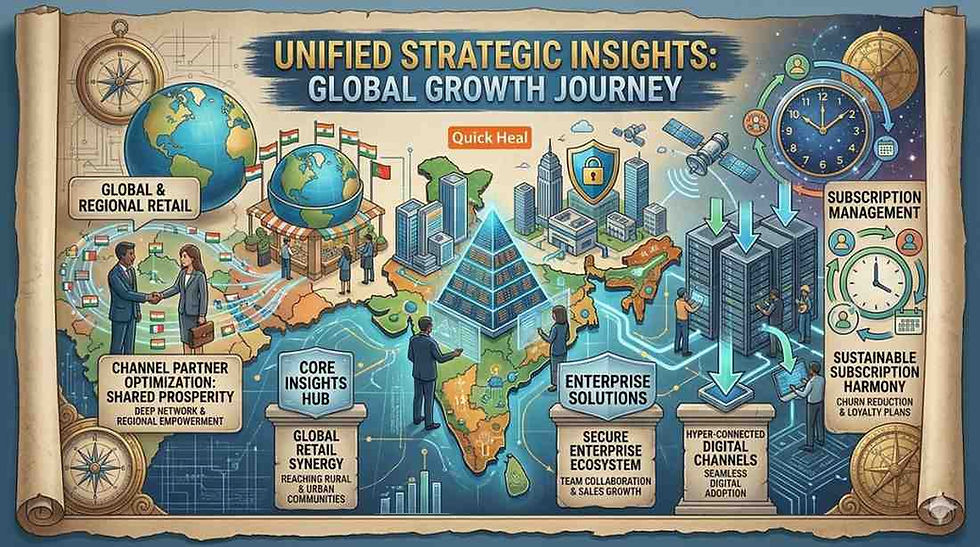
The foundational tier of the architecture is the retail channel partner network. At the time of the company's IPO in February 2016, as documented in the IPO prospectus and reporting by credible publications, Quick Heal had built a network of over 19,000 retail channel partners, 349 enterprise channel partners, 319 government partners, and 944 mobile channel partners. The company's FY2016 annual report confirmed that the channel partner network was the primary vehicle for consumer sales, with channel sales expected to account for a significant percentage of revenues going forward. The network covered more than 80 countries, with India being the primary market. The company maintained offices in 64 locations across 36 cities in India, with subsidiaries in Japan, Dubai, the United States, and Kenya.
The structural logic of the retail channel was hardware co-distribution: by training hardware vendors to recommend and bundle antivirus software with device purchases, Quick Heal converted a passive distribution point into an active sales resource. This required investment in channel education, local branch presence to service and train partners, and consistent margin structures that kept hardware vendors economically motivated to promote Quick Heal over competitors. The FY2016 annual report notes that revenue concentration was actively managed — the top 20 dealers accounted for 52% of revenue in FY15, declining to 45% in FY16 — indicating a deliberate effort to broaden the revenue base across the channel network and reduce dependency on any single large partner.
The enterprise and government distribution tier operated through a separate, specialized channel of 349 enterprise and 319 government partners as of December 2015, as documented in IPO filings. This tier required fundamentally different channel management, as enterprise and government procurement involves formal tendering, technical evaluation, and long sales cycles that are incompatible with the high-volume, fast-turnover model of retail antivirus distribution. The company launched its dedicated enterprise brand Seqrite in 2015, providing a structurally distinct product and channel identity for the B2B and B2G segments, separating enterprise positioning from the consumer Quick Heal brand.
Internationally, the company announced new distribution alliances in North America with TechWise Networks, Rain Networks, and EIGRS at CompTIA ChannelCon in 2015, as documented in publicly available trade press. In 2024, the company signed a distribution agreement with EET Group to strengthen its European cybersecurity distribution footprint, as reported by Business News This Week.
A commercially significant and publicly documented feature of Quick Heal's channel design is its profit-sharing program for partners. As stated by Sneha Katkar, Head of Product Strategy at Quick Heal, in a published interview carried by DQ Channels in November 2025: Quick Heal is the only brand that provides a profit-sharing program where even if a consumer renews or buys online, the relevant partner continues to receive their share. This structural commitment — extending channel economics into online renewals rather than disintermediating partners as digital sales grew — reflects a deliberate strategic choice to preserve channel loyalty in an era of accelerating direct-to-consumer digital commerce.
Positioning & Consumer Insight
Quick Heal's distribution strategy was grounded in a consumer insight that was specific to India and rarely articulated explicitly in global antivirus marketing: the Indian consumer buying their first computer did not have a pre-existing mental model for digital security and required trusted, in-person guidance to make a purchase decision. Unlike the self-directed, digitally literate consumer in developed markets who would research antivirus options online and purchase through e-commerce, the first-generation Indian computer buyer was acquiring both a device and a new behavioral category simultaneously. The person they trusted most in that moment was the hardware vendor or computer repair professional who had just sold or assembled their machine.
By positioning hardware vendors and local IT service providers as the primary distribution channel, Quick Heal aligned its sales motion with the consumer's existing trust architecture rather than attempting to build an independent brand-led sales funnel from scratch. This insight — that distribution through trusted local technical intermediaries was more efficient than direct brand marketing for a category most consumers did not understand they needed — explains why Quick Heal prioritized channel depth over advertising investment in its early decades.
The company's public disclosures confirm that at the time of its IPO, 70% of revenue came from retail products and 30% from enterprise and government — a ratio that reflected the scale of the consumer channel but also signaled the strategic imperative to grow the higher-margin enterprise segment. The company's IPO prospectus stated that it had over 30% market share in the retail segment in India, making it the leading domestic antivirus brand by retail channel reach at the time of listing.
Media & Channel Strategy
No verified public information is available on Quick Heal's specific advertising spend allocations, media mix breakdowns by year, or digital marketing performance metrics from official company sources.
What is documentable from public filings is the company's stated intention to deploy IPO proceeds toward marketing investment. The IPO prospectus confirmed that approximately 50% of the fresh issue proceeds — approximately Rs 110 crore — were allocated to marketing activities, with 16 to 17% directed toward R&D and the remainder toward new offices. This represented the largest single allocation of the IPO capital, reflecting the company's recognition that brand-led consumer marketing needed to supplement and strengthen its channel-led distribution as competition from free and embedded security solutions intensified.
The company confirmed in publicly available partner documentation that it maintained sales and marketing activities out of 64 offices across 36 cities in India, indicating a field-sales-heavy marketing model consistent with a channel-led distribution strategy. The emphasis on local branch presence reflects the operational requirements of managing a geographically dispersed partner network of approximately 20,000 entities across India.
Business & Brand Outcomes
The documented business outcomes of Quick Heal's distribution strategy are as follows, drawn from IPO filings, annual reports, and credible financial reporting.
At the time of its IPO in February 2016 — the first Indian software product company to list on public markets, as confirmed in official company communications — Quick Heal had installed over 24.5 million cumulative licenses across more than 80 countries, and maintained over 7.13 million active licenses as of December 31, 2015. The company reported revenues of Rs 284 crore in the fiscal year immediately preceding its IPO, growing at a CAGR of 17% over the preceding four years. The IPO itself raised Rs 451.25 crore, listing at a market capitalization of approximately Rs 1,500 crore.
Post-IPO, the company faced structural revenue pressure as the consumer antivirus segment deteriorated, driven by the increasing efficacy of free, embedded security solutions. Revenue from operations for FY2024 stood at approximately Rs 277 crore on a consolidated basis, as reported by Screener and corroborated by trade publications. However, the enterprise segment showed meaningful recovery. In Q1 FY25, Quick Heal Technologies reported 37% revenue growth year-on-year and 117% growth in EBITDA, per the company's official Q1 FY25 results press release published July 29, 2024. The company's enterprise brand Seqrite received a 4.6 out of 5 rating from Gartner Peer Insights in the same period.
In Q2 FY26, the company reported consolidated net profit growth of 90.6% and revenue from operations growth of 13.65% to Rs 83.52 crore, as reported by credible financial publications. A major government order of Rs 64 crore with a five-year fulfillment period was secured, as confirmed through an exchange filing. The company's order book exceeded Rs 80 crore as of Q3 FY26. Enterprise revenue grew 37.1% year-on-year in Q3 FY26, while consumer revenue declined 21.2% in the same period, confirming the ongoing structural shift in the business mix. The company's gross margin stood at 95.9% in Q3 FY26, consistent with the high-margin software product model.
The company was listed as a consortium member of the US Artificial Intelligence Safety Institute Consortium in FY24, the only Indian cybersecurity firm to receive this designation, as confirmed in official investor communications. Quick Heal also won the "Product of the Year" and "Top Remediation Time" awards in AV Lab Poland's malware testing in Q1 FY25, achieving a 100% protection rate, as stated in the company's official results announcement.
Strategic Implications
The Quick Heal distribution case carries several implications that are strategically generalizable beyond the cybersecurity category.
The first implication concerns the role of distribution as a primary marketing instrument in low-awareness product categories. For any product that consumers do not know they need, advertising creates awareness but the trusted intermediary closes the sale. Quick Heal's early decision to embed its distribution within the hardware vendor ecosystem — rather than building a standalone retail brand — reflects a precise understanding that in a category with zero prior consumer familiarity, the channel relationship is the brand relationship. This principle is applicable to any new-to-consumer category entering an emerging market where the target consumer lacks the prior knowledge to make an independent, digitally-informed purchase decision.
The second implication concerns the management of channel concentration risk. The FY2016 annual report's disclosure that the top 20 dealers had reduced their revenue contribution from 52% to 45% — an explicitly managed decline — illustrates a mature approach to channel portfolio management. A distribution network that depends excessively on a small number of large partners creates structural vulnerability, particularly in a category where those partners have the negotiating leverage to switch brands. Quick Heal's documented effort to broaden distribution across the partner base is a channel risk mitigation strategy that carries direct implications for any brand dependent on intermediary distribution at scale.
The third implication is about the structural tension between online disintermediation and channel loyalty. As digital commerce grew, most software brands migrated toward direct-to-consumer online sales that bypassed the physical channel entirely. Quick Heal's documented response — building a profit-sharing model that extends partner economics into online renewals — represents a deliberate choice to sustain channel alignment rather than pursue short-term margin improvement through disintermediation. This decision preserves the company's most durable competitive asset — its deep field penetration into smaller Indian cities and towns — at the cost of some margin efficiency. The strategic calculus here is that the channel network's geographic reach into Tier 2 and Tier 3 India is more valuable than the margin gain from removing the channel from digital sales.
The fourth implication is about dual-brand architecture as a channel strategy tool. The creation of Seqrite as a distinct enterprise brand in 2015 — separate from the consumer Quick Heal brand — was not merely a product decision. It was a channel architecture decision. Enterprise channel partners, who operate through formal procurement relationships with IT managers and CISOs, require a different brand identity, a different pricing conversation, and a different sales narrative than the retail hardware vendor selling antivirus to a home user. By separating the two brands, Quick Heal avoided the positioning dilution that would have resulted from using a consumer-facing antivirus brand to pursue enterprise security contracts, while allowing the company to invest its IPO proceeds and enterprise channel resources in building Seqrite's credentials independently through certifications, Gartner ratings, and government partnerships.
Finally, the sustained decline in consumer antivirus revenue against the growth of enterprise revenue confirms a structural trend in the cybersecurity distribution market: the most defensible and scalable revenue in software security flows to platforms that are embedded in institutional procurement cycles rather than consumer purchase decisions. For Quick Heal, the distribution strategy pivot from retail-first to enterprise-first is not a departure from its original channel logic — it is an extension of the same principle that drove its founding: find the procurement decision-maker, build the trusted intermediary relationship, and distribute at scale through that relationship rather than against it.
Mba-Style Discussion Questions
Quick Heal built its retail dominance by embedding distribution within the hardware vendor ecosystem, a strategy that aligned the antivirus sale with the device purchase decision. As Indian consumers increasingly purchase devices online and as antivirus software migrates to subscription-based digital delivery, evaluate the long-term viability of this hardware-vendor-centric channel model. What distribution architecture should Quick Heal pursue for its next decade of consumer business?
The company's FY2016 annual report explicitly identified the objective of reducing dependence on its retail-centric revenue base. Using a Go-to-Market framework, assess the challenges Quick Heal would face in transitioning a 19,000-strong retail channel partner network — optimized for fast-moving, low-ticket consumer software — into a channel capable of supporting long-cycle, high-ticket enterprise security sales through Seqrite.
Quick Heal's documented profit-sharing program — which extends partner economics to online renewals — represents a conscious decision not to disintermediate its physical channel as digital sales grow. Analyze the trade-offs of this decision using the lens of channel conflict management theory. Under what market conditions does sustaining physical channel economics in a digitizing category create competitive advantage, and when does it become a structural cost burden?
The company's Q3 FY26 results show enterprise revenue growing 37.1% year-on-year while consumer revenue declined 21.2% in the same period. If this divergence continues, Quick Heal will increasingly resemble an enterprise cybersecurity company with a legacy consumer business. Discuss the brand architecture and portfolio management implications of this shift, and evaluate whether the Quick Heal and Seqrite brands should eventually be formally separated as distinct market-facing entities.
Quick Heal built market leadership in India as the dominant domestic alternative to global antivirus brands in the retail segment. With the consumer antivirus category structurally declining and enterprise security increasingly dominated by global players such as CrowdStrike, Palo Alto Networks, and Microsoft Defender for Business, what is Quick Heal's sustainable competitive positioning in each of its three customer segments — B2C, B2B, and B2G — and how should its distribution strategy differ across each?


Comments