HUL Dove vs HUL Pears: Internal Brand Positioning Conflicts
- Jan 14
- 11 min read
Executive Summary
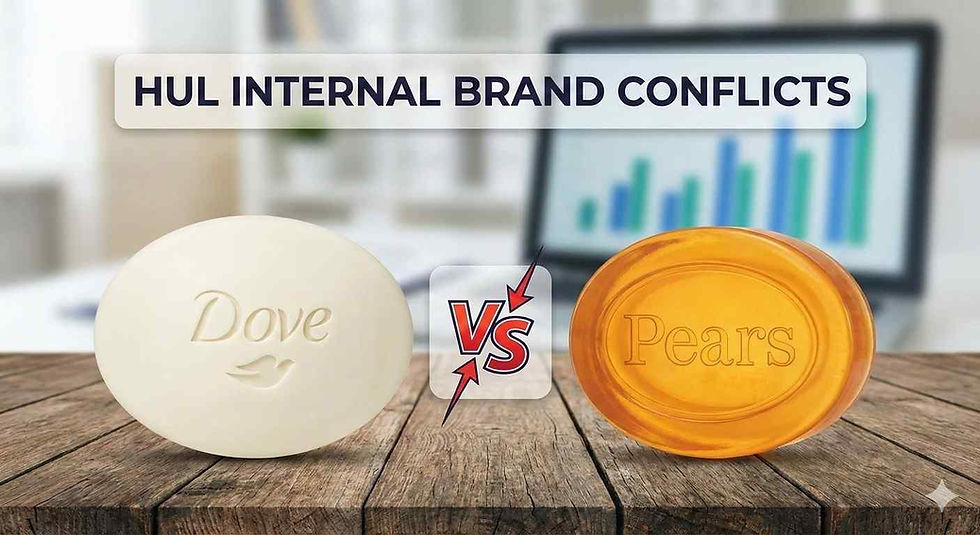
Hindustan Unilever Limited (HUL), India's largest fast-moving consumer goods (FMCG) company, has managed multiple soap brands within its personal care portfolio for decades. Among these, Dove and Pears represent two distinct approaches to the premium soap segment, creating an internal positioning challenge within the same corporate structure. This case study examines how HUL has navigated potential cannibalization and differentiation between these two heritage brands, both targeting health-conscious, premium-seeking consumers but with fundamentally different brand promises and historical legacies.
Company Background
Hindustan Unilever Limited is a subsidiary of Unilever PLC and has operated in India since 1933. According to HUL's Annual Report 2022-23, the company's portfolio includes over 50 brands spanning 14 categories including soaps, detergents, shampoos, skin care, and foods. HUL reported that its Home Care, Beauty & Personal Care, and Foods & Refreshment segments collectively serve approximately 1.4 billion consumers across India.
The company's soap portfolio is particularly extensive, featuring brands at multiple price points including premium offerings (Dove, Pears, Lux), mid-tier brands (Lifebuoy, Breeze), and economy segments. According to HUL's investor presentations, the Beauty & Personal Care segment has consistently been one of the company's largest revenue contributors, though specific brand-level revenue data is not publicly disclosed.
Brand Histories and Heritage
Pears: The Transparent Pioneer
Pears soap was established in London in 1807 by Andrew Pears, making it one of the world's oldest continuously existing soap brands. According to Unilever's official brand history archives, Pears was the world's first transparent soap and built its reputation on gentleness and purity. The brand's famous tagline "Good morning, have you used Pears soap?" became iconic in advertising history.
Pears came under Unilever's ownership in 1917 when Lever Brothers acquired A&F Pears. When Unilever expanded its operations in India through Hindustan Lever (now HUL), Pears became part of the Indian portfolio. According to reports in The Economic Times (October 2015), Pears had established a strong position in India's premium soap segment by emphasizing its gentle formulation suitable for all skin types, particularly positioning itself as safe for babies and sensitive skin.
Dove: The Moisturizing Challenger
Dove was launched by Unilever in the United States in 1957 as a "beauty bar" rather than a traditional soap. According to Unilever's corporate history, Dove was formulated with one-quarter moisturizing cream, differentiating it from conventional soaps that could dry the skin. This functional differentiation formed the core of Dove's brand identity.
Dove entered the Indian market in 1995 under HUL's management. As reported by The Hindu BusinessLine (March 2010), HUL introduced Dove in India as a premium product targeting urban, affluent consumers who were willing to pay a significant premium for superior miniaturization benefits. The brand was priced substantially higher than mass-market soaps, positioning it as an aspirational product.
Market Context and Competitive Landscape
India's soap market is one of the largest globally by volume. According to a report by RedSeer Consulting cited in The Economic Times (July 2019), the Indian bath soap market was valued at approximately $1.8 billion, with premium soaps (priced above ₹30 per 100g) representing a growing but smaller segment compared to mass-market offerings.
Within HUL's portfolio, the company faced the challenge of managing multiple brands competing for overlapping consumer segments. As noted in Mint (September 2018), HUL's soap portfolio strategy involved clear segmentation: Lifebuoy focused on health and germ protection for mass markets, Lux emphasized beauty and glamour, while Dove and Pears both targeted the premium segment but with different functional and emotional positionings.
The competitive landscape extended beyond HUL's internal brands. According to Business Standard (June 2016), international and domestic competitors including Procter & Gamble's Olay, ITC's Vivel, and Godrej's Cinthol also competed in the premium soap segment, making differentiation critical for market share retention.
Positioning Strategies: Points of Parity and Difference
Pears' Positioning Evolution
Pears traditionally positioned itself on three core pillars: transparency (as a literal product attribute), gentleness, and heritage. According to Campaign India (April 2014), Pears' advertising in India consistently emphasized the brand's 200-year legacy and its formulation's suitability for sensitive skin. The brand's "Pure and Gentle" positioning targeted mothers purchasing soap for their children and families seeking mild cleansing products.
However, reports in The Economic Times (October 2015) indicated that Pears faced challenges in the Indian market during the 2010s. The article noted that HUL repositioned Pears with renewed focus on natural ingredients and glycerin content, moving away from its traditional baby soap positioning to appeal to a broader adult audience seeking natural skincare solutions. The company reportedly reduced Pears' prominence in baby-focused messaging while maintaining its gentleness credentials.
Dove's Positioning Strategy
Dove maintained a consistent positioning globally and in India around "real beauty" and superior moisturization. According to The Hindu BusinessLine (March 2010), HUL's Dove strategy in India centered on functional superiority—the claim that Dove's formula with one-quarter moisturizing cream provided better skin care than traditional soaps.
Dove's marketing communications, as documented in various industry publications including Campaign India (February 2017), emphasized self-esteem, body positivity, and challenging conventional beauty standards through its "Real Beauty" campaign. This emotional positioning, combined with functional miniaturization claims, differentiated Dove from traditional soap brands including Pears.
According to Business Today (August 2013), Dove expanded beyond bar soaps in India to include body washes, shampoos, and other personal care products, building a comprehensive beauty and personal care platform. This brand extension strategy contrasted with Pears' more focused presence primarily in the soap segment.
Strategic Conflicts and Cannibalization Risks
The simultaneous operation of Dove and Pears within HUL's portfolio created potential internal competition. Both brands targeted affluent, urban consumers willing to pay premium prices. Both emphasized skin gentleness and care. Both positioned themselves as superior to mass-market soaps through specific formulation attributes.
According to analysis in Mint (September 2018), HUL's multi-brand strategy in overlapping segments was both a strength and a challenge. The article noted that while having multiple entries allowed HUL to capture different consumer preferences within the premium segment, it also required careful brand management to prevent cannibalization and maintain distinct brand identities.
Industry observers quoted in The Economic Times (March 2016) suggested that the primary differentiation between Dove and Pears lay in their functional claims and price positioning. Dove commanded a higher price premium, justified by its moisturizing claims and modern brand image. Pears, while still premium, was positioned at a lower price point with emphasis on heritage, transparency, and natural gentleness.
Marketing and Communication Strategies
Advertising Investments and Campaigns
Both brands received significant marketing support from HUL, though specific advertising expenditure by brand is not publicly disclosed. According to Campaign India (February 2017), Dove's "Real Beauty" campaign became one of the most recognized marketing initiatives in India, with multiple iterations addressing body image, self-esteem among young women, and challenging fairness cream culture.
Pears' advertising, as documented in Marketing & Advertising News (May 2016), focused more on product demonstrations and heritage storytelling. Campaigns emphasized the brand's long history and the visible transparency of the soap as proof of purity. Some campaigns specifically targeted mothers, while others addressed adult consumers seeking natural skincare.
According to data from the Advertising Standards Council of India (ASCI) annual reports, both brands maintained regular advertising presence across television, print, and increasingly digital media, though Dove appeared to receive more prominent placement and higher-profile celebrity associations.
Distribution Strategies
Distribution strategies for both brands reflected their premium positioning but with subtle differences. According to Retail Insight Network (January 2018), Dove was distributed through modern retail outlets, premium general stores, and e-commerce platforms with particular emphasis on urban markets. The brand's expansion into body washes also pushed it toward modern retail formats where such products were more commonly purchased.
Pears maintained broader distribution including traditional retail alongside modern trade, reflecting its longer presence in the Indian market and somewhat wider target audience. As reported in The Hindu BusinessLine (October 2017), HUL's distribution strength across India's retail landscape benefited all its brands, but premium brands like Dove and Pears concentrated more heavily in urban and semi-urban markets with higher purchasing power.
Performance Indicators and Market Position
Specific market share data for individual soap brands is not regularly disclosed by HUL. However, aggregated information provides some context. According to HUL's Annual Report 2022-23, the Beauty & Personal Care segment showed sustained growth, with management commentary attributing performance to "premiumization trends and strong brand equity across the portfolio."
Industry reports cited in The Economic Times (August 2020) suggested that Dove had emerged as one of India's leading premium soap brands since its introduction, though exact rankings and market share figures were not provided. The same report noted that traditional brands like Pears faced pressure from both newer entrants and sister brands within the same corporate portfolio.
Nielsen retail audit data referenced in Business Standard (June 2019) indicated that the premium soap segment in India was growing faster than the mass segment, driven by rising incomes and increasing consumer preference for specialized skincare benefits. This trend theoretically benefited both Dove and Pears, though their relative performance within this growth was not specifically detailed in publicly available sources.
Strategic Management of Internal Competition
HUL's approach to managing potential cannibalization between Dove and Pears involved several documented strategies:
Price Tier Differentiation: According to retail price surveys reported in The Economic Times (November 2018), Dove soaps were typically priced 20-30% higher than Pears soaps of comparable size, creating a clear price-based segmentation within the premium category.
Functional Claim Differentiation: Dove's consistent emphasis on moisturization with its "¼ moisturizing cream" claim contrasted with Pears' focus on transparency, purity, and natural gentleness. These distinct functional platforms, while both appealing to skincare-conscious consumers, addressed different primary concerns.
Brand Personality and Communication Tone: As evident from publicly available advertising campaigns documented in industry publications, Dove adopted a more modern, empowering communication style aligned with contemporary beauty standards discourse. Pears maintained a more traditional, heritage-focused communication approach emphasizing trust through longevity.
Portfolio Architecture: According to HUL's product category descriptions in annual reports and investor presentations, the company managed its soap portfolio as part of a broader "house of brands" strategy where each brand had defined roles. While specific internal documentation is not public, the observable market behavior suggested Dove was positioned as the flagship premium moisturizing platform, while Pears served as a heritage premium option with different functional emphasis.
Challenges and Strategic Tensions
Several challenges emerged from managing both brands simultaneously:
Resource Allocation: With finite marketing budgets and management attention, HUL faced decisions about investment prioritization between brands targeting similar consumer segments. Industry analysts quoted in Business Today (September 2019) noted that Dove appeared to receive more prominent marketing support in recent years, suggesting strategic prioritization.
Innovation Pipeline: Product innovation could potentially benefit either brand but risked making their offerings more similar. For example, when Dove introduced variants focusing on gentleness, it moved closer to Pears' traditional territory. According to reports in Campaign India (July 2018), both brands introduced variants with natural ingredients, potentially blurring differentiation.
Retail Shelf Space: Premium soap sections in retail stores had limited space. Having two brands from the same manufacturer competing for shelf presence could disadvantage one or both against competitor brands. Retail trade reports cited in Retail Asia (March 2017) suggested that retailers sometimes rationalized SKU counts, potentially pressuring brands with similar positioning.
Consumer Confusion: No verified public research data exists on consumer confusion between Dove and Pears, but marketing experts quoted in Mint (April 2019) suggested that clearly distinct brand identities were essential to prevent consumer uncertainty about which product best met their needs.
Organizational and Strategic Implications
From an organizational perspective, managing competing brands within the same portfolio required sophisticated brand management systems. According to HUL's recruitment materials and LinkedIn postings for brand management positions (publicly available), the company structured brand teams separately for major brands, suggesting organizational separation between Dove and Pears management despite corporate ownership overlap.
Industry observers cited in The Economic Times (January 2020) noted that HUL's multi-brand strategy reflected both its heritage as a merger of multiple companies with distinct brands and a deliberate strategy to capture multiple consumer segments and usage occasions. The potential inefficiency of internal competition was considered acceptable given the benefits of market coverage and consumer choice.
Comparative Analysis: Global vs. India Strategy
Unilever's management of Dove and Pears differed across markets. According to Unilever's global brand portfolio information available on its corporate website, Dove was positioned as a global strategic brand present in virtually all markets, while Pears had more selective geographic presence and varying importance across regions.
In some markets where Unilever operated, only one of these brands was present, eliminating internal competition. India represented a market where both brands operated simultaneously, making it a relevant case for studying internal brand portfolio management. No verified public information is available on whether Unilever conducted formal internal analyses comparing the India approach with single-brand strategies in other markets.
Strategic Outcomes and Current Status
As of 2023-2024, both Dove and Pears remained in HUL's active brand portfolio. According to HUL's Annual Report 2022-23 and product listings on the company website, both brands continued to be manufactured, distributed, and supported with marketing activities, indicating that HUL's strategy involved maintaining both rather than consolidating around one premium soap brand.
Reports in The Economic Times (February 2023) indicated that HUL continued to invest in premiumization across its portfolio, with specific mention of innovations in Dove body washes and expansion of the Dove brand into additional categories. Pears received less prominent coverage in these reports, though the brand remained available in the market.
No verified public information is available on detailed performance metrics, profitability comparisons, or strategic reviews that would indicate whether HUL considered the dual-brand strategy successful or contemplated consolidation.
Lessons for Brand Portfolio Management
This case illuminates several principles relevant to managing multiple brands within a single corporate portfolio:
The Importance of Distinct Positioning: Despite targeting similar demographics, Dove and Pears maintained sufficiently distinct functional claims and brand personalities to justify separate existence. The degree of overlap was managed through price differentiation and communication strategy differences.
Heritage vs. Modernity Trade-offs: Pears' strength in heritage and tradition represented both an asset (trust, credibility) and a potential limitation (relevance to younger consumers). Dove's more contemporary positioning potentially offered greater flexibility for evolution but lacked the deep-rooted equity of a 200-year-old brand.
The Portfolio Coverage Logic: Having multiple brands in the premium segment allowed HUL to respond to diverse consumer preferences within that segment—those seeking heritage and naturalness (Pears) versus those prioritizing functional innovation and modern brand values (Dove). This coverage could defend against competitors better than a single brand might.
Resource Intensity of Multi-Brand Strategies: Maintaining distinct identities for multiple brands requires sustained investment in separate marketing campaigns, innovation pipelines, and brand management resources. The efficiency costs must be weighed against market coverage benefits.
Conclusion
The coexistence of Dove and Pears within HUL's portfolio represents a deliberate strategic choice to manage internal brand competition through clear differentiation in pricing, functional claims, and brand personality. While no verified public data exists to assess the profitability or market share impact of this dual-brand approach compared to alternatives, the continued presence of both brands in HUL's portfolio after decades suggests the company found the arrangement strategically viable.
The case demonstrates that internal brand portfolio conflicts can be managed through careful positioning, price tier separation, and distinct communication strategies, though questions remain about the optimal resource allocation between competing sister brands and whether consolidation might improve overall performance in the premium soap segment.
Discussion Questions for MBA Analysis
Portfolio Strategy Evaluation: Given the limited public information available, what analytical framework would you use to evaluate whether HUL should maintain both Dove and Pears in its portfolio versus consolidating around one premium soap brand? What specific data points would you need to make this recommendation, and how would you assess whether the benefits of market coverage outweigh the costs of internal competition?
Brand Positioning Architecture: How would you design a long-term positioning strategy to maximize differentiation between Dove and Pears while both remain in the premium soap segment? What specific positioning dimensions (functional, emotional, price, distribution, target consumer) should be emphasized for each brand to minimize cannibalization risk?
Resource Allocation Decisions: If you were HUL's marketing director with a fixed budget for premium soap brands, how would you allocate resources between Dove and Pears? What criteria would you use to determine which brand deserves greater investment, and how would you balance short-term market share goals with long-term brand equity building?
Innovation Pipeline Management: When developing product innovations in the premium soap category (such as natural ingredients, specialized variants, or new formats), how should HUL decide whether to launch them under the Dove brand, the Pears brand, or both? What framework would guide these innovation allocation decisions to strengthen differentiation rather than increase overlap?
Global-Local Strategy Tensions: Unilever positions Dove as a global strategic brand while Pears has more selective geographic presence. How should HUL balance global brand building imperatives for Dove (which might suggest aggressive investment) with local market realities in India where Pears has established heritage equity? Should the India market strategy align with global Unilever priorities, or should local market conditions take precedence?


Comments