Idea-to-Impact Funnel: Why Most Marketing Ideas Die Before They Matter
In 2015, a Bangalore startup faced a challenge. Their app, designed to connect users with nearby service professionals, was well-developed, had clear messaging, and decent funding. Yet, their marketing campaigns consistently failed. The creative team generated brilliant concepts that excited the founders, and after approvals, they would launch, only to be met with indifference. Sound familiar?
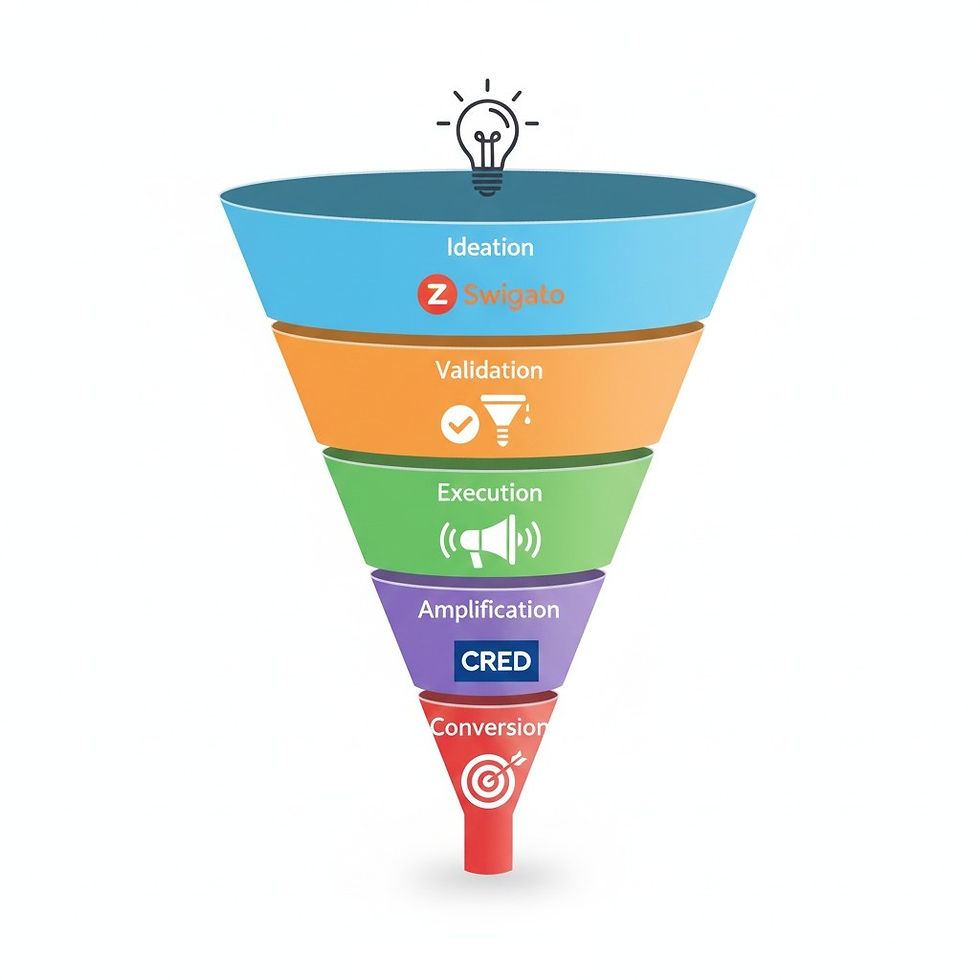
Most marketers overlook that having a good idea is only 10% of the battle. The other 90% involves navigating the Idea-to-Impact Funnel—a structured process that ensures your marketing concept achieves business outcomes instead of fading into noise.
What Is the Idea-to-Impact Funnel?
The Idea-to-Impact Funnel is a five-stage framework that maps how marketing ideas move from conception to measurable business results. Each stage has a specific conversion challenge, and most ideas fail because marketers focus only on the first stage while ignoring the rest. The five stages are:
Ideation → Generating the concept
Validation → Testing strategic fit and feasibility
Execution → Bringing the idea to life
Amplification → Making it reach the right people
Conversion → Turning attention into action
Let's break down each stage with examples from the Indian marketing landscape.
Stage 1: Ideation → The Spark
This is where most teams spend 80% of their time—brainstorming sessions, mood boards, references from Cannes Lions winners. The problem? Ideas are abundant. Execution is scarce. Example: Zomato's "Butterfly" OOH Campaign (2023): Zomato's outdoor advertising in Delhi featured minimalist visuals with cryptic messages like "Butterfly khane ka mann hai?" The idea was simple: create intrigue around unusual food searches people make on the platform. The ideation was clever—take real search data and turn it into conversation starters. But the idea alone meant nothing. It needed to pass through the rest of the funnel.
Stage 2: Validation → The Filter
This is the stage where most brilliant ideas should die—but don't. Validation asks three critical questions:
Does this align with brand strategy? (Not just brand identity)
Is our target audience even receptive to this format/message?
Can we actually execute this within constraints of budget, time, and capability?
Cred's "Not Everyone Gets It" Campaign: When Cred started running those surreal, celebrity-packed ads featuring Rahul Dravid losing his calm or Madhuri Dixit as a gully cricket fan, many marketers scratched their heads. Was the brand messaging clear? Not really. Did it align with Cred's positioning as an exclusive, reward-focused credit card payment app? Absolutely. The validation wasn't about whether everyone would understand the ads. It was about whether the right people—high credit score individuals who appreciate subversive humor—would pay attention. They did. The campaign passed the validation filter because it aligned with strategic intent, even if it confused the masses.
Stage 3: Execution → The Make-or-Break
Most ideas fail here. Not because the concept was weak, but because execution didn't do it justice. Execution quality determines whether your idea is remembered or ignored. This includes copywriting, design, production value, casting, timing, channel selection, and internal coordination. Cadbury's "Not Just a Cadbury Ad" (2021): During the pandemic, small businesses were struggling. Cadbury created a campaign where Shah Rukh Khan appeared in personalized video ads promoting local stores. Using AI and deepfake technology, they created thousands of versions where SRK mentioned specific store names and locations. The idea was good. But the execution made it iconic:
Technology integration was seamless
The emotional connect was real
The timing aligned with festive season and recovery sentiment
Distribution was hyper-local via WhatsApp and social platforms
If they had just made one generic ad with the same message, it would have been forgotten in a week.
Stage 4: Amplification → The Multiplier
You've created something great. Now what? Amplification is about earned attention, algorithmic favor, influencer pickup, PR momentum, and word-of-mouth triggers. It's the difference between your campaign being seen by 50,000 people versus 5 million. Example: Swiggy's "Voice of Hunger" Campaign (2022). Swiggy ran a campaign where they encouraged users to share their food cravings using quirky, unfiltered language. They amplified it by:
Partnering with meme pages and creators
Running contextual social media responses
Timing posts around hunger-peak hours (late night, post-work)
Encouraging UGC through relatable formats
The amplification strategy turned a simple brand campaign into a cultural moment. Without that layer, it would have been just another "order food on our app" message.
Stage 5: Conversion → The Proof
This is where marketing meets business reality. Conversion isn't just about sales. Depending on your objective, it could mean:
App downloads
Brand recall lift
Purchase intent shift
Customer retention improvement
Category consideration increase
Example: Mamaearth's "Goodness Inside" Positioning: Mamaearth didn't just run awareness campaigns. Every piece of content, every influencer collaboration, every retail placement was designed to drive a specific behavior: getting consumers to check ingredient labels and choose toxin-free products. Their idea-to-impact funnel was tight:
Idea: Position as safe, natural, millennial-parent-friendly
Validation: Confirmed demand for toxin-free baby and beauty products
Execution: Ingredient transparency, dermatologist endorsements, Made Safe certification
Amplification: Influencer seeding, Amazon visibility, Shark Tank appearance
Conversion: Became India's first unicorn D2C brand with clear attribution from awareness to purchase
Where Most Indian Marketers Get Stuck
After analyzing hundreds of campaigns across FMCG, D2C, fintech, and tech startups, I've noticed three common failure points:
1. Over-indexing on Ideation, Under-investing in Execution
Agencies present beautiful decks. Brands approve them. Then they cut the production budget by 40%, shorten the timeline, and wonder why the output looks mediocre.
2. Ignoring Validation Discipline
Too many campaigns are approved based on "gut feel" or founder preference rather than strategic alignment and audience receptivity testing. Just because an idea sounds cool in a conference room doesn't mean it will land in the market.
3. Treating Amplification as an Afterthought
The media plan gets finalized after creative is locked. Influencer outreach happens last minute. Earned media strategy is "let's hope it goes viral." This approach rarely works.
How to Use the Idea-to-Impact Funnel
When planning your upcoming campaign, consider this checklist:
Stage 1: Ideation
Is the concept based on genuine consumer insights or behaviors?
Does it include a compelling "why now" factor?
Stage 2: Validation
Does it align with our brand positioning and business goals?
Have we tested this idea (even informally) with actual audience samples?
Are we confident in our ability to execute this effectively with current resources?
Stage 3: Execution
Is our production quality competitive for the chosen channel?
Are we avoiding compromises that could undermine the core idea?
Do we have the appropriate partners/vendors/talent involved?
Stage 4: Amplification
What is our earned media strategy beyond paid placements?
Are we optimizing for platform algorithms and shareability?
How are we engaging creators, communities, and influencers?
Stage 5: Conversion
What specific behavior change are we aiming to drive?
How are we assessing success beyond vanity metrics?
What is our attribution model linking this campaign to business outcomes?
The Real Lesson
Marketing impact isn't about having the best ideas. It's about having a disciplined system that moves ideas from conception to measurable outcomes. The brands that consistently win—whether it's Asian Paints maintaining category dominance, Swiggy building cultural relevance, or D2C challengers like Boat capturing market share—don't just create campaigns. They build idea-to-impact machines. Your next campaign might already have a brilliant concept. But ask yourself: are you managing just the idea, or the entire funnel? Because in marketing, the gap between a great idea and great impact is not creativity—it's discipline.


Comments