Influence Velocity Matrix: Why Some Brand Moves Create Waves While Others Sink
In March 2024, when Zomato changed its brand color from red to white, the internet erupted. Memes flooded Twitter, LinkedIn buzzed with marketing opinions, and even competitors joined the conversation. The rebrand was reversed in days, but its cultural impact lingered for weeks. Contrast this with a legacy FMCG brand's quiet packaging update.
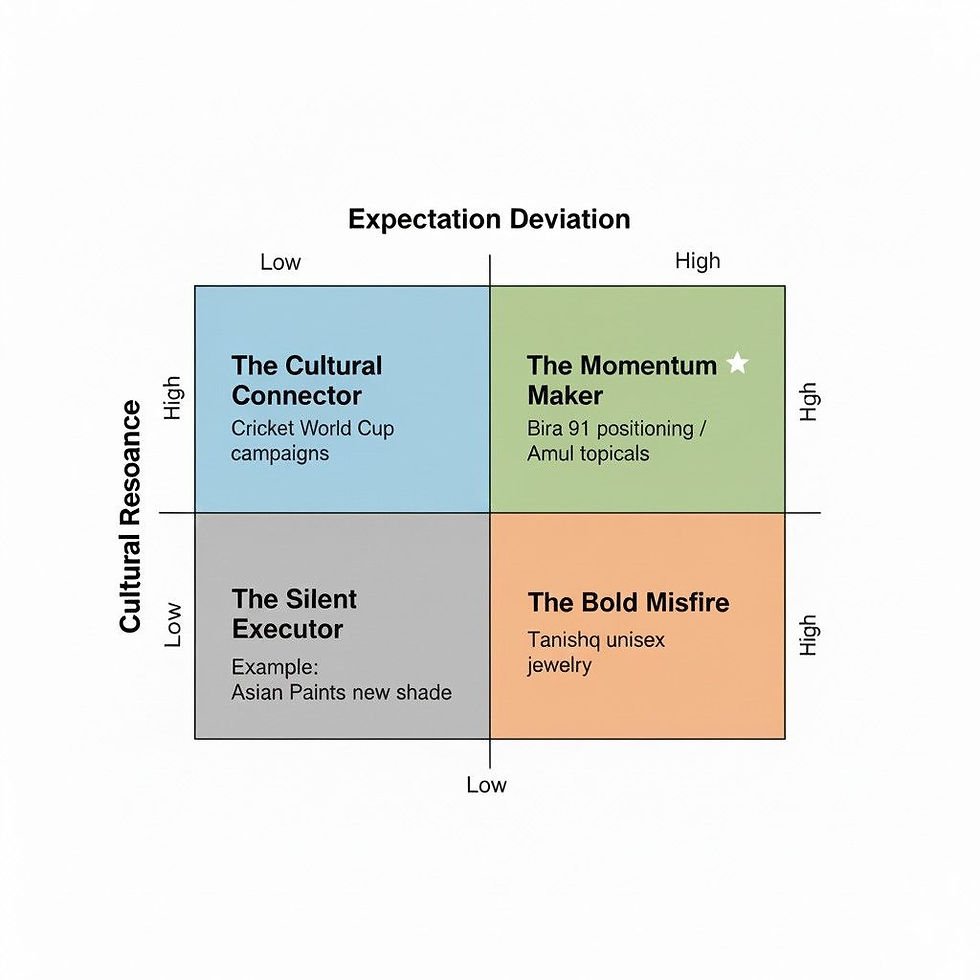
Both involve a visual identity change, yet the responses differ greatly—one generates buzz, the other silence. This highlights a key marketing truth: not all brand actions generate momentum equally. Enter the Influence Velocity Matrix—a strategic framework that explains why some marketing decisions boost brand visibility while others fade, regardless of media spend.
What Is Influence Velocity?
Influence velocity is the speed and scale at which a brand action triggers conversation, perception shift, and behavioral response in the market. It's not virality—it's deeper. Virality is often shallow and short-lived. Influence velocity measures how fast a brand move creates meaningful momentum that compounds over time. Think of it this way: when Swiggy's Instamart started delivering in 10 minutes, it didn't just trend on social media. It forced Blinkit, Zepto, and BigBasket to respond. It changed consumer expectations. It redefined the category standard. That's high influence velocity—a single move that creates a ripple effect across the ecosystem.
The Two Axes That Matter
The Influence Velocity Matrix operates on two critical dimensions:
1. Expectation Deviation (X-Axis) How far does your action deviate from what the category or brand is expected to do?
2. Cultural Resonance (Y-Axis) How deeply does it connect with existing cultural conversations, tensions, or desires? When you map brand actions across these two axes, you get four distinct quadrants—each with different velocity characteristics.
Quadrant 1: The Silent Executor
Low Deviation × Low Resonance
These are the "business as usual" moves. Important for operations, invisible to culture. Example: When Asian Paints launches a new shade of white emulsion, it serves a functional need but generates zero conversation. The market expects it. No one talks about it. It's competent execution, but it carries no velocity. Most brand activities live here—product improvements, minor feature updates, seasonal campaigns that follow category norms. They're necessary but insufficient for building momentum. Strategic Implication: Don't expect these moves to build brand salience. They maintain market presence but don't expand it.
Quadrant 2: The Cultural Connector
Low Deviation × High Resonance
These actions stay within expected brand behavior but tap into culturally charged moments. Example: During the 2023 Cricket World Cup, every brand from Dream11 to CRED to Swiggy ran cricket-themed campaigns. None of them deviated from their core positioning, but they all rode the cultural wave of cricket mania in India. Cadbury's "Not Just a Cadbury Ad" campaign during festivals follows this pattern—it's expected that Cadbury will show up during celebrations, but by tapping into the cultural sentiment around togetherness and gifting, it gains velocity. Strategic Implication: High resonance without deviation works when cultural moments are strong enough to carry your message. The risk? You're one voice in a chorus. Differentiation becomes harder.
Quadrant 3: The Bold Misfire
High Deviation × Low Resonance
This is where brands try to be different for difference's sake—but the market doesn't care. Example: Remember when Tanishq launched a unisex jewelry line? High deviation from category norms (jewelry in India is heavily gendered), but low cultural resonance (the market wasn't asking for it, and the cultural conversation around gender-neutral fashion was nascent). The product quietly disappeared. Or consider when established brands suddenly try "cool" Instagram Reels that feel forced and disconnected from any real cultural insight. High effort to deviate, zero resonance. Strategic Implication: Deviation without cultural grounding creates confusion, not momentum. You need permission from culture to break norms.
Quadrant 4: The Momentum Maker
High Deviation × High Resonance
This is the sweet spot—where brand actions are unexpected yet deeply connected to existing feelings, thoughts, or desires. Example: Dove's "Real Beauty" campaign broke beauty norms by promoting authenticity and inclusivity, resonating with cultural desires and redefining the category. Similarly, Amul's topical ads deviate from typical dairy communication by addressing current affairs, resonating with India's love for witty, timely commentary. Each ad builds momentum. Strategic Implication: This approach requires deep insight into cultural trends and the courage to break norms, but it can lead to significant returns.
How to Apply the Matrix
Step 1: Map Your Planned Actions
Take any major brand decision—launch, campaign, partnership, positioning shift—and honestly assess:
How expected is this from us or our category?
How connected is this to active cultural conversations?
Step 2: Identify Your Current Quadrant Pattern
Most brands default to Quadrant 1 (safe execution) or occasionally jump to Quadrant 2 (cultural riding). Few systematically operate in Quadrant 4.
Step 3: Diagnose Why Velocity Is Low
If your campaigns aren't generating momentum, the matrix reveals why:
Too safe? You're in Q1.
Riding trends but feeling invisible? You're in Q2.
Being different but getting ignored? You're in Q3.
Step 4: Build for Quadrant 4
To create high-velocity moves:
Find cultural tension: What is the market feeling but not saying? What category norm feels outdated? Where is there unmet desire? Example: The cultural tension around "hustle culture" and burnout in India created space for brands like Sleepy Owl Coffee to position around slow mornings and mindful consumption—deviating from the typical "energy boost" coffee messaging.
Earn permission to deviate: Your brand history, equity, and actions must make the deviation feel authentic, not opportunistic. When Zomato makes cheeky, self-aware jokes on social media, it works because they've built permission over years. When a traditional bank tries the same tone, it feels jarring.
Design for conversation, not just consumption: High-velocity actions are designed to be talked about, not just seen. They have inherent shareability—through insight, emotion, wit, or controversy.
The Zomato Color Change: A Matrix Case Study
Let's revisit the Zomato rebrand through this lens:
Expectation Deviation: Extremely high. No one expects a mass-market delivery app to suddenly go minimalist white in a sea of vibrant brand identities.
Cultural Resonance: Medium to high. The design world and marketing Twitter were already debating minimalism vs. maximalism, brand distinctiveness vs. sameness. Zomato's move landed right in that conversation.
Result: Massive velocity. Not all positive, but momentum nonetheless. The reversal itself became another conversation point, reinforcing Zomato's agility and cultural awareness. Did it "succeed"? Depends on your metric. Did it create influence velocity? Absolutely.
Why This Matters Now
In an attention-fragmented market where paid media delivers diminishing returns and organic reach is dying, influence velocity becomes your multiplier. A high-velocity move can:
Generate earned media worth crores
Create community-driven amplification
Shift perception faster than any campaign
Force competitive response (which further amplifies you)
Build brand salience that lasts beyond the moment
Indian brands are increasingly understanding this. From Mamaearth's transparency-first positioning (high deviation in a beauty category full of hidden ingredients) to Noise's challenger brand energy in wearables (resonating with India's desire for affordable premiumness), the wins are coming from strategic velocity, not just volume.
Final Thought: Velocity Is a Choice
Most brands drift toward safety—Quadrant 1. They execute well but build slowly. A few brands stumble into Quadrant 4 by accident. The best brands architect for velocity. They study culture, understand their permission space, and deliberately design actions that sit at the intersection of deviation and resonance. The question isn't whether your next move will be big or small. The question is: will it create momentum? Because in modern marketing, momentum is the strategy. Everything else is just activity. Key Takeaways: → Influence velocity measures how fast a brand action creates meaningful market momentum→ It's determined by expectation deviation and cultural resonance→ Most brand actions are low-velocity (safe but invisible)→ High-velocity moves require cultural insight + courage to deviate→ In attention-scarce markets, velocity multiplies every other investment The matrix doesn't tell you what to do. It tells you what your action can do—and whether that's enough for the goals you're chasing.


Comments