Lenskart's Focus on Value-Seeking Indian Consumers
Executive Summary
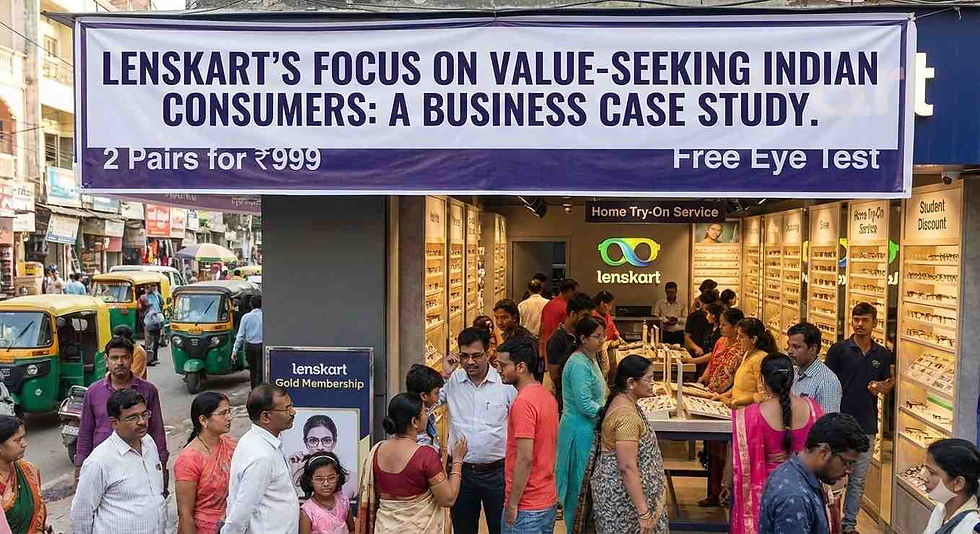
Lenskart Solutions Limited has emerged as India's leading eyewear retailer by addressing the needs of value-conscious consumers through a vertically integrated business model that combines affordability, accessibility, and technology. Founded in 2010 by Peyush Bansal, Amit Chaudhary, and Sumeet Kapahi, the company has transformed India's fragmented eyewear market by democratizing access to quality eyewear. As of 2025, Lenskart operates over 2,000 physical stores across India and international markets, serving more than 30 million customers annually. The company's strategic focus on value-seeking consumers has enabled it to capture approximately 41% share of India's organized eyewear market, surpassing established players like Titan Eye+ and Reliance Vision Express.
Industry Context and Market Opportunity
The Indian Eyewear Market
India's eyewear market offers significant growth potential with low penetration and high fragmentation. Estimated at ₹74,000 crore in FY2025, it is projected to double to ₹1.48 lakh crore by FY2030, with a 13% CAGR. Despite this, only 25% of those needing spectacles wear them, and 30% own corrective lenses, leaving about 550 million people without necessary eyewear. The market is 70-80% unorganized, with the organized segment, including Lenskart, capturing 18-20% and expected to grow to over 30% by 2030. Lenskart leads with a 41% share.
Consumer Characteristics and Value Sensitivity
Lenskart targets tech-savvy, urban individuals aged 18-35, with engagement mostly from the 18-24 (38.74%) and 25-34 (35.96%) age groups. The consumer base is 62.30% male and 37.70% female. Price sensitivity is crucial, with 80% of purchases driven by price, and 94% of the market in the non-luxury segment. Less than 50% of Lenskart's revenue comes from metro cities, with expansion into Tier 2 and Tier 3 cities like Jaipur and Pune.
Lenskart's Value Proposition for Price-Conscious Consumers
Affordable Pricing Architecture
Lenskart offers a value-based pricing strategy, with entry-level frames starting at ₹500. The "First Frame Free" campaign reduces entry barriers, while the vertically integrated supply chain keeps costs 35-40% lower than competitors, maintaining a 69% gross margin in FY2025.
Membership-Based Value Programs
Lenskart's Gold Membership, priced at ₹500-600 annually, offers "Buy 1 Get 1 Free" on select brands, free eye tests, and discounts on contact lenses. This program has attracted over 50 million customers.
Accessible Services and Convenience
Lenskart provides free eye checkups at over 1,300 stores and at-home services for ₹99, refundable upon purchase. The 3D virtual try-on feature enhances online shopping convenience, appealing to digitally-native consumers.
Manufacturing and Supply Chain Strategy for Cost Advantage
Vertical Integration as a Value Enabler
Lenskart's ability to serve value-seeking consumers at scale stems directly from its vertically integrated manufacturing model. The company operates what it describes as "the world's largest automated eyewear manufacturing facility" in Bhiwadi, Rajasthan, with an annual production capacity of 50 million (5 crore) glasses. This facility, built on 10.7 acres with 75% automation, is ranked among the top two vertically integrated centralized manufacturing facilities for prescription eyeglasses globally by capacity as of FY2025. The Bhiwadi facility houses both lens laboratory and frame manufacturing capabilities. In FY2025, Lenskart produced 6.4 million frames in-house and manufactured 4 million lenses in India, including complex progressive and bifocal lenses. This in-house production is complemented by a frame manufacturing joint venture in China (established 2017) and facilities in Gurugram (established 2021), creating a multi-location production network. The manufacturing strategy utilizes robotic technology imported from Germany, offering what the company claims is "zero error tolerance" in lens precision accurate to three decimal places. This automated precision manufacturing contrasts with traditional optical stores where human technicians manually cut and edge lenses, resulting in occasional fitting errors that require adjustment periods.
Supply Chain Efficiency and Cost Control
Lenskart's centralized inventory model represents a strategic departure from traditional optical retail, where each store maintains independent inventory with limited selection. As of March 31, 2025, 75.4% of Lenskart's inventory in India was centralized, enabling customers to access the entire product assortment regardless of which store they visit or whether they shop online. This centralization supports next-day delivery in 40 Indian cities and 3-day delivery in 69 cities for single-vision eyewear. The supply chain operates through a highly automated distribution center designed in partnership with Addverb Technologies, a Reliance Industries-backed robotics company. This facility can supply over 200,000 glasses per day to India and overseas markets, using mobile robots to meet demand for up to 100 million customers annually. By controlling procurement and eliminating intermediaries (importers, distributors, wholesalers), Lenskart achieves material cost efficiency despite raw materials representing 24.5% of expenses in FY2025. The company sources components directly from manufacturers, particularly from China, which supplies approximately 54% of frames through the joint venture arrangement. This direct sourcing model allows Lenskart to pass cost savings to price-sensitive consumers while maintaining competitive margins. The financial impact of this integrated model is evident in the company's operating metrics. Lenskart's facilities in New Delhi manufacture 300,000 glasses monthly, while the automated Rajasthan facility targets annual capacity of 50 million units. This scale creates significant economies that traditional retailers struggle to match.
Omnichannel Expansion to Reach Value Consumers
Tier 2 and Tier 3 Market Penetration
Lenskart's expansion strategy focuses on underserved markets with value-conscious consumers, operating over 2,000 stores in 175-313+ Indian cities, balancing metro and non-metro locations. Co-founder Amit Chaudhary revealed in 2019 the introduction of a low-cost franchise model, Lenskart Lite, to target tier-3 and 4 markets, enabling rapid expansion into smaller cities while managing capital intensity. The company aimed for 50% of new store openings in Tier 2 and 3 cities, recognizing growth potential with less competition. Plans included opening 500 more stores in two years and reaching 2,000 stores in five years. This strategy addresses the gap left by traditional optical chains concentrated in metros, bringing standardized quality and modern retail experiences to smaller cities. The franchise model balances affordability with brand consistency, supported by the Lenskart Academy, which trains optometrists, sales staff, and franchisees, ensuring consistent service quality and generating additional revenue streams.
Physical-Digital Integration for Value Delivery
Lenskart's omnichannel approach offers value through convenience, assurance, and price. Initially online-first in 2010, it opened its first physical store in Delhi in 2013, recognizing consumers' preference to physically experience eyewear before buying. The integrated model allows customers to browse online, try frames virtually, visit stores for eye tests, order online for delivery, or pick up in-store. This addresses concerns about fit and appearance. Technology enhances the omnichannel experience with AI-powered eye testing equipment reducing dependency on traditional optometrists, lowering costs, and maintaining accuracy. The virtual try-on feature increases online conversion rates, and personalized lens recommendations ensure appropriate vision correction. Physical stores provide additional value with services like adjustments, repairs, and consultations, converting stores into service centers that foster long-term customer relationships.
Competitive Positioning Against Value Alternatives
Organized Retail Competition
In the organized eyewear segment, Lenskart competes with established players like Titan Eye+, which operates a similar omnichannel model but with different scale and pricing. In FY2023, Lenskart reported ₹3,780 crore revenue, while Titan's eyewear segment generated ₹689 crore. Lenskart's 1,300+ stores outnumber Titan Eyewear's approximately 867 stores in India. Key differentiators include Lenskart's in-house production, offering cost and speed advantages, and its technology adoption, such as AR try-ons and AI recommendations, appealing to younger consumers. Lenskart is positioned as an affordable option compared to Titan's premium brand. Reliance Vision Express hasn't matched Lenskart's scale. Lenskart's first-mover advantage in the online-to-offline model and customer data provide switching cost advantages.
Unorganized Sector Pressure
The unorganized optical market poses a significant challenge. Local opticians, with lower overheads and strong community ties, can match or undercut Lenskart's pricing while offering personalized service. Competitors like ClearDekho target ultra-budget consumers in Tier III and IV cities, showing the competitive intensity for value-conscious consumers. Lenskart leverages scale, technology, and brand endorsements to compete, offering convenience and aspirational value. Lenskart's omnichannel model provides a competitive edge, allowing customers access to a full catalog online or in-store with rapid delivery, creating convenience value that justifies premium pricing.
Challenges in Serving Value Markets
Balancing Affordability with Profitability
Lenskart faces challenges in maintaining affordability while achieving profitability. Raw material costs and expansion strategies create margin pressures. The membership program, while driving volume, impacts margins and requires careful management.
Franchise Model Tensions
The franchise strategy introduces control challenges, with accusations of unfair practices and financial discrepancies. Limited control over franchise operations can lead to brand dilution and customer dissatisfaction.
Market Development Costs
Educating non-users about eyewear requires significant investment. Technology adoption barriers and competition from tech giants add to acquisition costs. Lenskart's smart eyewear initiative may divert focus from core business.
Strategic Implications and Future Outlook
Deepening Value Proposition
Lenskart aims to scale and enhance accessibility, with investments in manufacturing and potential installment plans for low-income consumers. A subscription model could capture greater lifetime value.
Global Expansion of the Value Model
Lenskart's international growth replicates its India model in other markets. Success requires adapting the value proposition to local contexts while maintaining core affordability.
Technology as Competitive Moat
Continued technology investments enhance competitive advantages, improve margins, and enrich customer experience. Leveraging customer data can optimize marketing and product offerings.
Conclusion
Lenskart's success in serving value-seeking consumers shows that affordability and quality can coexist with innovative business models. Its financial growth and market leadership validate this approach. However, sustaining success requires navigating challenges in affordability, profitability, expansion, and quality. Operational excellence, brand equity, and innovation will be key to maintaining its market position and expanding globally.
Discussion Questions for MBA Analysis
Value Chain Architecture and Competitive Advantage: Evaluate Lenskart's decision to invest heavily in vertical integration (manufacturing, supply chain, retail) rather than pursuing an asset-light marketplace or retail-only model. What are the strategic advantages and risks of this capital-intensive approach in serving price-sensitive consumers? How sustainable is the cost advantage created by vertical integration given increasing competition and potential supply chain disruptions?
Franchise Model Governance: Analyze the tensions between Lenskart's company-owned stores and franchise operations as revealed by the 2024 disputes with franchise partners. What governance mechanisms, incentive structures, and contractual frameworks should Lenskart implement to align franchisee economics with corporate expansion while maintaining brand consistency? How should companies balance rapid geographic expansion through franchising versus controlled growth through company-owned operations?


Comments